book review · lifestyle · travel

Anthony Bourdain Remembered

43884234Anthony Bourdain Remembered* by CNN

I read it as an: ARC

Source: Edelweiss

Length: 208 pp

Publisher: CNN

Year: 2019

Sometimes when I cook, I have the voice of chef Anne Burrell in my head, telling me I’m using my knife wrong or I need to do something differently. Over the years, though, another voice has been added to hers, overwriting it to tell me that it doesn’t matter if I do it perfectly so long as I’m trying something new, and “screwups are good. Screwups – and bouncing back from screwups – help you conquer fear. … Do not be afraid” (Les Halles). As long as my mise en place is in order (and it had better be or he will yell at me), then everything will be fine. That distinctive voice belongs to Anthony Bourdain.

Probably it’s not normal to have the voices of anyone in your head, but I’ve always been one to have conversations with people I only meet in books, or on TV, or from studying history. I’m not ashamed to admit that some of the best life lessons were ones I’ve received from people I’ve never met in person, some of them fictional. This is far more a tribute to him than is it a book review, so I am going to talk about the late, greatly missed Tony Bourdain. From Tony, watching his shows and reading his books, I’ve learned so many things. Now I know that you should always try a dish twice in case it wasn’t prepared well the first time. Borders don’t matter because we have far more similarities than differences. You’ll never know what you like until you try it. The one truly universal connection between people is food and breaking bread together over a meal, prepared with love and served in a spirit of generosity and openness, is something that transcends religion and politics and language. Traveling to new places and seeing how people in different cultures live is something everyone should do; there is no education in any hallowed institution on earth that can compare with this.

Most of us never got to meet Tony in real life; nevertheless, he had a tremendous impact on our lives all the same. I never met him, but that doesn’t change the fact that I look up to him as a mentor, or that his death left a wound that will always be tender. I know this isn’t how depression works, but I can’t help but wonder if he knew how very many people would be affected by his death, if it would have made a difference. Probably not. I’ll save my rant about the need for better mental health care for a more appropriate place.

As I said, I never got the chance to meet Tony in person. The closest I ever got was a random encounter in London, on opposite sides of a busy street in Soho. That sardonic smile was plainly visible through traffic and crowds and will be a sight I’ll cherish dearly. Nevertheless, I can say that I feel lucky that I was alive and shared the earth at the same time he did. I think the best way to remember him will be to try to approach life like he did – with curiosity and openness and a hunger that can only be satiated by going and seeing and experiencing it for myself.

This book is a collection of memories, left by people who feel as I do. This is not great literature. It isn’t going to move mountains or bring about world peace. It is simply the heartfelt notes of people given in their grief to express a love for a deeply flawed, deeply compassionate, curious, creative, soulful man, someone who touched us all profoundly in some way, and whose loss we feel acutely. People who also learned from Tony that “there is less to fear about the world than we think” or that we should “listen, rather than speak.” We know, because of him, that “it is a privilege to sit at someone’s table” and that we should “go to the place. Eat the thing. Talk to the person.” When we travel, he taught us how to be “less of an observer and more of a participant…”, that we should “offend no one, appreciate the simplest things, and absorb it all”, that “food was a tool through which to understand a place, to broaden your own understanding of the world…”, and that there is “beauty in the sad, and the poignant, and even in the mundane, every day.” He taught us new ways to see, how to be better listeners, and how to find the interesting experiences. I think he’d get a kick out of one comment in particular, written by Amy P, who said, “Tripe. I didn’t enjoy it, but Tony was 100 percent the reason I tried it.” Yes, girl! I have tried things, culinary and otherwise, that I never would have thought to do because of something I learned from Tony. Just try the food. If you don’t like it, then try it again somewhere else, in case the first time wasn’t the best. If you don’t like it after that, well, at least you tried it. But then again, you may discover your new favorite food. You might learn about your new favorite activity. I learned about black pudding in London’s old east end butcher district, and the next time I am there, I’m absolutely going to try some, because that’s what Tony would do. Because the real lesson he left us with is not to be afraid. Go out and try things and see where they take you.

“Travel isn’t often pretty. It isn’t often comfortable. Sometimes it hurts, it even breaks your heart. But that’s okay. The journey changes you; it should change you. It leaves marks on your memory, on your body. You take something with you. Hopefully, you leave something good behind” (No Reservations). Anthony Bourdain left something good behind, and his presence will continue to be missed. Let’s all go out, have an adventure, and make our own mark on the world. 

RIP, Anthony Bourdain. We still miss you.
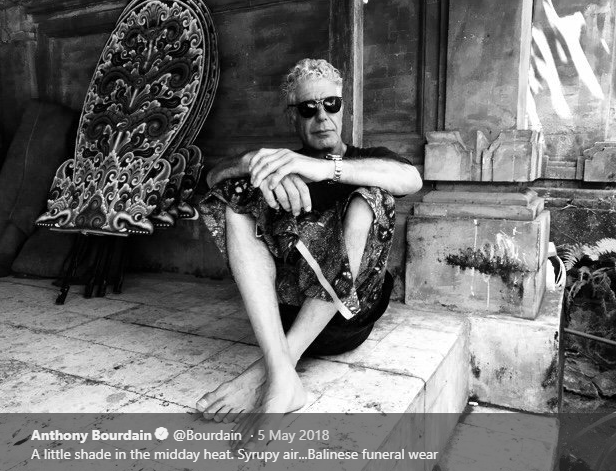
Bourdain twitter BW
Image retrieved from Anthony Bourdain’s Twitter: https://twitter.com/Bourdain/status/993005310611619840

Bourdain, Anthony. Anthony Bourdain’s Les Halles Cookbook: Strategies, Recipes, and Technique of Classic Bistro Cooking. New York: Bloomsbury, 2004.

—-. No Reservations: Around the World on an Empty Stomach. New York: Bloomsbury, 2007.

*Amazon affiliate link.

book review · Elizabethan England · historical fiction

Black Death

44597455Black Death (A Tudor mystery featuring Christopher Marlowe)* by MJ Trow

I read it as an: ARC

Source: Netgalley

Length: 224 pp

Publisher: Severn House

Year: 2019

Robert Green and Christopher Marlowe are not friends. But when Green believes someone is trying to kill him, he sends a desperate letter to Marlowe, behind for his help. When Green is found dead, Kit believes it is his duty to discover who murdered Green and so undertakes the investigation. At the same time, stage manager Ned Sledd is wrongly taken to Bedlam in lieu of an escaped inmate just days before the opening of one of Marlowe’s new plays. Marlowe has to find the connection between all these events and help his friend. And also, the Spymaster, Robert Cecil, is taking an inordinate interest in things. And there’s plague. What could go wrong?

This is a short, quick read and like other MJ Trow novels I’ve read, it is a fun and witty tale as well. The plot is full of twists and turns and not all is as it appears. The characters, especially Marlowe, are all multidimensional. I really love the little digs at William Shakespeare (spelled here as Shaxper) throughout and the subtle shade thrown on the authorship of his works. There are many literary gems hidden in these pages that appeal to any Anglophile.

The descriptions of Elizabethan London are also vivid and gritty. So much of that period is romanticized but here, we get the more realistic portrayal of what it might have actually been like – dirty, smelly, and depressing. Oh, and don’t forget the plague!

A fun and fast read, highly recommended for any lovers of Marlowe, Shaxper :-), or Elizabethan English history in general.

book review · books

All This I Will Give to You

43267676All This I Will Give to You* by Dolores Redondo (trans. Michael Meigs)

I read it as an: audiobook

Narrator: Timothy Andres Pabon

Source: My own collection

Length: 18:10:00

Publisher: Brilliance Audio

Year: 2018

Manuel Ortigosa is a writer  living in Madrid. He is hard at work on his next novel, waiting for his husband Alvaro to return from a business trip to Barcelona, when he receives word from police that Alvaro has been killed in a car accident. In Galicia, the opposite side of the country from Barcelona. Manuel travels to the town in Galicia where Alvaro died and learns that his husband was the Marquis of an ancient aristocratic family and Galicia is their ancestral home. Alvaro had hidden all this from Manuel because it seems he felt that his family was toxic and he wanted to shield Manuel from them. Upon his death, however, Manuel learns that Alvaro had saved his family from deep debt, using his own considerable funds to pay back loans and renovate the family homes, which put them in Alvaro’s personal possession, and thus he bequeathed everything to Manuel. Manuel is trying to come to terms with the fact that his husband hid who he was from him for the 15 years of their marriage, deal with the family who is indeed toxic, and find out what truly happened to Alvaro because he hadn’t died in an accident – he was murdered. Manuel meets two allies – a recently retired cop and a childhood friend of Alvaro’s, now a priest and Alvaro’s confessor – who aid him in finding out the truth.

This was a nicely complex book and I enjoyed not only the mystery plot but the travel element as well. I’ve never been to Spain, so the descriptions of the settings were some of my favorite parts, irrespective of the rest of the story.

The characters were generally complex and multifaceted. Manuel, the cop, and the priest were the ones I thought were the most multidimensional and complex people, though many of the other secondary characters, such as the family’s nanny, also seemed to have rich personalities.

There were many points of conflict – between Manuel and his husband’s family, between more progressive ideals and traditional Catholic practices, between the newer social order and the ancient traditions of nobility. There were also rivalries and intrigues between the family members as well, dark secrets and infighting. Alvaro was right – his family is toxic and he did well to keep Manuel from them. It would be exhausting to have to deal with a family like that.

I listened to this on audio book, so I have no idea how to spell some of the names, like the name of the cop friend, or the name of Alvaro’s family home. In any case, I think I would have preferred to eyeball read this one. I had picked up the audio book because it was a daily deal on Audible, but I didn’t care for the narrator. He did all right but I didn’t think he did a great job differentiating between characters. I had a hard time telling when it was supposed to be Manuel speaking and the cop, for example. His reading of women’s voices was pretty awful, though at least he didn’t make them sound like vapid cows like some male narrators do.

I loved the last line of the book SO MUCH. It is one of my favorite last lines ever now.

book review · historical fiction · Medievalism

Age of Saints

43925261Age of Saints: Druid’s Brooch Series: 7* by Author

I read it as a: galley

Source: Helen Hollick at Discovering Diamonds

Length: 240 pp

Publisher: Tirgearr Publishing

Year: 2019

Connall had promised his father that he would take care of Lainn, his little sister. Then his father went away and Connall, despite his best efforts, failed spectacularly in every way to uphold his promise. He and Lainn endure an abusive stepfather; a neglectful mother; starvation, terror, imprisonment, and torture in the land of Faerie; and literal insanity in both human and fey realms. Connall tries to draw on the power of a magic brooch, passed down through his family for generations, to help him and Lainn survive, but in doing so, is he saving them or only delaying the inevitable?

This is the seventh book in Christy Nicholas’s Druid’s Brooch series, and as with the others, it can be read as a standalone. I have read most of the others in the series and with each installation, I appreciate anew how well Nicholas crafts her characters. Each one has depth and vision to them, even minor characters who are only on the page a moment.

Equally appreciated is Nicholas’s deep understanding of Irish legend and lore. Her books are rich with these, and they bring the culture and people within the pages to brilliant life. This novel features the early days when the old ways of the Druids and the new ways of the Christians were still able to live together peaceably, though by the end of the book, the two religions were showing the strain. The Age of Saints refers to the 5th and 6th centuries when the Church was working especially hard to convert the Celtic countries, often using converted Celts to do so, such as St Patrick or Columba, who is referenced in this novel. It was interesting to see the interplay between the two cultures in this way.

I also loved the theme of protection that wove throughout the book. Connall cares for and protects Lainn as best he can, even when he fails utterly. He tries to keep his father’s words in mind as a way to protect himself as well, because at the end of the day, Connall is still a very young man, still in need of protection himself in a variety of ways. He learns how to protect himself, but also how to accept it from others when needed. The raven companion provides protection of a sort as well, and teaches a hard lesson. Connall protects his mother even when he doesn’t really want to. Even though most of the hardships in the book were because of a bad decision he made, Connall was still a sympathetic figure. He honestly did what he thought was best, or at least tried to. He never did anything out of maliciousness, just out of simple naivety or lack of experience, and he never whined about it, unlike some characters in other books. He Had his issues and his flaws, and he had an epic meltdown at one point, which I think was entirely understandable, but he was not an unsympathetic figure at all. He just needed someone to protect him but he had no one to do that, and so he did the best he could.

I also liked the exploration of his sexuality here, and how he was concerned about how Christians would think of him as sinful or unnatural to want to lie with another man, but the Druids had such members within their ranks and thought nothing of it. The conflict in him didn’t feel forced, like Nicholas was just trying to do something new or make a point. It was nicely done and flowed well within the narrative of the story.

One of the things I really love about this series is that it works in reverse time – the books begin in a more recent time and are gradually working back toward a time when the magic is newer and closer to the surface. I hope that, in the final installment of the series, readers will finally understand the genesis of the story, the event that caused the brooch to be given to the humans from the fey, and to see the full circle of all the novels in the series thus far. It has been a finely crafted series to date and I look forward to reading more. Highly recommended.

*Amazon affiliate link.