Uncategorized

Tales of Ming Courtesans

52662129Tales of Ming Courtesans by Alice Poon (Website, Twitter, Insta, Facebook)

Genre: historical fiction

Setting: 17th century China

I read it as an: ARC from the author (thank you, Alice!)

Source: review copy

Length: 354 pp

Published by: Earnshaw Books (1 June 2020)

Her Grace’s rating: 4.5 out of 5 stars

Tales of Ming Courtesans is the interwoven story of three young women who trained and worked as courtesans in 1600s China. Rushi, Yuanyuan, and Xiangjun were all real women, and they had a shared background of being sold as children to “thin horse traders,” who were essentially sex traffickers. Their paths cross in a performance house in Nanjing and their friendship sustains them through some truly awful events, ranging from small personal tragedies to sweeping national crises. 

The thing I liked best about this book was how incredibly descriptive it was. Images, smells, and locations were all so vividly described, I felt like I could see the river, smell the flowers or the cooking, hear the birds and noise of the town. I liked the names of a lot of the houses or other places – Villa of Alluring Fragrance, for example. It’s descriptive and mysterious and lyrical. I loved it. It makes me want to take a trip to China to see some of these places. 

The women themselves were a force to be reckoned with – or should have been except that life, men, and the caste system kept them down. I know literally nothing about Chinese history, and even less about this particular period transitioning between the Ming and Qing dynasties. I enjoyed learning some of the history and culture of that time. It is such a rich culture with many interesting rituals, art, and literature. 

I have a very likely inaccurate vision of these courtesans as something akin to Inara Serra from Firefly. My understanding is that courtesans were pretty well educated, trained in poetry, dance, music, performance, and yes, bedroom skills. But they could choose whether or not to take a patron to bed for money, and that choice was the real defining difference between courtesans and prostitutes, who had no choice at all. At any given moment, all three women in this novel worried they would have to sell themselves to a brothel to pay off a debt or avoid homelessness. Owing a debt literally meant you could be sold like chattel to anyone who could pay off the debt by buying you. It is a horrifying thought that the women effectively were forced to participate in their own slavery and sale of their bodies. The courtesans seemed to be in high demand as well, which gives a really interesting dichotomy because it isn’t the sort of role I typically associate with being desirable. The ways in which families sought to have a child by using concubines was new to me. I guess I just need to read more since I am woefully ignorant about this part of the world, in any time period. 

Literally the only quibble I had was that, sometimes, the dialogue between characters felt a bit odd. Sometimes it seemed really formal, especially for just talking to friends or family, but maybe that is how people talked to each other in 17th century China. Other times it had some anachronisms that I am not sure about, like saying a courtesan can “hook up” with anyone she chooses to. That drew me out of the story a little bit, but the rest of it was so good that I got over it quick. 

I definitely recommend this one! It made me curious and want to know more about a place or time or culture, which, to me, is the very best thing any book can do!

Favorite part/ lines (potential spoilers!):

  • You can strive all you can to change a condition, but people can choose to ignore facts and cling to their bigoted views.
  • It sickened me to realize that Zhengyu was one of those people who could turn their back on a good friend just because standing up for the truth would inconvenience them. As Fo had remarked previously, it often took a critical incident to reveal the true nature of a person.
  • You must never let anyone make you doubt your own worth.
  • Time rushes forward and never back, oblivious of human joy or pain. We cannot but be driven by the tide of life.
  • What gives one person the moral right to call another human worthless? It’s just not right. A human is a human, regardless of high or low birth.
  • I’ve always believed food is the best glue to bind people together. 
  • Love alone can transcend time.
  • Look at the flowing water. Water is humble. It always heads to a low point. Water is soft, formless and flexible. It slides meekly and wittily around rocks, and it nurtures the plants on all sides. That way, it is content and it sings. If you are humble, wise and nurturing in the same way as water, you will not feel shame. You will have peace.


book review

The Witches Are Coming

48589607._sx318_The Witches Are Coming by Lindy West (Website, Insta)

Genre: nonfiction/ essays

I read it as an: audiobook

Narrator: Lindy West

Source: my own TBR

Length: 06:27:00 

Published by: Hachette Audio (5 Nov 2019)

Her Grace’s rating:  4.5 out of 5 stars

The Witches Are Coming is a collection of essays dealing with various aspects of feminism, mostly, with other topics such as white nationalism and climate change added as well. West is a terrific writer, making her arguments succinctly, pointedly, and with a lot of humor. I had not read any of her work before, nor have I watched Shrill on Hulu. So I don’t know how much of this collection is repetitive from anything she’s written previously, but it was all new to me. 

Well, the topics themselves were not new, and I’m not really sure West added any new points to them that haven’t already been said. But her own take on them was new for me, and I enjoyed her writing voice a great deal. 

She wrote about some things I’ve said for years, among which is we need to stop praising people, especially mediocre white men, for doing things normal adults are supposed to do anyway. You went to work! You do not get a ‘yay for you!’ for that. Adults are supposed to go to work. No, you cannot babysit your own children. Taking care of your own children is called parenting. Babysitting is what you pay the teenager across the street to do. Praising mediocre white men for doing things normal people are supposed to do is partly why we are stuck with Trump in the White House and his troglodyte followers in positions of power they are in no way qualified to hold. 

Also, stop talking about how charming and handsome Ted Bundy was. He murdered women and everyone is still hung up on how nice he was. No he fucking wasn’t! He liked to kill people. Murderers by definition are not nice. If it takes a while to catch them, it’s not because they are so nice or blend in so well with society, it’s because they snowed everyone around them and used their gullibility to get away, literally, with murder. That’s not charming, that is creepy.

Also, abortions are health care and modern day fucked up rape culture needs to stop. 

So yeah, I guess a lot of it is preaching to the choir and all, but I still think most of the essays included are excellent and this is yet another book that should be required reading.


bookish things · books · editorial

Diversify Your Reading – Cancel Culture

AOC banner
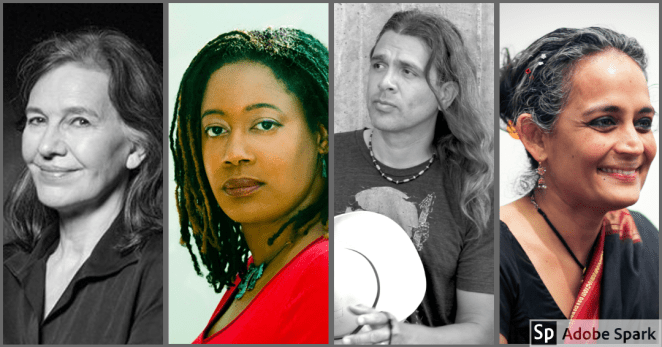
Louise Erdrich, NK Jemisin, Stephen Graham Jones, and Arundhati Roy. Images retrieved from Creative Commons.

I’m sure that everyone has heard the term “canceling” or “cancel culture” by now. This is the practice by which a person has their career damaged or even ended by others refusing to extend their support or patronage to them any longer. We’ve seen examples of this with Senator Al Franken, comedian Louis CK, actor Kevin Spacey, and singer Kanye West. Each of these people have, at one point or another, committed acts or made statements which are largely unacceptable to society. Certainly, there are some things that should not be forgiven or overlooked, and that absolutely must be called out. Sexual assault comes to mind. There can be no instance in which sexual assault is ever acceptable or tolerable. Other examples may be less clear-cut but still require an outcry. The world of publishing is no exception to this and has a long history of troublesome practices, just like many other industries.

Cancel culture actually has a longer lifespan than many people realize. It has its origins in the Civil Rights Movement and is related to boycotting, only instead of boycotting a business, one boycotts, or “cancels,” a person. This practice stems from a sense of powerlessness and inability to effect positive change, according to Anne Charity Hudley, the chair of linguistics of African America at UC Santa Barbara. She explains that if a person doesn’t have the ability to take action through political means, they can refuse to participate. She goes on to say that canceling someone is “a collective way of saying, ‘We elevated your social status, your economic prowess, [and] we’re not going to pay attention to you. … I may have no power but the power I have is to [ignore] you’” (Romano, 2019, para. 24). This approach seems to be effective only some of the time, however. When revelations about Michael Jackson and R. Kelly came to light, the instances of people streaming their music actually increased rather than the other way around. Roseanne Barr, who was fired from her show The Connors for making racist comments on Twitter, still has a career. So does Johnny Depp, although he was accused of domestic abuse.

Being able to refuse participation in the works of a person who is offensive to us is a powerful tool and can hopefully be used to help effect change. It highlights bad behavior and reminds us that, yes, people might like the music of R. Kelly (or Michael Jackson, Kanye, John Lennon, Frank Sinatra, apparently ad infinitum), but surely there must be others whose music (or acting, art, writing, etc.) is just as good with the added benefit of them not being a terrible person. The issue is complex and fraught with emotion across the spectrum; I definitely don’t know the right way to approach the topic. For me personally, it seems to make a difference whether the person is still alive or not. Living people have the opportunity to correct their ways and make amends, however unlikely that may be; the departed can never learn from their actions or remediate. Regardless, depending on what the issue is, I admit that I can have a hard time separating the artist from their art.

How does cancel culture impact publishing? As with every other area of entertainment, publishing is not exempt from cancel culture in all its varieties. Very recently, beloved author JK Rowling made some comments on Twitter which appeared to be trans-phobic. This sparked outrage and even caused some to suggest insanely that Rowling isn’t the author of the Harry Potter series, removing her from the picture entirely. This seems, to me, to be overkill. Of course, Rowling wrote the Harry Potter books; her posting something unpalatable doesn’t magically rescind her authorship and bestow it upon another. What is more important is how others will react going forward. As Charity Hudley might suggest, readers do not have to participate in Rowling’s works, and they can choose not to buy her new books or even to refuse to read those that are already published. Since making the offending statements, Rowling has not returned to Twitter, proving, perhaps, that a healthy dose of embarrassment might be an effective way to force a person to reflect on their actions. For other authors, I think it is important to consider when they were writing. Mark Twain, for instance, would no doubt be considered a horrific and unrepentant racist by today’s standards; by the standards of his own time, however, he was quite progressive. Yet many people try to cancel him and his books for their use of racial slurs. Since Twain has been dead for over a century, there is no possible chance for him to learn new ways or correct past behavior. We have to accept that his language was common for the period in which he was writing, learn from it, and move on. Same for Marion Zimmer Bradley, author of one of my all-time favorite books, The Mists of Avalon. Bradley was a celebrated fantasy author – and horrific child abuser. She died in 1999, and her daughter came forward in 2014 with allegations of molestation and abuse. Even though Bradley was long since dead when this news came to light, I confess that I have been having a very hard time separating the writer from her writing. Since she is deceased, I am not sure I should because she isn’t here to make amends; it is still a stain on one of my favorite literary experiences, and I have so far been unable to read The Mists of Avalon again since the abuse came to light. Author G. Willow Wilson, talking specifically of Bradley, tweeted that she can forgive artists for “falling short of their ideals, but not for CHILD ABUSE. Will never recommend any of her work again” (as cited in Flood, 2014, para. 8).  I understand the sentiment and, for the most part, I tend to share it.

All this was a long-winded way to say that I have been thinking of my favorite authors and if I should still like their work and recommend it to others based on their past actions. Mark Twain, yes, I will always recommend him. He lived and wrote in a very different time and canceling him would be a detriment to literary and historical study. I also truly think that not engaging with problematic texts is often the wrong approach and doesn’t teach readers where the problems lie or how to address them in the future. But more modern writers? Do we cancel them, read and recommend them but with caveats, or shrug and figure one of the literary critics is bound to take them to task? You tell me. If your favorite author turned out to be a child abuser, rapist, domestic abuser, or something else, would you still read and recommend their work?

Below are some suggestions for read-alikes for favorite authors who turned out to be vile humans.

If you liked:

The Mists of Avalon by Marion Zimmer Bradley (child molester), you might prefer instead The Guinevere Trilogy by Persia Woolley, the Pendragon’s Banner Trilogy by Helen Hollick, or the Merlin Chronicles by Mary Stewart.

One Flew Over the Cuckoo’s Nest by Ken Kesey (racist, against Native Americans in particular), you may like to try Trail of Lightning by Rebecca Roanhorse, Heart Berries: A Memoir by Terese Mailhot, There There by Tommy Orange, or The Round House by Louise Erdrich.

Ender’s Game by Orson Scott Card (raging homophobe), you might prefer Old Man’s War, the titular first book of the series by John Scalzi, Ready Player One by Ernest Cline, the Vatta’s War series by Elizabeth Moon, The Calculating Stars by Mary Robinette Kowal, or The Martian by Andy Weir.

The Thomas Pitt series or the William Monk series by Anne Perry (literally a murderer), you might prefer the Crispin Guest series by Jeri Westerson or the Lady of Ashes series by Christine Trent.

The Cthulhu Mythos by HP Lovecraft (racist), you might prefer anything at all by Neil Gaiman, The Only Good Indians and After the People Lights Have Gone Off by Stephen Graham Jones, Her Body and Other Parties by Carmen Maria Machado, or Certain Dark Things by Silvia Moreno-Garcia.

Heart of Darkness by Joseph Conrad (racist, imperialist), you might prefer The Belles by Dhonielle Clayton, the Broken Earth series by NK Jemisin, The Salt Roads by Nalo Hopkinson, or Things Fall Apart by Chinua Achebe.

The Jungle Book by Rudyard Kipling (racist, imperialist), you might prefer Erotic Stories for Punjabi Widows by Balli Kaur Jaswal, The God of Small Things by Arundhati Roy, or just about anything by Sonali Dev.

Harry Potter series by JK Rowling (who, depending on who you ask, is transphobic), you may prefer An Unkindness of Ghosts by Rivers Solomon, All the Birds in the Sky by Charlie Jane Anders, the Tensorate series by JY Yang, or The Merry Spinster by Mallory Ortberg.

References

Flood, A. (2014, June 27). SFF community reeling after Marion Zimmer Bradley’s daughter accuses her of abuse. The Guardian, https://www.theguardian.com/books/2014/jun/27/sff-community-marion-zimmer-bradley-daughter-accuses-abuse.

Romano, A. (2019, Dec. 30). Why we can’t stop fighting about cancel culture. Vox.com, https://www.vox.com/culture/2019/12/30/20879720/what-is-cancel-culture-explained-history-debate.

book review

The Power

29751398._sy475_The Power by Naomi Alderman (Website, Twitter)

Genre: speculative fiction

Setting: everywhere, possibly in the near future

I read it as a: paperback

Source: my own collection

Length: 341 pp

Published by: Viking (27 Oct 2017)

Her Grace’s rating: 3 out of 5 stars

TL;DR version: girls are now born with the ability to conduct electricity (specifically, they can electrocute people) because of a weird skein under their collar bones, and the menz are scared shitless.

In an unspecified time which feels like the near future, girls are suddenly born with a ‘skein’ under their collar bones which allows them to electrocute people. They can turn on this ability in older women as well. The Power follows four young people through their initial discovery of these skeins and the ways in which they adapt to them. One is Roxy, a tough girl from London whose family is feared for running an organized crime operation. Allie/Mother Eve is an abused foster child from the east coast who takes the power from her skein to escape and set up a new life for herself. Jocelyn is the daughter of an up and coming political superstar in the midwest, and her skein seems to be broken. Tunde is an aimless young man from Nigeria who finds his path as a reporter. The ways each of their lives intermingle relay the genesis of the skeins and their impact upon all of human society.

First, things I liked.

If I had a skein that let me zap people, I can’t honestly say I would use it for good. I can think of a fair few men who could use a good electrocution. But you know? If (mainly white) men overall, and throughout history, weren’t such rapey, abusive dicks bent on systematic oppression of women and minorities (see plot line with Roxy’s brother and dad), I wouldn’t even think about what I could do with the ability to electrocute people. Do better, menz. 

I liked that the book touched on beneficial ways women could use their skeins. It was clear that some women were more skilled than others in how they could use their power – some could only use it to hurt, but others could use it to try to help or heal people. Some girls were skilled and powerful enough to awaken the power in older women who had not been born with a skein. Others healed the sick or injured. 

I thought it was interesting, though not at all surprising, to consider that religious exploitation was a thing regardless of whether it was women in charge or men. It seems that religion will always find a way to take advantage of people who are afraid or feel lost or whatever it is that makes them flock in their thousands to weird evangelical circus-like performances and throw their money at it. Faith healers are such a crock, whether in reality or in spec fic, and they prey upon people who are desperate in some way or other. And really, religion is a crock as well. Logic is better than magical thinking, and taking active steps to fix a problem in society is more effective than trying to pray it away. 

Also, I did like that this dystopian novel gave something to women rather than taking something away and exploring the fallout from that. In The Handmaid’s Tale and Red Clocks, women no longer have any reproductive rights. In The Unit, older people are sent to a nursing home type of setting to await the days when their organs will be needed for people who are considered young and relevant still. In Vox, women’s voices are taken away in that they are only permitted to speak 100 words a day. So many other examples portray a world in which something vital is taken away from women. So it is interesting to read a book where something is given to them for once. 

Now, things I didn’t care for.

The novel at times felt more like a research project than a book. It should come as a surprise to absolutely no one that power and authority in the world tends to come from the ability to hurt other people. Ask any woman and I can almost guarantee that she has at least once in her life been afraid of a man and what he would do to her. So kind of the whole premise, while an interesting thought experiment, it also doesn’t really ask any new or profound questions. It seems to be trying to answer questions that have been posed and explored forever in other speculative fiction novels, movies, TV shows… 

The book eventually got around to Men’s Rights movements. I found myself snorting at these scenes every time they came up. Of course, my reading is influenced by actual history and I couldn’t quite separate that from the book, which is no fault of Alderman’s. But a Men’s Rights movement was as ridiculous to me as a Straight Pride parade – do men think women’s rights are as preposterous as I felt the men’s rights were in this? Again, if the menfolk would quit trying to control and suppress everyone, there would be no need for men’s OR women’s rights movements. We could all just be equal. Which seems to scare men like Moscow Mitch absolutely shitless. 

The biggest drawback for me was that the plot and character development were really…not great. Most of the characters were flat, had little actual development, and I didn’t give a crap about any single one of them. Well, I kind of cared what happened to Jocelyn a little bit, and Tunde was an interesting perspective. But in general, even they were mostly static, and I don’t think the novel needed ALL of the POV characters to be POV characters. Most of them weren’t really all that interesting, or at least I didn’t think so. I think it would have been more interesting if the novel had been told from the POV of just one person. All the international politics and women going insane seemed like it was contrived and hard for Alderman to pull off convincingly. 

I actually quite liked this book and don’t mean to sound as if I didn’t, but I think it had a lot of problems.