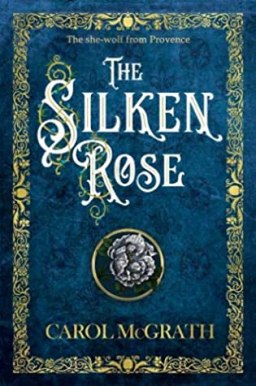
 The Silken Rose by Carol McGrath (Website, Twitter, Facebook)
Genre: historical fiction
Setting: 1300s England
I read it as a: digital copy
Source: Helen Hollick at Discovering Diamonds
Length: 355 pp
Published by: Accent Press Ltd. (23 July 2020)
Her Grace’s rating: 3-4 out of 5 stars*
This novel, the first of a planned trilogy, focuses on Eleanor of Provence, the wife of Henry III, beginning with her journey to England to marry a man who was more than 15 years her senior. In this book, she is called Ailenor. The narrative brings readers along as Ailenor learns first how to be a wife and queen and then a mother. It gives us a varying perspectives, from Ailenor to Eleanor (sister of Henry III, wife of Simon de Montfort) and a fictional embroideress, Rosalind, and covering a variety of the events that plagued Henry III’s reign. The trilogy plans to take a look at the women who have been termed “She-Wolves” for various reasons. This first installment takes care of Eleanor of Provence and her reign as Queen Consort.
First, the good. There were many, many enjoyable things about this book. I loved how much detail there was. In every scene, McGrath evoked imagery, scents, sounds of daily life in medieval London. I especially loved the details with herb and flower gardens. I can practically smell the lavender and rosemary. Similarly, the descriptions of the street scenes in London were pretty evocative as well.
I also really appreciated other small details, such as the use of relics, in particular the Virgin’s girdle, as charms for a safe childbirth experience. The churching ceremony after giving birth was not given a lot of detail, but it was mentioned a few times throughout the novel and it added extra depth. Also, a queen’s role as intercessor was mentioned several times. I’m fascinated by the queens’ intercessory role throughout time and how it changed, helped, or hindered politics. Little things like this make readers like me happy. I know not everyone cares about historical accuracy when they read a book for pleasure (*horror!*), but I am always deeply appreciative of authors who are accurate anyway. The readers like me will be happy and the readers who don’t care will still read the book and enjoy it regardless.
A few quibbles. The writing here was clear and easy, flowing smoothly from one perspective to another. The main POV character was, of course, Ailenor, but Rosalind and Nell also got a good deal of time. I was glad, though, that the chapter headings indicated when a change of perspective happened because I didn’t find there was always a lot of variance in the voices between the three women. Ailenor, Nell, and Rosalind often sounded similar and could be hard to tell apart if it were not for chapter headings.
By the same token, I felt that Rosalind was the only one who really had any character development. Ailenor, by contrast, sounded like a fully mature woman even on her journey to meet her husband-to-be when she was only 12 years old. Rosalind, on the other hand, started as a young and shy embroideress but grew into a confident and respected woman, wife, and mother. I did wish a little more of her story had been given to us. She was probably my favorite character in the book. It felt a little incomplete because there were some fairly substantial jumps in the events of her life. However, since she was NOT the primary focus of the novel, it is understandable why the author decided not to make her a larger figure.
The novel ended with the promised betrothal of Edward to Eleanor of Castile in roughly 1254. This was about ten years before the start of the Second Barons’ War. I was a little disappointed that the novel didn’t cover that time period since I think a lot of interesting content could have been written about Ailenor during that time period. She was considered one of the She-Wolves, and the Barons’ War and Simon de Montfort’s role was a major element within Henry’s reign. It would have been particularly interesting to see Rosalind’s role in that. Even though she is fictional, sometimes those are the best characters through which to explore an historical event or person. Again, I understand why it wasn’t included. It would have been a tome otherwise!
Overall, I enjoyed this novel. It was a fast, easy read and gives an interesting glimpse into a fascinating period of England’s history.
*N.B.: I am unclear if the copy I received to review was supposed to be a finished copy or if it was an edited digital galley. The book was already published (in the UK, at least) when I got the file to review, but it was a PDF which is usually how I get galleys. I mention this because if it was a finished copy, then there were numerous places throughout where the text was positively jumbled up and sentences were a mash-up of words. For example: “I think it safer and the apartments there of the City. Without destruction remained have been redecorated.” And “He could not change his mind, had he so wished. as they fell resounding from the ancient A squire always followed his knight.” These are just two of several such examples that were scattered throughout the text. If I got an unedited galley, then never mind, these errors would be corrected upon editing. If it is supposed to be a finished copy, then that is not good and would certainly cause me to greatly reduce my rating of the book.

 Isabella of Angouleme: The Tangled Queen 1 by Erica Laine (Website, Twitter, Facebook)
 Recursion
  Her Grace's Library