book review · books · sci-fi · Star Trek

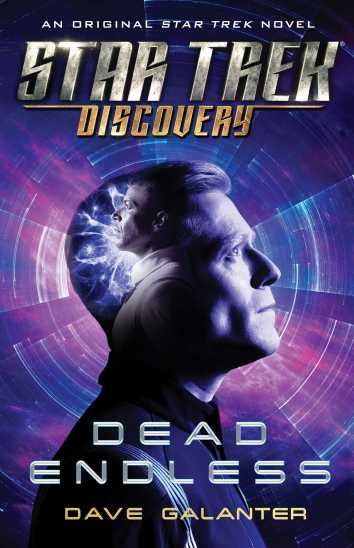
Star Trek Discovery: Dead Endless

ST Disco Dead EndlessDead Endless by Dave Galanter (Twitter)

Genre: sci-fi

Setting: the mycelial network, mostly

I read it as a(n): paperback

Source: my own collection

Length: 342 pp

Published by: Gallery Books (17 Dec 2019)

Her Grace’s rating: 3.5 out of 5 stars

**Spoilers abound!**

Discovery receives a distress call, which is not anything out of the ordinary for a Starfleet vessel. What is unusual is that it originates from within the mycelial network, the subspace domain Discovery can navigate briefly, but not endure for long, thanks to Lt. Paul Stamets and the spore drive he created. The crew responds to the distress signal and gets stuck in the mycelial network as a result. While there, the ship’s store of spores and the forest from which the crew harvests them disappears. Without the spores, there is no way for Discovery to return to normal space, and staying in the mycelial network will kill them sooner rather than later. The crew has to decide whether or not to trust someone who seems to be a human even though he was living in the network, or figure out if he’s an alien who intends to use Discovery’s spores to escape from the mycelial network at any cost.

This was a really unique story. At first, I was totally lost because the earliest references to “the captain” were vague. Is it Gabriel Lorca? Christopher Pike? It is only quite a bit later that we learn the captain refers to Michael Burnham. Of course, that sets off a whole other host of confusions because Burnham was never a captain, of Discovery or any other ship. Eventually, we learn that it IS Burnham but the setting is an alternate universe from either the Prime timeline or the Mirror Universe which we have seen in the show itself. I thought this was a great way to tell this story since it places the narrative within familiar territory – the ship itself with all the same characters – but in such a way that it doesn’t interfere with potential future canon. 

I enjoyed the mystery of how the spores were disappearing. Often, I don’t care one way or another for new aliens we meet in the books, but I really liked the Maligonq folks in this story. It was fun to see the Starfleeters knocked down a peg or two by being considered the far less advanced society of the two! 

Yes, a fun plot (once you figure out what the hell is happening) and fun aliens, but what really shines about this novel is the relationship between Stamets and Culber, and the interplay of those two characters with the rest of the crew. Galanter nailed their voices, especially Stamets’s. The whole idea of their relationship is beautifully written and shows a side of these men we can infer but do not always see in the show. It is a love story like any other, which is partly the point. In the future which Star Trek envisions, straight, gay, nonbinary, whatever is all fine, it just is love between people and that is all that matters. 

There is also an underlying theme about missed opportunities and the roads not taken. I thought it was so bittersweet that the Stamets we see in this story is NOT our Stamets in the Prime timeline. It IS Prime Culber who was trapped in the network, and who is eventually rescued in the show. But here, he encounters Stamets as he was early in their marriage, not a man who became bitter from watching his life’s work get conscripted into wartime use. The other Stamets is a kind and funny person, if somewhat irritable, partly because in his universe, there was never a Battle of the Binaries, no Klingon War. Burnham didn’t mutiny but instead became Discovery’s captain after Lorca moved on. Culber is trapped, he thinks, in this new alternate timeline and is torn because this new Stamets is more like the man he originally married and he wants to stay with him. But there is already a Hugh Culber in this timeline serving on another ship, and he feels too that staying with this Stamets would be the same as cheating on his spouse. Of course, Stamets recalls his universe’s Culber because their initial encounter with Hugh humming Casseelian opera ended with them calling each other an asshole and never meeting again. Stamets learns what he was missing out on for all those years he and Hugh could have been together. By the time he realizes it, it’s too late and Culber is drawn back into the network and is beyond reach. Like I said, missed chances. It ends on a very hopeful note, though, not as melancholy as it could have been.

I definitely recommend this one. It’s funny, too, that it is the first Discovery novel that’s actually set primarily on the titular ship. All the other ones before it were prequels and had nothing, if anything, to do with the ship itself. Those focused all on the characters, which is also just fine with me. The ship doesn’t have to be the setting to make a Disco novel, though I get why some readers were a little put off by that. ANYWAY. Read this book. Some of my favorite lines are below. It will be interesting to hear what some of your favorite lines are.

Favorite part/ lines:

    • On a scale of zero to Vulcan, it’s a Tilly, so…draw your own conclusions (10).
    • “Is sarcasm terminal?” “Yours is chronic” (36).
    • “You know,” Burnham said as they walked through, “my mother had a solution for tense situations. … She told me that there was nothing wrong with being nervous. Nerves remind us we’re alive. Nerves tell us we’re in pain, or when we’re experiencing pleasure, or when we’re in danger. It’s an important part of who we are” (78).
  • “I never want to hurt anyone. Like any living entity, I have instincts and I reacted.” “Do you know what those instincts are?” Chittering thoughtfully, Ephraim seemed uncertain. “I suppose only once they come into use.” “I guess that true of us all.” Ephraim’s mouth puckered and he radiated happiness again. “Then I am a people?” Smiling slightly, Culber nodded. “You certainly are to me.” 
  • “Is he pink?” Breytik asked Burnham. “He’s very pink.” He turned back to Stamets. “You’re very pink.” “Thank…you?” “I hope you feel better soon,” the Maligonq told him, just above a whisper.

***N.B.: As I was Googling to find the URL for Galanter’s various sites, I stumbled across an announcement from earlier this month. Galanter posted a long, beautiful, and sad note on his social media sites telling us that he was diagnosed a year ago with late-stage cancer of the bile ducts. His doctors now predict he has 3-6 months left to live, with the note that it is probably closer to three. This is supremely sad news and I wish Galanter and his family and friends a gentle time. For the full post, please view Galanter’s Twitter.
book review · historical fiction · Medievalism

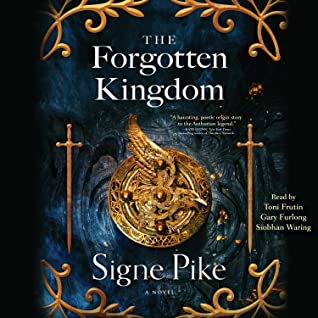
The Forgotten Kingdom

The Forgotten KingdomThe Forgotten Kingdom by Signe Pike (Website, Twitter, Insta)

Genre: historical fantasy*

Setting: 6th century Scotland

I read it as a(n): audiobook

Narrator: Toni Frutin, Gary Furlong, and Siobhan Waring

Source: my own collection

Length: 14:07:00

Published by: Simon and Schuster Audio (15 Sept 2020)

Her Grace’s rating: 4 out of 5 stars

The Forgotten Kingdom is the second instalment in Signe Pike’s Lost Queen trilogy. It picks up immediately after the events of the first book. Languoreth is imprisoned and awaiting news of a battle that holds the fates of her brother, eldest son, and husband. The land is divided and her brother, Lailoken, is battling against her husband, Rhydderch. At the same time, Languoreth’s youngest daughter, Angharad, is traveling with Lailoken to become a Wisdom Keeper. IN the chaos of battle, they become separated and Lailoken is drawn into the political and military intrigues while his young niece is lost in the wilderness and left on her own. The survivors of the battle are similarly thrown to the elements, left to fend for themselves in the Caledonian forest. 

This summary does no justice to the depth of this novel. While I liked the first book in the trilogy a bit better, this was a necessary examination of the politics and alliances Languoreth and her kin had to make to survive against the tide of the new Christian religion. Readers are introduced to Artur, who will, I’m sure, become King Arthur later. Angharad, surviving with a relative she discovered among the Pictish folk, may, I suspect, become the Lady of the Lake. I’m very curious to see if I am right, and how this will all play out.

Dumbarton Castle and Fortingal are the modern names for real places in the book. Pike set her story among these locations based on her extensive research. Clyde Rock and the kingdom of Strathclyde, as well as Languoreth’s birthplace of Cadzow, were historical sites, long since lost to history. But, as I have said in other reviews, placing a fantasy in a historical context is the best. It gives us hope that the figures and stories we love so well might not be stories at all, but are part of an actual history that has been lost or overwritten. 

Pike’s term “the forgotten kingdom” regrets to the Picts, the Scots of Dalriada, and other Brythonic peoples. Much of what we know about these people comes from Roman records, which must be taken with a large grain of salt. The Britons of the early medieval period passed knowledge primarily through oral tradition and so their histories were recorded by others. Few relics of their cultures survive. Sometimes, the best we can hope for are post holes from a building; the buildings themselves were mostly made from wood, or wattle and daub, and rotted away. Pike did a terrific job with the use of historical placenames and customs of various groups of people and of bringing the characters to life.

The politics and battles in this book were complex and dramatic. In a way, I wish this period of history was better recorded so we could know more for certain about it. But the very fact that it is not well recorded leaves rich ground for authors to craft stories around the few facts we do have. 

I highly recommend this book (though it is not really a standalone, so you’ll want to read The Lost Queen first, if you haven’t already). The only thing I don’t like is that the third book isn’t coming out until late 2023, per Pike’s website. That is so long! 

*The author’s note made an excellent argument that historical fiction is often miscategorized as historical fantasy, especially if there are references to old or other deities than those found in the Christian tradition. A character will do a chant, prayer, or spell and something happens as a result of it, so they think, and so the story is labeled fantasy. And yet, when Christian characters do the exact same things, the story is labeled historical fiction, as though the religions and beliefs of pre-Christian cultures are somehow less worthy of being considered real. Pike makes a great point with that argument. What we now consider to be mythology was once the official religion of state for the Roman Empire. It would be interesting to see what people in a thousand years will think of Christianity, Islam, or Judaism. Short of having actual magic or dragons or other similar elements of pure fantasy, I will be calling all books like Pike’s historical fiction. She made a convert out of me. Every pun intended.

book review

Homes: A Refugee Story

Homes A Refugee StoryHomes: A Refugee Story by Abu Bakr al Rebeeah and Winnie Yeung

Genre: memoir

Setting: mostly Homs, Syria

I read it as a(n): paperback

Source: my own collection

Length: 217 pp

Published by: Freehand Books (1 May 2018)

Her Grace’s rating: 4.5 out of 5 stars

Abu Bakr al Rabeeah was born in Iraq. His family moved to Syria when he was nine in the hopes of escaping the escalating violence in Iraq. Of course, that was right around the time the Syrian civil war was getting started, so Bakr and his family essentially leapt from the frying pan into the fire. 

As he grew up in a country sundered by war, Bakr and his friends found small joys and ways to be happy. Playing soccer or video games were evergreen favorite pastimes, and he loved learning more about his faith and attending services in his nearby mosque. As the violence in their city of Homs grew worse, Bakr learned, along with everyone else, to avoid the soldiers who would randomly stop citizens, never to go anywhere without his documentation proving who he was, and what to do if there was gunfire or a bomb explosion. Eventually, Bakr and his family gain a highly coveted spot in the UNHCR refugee program and were relocated to Canada, where they all had to learn an entirely new way of life.

My summary probably makes this book sound boring AF, but it was definitely not. It was beautifully written, almost poetic in parts, and packed in a ton of detail and information is such a slim book. It also really highlighted a lot of things I think more people, Americans in particular, need to learn about. 

For one thing, it is absolutely horrifying what humans can become accustomed to. When Bakr first arrived in Canada, one of the things he had the hardest time adjusting to was how quiet it was. He said there wasn’t a constant background noise of gunfire, explosions, screaming. When a bomb had gone off near his home, the community ran towards it to try to help because they knew the ambulances would be a long time coming, if they came at all. A couple days afterward, Bakr and his friends came home from playing soccer and saw that the site of the explosion still had a lot of blood and body parts. They sighed and went and got buckets and things to clean it up with, and other neighbors came out to help. I cannot imagine a child (he was only about 10 at the time) seeing something that awful in the first place, let alone having to help clean it up, gather body parts to take to the authorities, or be in any way involved. It is heartbreaking to know that this is the reality for so many people.

Another thing that is important was Bakr’s relationship with Islam. I think there are still far too many people who assume Muslims are terrorists. That is ridiculous; it would be like assuming all Christians are members of the KKK. It was really nice to read how Bakr’s parents raised and taught their children always to love people, even if they were not kind, because that is what they believed Islam is. Bakr loved the peace his faith brought to him. His father taught him that extremists and the soldiers who were fighting and hurting innocent people were not Muslim because they were acting in ways contrary to the teachings of the Quran. I’m atheist so religious devotion of any kind is utterly baffling to me. However, I have tried to educate myself about a variety of religions and it seems that there are crazies on all sides but the vast majority of people are just normal, peaceful folk who wouldn’t hurt anyone and who just want a safe world for their children. I really don’t know what’s so hard to figure out about that. I think everyone who has children must want a safe world for them. 

I definitely recommend this as a fast, easy read dealing with difficult topics.

book review · fantasy · historical fiction

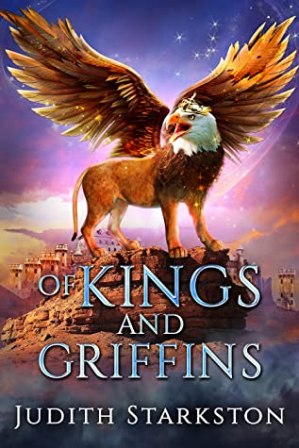
Of Kings and Griffins

Of Kings and Griffins

Of Kings and Griffins by Judith Starkston (Website, Twitter, Insta)

Genre: historical fantasy

Setting: Hitolia, the fantasy version of Anatolia, the ancient Hittite lands

I read it as a(n): ARC

Source: Helen Hollick at Discovering Diamonds 

Length: 482 pp

Published by: Bronze Age Books (13 Oct 2020)

Her Grace’s rating: 4.5 out of 5 stars

In this third instalment of Starkston’s delightful Tesha series based on ancient Hittite culture, Of Kings and Griffins picks up a few months after the events of her second book, Sorcery in Alpara. Tesha, our protagonist, is now Queen of Alpara and has given her husband, Hattu, a baby daughter, Arinnel. Hattu’s brother, the Great King, has died, leaving as heir his untested teenaged son, Urhi, who plots against Hattu’s aid. At the same time, Tesha’s blind sister, Daniti, is called by the griffin king, Bothar, to help him overcome a deadly danger in a way she is uniquely suited for.

This novel opens around a year after the events of Sorcery in Alpara. Tesha and Hattu are at the funeral of his brother, the Great King Muwatti, and Tesha, seeing that Hattu’s young nephew, Urhi, will be a problem for them, uses her magic to influence him to bend to Hattu’s will. Except Tesha, still being very young, wasn’t so subtle and got caught, thus undermining any authority Hattu might have had over Urhi. At odds with each other and his nephew, Hattu and Tesha return to Alpara to regroup. 

At the same time, Hattu’s best friend and military commander, Marik, is dealing with a mysterious illness that is striking down his troops. The court physician believes the illness to be caused by a curse from a powerful sorcerer, and that the ultimate goal is to kill Marik or Daniti next. To stop the magickal illness from killing all his troops, Marik goes on a dangerous spying mission to learn what he can and, with luck, kill the sorcerer responsible for the curse.

There are many layers to this novel, all delicately entwined and teased out over the course of the narrative. The politics involved are interesting and often very subtle. I liked the interplay between Tesha and both Urhi and the Egaryan ambassador, Ahmose. Seeing how Tesha learned to work with and, in some cases, manipulate, these men was fun to read. She has grown as a priestess, a queen, and a woman since we first met her and she’s becoming a very well rounded character. 

I always liked Daniti, so it was great to see her have such a prominent role in this novel. She has begun to manifest magic as well, not as strong as Tesha’s, but she is able to communicate telepathically a little bit over distances. She uses this skill to talk to her niece Arinnel. This ability, as well as her blindness, makes her valuable to the griffin king Bolthar, who brings her to the hidden realm of the griffins to help protect his young cubs. Daniti is certainly kinder than I would be. Bolthar needs her help and yet he is arrogant and disdainful of her practically every step of the way. It would be really hard to want to help someone who treats you like that, but Daniti has a loving heart and throws herself into the project despite Bolthar’s attitude. 

I also liked that Marak played a large role here, even more so than Hattu. Marak was all over the place in this story, from undercover spy searching for a sorcerer to leading military campaigns. It seemed like everywhere you turned, there was Marik, in the best way possible. 

I remain utterly delighted with this series. I read a LOT of fantasy, both pure fantasy and historical fantasy. A series that is based on historical context is almost always going to appeal to me greatly, like Stephen Lawhead’s Robin Hood King Raven series, or Signe Pike’s The Lost Queen Arthurian series. To have a historical fantasy series that is based on ancient Hittite culture is entirely unique. Starkston’s knowledge of the Hittites and the political events of the time period is deep. She supports her characters’ decisions and drives the plot based on her thorough research and understanding of the culture. I have read all three books that are now in the series and can honestly say they are just getting better and better. Also, these books could probably all be read as standalone stories, though you are missing out if you don’t read all of them. Including the author’s notes! Learning the real historical events and people that the Tesha series is based on adds so much depth and meaning to the story. 

Very enthusiastically recommended! 

Favorite part/ lines (potential spoilers!):

  • When searching through old scrolls and clay tablets for a binding spell, Tesha discovers a whole room of forgotten, ancient tablets. She says the old ones are the best kind. I loved this! Tesha would totally be a book nerd! 
books · lists

20 Books about Fire

fireI often enjoy reading groups of books that are thematically similar, or pair well together. For one thing, I find it easier to remember titles if I group them. Sometimes I even remember plots! I swear I do a memory dump every time I finish a book and couldn’t tell you a single plot point or character name, even if I loved it. I really hope I don’t ever meet an author who wants me to tell them my favorite part of a book just on the spot. I’ll be reduced to screaming, “I loved your book! I READ ALL THE WORDS!!” Then, of course, I would just melt into a puddle of embarrassed flaming goo. 

So because embarrassed flaming goo is apparently on my mind, I thought I would give a list of books that are, in some way or another, about fire, burning, explosions, etc. Maybe it’s in the title, maybe it’s related to the plot, maybe both. Who knows. No, I am not going to list any of the Game of Thrones books. Do you have any other recommendations?

  1. Little Fires Everywhere by Celeste Ng. Seemingly perfect lives all go up in flames! Literally and figuratively.
  2. The Fire Next Time by James Baldwin. Necessary reading regarding racism in America.
  3. A Burning by Megha Majumdar. Three people trying to rise in life, connected by a shared catastrophe.
  4. Smoke Gets in Your Eyes & Other Lessons from the Crematory by Caitlin Doughty. A medievalist takes a job at a crematory and learns about the culture of caring for the dead.
  5. The Fire This Time edited by Jesmyn Ward. Using James Baldwin’s narrative, several writers offer essays and poems on race.
  6. A Fire Upon the Deep by Vernor Vinge. A galactic war brought about because a person’s potential is determined by its location in space, known as regions of thought.
  7. The Incendiaries by R.O. Kwon. A young woman at an elite university is drawn into domestic terrorism by a cult with ties to North Korea.
  8. The Association of Small Bombs by Karan Mahajan. A bomb in a market in Delhi impacts the life of a survivor in ways that may seem impossible.
  9. Girls Burn Brighter by Shobha Rao. Two girls in India find a friendship that helps them survive a life of crushing poverty, abuse, trafficking, and immigration.
  10. Smoke Signals by Sherman Alexie. Two Native American boys, Victor and Thomas, on a journey and the lessons they learn along the way.
  11. Smoke by Dan Vyleta. In an alternate Victorian England, people who are sinful are surrounded by smoke and soot while the virtuous are clean and pure. 
  12. A Burnable Book by Bruce Holsinger. In 1380s London, a seditious book predicting the assassination of Richard II is causing a lot of problems. So bureaucrat Chaucer asks poet and information trader Thomas Gower for help.
  13. Miracle Creek by Angie Kim. A hyperbaric chamber at a specialized treatment center explodes. Layers of mystery and secrets lead readers to discover who is behind the explosion.
  14. Did You Ever Have a Family by Bill Clegg. A woman loses her entire family in one horrible accident. She drives across the country to get away from the memories, and finds connection in shared heartbreak with others.
  15. The Fire Line by Fernanda Santos. The story of the Granite Mountain Hotshots, an elite team of firefighters, and the Yarnell firestorm tragedy.
  16. Nothing to See Here by Kevin Wilson. Lillian and Madison, best friends from college, drifted apart after they left school. Years later, Madison contacts Lillian, begging her to come and take care of her twin stepchildren who spontaneously combust when agitated. Lillian figures why not. 
  17. Smoke and Mirrors by Neil Gaiman. Short stories by Neil Gaiman. What else do you need to know?
  18. Things You Save in a Fire by Katherine Center. Cassie is one of the first female firefighters in Texas, she is great at dealing with emergencies. And then her mother asks her to move home to Boston to tend to a different kind of emergency.
  19. The Demon-Haunted World: Science as a Candle in the Dark by Carl Sagan. Astronomer Sagan discusses why scientific thinking is necessary both for the pursuit of truth as well as for the health of society. Because how can you make good decisions if you don’t know the difference between myths, pseudoscience, and actual testable scientific fact?
  20. Fahrenheit 451 by Ray Bradbury. In the future, all entertainment is on the TV and literature and books are forbidden. Firefighters are those who seek out and burn books. One firefighter, Guy Montag, begins to question everything he thought he knew. 
book review · books · sci-fi · Star Trek

Star Trek Discovery: The Enterprise War

Discovery The Enterprise WarThe Enterprise War by John Jackson Miller (Website, Twitter)

Genre: sci-fi

Setting: spaaaaaaaaaace! 

I read it as a(n): paperback

Source: my own collection

Length: 420 pp

Published by: Gallery Books (30 July 2019)

Her Grace’s rating: 4 out of 5 stars

So you know how season two of Discovery says the Enterprise was ordered to sit out far away during the Klingon War? This story fills in what they were doing during that time. 

Christopher Pike and the crew of Enterprise are on a year-long mission to the Pergamum nebula, a dense cloud of plasma that wreaks havoc on the ship. While exploring, they encounter a ship called Boundless, which is run by a crew kidnapped from various species and forced to work together in the Boundless’s war against the Rengru. The crew of Enterprise is on a survey of a nearby icy moon when they are attacked. Enterprise is damaged and Pike orders an emergency saucer separation, leaving the stardrive damaged in space and the saucer spinning out of control to who knows where. The survey crews, thought to have been killed in the Boundless’s attack, are conscripted into military duty against the Rengru. Pike and Number One have to reunite their ship and then figure out how to reunite their scattered crew before they become victims of a war that is not their own.

This was a really fun Trek novel. Some of the novels lately, across all the various series, have been a little slow. This one read like an old fashioned Star Trek episode. Lots of exploring, plenty of humor, and Battles in SpaaaaaceTM. The way the Rengru were described made me think they were space-capable pillbugs. Kinda icky and with too many legs. The crew of Boundless and all her sister ships is like the Breen, one cohesive nation made up of disparate species. 

At its heart, this novel was an essential Star Trek story – the crew overcoming obstacles, learning new things, and helping others to attain peace and understanding. The chief engineer, who is decidedly not Scotty, is a genius on paper but an absolute moron in practice, so they’re kind of screwed when the ship gets wrecked. The commander of the Boundless has been fighting a war that she inherited from her forebears and they no longer know why. 

My only quibble is that the ending was a little too tidy, but it was just untidy enough to be acceptable. I also tend to vacillate between being super lenient and super picky about my Star Trek books; sometimes I expect them to be of the highest caliber and have complex plots dealing with a shitload of ethical issues, and sometimes I just want to be entertained by characters I know and love. This fell somewhere in the middle of that. 

Enthusiastically recommended!

Favorite part/ lines:

  • I LOLed at how stupid Baladon’s crew was. For example, “You are all equally incompetent. You function together as parts of a machine that does absolutely nothing. When the end comes, I will be able to say with pride: each crewmember aboard brought me to it.” Several on the bridge erupted in self-congratulatory cheers. 
  • “Need more torpedoes.” 
  • (After a nasty battle) Raden’s eyes opened a fraction. Woozy, he does Pike and mumbled, “Did…I leave…a mark?” “Your head will be fine,” Pike said. “We’ll get you help.” “I mean…did I leave one…on the bulkhead?”
  • “We don’t even tell our own people, because it’s too horrible. The Rengru inject feeding tube into the backs of their victims’ necks – and devour their brains. Then they implant their young in the empty skulls!” “Wouldn’t it make more sense if they implanted the young first and let them devour the brains?” Pike looked around to his crew. “I mean, I’ve heard some scary monster stories in my day, and what really sells them is logic. … Now, Vulcans – you’d think they’d be great at writing horror.”