book review · sci-fi · Star Trek

Revenant

Revenant (Deep Space 9) by Alex White

Genre: sci-fi

I read it as a(n): paperback

Length: 308 pp

Her Grace’s rating: 4 out of 5 stars

Revenant is set during the early 4th season of Deep Space Nine and follows Jadzia Dax to Trill. An old friend of hers comes to ask for her help in tracking down his wayward granddaughter, Nemi, who ran off after being denied twice to be joined with a symbiont. Upon finding the young woman, whom Jadzia views as a younger sister, she realizes there is something very wrong with Nemi. Scans reveal that Nemi has a symbiont and no life signs of her own. Horrified, Dax returns to Trill to unearth a centuries-long conspiracy which involves not only Jadzia, but at least two of Dax’s previous hosts as well.

I loved this story from the plot to the title. A revenant is someone who returns from death, like a zombie. Or Jesus. You know. As one does. I thought the idea of an evil symbiont who takes over a body and reanimates it is so interesting and I’m honestly not sure why since I generally think zombie stories are dumb. But this wasn’t a zombie story, per se. It was a glitch with the Trill and their symbionts and the ones like Nemi weren’t all corpsified and gross like other zombie stories. 

I’ve always thought the Trill are an interesting species and this book reinforces that interest. The idea of hosts and symbionts can make for some terrific discussion on identity and mortality. How does it affect one’s perception of time if you get a really old symbiont? What becomes important? 

Dax’s condemnation of the Symbiosis Commission also raised some good points about the elitism of joined Trill. The Commission always matches symbionts with the best and brightest young Trill, those who excel in their field in some way. I can see their point in doing so – I suppose you wouldn’t want to join a symbiont with the Trill equivalent of a maga hillbilly or something – but there is no reason not to allow a regular person to be joined. Sure, join them with astrophysicists and doctors and diplomats, but maybe also join them with housewives and schoolteachers and mechanics sometimes, too. It takes all kinds. 

The hive mind element was also intriguing. In Star Trek, when you hear hive mind your first thought usually is, “Borg! Run away!” But this was more like a telepathic fungus and made me think a bit of Mexican Gothic by Silvia Moreno-Garcia. I’m not sure if that was intentional on White’s part or not but I thought it was a cool connection regardless. 

I’m super behind in reading the newest Trek novels, so maybe more of them are like this, but I am digging the apparent return to episodic, one book equals one story format. The relaunch books were nice but I never liked how you had to read all of them to know what the fuck was going on. Episodic novels are way better IMNSHO. 

It was also fun to see an early side to the Worf/Jadzia relationship. I never cared one way or another for that ship but I know it was popular and sad so it was fun to see a new story about them from early on. 

At any rate, this was a really fun story. Enthusiastically recommended for any Star Trek fan!

book review · books

Catch-Up Round: There There and Running with Sherman

There There by Tommy Orange

Genre: contemporary literature/ Indigenous

I read it as a(n): paperback

Length: 294 pp

Her Grace’s rating: 4 out of 5 stars

This novel highlights the lives of 12 people and how they intersect at the Big Oakland Powwow. There are people whose lives have been ruined by alcohol, drugs, the murder or suicide of loved ones, and somehow they still manage to keep going. There is an underlying discussion about generational trauma, especially among the Native tribes. There is also vast systemic racism, which impacts people in so many ways, sometimes in ways no one even is aware of. 

This was a short but powerful book. It was a fast read as well, but not an easy one. It is hard to read about the suffering of others and to know how very privileged you are by comparison. 

I always love reading about a culture I’m not that familiar with. Even though I live in the Southwest and there are several different Native American tribes in the area, I don’t know anyone personally who is Native. My exposure to actual Native culture is mostly confined to the occasional powwow I go to and reading books written by Native authors. 

Definitely recommended!

Running with Sherman by Christopher McDougall

Genre: nonfiction

I read it as a(n): audiobook

Length: 12:13:03

Her Grace’s rating: 2.5 out of 5 stars

Christopher McDougall and his wife, Mika, are tired of living in Philly so they buy a place in Amish country and basically now have a hobby farm. One of the neighbors tells McDougall that one of the members of his church needs help and that he’s an animal hoarder. McDougall goes with his friend to the hoarder’s farm and they rescue a little donkey who was severely ill, standing on horrifically overgrown hooves in filthy straw in a tiny stall. McDougall and his friends and family rally to take care of the donkey, who they name Sherman, and eventually he gets better. Then McDougall learns about donkey racing. 

This was not exactly what I thought it would be. I heard about it in an article I read somewhere recently and I thought it was about the Born to Run guy teaching the donkey how to go running with him, like you take your dog running with you. I had visions of a fuzzy donkey trotting alongside McDougall on the road and it is something I would desperately love to see. But no. Apparently there is a whole community of donkey racers who, from what it sounds like, allow their donkeys to drag them up hills and mountains in some kind of hard core trail running crossed with Mountain Man stuff. Much like running a marathon, it doesn’t sound at all fun. 

I thought this book was only OK, partly because I misunderstood the premise of running with Sherman and partly because it kind of dragged in a lot of places. There wasn’t as much about Sherman as I would have liked; instead, there was a lot about the people involved, the training involved, the stories of the people involved, and I just didn’t care that much about them. I stuck through to the end because I did want to see how Sherman did in his big donkey race in Colorado, and parts of it were funny, but overall I thought it was just mediocre.

book review · weird

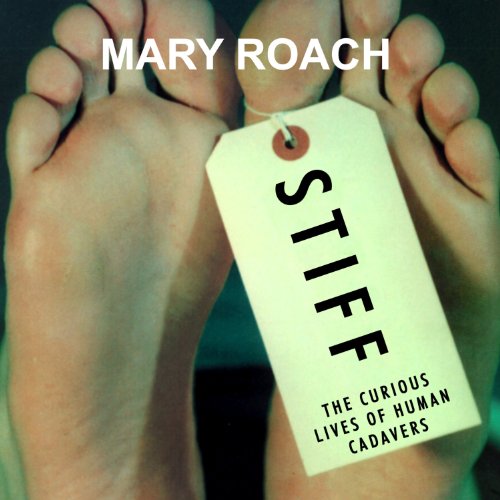
Stiff: The Curious Lives of Human Cadavers

Stiff: The Curious Lives of Human Cadavers by Mary Roach

Genre: nonfiction/science

I read it as a(n): audiobook

Narrator: Shelly Frasier

Length: 8:00:00 

Her Grace’s rating: 3 out of 5 stars

Do you ever wonder what happens to the body if its owner has donated it to science? If so, this is the book for you. Author Mary Roach covers the uses of cadavers ranging from medical/surgical practice to body snatching, crash test dummies to a new residence at the Body Farm, and many topics in between. Always respectful but lightening the subject with her typical humor, Roach guides readers through the many relevant roles cadavers have in their post-mortem, well, lives. 

I had read this book years ago for my book club and remember being kind of bored with it. I listened to it this time on audio and I think the problem before was that I skimmed some of the parts that were horrifying to me and I was more focused on that than on the actual topic. This time, I didn’t skim or skip sections and the experience this go round was difficult in places. I am terrified of flying, for example, and so the chapter discussing the ways forensic examiners look at bodies in plane crashes to figure out what happened was really anxiety-making for me. A couple other sections made me lose my appetite. 

This still wasn’t my favorite book by Mary Roach. I haven’t read all of them yet, but of the ones I have read, I think my favorite is Packing for Mars. If a person has never read one of her books, I likely wouldn’t recommend this one as their first. That said, I was a lot more engaged and interested this time. In horror, I laughed out loud a few times. I definitely learned a lot. 

And yes, I still plan to donate my body to science when the time comes.

book review

The Invisible Life of Addie LaRue

The Invisible Life of Addie LaRue by VE Schwab

Genre: fantasy

I read it as a(n): hardback

Length: 444 pp

Her Grace’s rating: 1.5 out of 5 stars

SPOILERS BELOW!!

Adeline “Addie” LaRue, a young woman in 1714 rural France, is being forced to marry. Only she does not want to marry, not this guy and not anyone else for now. In desperation, she begs and makes a deal with one of the Old Gods for more time. It helps to be specific when asking for things from genies or Old Gods because Addie is now immortal. The price of her immortality is that she can leave no mark upon the world. She can’t write, make art, not even say her own name. Everyone instantly forgets her as soon as she leaves their sight. Except one day, about 300 years later, one person doesn’t forget her. 

I think the premise of this novel was awesome. I’m sure everyone, at one point or another, has wondered what it would be like to live forever. Personally, I would hate it unless my daughter was immortal along with me. Kind of like heaven. Why the fuck would anyone want to go there and be stuck for all eternity with people you don’t like, or not to be able to help someone you love if you see them in trouble, or not to see loved ones ever again if they didn’t win a ticket to the cloud house? Pass, thanks.

Anyway, the premise was interesting and I think there are a ton of fascinating ways the novel could have gone. Unfortunately, nothing of the sort happened. 

Addie would have seen amazing things in her long life, yet she herself was not at all interesting. I thought she was boring AF. I’d forget her instantly, too. She had 300 years and all she did was travel to the same handful of places, learn a few all-Western languages, and bitch and moan about things. She could have visited the entire world, learned languages that weren’t some variation of a romance language, maybe even found a way to be an anonymous yet generous benefactor in some way to kids or a starving artist or something, despite her inability to leave a mark on the world. She could have chosen to remember some major historic events from an eyewitness POV. French Revolution? That was interesting. American Revolution? Yeah, Washington wasn’t as tall as people think. The Civil War and subsequent Jim Crow era, the Japanese surrender in 1945, the launch of the first Sputnik rockets, the Tiananmen Square Massacre, the politics of the Belgian Congo, the Rwandan Genocide. SO MANY things she could have seen and discussed. Instead, she wanders around stealing books and thinking incessantly about herself.

Henry was equally forgettable. He was a bland, boring man, though honest kudos to Schwab for trying to have a discussion about depression through his character. We need open and frank talks about mental health and any genuine attempt to do so is worthy of praise. But maybe make him interesting while also talking about depression. He just kind of wandered through the story and had no real purpose except to be the person who remembers Addie. 

Luc, the Old God sort of creature who Addie made her Faustian deal with, was physically sexy. But there the interest ended. We are supposed to believe he is some kind of god but he has a weird fetish with Addie? With making her suffer because he has nothing better to do? He didn’t even torment her to give readers any sort of character development. And then he and Addie end up together? After all that? OMG Stockholm Syndrome much? She wanted more time and not to have to be with anybody forever and then she ends up with Luc? Schwab sets up the plot for a sequel, but I was too bored and irritated by this to ever bother with a sequel. 

I have seen the writing described as beautiful, amazing, vivid, and so on. I wonder if I was reading the same book. Yes, there were some parts that were very nicely detailed and described. But there was also a LOT of repetition. If it was supposed to be vivid or whatever, I feel it missed the mark. If it was to subtly underscore the repetitive and boring nature of eternal life, then well done, mission accomplished. 

TL;DR version: Self-centered forgettable immortal woman thinks constantly about herself while stealing books, traveling to the same handful of places, learning a few Western-only languages, not witnessing many historical events or, apparently, meeting anyone who isn’t white until 2014. Wave off this one if you’re on the fence about reading it. So yeah, unpopular opinion, I guess. But I didn’t think this one was at all worth the hype.

book review

Katherine

Katherine by Anya Seton

Genre: historical fiction

I read it as a(n): audiobook

Narrator: Wanda McCaddon

Length: 23:44:00

Her Grace’s rating: 3 out of 5 stars

Katherine is the classic novel by Anya Seton that follows the life of Katherine Swynford, most famous as the long-time mistress of John of Gaunt. The novel begins as Katherine is heading to court after having lived for years at a convent. Naturally, she is young and beautiful and so must, therefore, get a husband. Some younger knights and squires turn her head but the intimidating Duke of Lancaster, John of Gaunt, catches her eye more than others. She knows better, and he is married, but likes him anyway. Katherine is horrified, though, when one of Lancaster’s knights, Hugh Swynford, asks to marry her. It is an advantageous marriage and it is quickly arranged. She goes with her new husband to his home at Kettlethorpe and has two babies and that, she thinks, is that. But then Hugh gets sick in France while in service to Lancaster and sends for her, and dies soon after. Woo hoo! Now she and Lancaster can get it on if they want to, since his wife, too, had died. The rest, as they say, is history.

This novel was first written in 1954 and it shows in a lot of ways. Sometimes, the women seemed infantilized in ways that they are not in newer historical fiction. No, there was no such thing as feminism in the Middle Ages, and no, the women tended not to ever act or speak in terms like we would today. But they are not always depicted quite as the meek and submissive women that they often were in Seton’s novel. It felt very much like The Good Housewife’s Guide from, well, the 1950s. LOL gross. 

This was a very well researched book, though. It didn’t feature any battle scenes or gore, which makes sense since it was centered around Katherine. She wouldn’t have had first hand knowledge of anything like that. We got a lot of the day-to-day of women’s lives in this, which was interesting. The historical record doesn’t actually go into much detail about women’s lives since they weren’t the ones in power. There’s a lot about war and men and the church instead. I think the lack of actual record makes for a great way for a skilled author to bring to life aspects of a time that we may not know very much about. 

Though this wasn’t my favorite book I’ve ever read, it was enjoyable enough and the narrator, Wanda McCaddon, did a good job in her performance. Probably I would read or listen to other of Seton’s mediaeval books, though I’m not sure I liked this one well enough to branch out into her works set in later (i.e., less interesting to me) time periods.