
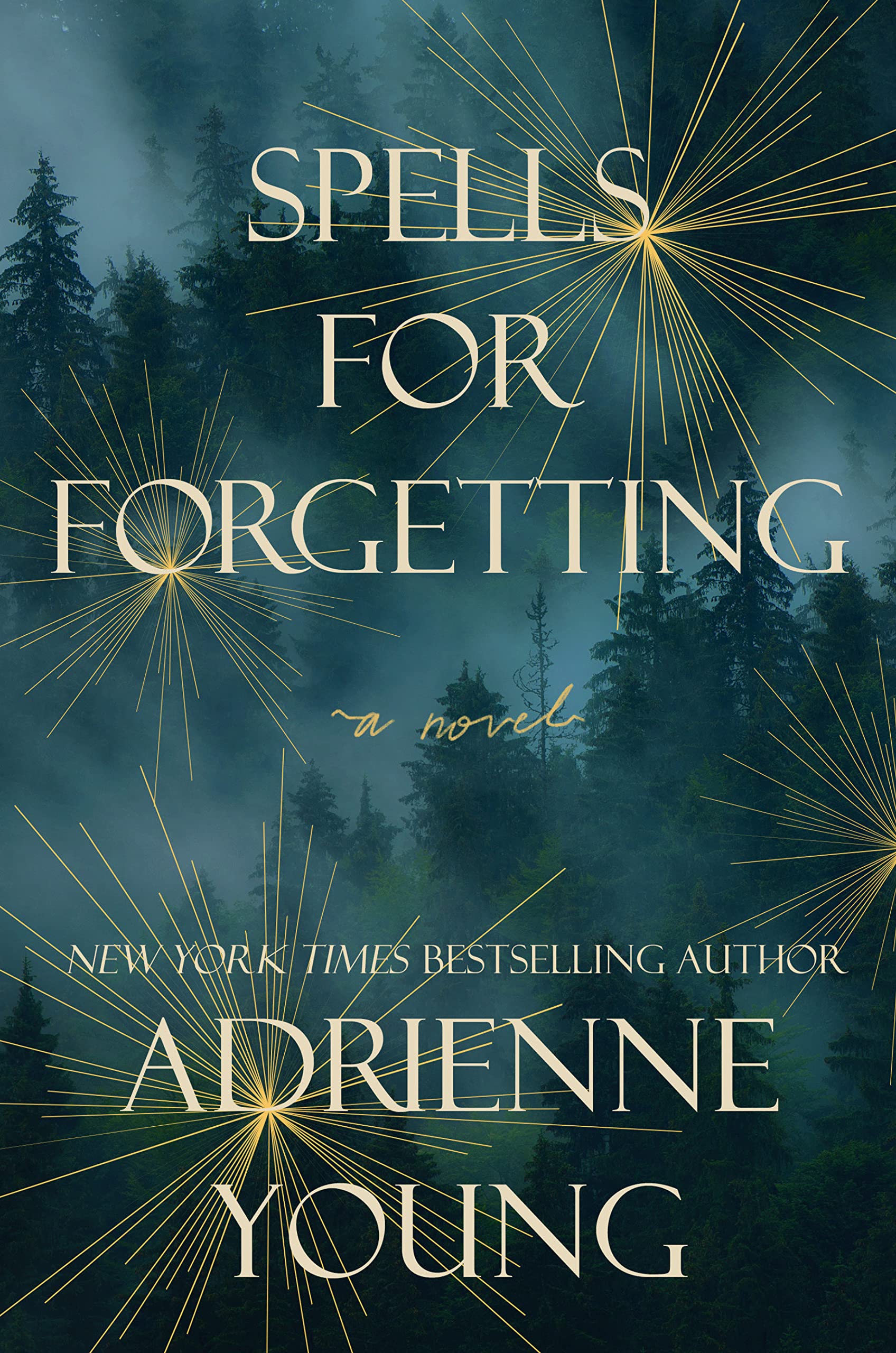
Spells for Forgetting by Adrienne Young
Genre: literary fiction/ magical realism
I read it as a(n): hb
Length: 350 pp
Her Grace’s rating: 4 stars
The residents of Saoirse Island, WA, are a different group of people. They are insular, some of them to the point of xenophobia, yet they are almost entirely dependent on the tourists who come to the island to pick apples from its gigantic orchard. Every person on the island is tied in one way or another to the orchard. So when the orchard burned nearly to the ground and a teen died, folks did what they felt was necessary – ostracized the boy who seemed responsible, forcing him and his mother out of the community, and then never spoke of it again. That is, until that boy, now a man, returns to the island to bury the ashes of his mother. August Salt’s return to the island stirs up memories and secrets most want to leave buried except for Emery Blackwood, the girl August left behind.
Saoirse is an island that wraps itself around the lives of its people, dictating their fates in ways that feel inescapable. It is ironic since Saoirse means freedom in Irish, but it’s anything but free for some of the islanders who are bound by the weight of history, tradition, and unsolved mysteries. For those who live there, leaving is never really an option. Even when they manage to get away, as one of the characters does, they are always drawn back, like a magnet pulling them to confront what has been left unresolved. It is not really an ominous sense, though, as the island protects many who need it, and wreaks havoc on others who deserve it. Also? I love it when there is an inanimate object that is a fully fledged character in its own right. Saoirse Island is certainly that.
In magical realism, the blending of the ordinary with the extraordinary is seamless, and Spells for Forgetting exemplifies that perfectly. Saoirse is full of magic, but it’s a kind of magic that feels like part of the natural world. It just exists, like the air or the tides, and nobody questions its existence. The magic is tied to the land itself, the orchard in particular. The island breathes life into this magic, and just as it holds the people in its grip, it also holds their power. This is why the women, especially the older women, are so central to the story. Their knowledge of magic isn’t learned in books or schools—it’s passed down through the generations, grandmother to granddaughter, like a family secret.
In folklore, older women tend to hold a special place when they aren’t relegated to the role of witch or wicked stepmother. They are the keepers of tradition, the wise ones who hold knowledge that others don’t understand or respect until it’s too late. But Spells for Forgetting subverts this role in an interesting way. Yes, the grandmothers are the teachers, the ones who understand the magic and the island, but they are also trapped by it. The island’s magic is as much a burden as it is a gift. It binds them to Saoirse just as much as it empowers them, and in this way, they are not the all-knowing, all-powerful figures of traditional folklore. Instead, they are characters shaped by the same constraints and fears as everyone else, forced to carry the weight of the island’s secrets and never able to escape its influence.
The role of women in the story, particularly in the context of magical realism, highlights the balance between empowerment and imprisonment. Their connection to the island, through magic, bloodlines, and tradition, gives them strength but also makes them part of Saoirse’s pull. While folklore often celebrates the wisdom of old women, Spells for Forgetting shows the price of that wisdom—knowledge of the island’s magic comes with a cost, and freedom, in the true sense of the word, is not part of the bargain.
In this way, the island itself becomes the ultimate character, shaping and controlling the lives of everyone who resides there. Its magic is subtle, but Saoirse is a constant reminder that what should be freedom is, in reality, a kind of beautiful, inescapable prison. The natural elements—earth, water, wind, and fire—aren’t just parts of the scenery but active forces that tie the people to the island, just as much as the magic and the folklore do.

 Her Grace's Library