
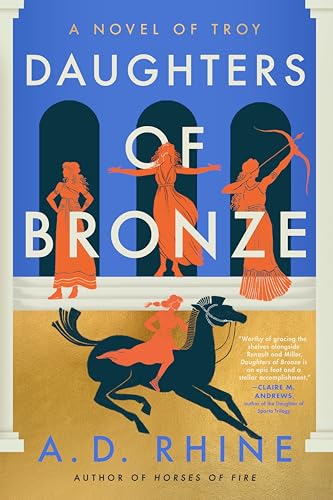
Daughters of Bronze by A.D. Rhine
Genre: historical fiction
I read it as a(n): digital ARC
Length: 512 pp
Her Grace’s rating: 5 stars
In Daughters of Bronze, A.D. Rhine (the penname of writing team Ashlee Cowles and Danielle Stinson) continues their feminist retelling of The Iliad, focusing on four women: Rhea, Andromache, Helen, and Cassandra. This second* novel brings their stories to the forefront, challenging the traditional male-dominated narrative.
Helen, often blamed for the Trojan War, is portrayed as a victim of Paris, who took her against her will. Rhine gives Helen a voice, exploring themes of female agency and resilience.
Andromache, usually seen as Hector’s wife and Astyanax’s mother, is depicted as a complex character, fiercely protecting her family and city. Her story delves into motherhood, duty, and honor.
Cassandra, the seer cursed to be ignored, is shown as a character of heartbreaking vision. Her voice is repeatedly silenced, often by other women, yet she remains devoted to the truth. Her story highlights the consequences of ignoring or marginalizing women.
Rhea, a refugee turned spy for Troy, plays a crucial role in the war. She and other brave women work to undermine the Greeks, risking their lives and highlighting the invisibility of women in historical narratives. If Helen, Andromache, and Cassandra are the warp of this story, Rhea is the weft that binds them together.
Rhine’s novel is rich with themes that resonate deeply in contemporary discourse. The author uses the framework of The Iliad to explore issues of gender, power, and agency. Each character’s story is a testament to the strength and resilience of women, challenging the patriarchal structures that seek to confine them. By giving voice to Rhea, Andromache, Helen, and Cassandra, Rhine underscores the importance of listening to and valuing women’s experiences and perspectives.
The novel also discusses the personal cost of war, not just for the men who fight, but for the women who endure its aftermath. The emotional and psychological toll of the Trojan War is vividly portrayed through the eyes of its female characters, offering a stark reminder of the often-overlooked victims of conflict.
Rhine’s prose is lyrical and evocative, capturing the grandeur of the ancient world while providing intimate glimpses into the lives of its characters. The alternating viewpoints of Rhea, Andromache, Helen, and Cassandra are seamlessly woven together, creating a tapestry of interconnected stories. This narrative structure not only highlights the individuality of each character but also emphasizes their collective experiences and struggles.
Daughters of Bronze is a powerful and thought-provoking retelling of The Iliad that places women at its heart. A.D. Rhine’s novel is a celebration of female strength, resilience, and agency, offering a fresh perspective on a timeless epic. By reimagining the stories of Rhea, Andromache, Helen, and Cassandra, Rhine provides readers with a deeper understanding of the human experience and the enduring impact of women’s voices in history. This novel is a must-read for fans of historical fiction, feminist literature, and anyone seeking a more inclusive and nuanced take on classic tales.
*I somehow missed that this was the second installment, but it didn’t matter. The narrative is tight, and anyone familiar with The Iliad can jump right in. However, some backstory from the first installment, Horses of Fire, might further enhance the reading experience.
A version of this review was originally published at the Historical Novel Society.
 Her Grace's Library