
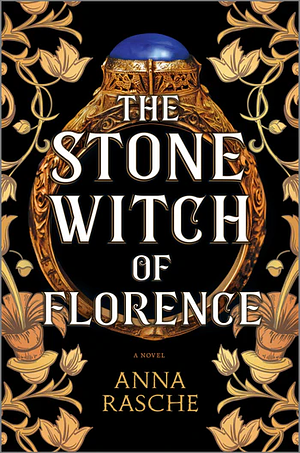
The Stone Witch of Florence by Anna Rasche
Genre: historical fiction
I read it as a(n): hardback
Length: 360 pp
Her Grace’s rating: 5 stars
2025 Reading Challenge tasks:
Her Grace’s: #14 – Flowers on the cover
TND: #15 – 350-499 pages; #20 – illustrations or images within
This magnificently written debut tells the story of Ginevra of Genoa, a woman with the ability to use gems and precious stones to work magic. This poses a problem for her, as Ginevra is a woman in mediaeval Italy in the midst of the Black Death. In her youth, she was already convicted of practicing witchcraft and was banished from her adopted city of Florence back to her birthplace of Genoa. Once the plague hits, Ginevra is called back to Florence by none other than the city’s bishop, who claims he wants to use her skills to help his inquisitor, Fra Michele di Lapo Arnolfi, catch a thief who is stealing all of Florence’s most beloved relics.
Anyone who’s known me for any length of time probably knows that I have a morbid fascination with the Black Death and with witches. Naturally, combining the two into one book is kryptonite for me and there was no way that I wouldn’t have read this book. It was a delightful bonus that it was imminently well researched, had interesting and flawed characters, and depicted many facets of mediaeval life and cities during the plague in sharp detail.
I really loved Ginevra. She was highly intelligent and compassionate, yet she was not a rich noblewoman. She had skills to heal, through the magic in the stones, but she was not educated. She didn’t have a perfect life, and didn’t end up with one handed to her, either. She worked for a living. She got in trouble and didn’t always get out of it unscathed. She tried her best and sometimes failed. She got mad at her friends, avoided things that were painful to her, and made mistakes. She was portrayed in a very real way that many people can identify with.
The other characters, from the Inquisitor Fra Michele to Lady Lucia to Piero and others, were all a great collection of social statuses, skills, ages, and personalities. Nobody was there just to use as a sidekick to Ginevra or to make her look good. Each character had a use within the plot. I was surprised that I liked Becchino and Giancarlo so well, but once you get to know them, I think you can’t help it unless you’re a heartless monster.
The only quibble I really have is that the mystery/detective story part started rather late in the novel, and it was pretty predictable. But everything else was excellent and so I just overlooked that. I can view it more like a straight historical fiction that happens to have a little mystery rather than a mediaeval mystery entirely.
 Her Grace's Library
One thought on “The Stone Witch: A Historical Fiction Mystery”