
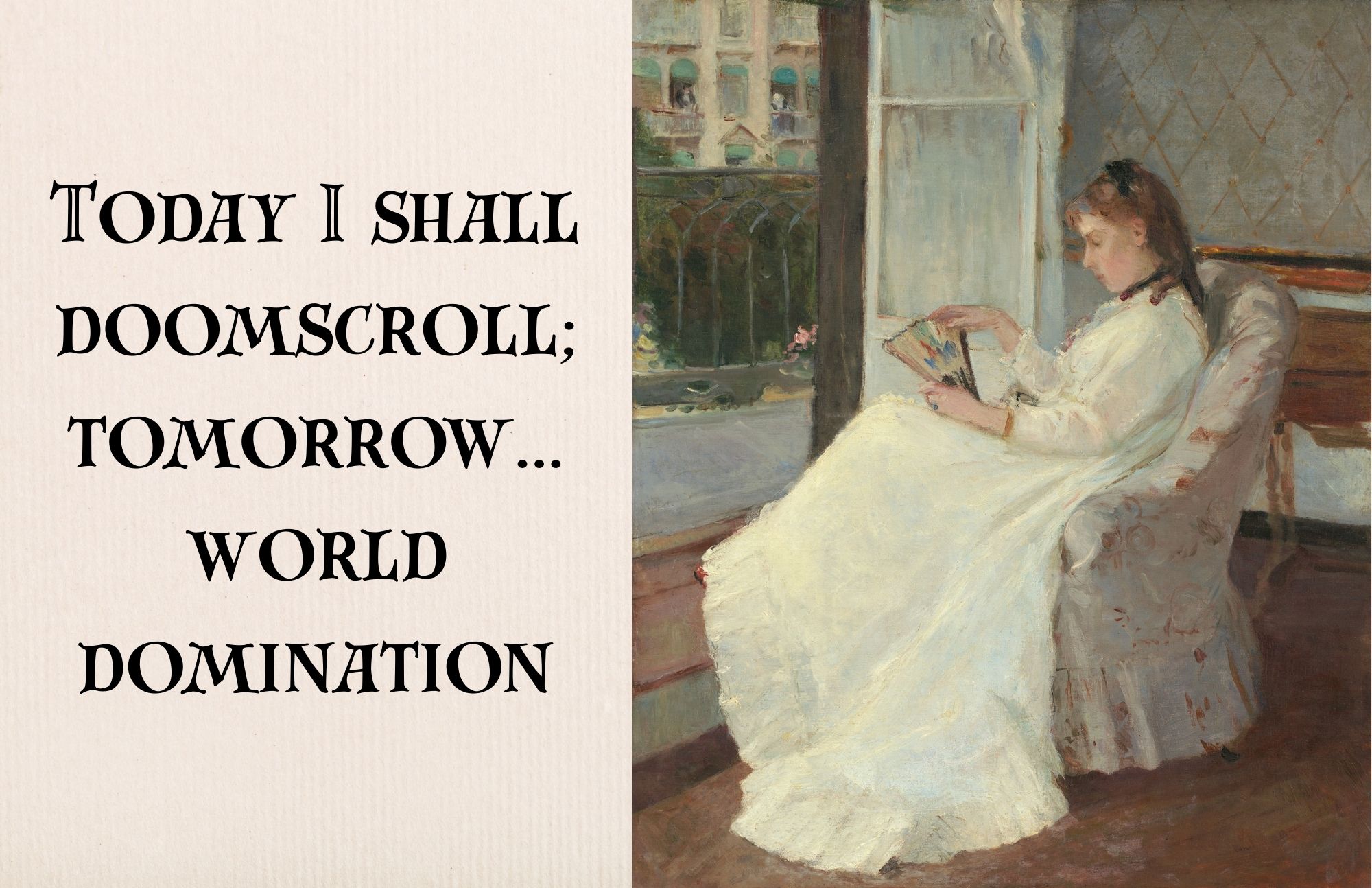
Doomscrolling. We’ve all done it. You pick up your phone to look up one small thing, open a browser, immediately forget what that thing was, yet somehow six hours later you’re still scrolling. Instagram. TikTok. A news organization’s social media page that is very carefully designed to make you angry, anxious, or afraid so you’ll keep clicking.
That’s not an accident. This is how those platforms make money, and they’re extremely good at it. They know how to grab your attention and keep you emotionally hooked, either by pushing content that makes you feel outraged and stressed out, or which gives you a big ol’ dopamine hit by confirming your biases.
A lot of people try to fight doomscrolling by carefully curating their social media feeds, like unfollowing certain accounts, avoiding news, or sticking only to content that feels light or harmless. I’ve done that, too. I don’t go on the hellsite known formerly known as Twitter at all anymore. My time on Bluesky is very limited. And my Instagram feed is aggressively curated. That’s where I go for posts about funny animals, art, travel, recipes, and crafting. No politics. No religion. Nothing designed to spike my blood pressure.
The problem is that even a carefully curated feed is still a feed. You’re still staring at a screen. You’re still scrolling. And you’re almost certainly spending more time doing it than you meant to.
What’s worked better for me is something the internet, ironically, has started calling analog doomscrolling.
There’s nothing especially doom-filled about it. It’s really just a mindset shift, a way of redirecting that urge to scroll back toward the kinds of things we used to do before the internet took over everything. Reading aimlessly. Flipping through books. Following curiosity without an algorithm deciding what comes next.
I suspect analog doomscrolling looks different for everyone. For me, what usually happens is that whenever I feel the urge to check social media, I pick up a book instead. Specifically, a book that’s meant to be dipped into, not read straight through. Now, I know that none of these categories of books below will be anything new to anyone. What I want to focus on is shifting the way we view them, making them alternatives to endless, mindless doomscrolling.
Sometimes what’s needed is literally a dictionary. I’ll flip through at random and look up words I don’t know, or words I half-remember. That probably sounds crazy boring, but it turns out dictionaries are actually kind of fascinating, especially when they’re not traditional ones.
One of my favorites is The Dictionary of Obscure Sorrows by John Koenig. It’s a collection of words that name feelings and experiences we don’t usually have language for. The very first entry is chrysalism, which describes the cozy, content feeling of being inside during a thunderstorm. What a great word to know! That one word is usually enough to send me flipping through the rest of the book.
Books That Are Perfect for Browsing
There are lots of other kinds of books that work beautifully for analog doomscrolling. Encyclopedias and reference books on specific or obscure topics are especially good for this. Of course you could use a real encyclopedia about a real topic, like an encyclopedia of Monet or horses or birds. I love things like A Dictionary of English Folklore, The Dictionary of Science Fiction Places and The Encyclopedia of Useless Information. These are not books you read cover to cover. You wander through them, follow whatever catches your attention, and stop whenever you feel like it. Just like scrolling through your phone but better!
Books of lists are another great option. Baby name books, lists of places everyone “should” visit, or collections like 14,000 Things to Be Happy About. They’re endlessly scrollable in the best way, and they often introduce ideas or experiences you might never have thought about otherwise.
Photography and art books are also excellent for this kind of reading. There are dictionaries and encyclopedias of art, books focused on specific artists, whole movements, or even entire centuries of artistic styles. I love my book of space photos taken from the Hubble telescope. Some people call these coffee table books, but they’re far more interesting than that label suggests, and they’re often surprisingly affordable, especially if you check that big sale section in Barnes and Noble or your local indie. Side note: My favorite online bookseller is Better World Books, not only for great deals on new and used books, but because of their philanthropy.
Poetry, Essays, and Reading in Small Bites
Poetry might be one of the best analog alternatives to doomscrolling ever. Last year, I made a habit of picking up a poetry book whenever I felt the urge to go online. Even reading just one poem at a time added up. That small habit carried me through four of Amanda Lovelace’s books, three by Rupi Kaur, all of Jared K. Anderson’s work, and so far, I’m about a quarter of The Complete Poems of Anne Sexton.
This year, I’m doing something similar with essays. I downloaded the complete nonfiction works of Edgar Allan Poe from Project Gutenberg. It’s… a whole lot, holy shit. He wrote far more nonfiction than poetry or fiction, and I expect it will take me years to get through all of it. But that’s kind of the point. Essay collections are perfect for slow, distracted reading. You can dip in, read a few pages, and stop without losing momentum.
I plan to do the same with Michel de Montaigne’s essays, which I’ve read here and there over the years but never all the way through.
Letters, Diaries, and Everyday Lives
Another form of analog doomscrolling I love is reading letters and diaries. In a way, they function a bit like social media. You get snapshots of people’s lives, thoughts, and worries, but without the performance or the algorithm.
Some of these collections are very well known, like the letters of Virginia Woolf, or the correspondence between Helene Hanff and Frank Doel, published as the beloved 84, Charing Cross Road. Jane Austen’s letters are endlessly engaging. Emerson’s hundreds of journals and essays, also available through Project Gutenberg as well as the University of Michigan Library, similarly work beautifully for this kind of reading.
There are also collections from people who were not famous writers at all. Nella Last’s diaries from the 1930s and 40s are a wonderful record of everyday life during wartime Britain. The Red Leather Diary, edited by Lily Koppel, preserves the journal of a teenage girl in 1930s New York that was discovered decades later in a dumpster. Even the journals of Kurt Cobain, though not written by someone who thought of himself as an author, offer an unfiltered look at a creative mind.
One of my personal favorites is The Paston Letters, a collection of correspondence from a medieval merchant family. Most surviving letters from the Middle Ages come from nobles and monarchs, so finding a record of a fairly ordinary (if well-off) family was a big deal. It’s fascinating to see what concerned people who were neither peasants nor aristocrats, just trying to live their lives.
Nature and Travel Writing as an Alternative Scroll
Nature writing is another genre that lends itself perfectly to analog doomscrolling. I love browsing nature journals, collections of short essays, and field guides, whether they’re scientific, personal, or somewhere in between.
Terry Tempest Williams is a longtime favorite of mine; I’ve loved everything she’s written. For something lighter and genuinely funny, Matt Kracht’s The Field Guide to Dumb Birds of North America and its sequel, The Field Guide to Dumb Birds of the Whole Stupid World are excellent. If you’re tempted to open TikTok looking for something amusing like an orange cat demonstrating the One Orange Braincell Theory, you might try flipping through one of Kracht’s books instead.
Everyone knows Bill Bryson is one of the most popular travel writers ever. His writing is hilarious and a fun way to spend time while not scrolling. I also really liked The Valleys of the Assassins and Other Persian Travels by Freya Stark. She was a lot braver than I would have been! To the River by Olivia Laing is, to me, a perfect blend of travel and nature writing. I haven’t read it yet, but A Simple Life: Living Off-Grid in a Wooden Cabin in France by Mary-Jane Houlton is calling to me since I, too, want to live in a cabin in France. But by cabin, I mean manor house and by off-grid, I mean with every amenity available to modern society. Some classics of travel writing to add to your list include Down and Out in Paris and London by George Orwell, The Innocents Abroad by Mark Twain, and Travels with a Donkey in the Cévennes by Robert Louis Stevenson.
There are also annual anthologies of nature, science, or travel writing aimed at general readers. These usually consist of short essays, are approachable without being patronizing or pedantic (in the case of science writing, that is), and reward even a few minutes of attention. You learn something, you stay off the internet, and you don’t feel worse afterward.
Slowing Down on Purpose
Analog doomscrolling isn’t about being productive or self-improving. It’s about giving your attention somewhere quieter and more humane. It’s about letting curiosity lead instead of outrage, and choosing engagement over consumption.
Below are just a few even more of my favorite books for analog doomscrolling. These, in addition to the ones I already mentioned above, are the ones I reach for when I’m actively trying to stay off social media and slow my brain down a bit.
If you have a book you love for this purpose, I’d genuinely love to hear about it. My TBR pile is always ready to grow!
A List of Slower, More Intentional Alternatives to Doomscrolling
- Absolutely anything written by Anthony Bourdain
- The Hour of Land and When Women Were Birds by Terry Tempest Williams
- The Boy, the mole, the fox, and the horse by Charlie Mackesy
- The Backyard Bird Chronicles by Amy Tan
- Meditations Marcus Aurelius
- The Book of Wild Flowers by Angie Lewin and Christopher Stocks
- Lost Crafts: Rediscovering Traditional Skills by Una McGovern
- Chasing the Ghost: My Search for All the Wild Flowers of Britain by Peter Marren
- Nightwalking: Four Journeys into Britain After Dark by John Lewis-Stempel
- Meditations for the Humanist by A.C. Grayling
- Astrophysics for People in a Hurry by Neil deGrasse Tyson
- Red Sky at Night: The Book of Lost Countryside Wisdom by Jane Struthers
- World of Wonders by Aimee Nezhukumatathil
- Brother Cadfael’s Herb Garden by Rob Talbot and Robin Whiteman
- Oxford Book of Essays, edited by John Gross
- Cambridge Companion to Travel Writing edited by Peter Hulme and Tim Youngs
- Mary Oliver, please
- The List of Shit I Explain to Men by Farida D.
- The Letters of Vincent Van Gogh
 Her Grace's Library