book review · books

Openly Straight

16100972Openly Straight by Bill Konigsburg

I read it as an: audiobook

Narrator: Pete Cross

Source: my own collection

Length: 09:01:00

Publisher: Dreamscape Media

Year: 2017

Rafe is openly gay and lives with the full support of his parents and community in Boulder, CO. The problem, as he sees it, is that everyone sees his label first. He’s always the gay boy, the gay soccer player, the gay writer, never just Rafe. He finally decides he is tired of it and wants a fresh start, which he will get by moving across the country to an all-boys boarding school near Boston. Where he tells no one he is gay. He doesn’t go back in the closet, he argues, he just doesn’t advertise that he’s gay. Naturally, things get out of hand. One little white lie about not being gay snowballs into Rafe actively asking his family and friends in CO to pretend he’s straight. And then there’s Ben, the quiet, kind soccer teammate who Rafe can’t help but fall in love with, and who may or may not be discovering things about his own sexuality that he doesn’t want to confront.

This was a very interesting and quick read. Well, I listened to it on Audible, but still. I am straight and have never had to deal with coming out, so I can only imagine what it’s like for people always to be labeled as “the gay ____” of the group. I would hate that, and I really hope I have never done that to anyone. If I have, I apologize. It was inadvertent. Which is the point. Labels suck, and they are often placed unconsciously. This realization leads to the two best parts of the book. The first was the discussion in Rafe’s literature class when everyone was talking about tolerance. It really isn’t a very positive word, which is something I have said forever. To tolerate something – she is tolerable, I suppose – implies that it is just on this side of not making you vomit. You don’t actively hate it. You allow its presence but don’t welcome it. I tolerate the cat but I can’t fucking wait not to have a cat. So why do we say that tolerance is good in society? Wouldn’t something like acceptance or inclusion be infinitely better? I wouldn’t want someone just to “tolerate” me. Rather than being tolerant, let’s work on being accepting. Even better, let’s be inclusive. Accepting is better than tolerant, but it is still not perfect, since to accept something has an implication of resignation or surrender about it, that you may not like something but you know you can’t change it so you’re going to just let it go. It is better than tolerating something, but I think embracing or including a person or an idea or whatever is perhaps the best way to go about it.

The second part that I really liked, which may be a spoiler, I don’t know, so consider yourselves warned, is when Rafe realized that the “cameras” he was always so worried about were rarely actually focused on him. He realized that he had been staring at a guy in his group but he was thinking about himself and how concerns and realized what people think didn’t have anything to do with his own sense of worth or his own masculinity or identity. And then he had that lightbulb moment and realized that when others stare at him, it isn’t necessarily that they are judging him, but that they are thinking about themselves and reflecting on something utterly unrelated to him. I think a lot of people need to figure this out, that they aren’t the center of everything and that people aren’t always concerned with them. I know teens tend to have those imaginary audiences a lot, but I think many people never outgrow that. As my grandmother says, “you don’t worry so much about what people think about you if you knew how seldom they do.” It’s true – I think people think about themselves far more than anyone else and, for the most part, don’t care what other people do so long as it doesn’t affect them too much.

I’m a bit off YA at the moment, but this was still a very good book even though it wasn’t one of my favorites. The whole thing was just an interesting discussion and I am glad I read it. The writing style was easy and enjoyable, and apparently the author is local for me. Maybe one of these days I’ll see him at a book thing or something, which would be cool.
book review · books

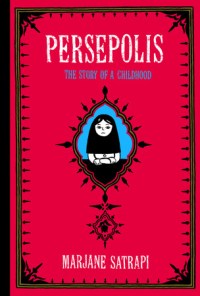
Persepolis

9516Persepolis by Marjane Satrapi

I read it as a: paperback

Source: public library

Length: 153 pp

Publisher: Pantheon

Year: 2004

Persepolis is the graphic novel memoir of Satrapi’s early life in Iran. It begins when she was about 10 but gets more in depth when she is around 12-14. She takes her readers through the political upheaval and conflicts that took the region from a progressive nation to the fundamentalist regime most of us think of now, all through the eyes of a young girl who lived through it all.

This was an incredible read. I know it’s been out for ages but I only now got around to reading it, and I’m so glad I did. On just a surface level, this is a terrific book to teach people about the basic history of the region and the more recent political issues that have resulted in the rise of such fundamentalism. On a deeper level, it shows readers what it was like to live through it, from being a child who doesn’t really understand what is happening, to a beloved family member being executed, to seeing your best friend’s body lying in rubble because her house got bombed. Yeah, that one hit me right in the feels. If anyone reads this and isn’t moved or doesn’t feel compassion, they’re just fundamentally broken. I think this should be required reading in all modern history classes for high school kids, to be honest.

The scene that did me in, and which makes this something that ought to be required reading for any high school kid, is summed up keenly by the below image. This was one time when graphic novels absolutely conveyed emotion better than prose. I needed no written words to know what she was feeling, because the image captured it. I was feeling it with her.

2e0ed962197ccf26412ed3cde20940d5
Image from Persepolis by Marjane Satrapi
bookish things · books

Read Harder 2019 is here!

ReadHarderChallenge2019_cover

Read Harder 2019 is here! Thanks to the awesome Rachel Manwill of Book Riot, we get another year of excellent reading tasks to challenge our reading comfort zones. 

I like to try to decide ahead of time what to read for the Read Harder tasks. I almost always change my mind as the year goes on, of course, but if I at least have a preliminary list going, it helps me stay on track to get the job done. This year, I am going to try hard to make every book on this list by an author of color or a woman. Preferably a woman of color. Below is my tentative list for the new 2019 Read Harder challenge. I can’t wait to dive in! I hope you’ll share what books you’re using for your own Read Harder tasks!

1. An epistolary novel or collection of letters:

  • Possession – AS Byatt.
  • The Diary of a Provincial Lady by EM Delafield, which looks like it can also double dip for a humor book.
  • I Capture the Castle – Dodie Smith
  • The Guernsey Literary and Potato Peel Pie Society – Mary Ann Shaffer and Annie Barrows

2. An alternate history novel:

  • The Big Lie – Julie Mayhew.
  • The Years of Rice and Salt – Kim Stanley Robinson. PLAAAAAAGUE! Yay!
  • River of Teeth – Sarah Gailey. Hungry, hungry hippos!

3. A book by a woman and/or AOC that won a literary award in 2018:

  • The Friend by Sigrid Nunez (National Book award). Might be able to double dip this for a book with an animal or inanimate object as the main character.
  • The Stone Sky – NK Jemisin (Hugo)
  • Milkman – Anna Burns (Man Booker)

4. A humor book:

  • possibly Mr. Fox by Helen Oyeyemi. I suppose it depends on your definition of humor.
  • The Diary of a Provincial Lady by EM Delafield.
  • Or the David Sedaris books that have been on my TBR forever.

5. A book by a journalist or about journalism:

  • Ten Days in a Mad-House – Nellie Bly.
  • The Sixth Extinction by Elizabeth Kolbert.
  • The Professor and the Madman – Simon Winchester.
  • Nine Parts of Desire: The Hidden World of Islamic Women – Geraldine Brooks.

6. A book by an AOC set in or about space:

  • probably something by Michio Kaku. Love that guy! He gets so excited about space!
  • ORRRrrr, I could finally get around to reading the Binti trilogy by Nnedi Okorafor!
  • Dawn (Lilith’s Brood series) – Octavia Butler.

7. An #ownvoices book set in Mexico or Central America:

  • Maybe Fruit of the Drunken Tree. Not sure if that is #ownvoices or not, though. Have to do more research on this one. 
  • Like Water for Chocolate – Laura Esquivel. Can also double dip for a book translated by a woman.
  • The Girl Who Could Silence the Wind – Meg Medina.

8. An #ownvoices book set in Oceania:

  • Whale Rider by Witi Ihimaera (Maori). I hear the book is way better than the movie was.
  • Where We Once Belonged by Sia Figiel (Fiji).

9. A book published prior to January 1, 2019, with fewer than 100 reviews on Goodreads:

  • The Scarlet Forest – AE Chandler.
  • Roses in the Tempest – Jeri Westerson.
  • The Long, Long Life of Trees – Fiona Stafford.
  • The World, The Flesh, and the Devil – Reay Tannahill.
  • On Night’s Shore – Randall Silvis

10. A translated book written by and/or translated by a woman:

  • The Little Paris Bookshop by Nina George.
  • The Vegetarian or Human Acts – Han Kang.
  • My Brilliant Friend – Elena Ferrante.

11. A book of manga:

  • I….yeah, I got nothing. I have no earthly idea. This will require a lot of research on my part because I really don’t have much knowledge of manga. Comics of any kind are generally not my jam. I’ll honestly have to see what the hivemind on the Read Harder Goodreads community recommends.

12. A book in which an animal or inanimate object is a point-of-view character:

  • Black Beauty – Anna Sewell. I can read this with my daughter!
  • The Bees by Laline Paull.
  • Tomorrow: A Novel by Damien Dibbins.
  • KA: Dar Oakley in the Ruin of Ymr by John Crowley.

13. A book by or about someone that identifies as neurodiverse:

  • The Kiss Quotient by Helen Hoang (Asperger’s, #ownvoices).
  • A Girl Like Her – Talia Hibbert (#ownvoices).
  • Made You Up by Francesca Zappia.
  • The Curious Incident of the Dog in the Night-Time by Mark Haddon.

14. A cozy mystery:

  • Murder in G Major – Alexia Gordon.
  • The Tale of Hill-Top Farm – Susan Wittig Albert.
  • Homicide in Hardcover – Kate Carlisle.

15. A book of mythology or folklore:

  • Deathless – Catherynne Valente.
  • Spinning Straw into Gold: What Fairy Tales Reveal About the Transformations in a Woman’s Life – Joan Gould.
  • The Myth of Morgan La Fay – Kristina Perez.
  • OR, finally get around to reading Norse Myths or reread American Gods – Neil Gaiman.

16. An historical romance by an AOC:

  • An Extraordinary Union – Alyssa Cole.
  • Freedom’s Embrace – Kianna Alexander.
  • I think an argument can be made that Americanah by Chimamanda Ngozi Adichie is a romance.

17. A business book:  

  • The Four-Hour Work Week – Tim Ferriss.
  • You Are A Badass : How to Stop Doubting Your Greatness and Start Living an Awesome Life by Jen Sincero.

18. A novel by a trans or nonbinary author:

  • All the Birds in the Sky – Charlie Jane Anders.
  • Small Beauty – Jia Qing Wilson-Yang.
  • Peter Darling – Austin Chant.
  • Lizard Radio – Pat Schmatz.

19. A book of nonviolent true crime:

  • The Dinosaur Artist by Paige Williams.
  • Mrs Sherlock Holmes by Brad Rica.
  • Can You Ever Forgive Me?: Memoirs of a Literary Forger – Lee Israel.

20. A book written in prison:

  • Le Morte d’Arthur – Sir Thomas Malory.
  • The Consolation of Philosophy – Boethius.
  • Civil Disobedience – Thomas Paine.

21. A comic by an LGBTQIA creator:

  • Fun Home – Alison Bechdel

22. A children’s or middle grade book (not YA) that has won a diversity award since 2009:

  • One Crazy Summer – Rita Williams-Garcia.
  • #NotYourPrincess: Voices of Native American Women – ed. Lisa Charleyboy

23. A self-published book:

  • The Wake – Paul Kingsnorth (Not technically self pubbed, but nontraditional, because he wrote in a made up language and traditional publishers didn’t want him, so a crowdfunding publisher by the name of Unbound stepped in. Just like with a Kickstarter, Unbound launched The Wake as a project that allowed hopeful readers to pledge their support for Kingsnorth’s work. [https://electricliterature.com/11-books-that-prove-theres-nothing-wrong-with-self-publishing-b507ef16d4e5].
  • Still Alice – Lisa Genova.
  • The Martian – Andy Weir (a reread for me).
  • Hand of Fire or Priestess of Ishana – Judith Starkston (both would be rereads for me).

24. A collection of poetry published since 2014:

  • the sun and her flowers – Rupi Kaur.
  • The Witch Doesn’t Burn in This One – Amanda Lovelace
book review · books

Born a Crime

33632445Born a Crime by Trevor Noah

I read it as an: audiobook

Narrator: Trevor Noah

Source: my own collection

Length: 08:44:00

Publisher: Audible Audio

Year: 2016

Trevor Noah is known to most American audiences as the newest host and replacement for Jon Stewart on late night comedy. But this book chronicles his childhood in South Africa in the last few years of apartheid, through the years immediately after with their unrest and violence, and his own experiences with abuse. And yet, through it all, he kept his innate goodness and kind nature, despite seeing some horrific things. I don’t know that I could have come through as happily as he did.

I’m not generally a fan of memoirs, though I find that I’ve been reading more lately. So I don’t know, maybe I’m more of a fan of them than I thought. In any case, Noah managed to discuss some really heavy topics like apartheid, racism, domestic violence, and crushing poverty with genuine humor. I never thought I would have laughed out loud over eating “dog bones” because you’re too poor to buy better food, but goddamn the way he told it was hilarious. Maybe the best way to effect change is to make people laugh about a thing. I don’t know. But by turning it into something laughable, it kind of felt like it was a little disrespectful. But I am not the one who lived through it, so I also feel like I don’t really get a say in it. In any case, I enjoyed this book and I learned a lot about many things. I definitely recommend this whether you enjoy Trevor Noah as a comedian or not.

book review · books · historical fiction

Priestess of Ishana

Priestess of Ishana by Judith Starkston

I read it as an: ARC, finished as a paperback

Source: from the author, and I bought a copy for my own collection

Length: 453 pp

Publisher: Bronze Age Books

Year: 2018

Tesha is the 15 year old high priestess of the goddess Ishana, a deity of war and love. Her duties and devotion to the goddess are strong and she carries out her role faithfully at the temple, believing she knows her life’s role. Until one day, two shepherds discover the charred remains of a man’s body in a cave, who had been killed by sorcery, a crime punishable by death. When the Great King’s younger brother, Hattu, arrives to Tesha’s city to deliver a great treasure to the temple as a sign of his devotion to Ishana, he is arrested for the murder of the man in the cave. Tesha and her blind sister, Daniti, are convinced that Hattu is innocent, but their father, Pentip, the Grand Votary and High Priest, believes otherwise. Acting against her father, Tesha meticulously searches for the truth that will set Hattu, with whom she shares an inexplicable bond and visions, free of his prison and save him from execution at his own brother’s command.

You guys. YOU GUYS! This novel is Hittite historical fantasy! Let me say that again:

HITTITE. HISTORICAL. FANTASY!

This is exactly the historical fantasy novel you were looking for to round out your 2018 reading! The world building is intricate and painstakingly drawn, which is always pleasing. The pacing has a nice blend of faster action sequences combined with complex (but not convoluted) politics and religious rites. Each character has depth and personality, some of whom you love to hate. I thought Tesha in particular was a complex person, a woman in her own right who had some power as a respected priestess, but who was also a woman in a very different and much earlier society who adhered to some patriarchal rules. It was fascinating to see her carry out her duties as well as her investigation within the scope of the limits her society imposed upon her.

The excellent author’s note at the end gives further insight into both the creation of the novel itself as well as the Hittites. I think a lot of people don’t know about the Hittites at all, or else only what is mentioned about them in the Bible. But their civilization was enormous and they had a ton of influence on the ancient world. They were literally lost to the sands of time and were only relatively recently rediscovered. There is still a lot we can learn about them, and frankly, learning history by way of well written fantasy novels isn’t a bad way to go. I think Judith Starkston has struck on a totally unique niche within the historical fantasy genre, and I can’t wait to see what she comes up with in her next installation in the series!

**A slightly different, probably longer and better version of this review will also be posted at the very awesome book review site Discovering Diamonds. You should go check them out.

book review · books

Underground Airlines

35051774Underground Airlines by Ben Winters

I read it as an: audiobook

Narrator: William DeMerritt

Source: my own collection

Length: 9:28:00

Publisher: Hatchette Audio

Year: 2016

The premise of this alt-history novel is WHAT IF America had never had a Civil War? What if slavery was enshrined in the Constitution? There are four states – the Hard Four – which still have slavery, a highly regulated system with a lot of checks and balances. People like to think that it is not the slavery of the 1800s or even “fifty years ago,” but those people are incorrect. And it’s fucking slavery. Enter Victor, a young man who had once been a slave himself and managed to escape. He maintains his freedom by working for a shady government official as a runaway slave catcher, a job he is very good at but which gives him a great deal of conflict. His newest case is to track down a runaway named Jackdaw who is thought to be headed to Indianapolis. Along the way, Victor encounters shades of his past that he had tried to escape or push down, and learns that even the shady people he reluctantly works for are not at all what they appear to be.

This was a horrifying book, mostly because I don’t think something like this is really that far from truth. I don’t think it’s much of a stretch to envision an America that still has slavery, judging from the revolting news we see everyday. There is rampant racism and neonazis and white supremacists and other disgusting groups who would probably jump at a chance to live in a world Winters portrays here. The poverty wages that many, many people earn are hardly better than slavery in this country, and in many other countries, there are sweathouse jobs that I would argue do constitute slavery conditions. So yeah, this book was terrifying. It is too easy to see this as reality. Let’s keep books like this fiction.

For as horrifying as I found this book to be, I was actually kind of bored with it. I thought the pacing was uneven and the plot a bit disjointed. It made it hard for me to follow at times. The characters as well felt rather flat and were hard to connect with. The narrator did a great job, though, using a variety of voices to differentiate everyone, which made it more appealing to listen to. I would still recommend this book, but perhaps not as an audiobook. I think I might have been more interested if I had eyeball read it instead. Maybe. I still think the characters would have felt one-dimensional and the pacing would still be uneven.

bookish things · books

Author Interview: Sherry Thomas

I am writing an article for the Historical Novel Society about Sherry Thomas and her awesome new book in the Lady Sherlock series. However, I thought it would be fun to post the raw interview Q&A here since my finished article for HNS will be quite different. 🙂 Thank you very much to Ms. Thomas for taking the time to respond to my questions! I always love seeing author interviews and Q&A, so I’m delighted that I get to share this with my own readers as well.

Sherry_Thomas_Author_Photo_72dpi
Sherry Thomas, courtesy of sherrythomas.com

Her Grace’s Library: The interplay of gender identity and expected Victorian gender roles is so interesting in your novels. There’s just so much to unpack with gender identity in the Lady Sherlock series, especially in The Hollow of Fear. I’m sure you’ve been asked this a million times before, but what made you want to write a Lady Sherlock series to begin with?

Sherry Thomas: I am a big fan of Laurie R. King’s Mary Russell and Sherlock Holmes series, in which Holmes meets a female partner every bit as formidable as himself. That’s the first story in the Sherlock Holmes pastiche that made me want to write an adaptation of my own, but I didn’t have any concrete idea what I want to write about so I didn’t do anything.

Then came the BBC Sherlock, which was so dynamic and stylish, and which did such a fantastic job updating the character to the 21st century. That’s when I said to myself, hmm, if BBC Sherlock already made Sherlock Holmes thoroughly modern, and Elementary on CBS made Watson a woman, then the only thing left to do was to make Sherlock Holmes a woman.

So that’s what I did.

HGL: Can you comment more about Charlotte’s use of food as her apparent drug of choice in lieu of Sherlock’s cocaine? I love her references to her “maximum tolerable chins.”

ST: Arthur Conan Doyle’s Sherlock Holmes is a casual user, taking to cocaine when he doesn’t have any stimulating cases. And he turns down plenty of cases if he finds them of insufficient interest. That’s because, as it is often deduced, Sherlock Holmes comes from either minor aristocracy or upper gentry, and has an independent income and doesn’t rely on his work as a consulting detective to pay the bills.

Charlotte Holmes is in a different situation. She does depend on her work to pay the bills and doesn’t have the luxury of whiling away her hours on drugs. So for solace she turns to food, especially sweet thing. But of course she wants to still fit into her clothes, and “maximum tolerable chins” becomes her gauge for judging whether she can indulge in an extra slice of cake or must regretfully refrain.

HGL: What is the hardest part about writing a character who seems to experience the world so differently than the rest of us? Is Charlotte supposed to be on the autism spectrum?

ST: Charlotte would probably be considered on the very high-functioning end of the autism spectrum, if she lived in this day and age. And it isn’t hard at all, as strange as it seems, to write how she experiences the world. Very freeing, in fact, because she sees the world as it truly is, with all the niceties stripped away.

HGL: What was your favorite scene that got edited out of The Hollow of Fear?

ST: The first ten thousand words I wrote for The Hollow of Fear were thrown out entirely, because they were about séances in Scotland, whereas the final version of the story concerns itself with neither séances nor Scotland.

But I didn’t have any favorite scenes from that, because it was just an exploratory draft to show me what not to do. Very seldom do I have good scenes that get cut because I typically underwrite in my preliminary drafts—usually due to time pressure—and in later drafts I need to fill in the scenes that should be there or should be written to greater depth.

It’s not a bad way to write. It ensures that every scene that is in the book is there only by necessity.

HGL: I read on your website that English is your second language. That’s amazing to me; I don’t think I could ever write very well in another language, let alone a well-crafted novel! Can you talk about how writing in a language that is not your native language has impacted your writing? What is the hardest part?

ST: English might be my second language, but by now it’s my primary language. (I arrived in the U.S. when I was 13, and that was 30 years ago.)

I don’t know that I ever found the language part of writing difficult. Storytelling is hard. Good ideas do not drop into my lap very often. But because I think in English, expressing ideas in English has become as natural as breathing.

I do sometimes wonder whether the fact I write largely historical fiction is because I learned English reading a lot of historical romances and even at age 18 possessed the vocabulary of a Victorian old lady.

Certain tenses in the English language elude my grasp. My critique partner is always correcting my usage of would/will, because I don’t do the subjunctive tense properly. Then again, I don’t think most of the reading population know or care about the subjunctive to the extent she does!

HGL: Who are some of your favorite authors/ literary influences?

ST: I read a great deal of martial arts epics when I was growing up in China. When I arrived in the states I read a ton of romance and science fiction. Later on I glommed onto fantasy and mysteries. So you can definitely say that I am a reader—and a lover—of genre fiction.

HGL: What are you reading right now?

ST: I just got done with The Game of Kings by Dorothy Dunnett last night. And am also reading Strange the Dreamer by Laini Taylor.

HGL: What’s on your playlist right now?

ST: I just finished a YA adaptation of The Ballad of Mulan (nothing to do with Disney). And for some reason, when I write a martial arts story with romantic elements, I always play Josh Groban’s My Confession on a loop.

HGL: What is the best thing you have learned about writing?

ST: That it’s like working with clay. It’s malleable. And readers can’t tell by the final product how ugly it was in the interim.

HGL: That last line of The Hollow of Fear…gah! The wait for the next book might kill me. Can I ask if there is a fourth Lady Sherlock book in the works? Will there be finally happy things in store for Livia?And Charlotte and Ingram? These poor, tormented characters! Or is it poor, tormented readers? We love it, though…

ST: Yes, I have already signed a contract for books 4&5 in the series and am busy working on book 4. Dear Livia will definitely have interesting things in store for her. Lord Ingram will be there too. And I don’t know yet what exactly will happen in this book, but I certainly hope characters will change and grow in the course of an exciting venture, which is the goal I have for every book I write.

book review · books · historical fiction

Doc: A Novel

8911226Doc: A Novel by Mary Doria Russell

I read it as an: audiobook

Narrator: Mark Bramhall

Source: library

Length: 16:38:00

Publisher: Random House Audio

Year: 2011

This historical fiction novel focuses on the life of John Henry “Doc” Holliday from his early years, before he was famous for his role in the gunfight at the OK Corral. He was born to be a Southern gentleman, but he moved to Texas in hopes that the hot, dry air would ease the tuberculosis that was already ravaging his lungs. When the job market proved to be less than he had hoped, he started professionally playing poker. At the urging of Kate Harony, the Classically trained Hungarian whore he lives with, Doc and Kate move to Dodge City, KS and start fresh. And Doc becomes friends with a young man named Morgan Earp and his brothers Wyatt and James and the rest, as they say, is history. Or is it?

This book! I read this book just to check off the “Read a Western” box on the Read Harder challenge, and it was the only one immediately available that sounded remotely interesting. I’m not a fan of westerns. I did not expect to enjoy it all that much, it was just something to get through. I had no idea that I would discover the book that is probably my favorite book of 2019! This novel was just absolutely delightful. Doc Holliday was not the man he is portrayed by history, at least not according to Mary Doria Russell. He was a quiet, mild mannered, Southern gentleman who loved playing the piano, reading Classical literature, and speaking Latin. He was born with a cleft palate, and he was one of the first babies the have his fixed. He was fiercely loyal and did not seek out fame or notoriety. This Doc Holliday was a person I genuinely cared about.

The narrator, Mark Bramhall, delivered a superb performance. He shifts seamlessly from Doc’s slow Georgia drawl to the sharper twang of the Texas cowboys to the cheerful Irish brogue of the local town drunk. He gives dry wit a biting edge that made me laugh out loud more than once, and imbued his voice with such sadness or nostalgia at times that only the coldest person would remain untouched. I hope he narrates other books, because I definitely want to hear his voice again.

There was almost nothing I didn’t love about this book. Some of my favorite scenes were when Doc fixed Wyatt’s teeth and gave him dentures to replace his missing teeth. Wyatt was so happy to see his own smile, it was heartbreaking. He had to practice saying his S’s and TH’s and he was determined to get it right, which was also somehow endearing. Doc was proud of his work and delighted to be able to give a person back some of their self confidence and health, which he vigorously defended later to Kate when she was nagging him about how dentistry doesn’t pay any money. I also loved the scene near the end when Doc was playing The Emperor piano concerto. That whole scene made my face leak on my drive to work. I want to buy this for my own collection. I would listen to it again, or eyeball read it. It was enthralling.

book review · books

Medusa the Mean

12052534Medusa the Mean (GoddessGirls #8) by Joan Holub

I read it as a: paperback

Source: our own collection

Length: 240 pp

Publisher: Aladdin

Year: 2012

In Medusa the Mean, there are only two things Medusa really wants – to be immortal like her sisters and the popular girls and for Poseidon to like her. To achieve these dreams, Medusa decides she needs The Immortalizer, a magical necklace she saw advertised in a magazine. The problem is that it doesn’t seem to work, of course. In the course of trying to become immortal, Medusa is also trying to find the perfect wedding gift for Zeus and Hera’s upcoming wedding, try to figure out how to bond with the kindergarten buddy she’d been saddled with, and make sense of the weird visit to the Grey Ladies she’d been forced to attend. And, since this is for pre-teens, there is plenty of angst and wondering about why she kinda likes Dionysus when her crush is on Poseidon.

I actually liked this one quite a lot. I’ve enjoyed the others well enough, though I think most are too involved with crushes and getting crushes and who likes whom, and hetero-normative reinforcement. But this one, though it had its share of crushes, focused a lot more on things like why Medusa was so mean. She was one of a set of triplets, but her parents treated her like she didn’t exist. Her sisters were born immortal but not Medusa. She was bullied in her hometown and had no friends. She is excluded from everything and to protect herself from being hurt, she starts shutting people out and being mean to keep them away. Which is completely normal, and really fucking sad. This is a great example of why you treat people nicely and try not to be a dick, because it can have real repercussions for people when you aren’t.

When we were reading this together, there were many times when my daughter said she felt really bad for Medusa. So did I. It opened up a dialogue of why kindness matters, and why maybe some people behave like they do. I’ve always told her that people who are mean didn’t get enough hugs when they were children. This is why we read literature, because it teaches and reinforces empathy. I don’t like all of the GoddessGirl books very much, but this one was definitely a win.

book review · books · sci-fi · Star Trek

Star Trek: Prey: The Hall of Heroes

29430792Star Trek: Prey: The Hall of Heroes by John Jackson Miller

I read it as a: paperback

Source: my own collection

Length: 387 pp

Publisher: Pocket Books

Year: 2016

The final installment in Miller’s Klingon trilogy was a great read. In this, Korgh’s plotting of nearly 100 years is unraveling around him and he scrambles to keep his plans intact. Starfleet is working closely with an old enemy, Ardra, to find the truthweavers, the illusionists who are responsible for misleading the Unsung as well as a variety of other races. They have also brought the Kinshaya to the brink of war with the Klingon Empire because of Shift, an Orion woman now working with the Breen. Enterprise, Titan, and Aventine and their crews are all working to track the Unsung as well as Korgh’s Phantom Wing, of course not knowing about Korgh’s involvement in any of it. Worf and Kahless are working with the Unsung to help them understand the Klingon way, an act that ultimately brings about redemption in ways none of them anticipate.

This was a fantastic finale to this trilogy. There was a ton of action – space battles! Chases! Hand to hand combat! There was intrigue – Korgh did it! No, Shift did it! Wait, is that Ardra? Maybe she did it! The plot throughout the trilogy was pleasingly complex but not overly convoluted, which I think is a difficult balance to strike. Miller managed it beautifully.

I really loved the theme of honor in this one. It was woven throughout the trilogy, of course, but it came through strongest in this final novel. Is honor something you can really take away from a person? Can you earn it? If someone says you are without honor, can you still act honorably? Is honor something that is innate, regardless of dogma or inculturation? How do you learn about honor if no one is there who can teach you? These issues and more are up to Worf and Kahless to decide as they try to guide the Unsung on a new path to redeem themselves for their past acts.

I had kind of hoped that Sarken would stay with Worf, but the resolution to that was perfect and appropriate. And the last line of the book was killer! I loved it.

On a side note, I eyeball read this but I might pick up the audiobook versions just to show S&S/Pocket Books that there IS a market for full-length Star Trek audiobooks. I’m glad they are starting to get their act together and put out the newer ones but I really wish they’d go back and do some of the older ones in an unabridged edition. If the need a narrator, I volunteer as tribute!