Greetings, friends! This year I thought I might try something new – creating my own challenge for 2024! I always participate in annual reading challenges. My favorites are the ones by The Nerd Daily, Book Riot, and PopSugar. It looks like The Nerd Daily hasn’t added their reading challenge for 2024 yet, so keep an eye on that site if you look forward to that particular one as much as I do.
For this year, as I did last year in the challenges I participated in, I am going to try to complete this by shopping my own TBR first. I have an unimaginably huge TBR – seriously, I think it’s about 500 books. So I am trying to pare that down and also still have some fun with reading challenges. I try, too, to make it more challenging by reading only women, BIPOC, or LGBTQ+ authors. It’ll be interesting to see if I manage to complete my own challenge. I haven’t completed a challenge in a couple years, though I did hit my Goodreads goal to read at least 50 books.
If anyone decides to try this reading challenge out, it would be awesome if you left a comment below or tagged me in one of the social media places! 💖
Also, I’ve been super into junk journaling lately, so I designed the PDF of the challenge prompts to look similar to a junk journal page. Thank you, Canva, for making design easy!
Here is a link to a basic Word doc with the prompts as well, if anyone wants that.
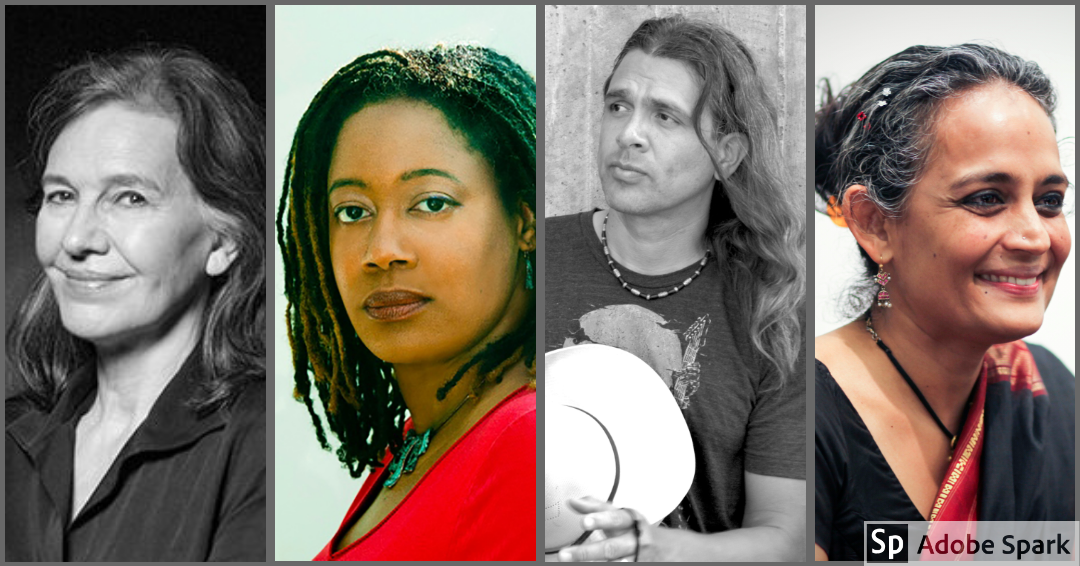
Louise Erdrich, NK Jemisin, Stephen Graham Jones, and Arundhati Roy. Images retrieved from Creative Commons.
I’m sure that everyone has heard the term “canceling” or “cancel culture” by now. This is the practice by which a person has their career damaged or even ended by others refusing to extend their support or patronage to them any longer. We’ve seen examples of this with Senator Al Franken, comedian Louis CK, actor Kevin Spacey, and singer Kanye West. Each of these people have, at one point or another, committed acts or made statements which are largely unacceptable to society. Certainly, there are some things that should not be forgiven or overlooked, and that absolutely must be called out. Sexual assault comes to mind. There can be no instance in which sexual assault is ever acceptable or tolerable. Other examples may be less clear-cut but still require an outcry. The world of publishing is no exception to this and has a long history of troublesome practices, just like many other industries.
Cancel culture actually has a longer lifespan than many people realize. It has its origins in the Civil Rights Movement and is related to boycotting, only instead of boycotting a business, one boycotts, or “cancels,” a person. This practice stems from a sense of powerlessness and inability to effect positive change, according to Anne Charity Hudley, the chair of linguistics of African America at UC Santa Barbara. She explains that if a person doesn’t have the ability to take action through political means, they can refuse to participate. She goes on to say that canceling someone is “a collective way of saying, ‘We elevated your social status, your economic prowess, [and] we’re not going to pay attention to you. … I may have no power but the power I have is to [ignore] you’” (Romano, 2019, para. 24). This approach seems to be effective only some of the time, however. When revelations about Michael Jackson and R. Kelly came to light, the instances of people streaming their music actually increased rather than the other way around. Roseanne Barr, who was fired from her show The Connors for making racist comments on Twitter, still has a career. So does Johnny Depp, although he was accused of domestic abuse.
Being able to refuse participation in the works of a person who is offensive to us is a powerful tool and can hopefully be used to help effect change. It highlights bad behavior and reminds us that, yes, people might like the music of R. Kelly (or Michael Jackson, Kanye, John Lennon, Frank Sinatra, apparently ad infinitum), but surely there must be others whose music (or acting, art, writing, etc.) is just as good with the added benefit of them not being a terrible person. The issue is complex and fraught with emotion across the spectrum; I definitely don’t know the right way to approach the topic. For me personally, it seems to make a difference whether the person is still alive or not. Living people have the opportunity to correct their ways and make amends, however unlikely that may be; the departed can never learn from their actions or remediate. Regardless, depending on what the issue is, I admit that I can have a hard time separating the artist from their art.
How does cancel culture impact publishing? As with every other area of entertainment, publishing is not exempt from cancel culture in all its varieties. Very recently, beloved author JK Rowling made some comments on Twitter which appeared to be trans-phobic. This sparked outrage and even caused some to suggest insanely that Rowling isn’t the author of the Harry Potter series, removing her from the picture entirely. This seems, to me, to be overkill. Of course, Rowling wrote the Harry Potter books; her posting something unpalatable doesn’t magically rescind her authorship and bestow it upon another. What is more important is how others will react going forward. As Charity Hudley might suggest, readers do not have to participate in Rowling’s works, and they can choose not to buy her new books or even to refuse to read those that are already published. Since making the offending statements, Rowling has not returned to Twitter, proving, perhaps, that a healthy dose of embarrassment might be an effective way to force a person to reflect on their actions. For other authors, I think it is important to consider when they were writing. Mark Twain, for instance, would no doubt be considered a horrific and unrepentant racist by today’s standards; by the standards of his own time, however, he was quite progressive. Yet many people try to cancel him and his books for their use of racial slurs. Since Twain has been dead for over a century, there is no possible chance for him to learn new ways or correct past behavior. We have to accept that his language was common for the period in which he was writing, learn from it, and move on. Same for Marion Zimmer Bradley, author of one of my all-time favorite books, The Mists of Avalon. Bradley was a celebrated fantasy author – and horrific child abuser. She died in 1999, and her daughter came forward in 2014 with allegations of molestation and abuse. Even though Bradley was long since dead when this news came to light, I confess that I have been having a very hard time separating the writer from her writing. Since she is deceased, I am not sure I should because she isn’t here to make amends; it is still a stain on one of my favorite literary experiences, and I have so far been unable to read The Mists of Avalon again since the abuse came to light. Author G. Willow Wilson, talking specifically of Bradley, tweeted that she can forgive artists for “falling short of their ideals, but not for CHILD ABUSE. Will never recommend any of her work again” (as cited in Flood, 2014, para. 8). I understand the sentiment and, for the most part, I tend to share it.
All this was a long-winded way to say that I have been thinking of my favorite authors and if I should still like their work and recommend it to others based on their past actions. Mark Twain, yes, I will always recommend him. He lived and wrote in a very different time and canceling him would be a detriment to literary and historical study. I also truly think that not engaging with problematic texts is often the wrong approach and doesn’t teach readers where the problems lie or how to address them in the future. But more modern writers? Do we cancel them, read and recommend them but with caveats, or shrug and figure one of the literary critics is bound to take them to task? You tell me. If your favorite author turned out to be a child abuser, rapist, domestic abuser, or something else, would you still read and recommend their work?
Below are some suggestions for read-alikes for favorite authors who turned out to be vile humans.
Ender’s Game by Orson Scott Card (raging homophobe), you might prefer Old Man’s War, the titular first book of the series by John Scalzi, Ready Player One by Ernest Cline, the Vatta’s War series by Elizabeth Moon, The Calculating Stars by Mary Robinette Kowal, or The Martian by Andy Weir.
The Thomas Pitt series or the William Monk series by Anne Perry (literally a murderer), you might prefer the Crispin Guest series by Jeri Westerson or the Lady of Ashes series by Christine Trent.
Heart of Darkness by Joseph Conrad (racist, imperialist), you might prefer The Belles by Dhonielle Clayton, the Broken Earth series by NK Jemisin, The Salt Roads by Nalo Hopkinson, or Things Fall Apart by Chinua Achebe.


 Her Grace's Library