book review · bookish things · historical fiction

Boudicca’s Daughter by Elodie Harper — Giving a Voice to the Forgotten

Elodie Harper’s Boudicca’s Daughter tells the imagined story of two young girls who, according to Roman accounts, were ordered by Gaius Suetonius Paulinus, the Roman governor of Britain, to be raped by Roman soldiers while their mother was flogged. This atrocity became the biggest catalyst for Boudicca’s rebellion against Rome. Historically, we know almost nothing about these daughters: not their names, their fates, or even whether Boudicca had other children besides the two girls. After their assault, they disappear completely from the historical record.

That’s what makes this novel so compelling. Harper takes these nameless figures, women who were written out of history, and gives them identities, voices, and lives of their own. The book begins with the lead-up to Boudicca’s rebellion, but the uprising itself only occupies about the first quarter. The rest of the story unfolds from the perspective of her eldest daughter, who in this book is called Solina, as she navigates the aftermath of her mother’s rebellion – the trauma of the assault, the crushing defeat of her people, and her struggle to survive being sold into slavery in the heart of Rome.

One of the things I appreciated most was Harper’s willingness to explore the complexity of what happens after the rebellion ends, especially to the women who are left behind. Solina’s story feels like a reclamation of history, giving voice to those who were silenced. I’m always drawn to stories of strong women, and this one in particular highlights how resilience and strength can take many forms. Sometimes strength is quiet, sometimes it is choosing one of two evils and hoping you can live with that choice. It is aways deeply personal.

A theme that really challenged me while reading was the “enemies to lovers” dynamic. Normally, that trope doesn’t bother me when it’s something like academic rivals, sports competitors, or even just a couple of people who take an instant dislike to each other. But I’ve always been uncomfortable with stories that romanticize relationships between oppressors and victims, for example, between a Nazi officer and a Jewish prisoner. While such relationships almost certainly existed – I would think it’s a survival mechanism in at least some cases – I’ve always found that version of the trope disturbing and something I’d rather not read even if it might be historically accurate.

Yet in Boudicca’s Daughter, Harper approaches that idea in a way that made me think more deeply. When Solina forms a complicated relationship with Paulinus, the very man who ordered her rape and who destroyed her people, it isn’t presented as simple romance. If it was, it would have been unforgivably disrespectful to Solina, Boudicca, and every other woman in history who had to make a similar choice. Instead, it’s messy, painful, and psychologically complex. It made me reflect on how trauma can distort love and loyalty, how survival can blur moral boundaries, and how what we label “enemies to lovers” might sometimes be closer to a portrayal of coercion, dependency, or even Stockholm syndrome. I am still not sure what I think about Solina and Paulinus’s relationship or how honest such a relationship could ever really be.

In the end, I came away deeply impressed. Boudicca’s Daughter is not just a story about rebellion; it’s about identity and reclaiming one’s voice in the aftermath of violence. It’s powerful, unsettling, and unforgettable. I’d highly recommend it to readers who love stories about strong women, historical fiction, or anyone interested in the human side of Boudicca’s rebellion.

(Image credit: duncan1890 via Getty Images)
book review

Top Quotes from Hardy’s ‘Far from the Madding Crowd’

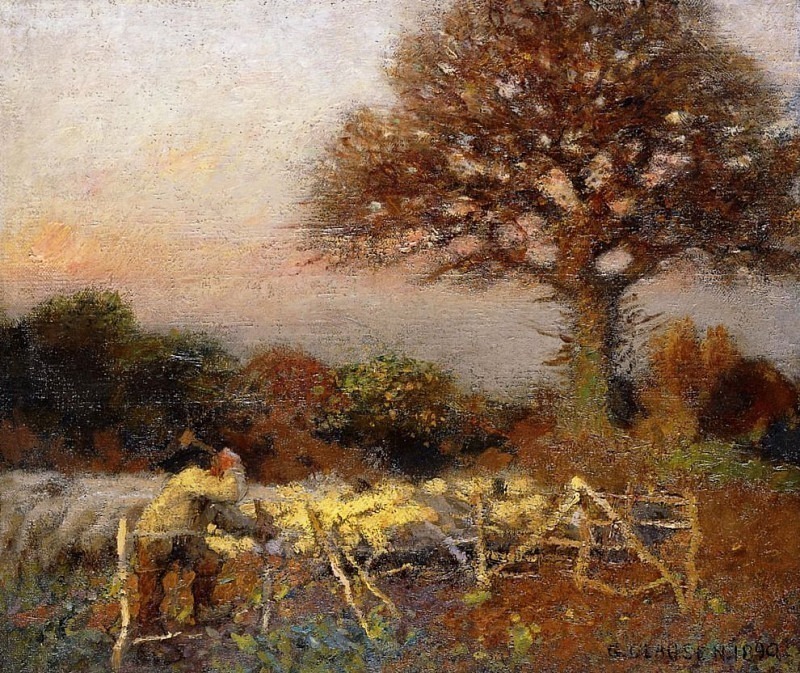
Sheepfold at Early Morning by Sir George Clausen. Image from Gallerix.org.

Far from the Madding Crowd by Thomas Hardy Genre: British classics I read it as a(n): paperback Length: 468 pp Her Grace’s rating: 4 stars 

So this is one of those classics that I not only never read in high school or college, but I didn’t even know what the plot was. Like, at all. All I knew was from the blurb on the book that I have. Since I want to be better about reading more classics, I thought this would be a good one to start with partly because I didn’t know anything about it, and because it’s British and I like British authors for the most part. 

But I don’t feel like writing a proper review of it. It’s been sitting on my desk for weeks since I finished it, waiting for me to review it. Other than saying that I loved it and that there were quite a few parts that I thought were actually hilarious, it was a solid story. I thought it took a bit longer than necessary to introduce all of Bathsheba’s suitors, but it was fine. I loved it overall regardless. 

One thing I like to do is make a note of any books or music that are mentioned in a book. The literature mentioned in this one is:

Anyway, like I said, I don’t feel like writing an actual review. Partly because I’ve had the book sitting on my desk for weeks and I finished reading this quite some time ago. So instead of a traditional review, I’m going to share my favorite lines from the novel. Here they are. Behold.

The instinctive act of human-kind was to stand, and listen, and learn how the trees on the right and the trees on the left wailed or chanted to each other in the regular antiphonies of a cathedral choir; how hedges and other shapes to leeward then caught the notes, lowering it to the tenderest sob; and how the hurrying gust then plunged into the south to be heard no more (14).

To find themselves utterly alone at night where company is desirable and expected makes some people fearful; but a case more trying by far to the nerves is to discover some mysterious companionship when intuition, sensation, memory, analogy, testimony, probability, induction – every kind of evidence in the logician’s list – have united to persuade consciousness that it is quite in isolation (18). [Extroverts? I think this describes extroverts.]

“My name is Gabriel Oak.”
“And mine isn’t. You seem fond of yours in speaking it so decisively Gabriel Oak.”
“You see, it is the only one I shall ever have, and I must make the most of it.” (27)

There was left to him a dignified calm he had never before known and that indifference to fate which, though it often makes a villain of a man is the basis of his sublimity when it does not (43).

[Discussing Joseph Poorgrass’s shyness]
“Yes – very awkward for a man.”
“Ay – and he’s very timid too,” observed Jan Coggan. “Once he had been working late at Yalbury Bottom, and had had a drap of drink, and lost his way as he was coming home-along through Yalbury Wood – didn’t ye, Master Poorgrass?”
“No, no, no – not that story!” expostulated the modest man, forcing a laugh to bury his concern.
“-And so ‘a lost himself quite,” continued Mr Coggan with an impassive face implying that a true narrative, like time and tide, must run its course and would respect no man. “And as he was coming along in the middle of the night, much afeared, and not able to find his way out of the trees no-how, ‘a cried out, ‘Man-a-lost! Man-a-lost!’ A owl in a tree happened to be crying ‘Whoo-whoo-whoo!’ as owls do you know, Shepherd” (Gabriel noddled), “and Joseph, all in a tremble, said ‘Joseph Poorgrass of Weatherbury, sir!’” (62-63). [LOOOOOOL that poor guy! 😂]

The good old word of sin thrown in here and there at such times is a great relief to a merry soul (65).

It was one of the usual slow sunrises of this time of the year, and they sky, pure violet in the zenith, was leaden to the northward, and murky to the east, where, over the snowy down or ewe-lease on Weatherbury Upper Farm, and apparently resting upon the ridge, the only half of the sun yet visible burnt rayless, like a red and flameless fire shining over a white hearthstone. The whole effect resembled a sunset as a childhood resembles age.
In other directions the fields and sky were so much of one colour by the snow that it was difficult in a hasty glance to tell whereabouts the horizon occurred; and in general there was here too that before mentioned preternatural inversion of light and shade which attends the prospect when the garish brightness commonly in the sky is found on the earth and the shades of earth are in the sky. Over the west hung the wasting moon, now dull and greenish-yellow, like tarnished brass (104).

O I love him to very distraction, and misery and agony. … Loving is misery for women always (207).

[Petrichor!] She went out of the house just at the close of a timely thundershower, which had refined the air, and daintily bathed the coat of the land, though all beneath was dry as ever. Freshness was exhaled in an essence from the varied contours of bank and hollow, as if the earth breathed maiden breath, and the pleased birds were hymning to the scene (210).

But man, even to himself, is a palimpsest, having an ostensible writing, and another beneath the lines. It is possible that there was this golden legend under the utilitarian one: “I will help, to my last effort, the woman I have loved so dearly” (254).

[A mutt!] He was a huge heavy and quiet creature, standing darkly against the low horizon, and at least two feet higher than the present position of her eyes. Whether Newfoundland, mastiff, bloodhound, or what not, it was impossible to say. He seemed to be of too strange and mysterious a nature to belong to any variety among those of popular nomenclature. Being thus assignable to no breed he was the ideal embodiment of canine greatness – a generalization from what was common to all (277).

All romances end at marriage (281).

Where however happy circumstance permits its development the compounded feeling proves itself to be the only love which is strong as death – that love which many writers cannot quench, nor the floods drown, beside which the passion usually called by the name is evanescent as steam (409). 

References:
Clausen, Sir George. A Sheepfold, Early Morning. 1890. Oil on canvas. Gallerix, https://gallerix.org/storeroom/1363/N/287/. 

Hardy, Thomas. Far from the Madding Crowd. Edited by Suzanne B. Falck-Yi and Linda M. Shires, 2nd ed., Oxford University Press, 2008.

book review · books

A Review of The Castle of Otranto: Insights into the First Gothic Novel

The Castle of Otranto by Horace Walpole Genre: Gothic, classics I read it as a(n): pb Length: 117  Her Grace’s rating: 4 stars

Generally considered to be the very first Gothic story, The Castle of Otranto is centered on Lord Manfred, his wife Hippolyta, his daughter Matilda, and his son’s fiancée Isabella. In the opening scenes, Manfred’s son, Conrad, gets smashed to a pulp by a giant metal helmet that seemed to come flying out of thin air when he was on his way to the church to marry Isabella. This, friends, is foreshadowing! Events proceed from there, with a family curse, a nefarious plot, a hidden nobleman, a random but handsome stranger from another town, and a salty monk bringing the action along with them.

One of the first things I noticed, and was surprised about, was how funny this story was! There are a couple of servants, Jaquez and Diego, who are like Rosencrantz and Guildenstern. The lady’s maid, Bianca, is like all four of those men rolled into one. Or maybe she is channeling her inner Lwaxana Troi. Either way, she’s hilarious. There were several spots where just the writing and narration itself made me laugh out loud as well. Walpole occasionally broke the fourth wall but good.  

There was also a very heavy implication that nobility is a blood- or birthright. Considering that Walpole was himself a nobleman, that makes sense. It was a little on-the-nose in some parts, but I feel like Walpole was making a deliberate commentary about nobility. The idea running throughout the story is that nobility is inherent, not something one can inherit with titles or take through force. We see this played out in full force with Theodore and Manfred. Theo started out as a peasant in the story but through his actions and behaviors, showed that he was more noble than Manfred. When Theo is revealed to actually be a nobleman, it reads like a confirmation of what we already knew more than an actual plot twist. It’s a big contrast to Manfred who has the titles and lands to back up his claim of nobility, but he’s cruel, paranoid, and basically unhinged. Just like a certain tangerine-colored politician. Example of how life imitates art! 

The way the women fit into nobility is also interesting, if frustrating on occasion. Hippolyta is noble by birth and actions. Her nobility is closely tied to her loyalty, humility, and piety. But she goes way overboard with the whole obedience thing and eventually her virtues are tied so closely with submission that they actually become the problem. She is a very virtuous doormat. Matilda is also virtuous and noble, and her compassion bears that out. She forgives and is empathetic even to people who wrong her. But since this is a Proper Gothic Story, there’s a lot of fatalism and in the end, Matilda’s virtues are not enough to save her. 

I think Isabella is the most interesting. She is virtuous and everything a woman was expected to be at that time, but she also has a spine. She tells Manfred to fuck off when he wants to marry her, she always tries to protect other people, she chooses to be noble as well as being noble by birth. She also tries to save herself by getting the hell out of the castle and pelting to the monastery where she can claim sanctuary and avoid Manfred. She and Theo would make a great match, if that were part of the plot. 

Overall, this was a fast and fun read, the first real Gothic story, and definitely one I recommend to anyone who is into that. 

Some of my favorite lines:

“I fear no bad angel, and have offended no good one” (30).

“He tells you he is in love, or unhappy, it is the same thing” (41).

“Since mirth is not your mood, let us be sad” (64). 

“A good Knight cannot go to the grave with more satisfaction than when falling in his vocation: whatever is the will of heaven, I submit” (66).

“He sighed, and retired, but with eyes fixed on the gate, until Matilda, closing it, put an end to an interview, in which the hearts of both had drunk so deeply of a passion, which both now tasted for the first time” (72).

“I can forget injuries, but never benefits” (95).

book review · historical fiction · Medievalism

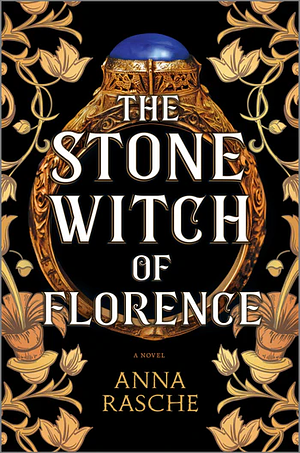
The Stone Witch: A Historical Fiction Mystery

book review

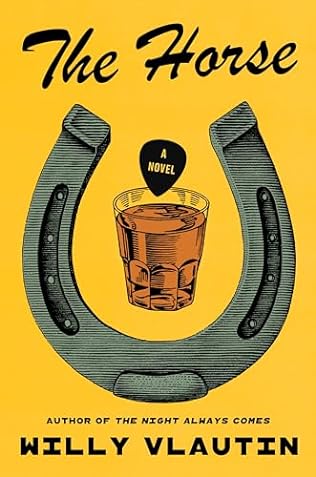
Exploring ‘The Horse’ by Willy Vlautin: A Reflection on Life

The Horse by Willy Vlautin
Genre: literary fiction
I read it as a(n): hardback
Length: 194 pp 
Her Grace’s rating: 3.5 stars 

Reading Challenge tasks: 
Her Grace’s: 13 – A book with a yellow spine
TND: 7 – A new to you author
PS: 8 – Under 250 pages

Al Ward is a 60-something alcoholic guitar player and songwriter who has hit rock bottom. He’s living in basically a shack with no electricity or running water on an old mining claim in the desert outside of Reno, NV, which he inherited from his uncle. Naturally, he’s wondering why he should bother to carry on when a random horse shows up at his door. The horse is blind, obviously old, and starving. It is also the middle of winter and Al worries that the horse will freeze to death. He decides it is his job to save the horse, but given that he has only canned condensed soup and no working vehicle, he’s in a quandary. He decides to walk 30 miles to the nearest neighbor’s farm to seek help for the animal, hoping that it will still be alive when he returns. Also, he’s hoping it’s a real horse and not a product of alcoholic hallucinations. 

In some ways, this book reads like a depressing case study in poor decisions and a life that has never had anything really go right. But it is also a deep reflection on the lived experiences of so many Americans. So many people live hand to mouth, no money, no savings, floating from one job to the next, wondering where they will sleep next or where their next meal will come from. Often it isn’t any fault of their own; they just lacked the necessary support systems to get a leg up. It also is about loneliness and people trying to make a connection with another living being, whether that is another human or a horse or something else. 

Al is a good man and sympathetic character. He never intentionally hurts anyone, he truly does try his best. He is also a highly unreliable narrator. His alcoholism becomes part of his identity and, try as he might, he is never able to totally dry out. This leads readers to question how much of his story is accurate or even real. It colors the portrayal of all the other characters in the story as well, whether they, too, are addicts in some way or not. 

The horse is more a place to hang the plot rather than being part of the plot itself. Its presence in the story is minimal and serves mainly as a way for Al to begin looking back over his own life and the choices he’s made. Anyone looking for an actual story about a horse will be disappointed. Initially, that was me, but the writing was excellent and I felt bad for Al. I wanted to know more about him and how it would end, so the lack of actual horses in the story quickly became irrelevant to its enjoyment.

lifestyle · travel

Highlights of My Busy 2024: Family, Travel, and Reading

My 2024 was pretty busy, mostly in good ways. 

So. That happened. I am sick to death of politics, so all I’ll say is, I hope everyone gets the year they voted for and deserve. 

New Zealand sister, her husband, and kids came for a good visit. I hadn’t gotten to meet her kids before now, so that was a delight. That whole visit was a highlight of the year, though I feel bad that their schedule meant they had to come in the hottest part of summer. There’s nothing good about summer in Phoenix. Sorry, Z – I hope next time you get to come when it is not a million degrees out. 

A few months after their visit, her younger brother came for a visit as well. He had a few days to kill between arriving in the States and taking his test to get promoted to captain (he works on superyachts – how cool is that?), so he came to visit us. I hadn’t seen him since he was like 8, so that was a fun visit as well.

I took my daughter on a trip to London during her fall break from school. One of my best friends met us there a few days later and we had one epic girls’ trip. I got a new tattoo while I was there; we saw a few plays, including A Comedy of Errors at Shakespeare’s Globe Theatre; got to visit my friend’s family during a trip to Kew Gardens and Camden; ate dinner at St John, which was one of Anthony Bourdain’s favorite restaurants in London; saw, FINALLY, the tomb of William Marshal in the Temple Church; and spent hours in a massive 6-storey Waterstone’s, buying books that weren’t published in the States yet because buying books in Britain is more fun, and also I have no ability to delay my gratification when it comes to books in general. 

I hit a major reading slump this year, too, but I still did alright. I read a total of: 

  • 36 books
  • 11,113 pages
  • 12 audiobooks
  • 153:27 hours listened
  • 67% of women authors
  • 33% of male authors
  • 8% LGBTQ+ authors 
  • 19% LGBTQ+ characters (I did really badly in these 2 categories this year; I try to do 25-30% at least)
  • The genre I read the most was sci-fi. Big surprise there. 44% of my reading was sci-fi
  • The month I read the most was December, which is weird
  • I had 8 books that I rated as 5-star reads
  • I had 1 book to which I gave a 1-star rating

My favorite books of this year were:

  • The Salt Path by Raynor Winn (also the audio)
  • The Wild Silence also by Raynor Winn
  • Thorn Hedge by T. Kingfisher
  • The Long Way to a Small, Angry Planet by Becky Chambers
  • A Closed and Common Orbit also by Becky Chambers
  • the witch doesn’t burn in this one by Amanda Lovelace

My favorite audiobooks of this year were:

  • The Salt Path written and read by Raynor Winn (also eyeball read this)
  • Lost Boy by Christina Henry, narrated by Samuel Roukin
  • Norse Mythology written and read by Neil Gaiman
  • The Gentleman by Forrest Leo, narrated by Samuel Roukin and John Keating. (Some serious, laugh out loud funny moments in this one. The side notes just about killed me)
  • The Shadowed Land by Signe Pike, narrated by Eilidh Beaton, Toni Frutin, Gary Furlong, Angus King, and Siobhan Waring (I waited 3 years for this book to come out and it was so worth it. Probably my new all-time favorite take on Arthurian legend)

I still have a few days left of 2024 so I may get a couple more books read between now and then. But it’s close enough.

My goals for 2025 are much as always – read lots, try new food, go to some interesting places, hang out with friends. I will try to complete my own reading challenge in 2025. For fun, I try to complete The Nerd Daily’s annual challenge as well, though I don’t make myself crazy if that doesn’t happen. And, of course, I try to do the reading challenges by tackling my own TBR in the process. I will post my annual reading challenge in a couple days for anyone who might want to participate. 

Happy Holidays, all!

book review

The Flaws of Remember Summer: A Romance Gone Wrong

Remember Summer by Elizabeth Lowell
Genre: ewww, romance
I read it as a(n): digital book from the library
Length: 384 pp 
Her Grace’s rating: 1 stars

Raine Smith is a world-class equestrian. Readers first meet her scanning the cross country obstacle course for the summer Olympics, where she is standing on a hill with a camera. The male protagonist, Cord Elliott, is an agent from a branch of the government anti-terrorist task force who is assigned to protect Raine, whose father is a bigwig in said task force. Except nobody told Raine that she has a protective detail, and someone gave Cord a terrible photo of Raine so he didn’t recognize her. Still thinking she’s alone, she reaches into her purse to grab a notebook, making Cord think she’s going for a gun – alone. On a hilltop. – and he tackles her to the ground. Two minutes later, they are making out.

I…do not understand romance books. Granted, this one was written in the 80s. But even in that strange time, I don’t think real people acted that way. Who the fuck makes out with a man who literally just attacked you? The only correct response, both in that instant and in every instance thereafter, is a solid kick to the balls.

I got this book (thankfully from the library – I spent no money on it) because I saw a review somewhere that only talked about the horse stuff. So I thought it was a horse book! For grown ups! I was a horse-crazy little girl. I still dig a good horse novel for adults, especially if it’s about English style riding or eventing. If I had known it was a romance, I would have passed on it. Because of crap like the above. There is hardly any horse stuff except in the last 10% or so, other than Raine talking or thinking about her horse. Otherwise, it could be just any kind of event or sport – fill in the blank with whatever activity you choose and you’ll have the same story.

The characters were flat and unlikable. Raine is supposed to be a world-class rider on a dangerous horse who has spent her entire life working towards this moment when she will compete in the Olympics, and yet one tackle and getting pinned to the ground by a random man turns her into a vapid cow who can only think about getting laid by said random man and who laments that her daddy doesn’t love her. 

Cord is a caveman with a gun – grunt woman mine! – who has poor communication skills and a one-track mind, if we’re being generous in factoring in his mission to kill a specific terrorist. Half-track mind if we focus only on his singular desire to drag Raine to bed by her hair and keep her there. Naturally, he also handles her horse better than she does.

I am sad that there is such a dearth of horse stories for adults, and that many of the ones that exist take the form of romance. Horses and women do not automatically have to equate to bodice-ripping, flat romance. I am definitely dumber for having read this book.