book review · books

A Review of The Castle of Otranto: Insights into the First Gothic Novel

The Castle of Otranto by Horace Walpole Genre: Gothic, classics I read it as a(n): pb Length: 117  Her Grace’s rating: 4 stars

Generally considered to be the very first Gothic story, The Castle of Otranto is centered on Lord Manfred, his wife Hippolyta, his daughter Matilda, and his son’s fiancée Isabella. In the opening scenes, Manfred’s son, Conrad, gets smashed to a pulp by a giant metal helmet that seemed to come flying out of thin air when he was on his way to the church to marry Isabella. This, friends, is foreshadowing! Events proceed from there, with a family curse, a nefarious plot, a hidden nobleman, a random but handsome stranger from another town, and a salty monk bringing the action along with them.

One of the first things I noticed, and was surprised about, was how funny this story was! There are a couple of servants, Jaquez and Diego, who are like Rosencrantz and Guildenstern. The lady’s maid, Bianca, is like all four of those men rolled into one. Or maybe she is channeling her inner Lwaxana Troi. Either way, she’s hilarious. There were several spots where just the writing and narration itself made me laugh out loud as well. Walpole occasionally broke the fourth wall but good.  

There was also a very heavy implication that nobility is a blood- or birthright. Considering that Walpole was himself a nobleman, that makes sense. It was a little on-the-nose in some parts, but I feel like Walpole was making a deliberate commentary about nobility. The idea running throughout the story is that nobility is inherent, not something one can inherit with titles or take through force. We see this played out in full force with Theodore and Manfred. Theo started out as a peasant in the story but through his actions and behaviors, showed that he was more noble than Manfred. When Theo is revealed to actually be a nobleman, it reads like a confirmation of what we already knew more than an actual plot twist. It’s a big contrast to Manfred who has the titles and lands to back up his claim of nobility, but he’s cruel, paranoid, and basically unhinged. Just like a certain tangerine-colored politician. Example of how life imitates art! 

The way the women fit into nobility is also interesting, if frustrating on occasion. Hippolyta is noble by birth and actions. Her nobility is closely tied to her loyalty, humility, and piety. But she goes way overboard with the whole obedience thing and eventually her virtues are tied so closely with submission that they actually become the problem. She is a very virtuous doormat. Matilda is also virtuous and noble, and her compassion bears that out. She forgives and is empathetic even to people who wrong her. But since this is a Proper Gothic Story, there’s a lot of fatalism and in the end, Matilda’s virtues are not enough to save her. 

I think Isabella is the most interesting. She is virtuous and everything a woman was expected to be at that time, but she also has a spine. She tells Manfred to fuck off when he wants to marry her, she always tries to protect other people, she chooses to be noble as well as being noble by birth. She also tries to save herself by getting the hell out of the castle and pelting to the monastery where she can claim sanctuary and avoid Manfred. She and Theo would make a great match, if that were part of the plot. 

Overall, this was a fast and fun read, the first real Gothic story, and definitely one I recommend to anyone who is into that. 

Some of my favorite lines:

“I fear no bad angel, and have offended no good one” (30).

“He tells you he is in love, or unhappy, it is the same thing” (41).

“Since mirth is not your mood, let us be sad” (64). 

“A good Knight cannot go to the grave with more satisfaction than when falling in his vocation: whatever is the will of heaven, I submit” (66).

“He sighed, and retired, but with eyes fixed on the gate, until Matilda, closing it, put an end to an interview, in which the hearts of both had drunk so deeply of a passion, which both now tasted for the first time” (72).

“I can forget injuries, but never benefits” (95).
book review · books · fantasy

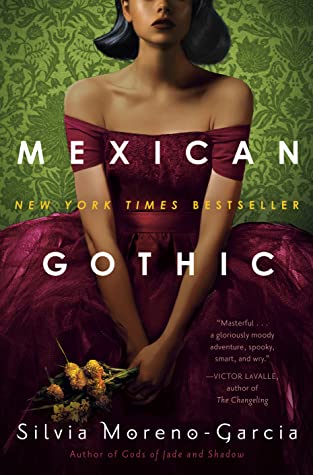
Mexican Gothic

mexican gothicMexican Gothic by Silvia Moreno-Garcia (Website, Twitter, IG)

Genre: Gothic fantasy

Setting: 1950s Mexico

I read it as a(n): hardback

Source: my own collection

Length: 301 pp

Her Grace’s rating: 3 out of 5 stars

Noemi Taboada is a young socialite in 1950s Mexico City. Her father is a wealthy merchant and the head of the family. As such, he is concerned about image and avoiding scandal. So, when his niece Catalina sends a letter to him that sounds completely unhinged, he wants to get to the bottom of that and fix whatever needs fixing before it hits the society pages in the newspaper. He sends Noemi to visit Catalina in her husband’s home manor of High Place in the remote Mexican countryside. Things go downhill from there. 

I really loved the first part of this novel. It was everything a proper Gothic novel should be – eerie, mysterious, dark, neglected, and so on. Very much felt like a Mexican Jane Eyre. I kind of lost the Gothic feel around 2/3 of the way through, when I think it felt more like a straight horror novel than Gothic. That said, I still really loved all of it, it just felt like it switched genre a little bit in the middle there. I wouldn’t even care that much except I’m not a huge fan of horror. 

I thought Noemi was a very believable character. She was sort of shallow and vain at first, but then we learn she wants to go to university to get a master’s degree in anthropology. She is something of a flirt and prefers the chase or courtship to being caught in her relationships, but she is self-aware enough to know it. She had hidden depths that reveal themselves nicely throughout the novel. She was a really well-developed character.

I didn’t think that so much about Catalina. I know that her flat personality was actually a part of the plot, but the glimpses we got from Noemi’s perspective about her were not really enough to give her much depth or make her into a fully-fleshed person in the story for me. She felt more like a prop than a person. 

The rest of the characters – Virgil, Francis, Florence, and Howard – were suitably developed for the roles they played in the novel. I don’t think they were super deep but they all did have certain nuances to their personalities and were fine for the purposes they served.

I especially loved how the house, High Place, was described. It was in the tradition of the best Gothic manor homes, like a cross between Thornfield Hall and the Haunted Mansion. Old, dusty, neglected, falling apart, mouldy, and of course it had a cemetery! Minus the mould, I would love to have a house like that. I’d put just enough money into it that it had proper amenities but keep the abandoned Gothic feel. 🙂 

Overall, I thought this was a fun read. Didn’t blow me away, but it was fun. Would certainly recommend.

book review · historical fiction

The Distant Hours

The Distant HoursThe Distant Hours by Kate Morton (Website, Insta)

Her Grace’s rating: 3 out of 5 stars

Genre: historical fiction/ mystery

I read it as an: audiobook

Narrator: Caroline Lee

Source: my own collection

Length: 22:31:00

Published by: Bolinda Publishing (26 Oct 2010)

Edie Burchill never really understood her mother. But the arrival of a letter, lost for 50 years and addressed to Edie’s mother from Milderhurst Castle, sets Edie on a mission to discover the mysteries of her mother’s past. Mystery mixed with a bit of the Gothic and the romantic, the plot takes Edie back to Milderhurst Castle, her mother’s home during the evacuation of London’s children during the Blitz. There, she meets the sisters Blythe, twins Persephone ‘Percy’ Blythe and Seraphina ‘Saphy’ Blythe, and their younger sister Juniper. Edie digs deep to discover why her mother is so reluctant to talk about her time at Milderhurst, why the abandonment of Juniper’s fiance in 1941 sent her mad, and what the twin sisters are really hiding. 

This was a solid Gothic mystery, though not one of my favorites. It seems like it has all the requisite components of a very good Gothic mystery, but something was just lacking. I think there was often too much telling and not showing, what must have been pages of no dialogue (listening to it on audio makes it a little hard to tell), and then the denouement was kind of flat and not really a surprise. 

I didn’t really like Edie very much. Not that she was a bad character or anything, she was just rather boring. Maybe this was intentional on Morton’s part because the sisters Blythe were certainly NOT boring. Maybe Morton did that so she could highlight the eccentricity of the sisters. Whatever it was, I did very much enjoy the sisters. The writing style itself was also nice. I like the florid style of Gothic literature, and while this wasn’t exactly florid or fully Gothic, I liked the atmosphere Morton created all the same. 

This was my first read from Morton and, while I didn’t care for some aspects of it, I liked her writing and am happy to give her other books a go.