book review · historical fiction

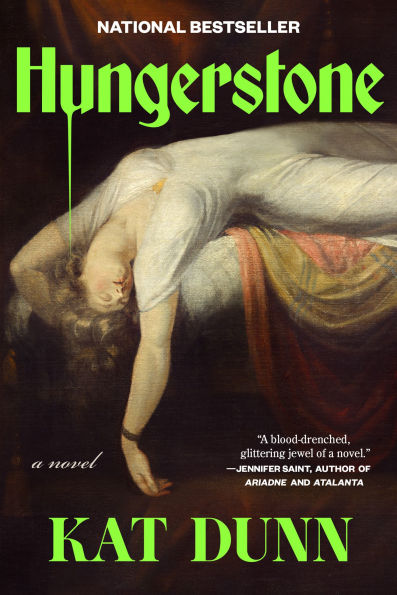
Hungerstone: A Feminist Retelling of Carmilla

Hungerstone by Kat Dunn
Genre: Gothic historical
I read it as a(n): Digital ARC 
Length: 336 pp 
Her Grace’s rating: 4.5 stars
2025 Reading Challenge tasks: TND: #1 – a 2025 release 

Lenore Crowther learned at a young age that nobody can save her but herself. She spent her childhood after the death of her parents learning everything a titled lady would need to know, secured herself a wealthy but untitled husband, and carried out a campaign to ingratiate him into the social circles that he craved. 

Ten years later, the shine is worn off the marriage and she has no children to occupy her time like a proper Victorian wife should have. When her husband, Henry, buys a large estate, Nethershaw, Lenore is hopeful it will be just what she needs to break the doldrums. 

However, the decrepit mansion is not at all what she’d hoped for, and the arrival of a mysterious woman who survived a carriage wreck only brings about more dissatisfaction. 

This atmospheric novel drips with the Gothic elements that so many of us love. The mansion isn’t a dark and drafty castle, but it is dilapidated and a sad shadow of its former imposing glory. The place is surrounded by misty heaths, treacherous cliffs, and windswept fields. The landscape and mansion are both characters in themselves, which is always a fun experience for readers, though significantly less so for the characters. 

Lenore tries her hardest to conform to the Victorian ideal of the Angel in the House, but as we read on, we learn that underneath her soft outer layers is a ruthless core of iron. Carmilla, the carriage-crash survivor who is recuperating at Nethershaw, is strange and defies every social convention there is. She awakens previously unknown desires in Lenore that are catalysts for her drastic change throughout the novel. 

This story is so much more than a retelling of Carmilla, as it is marketed, or even about hunger, as indicated in the Author’s Note. It is an examination of demand and dependency, societal expectation, and the injuries that cause invisible damage to us all. It is a commentary of society today as well. There is one quote that perfectly encompasses every issue the novel tackles: “What is a monster but a creature of agency?” Women’s agency, independence, intellect, women who decide for themselves what they want rather than allowing men to do it for them – all can be seen as monstrous depending on who’s doing the interpreting. What makes a monster or a savior is, in this novel, entirely in the eye of the beholder. 

Highly recommended for lovers of Gothic fiction, social commentary, and women who proudly identify as a problem.

book review · fantasy · historical fiction

Unraveling the Intrigue in ‘Flights of Treason’ by Judith Starkston

Flights of Treason (Tesha #4) by Judith Starkston
Genre: historical fantasy
I read it as a(n): digital ARC
Length: 522 pp 
Her Grace’s rating: 5 stars

Flights of Treason, the 4th and final book in Judith Starkston’s Tesha historical fantasy series, takes place about 3 years after the end of book 3, Of Kings and Griffins. Queen Tesha of Alpara and her husband, King Hattu, are facing off against Hattu’s corrupt and incompetent nephew, Great King Urhi. Adding to this already tense political situation is the fact that Traj, one of the griffin cubs from the previous book, has been lured to Hattusa where he was bound with evil magic and nearly killed. The griffin king is enraged by the harm to his son and vows to kill the sorceror who hurt Traj. Unfortunately, that sorceror appears to be Tesha and Hattu’s 4-year-old daughter, Arinnel. Magic, demons, griffins, and more converge into this exciting final novel in the Tesha series!

I loved this book so much! In the spirit of full transparency, Judith is a friend of mine. However, that doesn’t change the fact that this was an awesome read. The characters all have a great deal of growth throughout this book as well as the series overall. Tesha has tremendous guilt about her magic, which is powerful, but she refuses to use it to its full potential because of the inadvertent damage it did to Arinnel in the womb. (For that story, you’ll need to read book 2, Sorcery in Alpara.) Tesha tries to do what she can to help without using magic, and she has to work through her feelings of guilt and fear to become the queen she needs to be. Her reluctance to use her magic causes some tension with Hattu, particularly when it comes to using it to force his nephew, Urhi, to become a better king. I liked this because it felt like an actual issue that causes couples to get mad at each other in real life. It wasn’t Big Drama, it wasn’t hugely emotional or a cause to worry that Tesha and Hattu were going to call it quits. It was just one of those things that happens to any couple on occasion, and it made the novel feel that much more relatable. 

Tesha’s older, blind sister, Daniti, has a big role as well. Her previous bond with the griffins and her ability to speak telepathically to them over great distances plays a vital role in the conflict between humans and griffins. Arinnel shares her aunt’s telepathic abilities, a source of tremendous joy to both of them most of the time. Arinnel, though, has blocked Daniti out of her thoughts and, because of this, everyone fears that that little girl was, in fact, responsible for the grievous injuries the griffin cub Traj suffered. 

Marak, Hattu’s second in command and Daniti’s husband, has a slightly smaller role in this than he did in previous books, but his role remains important. He is almost as brilliant a military strategist as Hattu himself, and Marak’s diplomatic bonds with the Paskans comes into play in a very big way. I have a soft spot for Marak. He always strikes me as sort of a protective big brother who seems fierce but is all squishy around the edges. 

Flights of Treason is filled with exciting battles ranging from fighting with human armies, facing off against sorcerors, or making a stand against fantastical beasts. These scenes are all vividly depicted and they played out like a movie in my mind. 

Starkston absolutely excels at the historical details in this book, as she does in all her other books as well. The series might be marketed as historical fantasy, but it is solidly based in actual Hittite history. Many of the spells and incantations are actual documented parts of ceremonies and rituals found on clay tablets from the Hittite Empire. Her skill lies in taking those snippets of historical fact and weaving them into a fascinating new story that is both unique and also remains true to the remarkable, ancient people who provided the inspiration. 

I have said for years and years that sci-fi/fantasy is an ideal medium in which to discuss real-world issues. Flights of Treason is no different. I love the themes of fighting for one’s home, doing what needs doing even if it scares the crap out of you, and going through self-discovery to become who you are really supposed to be. These are all things that people in the real world need to do at one point or another. Maybe we don’t battle actual griffins in our life, but we sure as hell battle our own inner demons. We do things that scare us because we need to do them. We learn to define what “home” means to each of us, and then fight to keep it safe. There are so many things we do in real life that are explored in fantasy novels, barely hidden beneath the veneer of magic. In a well-written fantasy such as this, it is easy to find ourselves in the pages even as we get lost in the story.

One more thing that I really loved about this book was actually the ending. Starkston did what I wish more authors of series could do: she gave a satisfying ending with no loose threads left, didn’t make those endings feel like an afterthought by rushing through them, and yet still left openings to return to the series later if she decides to. I honestly am not sure of any other authors that I have personally read who managed to pull that off so well! Because I am a selfish creature, I want MORE Tesha books, but if such is not meant to be, then the way this one ended is the ideal way to conclude the series. 

As with the three preceding books in the series, I highly recommend Flights of Treason for the amazing world-building, complex characters, and fascinating historical details woven into every page. You will not be sorry you read this!

book review

Unveiling The Earthly Blaze: A Review of Alice Poon’s Kung Fu Duology

A young Chinese woman in kung fu fighting stance facing off with a dragon
Image generated with StarryAI


The Earthly Blaze
by Alice Poon
Genre: fantasy
I read it as a(n): digital ARC
Length:
396 pp 
Her Grace’s rating: 4 stars

In The Earthly Blaze, author Alice Poon takes up immediately after the events of the first book of this duology, The Heavenly Sword. Jumping right into the thick of it, Sai’er, who is the earthly incarnation of the goddess Chang’e, and her friends struggle against the forces of Prince Zhu Di, the earthly incarnation of the evil Sky Wolf. The fighters form a sect to network and recruit new members, resist the wicked acts of Zhu Di and his government, and hone their skills in kung fu to aid them in their battles. Along the way, bonds between the group are strained and tested in ways none of them could have foreseen. Adding in betrayals and double agents makes the entire situation all the more fraught, burdening Sai’er, Sanbao, Binhong, Yinho, and the rest of the Sect with wavering morale and uncertainty about who is friend and who is foe.

I enjoyed this book even more than The Heavenly Sword. After reading that first entry, I realized that I actually had No Clue™ about kung fu/ wuxia in general beyond having watched Crouching Tiger, Hidden Dragon and some Jackie Chan films, and even less about the literary genre. So I set out to learn a few things about it and lo and behold! I was rewarded by my new understanding with an even greater appreciation for the story as a whole and for the wuxia genre specifically. 

This action-packed book was rich in Chinese culture and mythology. I loved the attention to detail throughout. Everything from broad strokes such as landscape descriptions to tiny details such as decorations on a person’s clothes were included and helped to make a vibrant backdrop for the story. It made it feel like I was immersed and part of the action. Likewise, references to various deities and myths enriched the reading experience and, in a couple places, made me go off and look up a myth or character that was previously unfamiliar to me. The worldbuilding overall is excellent, and I also really loved the politics in this. They were complex, at times even labyrinthine, and provided some good insight into the social structures in real-life in earlier times. The legends, politics, and epic martial arts sequences mix together for an explosive adventure. 

I enjoyed getting to know Sai’er better. She was very much a mother figure to the Sect members and they looked up to her. She is not perfect, though, but her flaws and uncertainties make her relatable. It was fun to see how not only Sai’er grew as a person and how her celestial identity was resolved, but also how the others fulfilled their own roles, whatever those happened to be. Everything worked itself out the way it needed to, even when we lost characters along the way or wished that something had gone differently. One sign of a good story, to me, is when an author can take readers where they may not want to go but ultimately where they need to go; Poon does that exactly right.

Finally, a small point that nevertheless made a big difference. There was a recap of book 1 at the beginning! I had read and enjoyed the first book in this duology but, as with the majority of the books I read anymore, I forget most of the things about it as soon as I finish reading. The recap was greatly appreciated and was enough to jog my memory so that I could dive right into this one.

At the end of the day, this duology is a sweeping journey through a world filled with courage, destiny, and cosmic forces colliding in an epic battle of good vs. evil. I highly recommend it to anyone who loves kung fu, Chinese mythology, or just a rip-roaring, action-packed story.

historical fiction

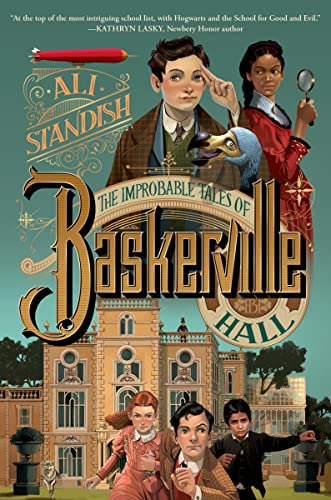
The Improbable Tales of Baskerville Hall

Baskerville HallThe Improbable Tales of Baskerville Hall by Ali Standish
Genre: historical fantasy/YA
I read it as a(n): ARC
Length:
336 pp
Her Grace’s rating: 2 out of 5 stars

The Improbable Tales of Baskerville Hall by Ali Standish mingles elements of the historical Arthur Conan Doyle and his most famous series, Sherlock Holmes into a steampunk-influenced adventure that’s reminiscent of a jaunt through Hogwart’s. A young Arthur Conan Doyle, living hand to mouth with his sisters, mother, and alcoholic father in Edinburgh, jumps at the chance to improve his family’s fortunes when he is offered a spot at an exclusive boarding school, Baskerville Hall. When he arrives – by airship! – Doyle settles in and quickly establishes himself as one of the most promising students currently in residence. When a series of break-ins, thefts, and threatening appearances by shadowy figures occur, events conspire to put Doyle’s education and life at risk.

This book will surely appeal to many young readers, but adult readers will wonder how the fuck Sherlock Holmes ended up in Hogwarts. At times, it felt as though the author were merely replacing names from Harry Potter with ones from Sherlock Holmes and dusting her hands off afterward. While that Potteresque aspect of the book might be forgiven since a lot of fantasy is pretty derivative anyway, it is harder to overlook the fantasy aspects as a whole. “Fantasy” isn’t usually what readers expect from anyone with the name Sherlock Holmes attached to it, so this book felt very out of alignment. The Sherlock Holmes series lends itself well to steampunk, no argument with that at all, and author Ali  Standish does a good job incorporating components of that genre into this novel. However, I was expecting a logic book. Where’s my damn logic book? In other words, it lacks the investigative style and logic that is associated with Sherlock Holmes and expected in any retelling of the great detective’s stories. 

To give credit where it is due, the story is filled with interesting and well-crafted characters. Real people such as Doyle himself mingle with his fictional characters such as Dr. Watson, creating an intriguing cast. I loved the diversity in the people the best. They’re not all homogenous and bland; they are vivid and have personalities that are deeply developed, given the relative shortness of the book and its targeted age level.

Younger readers will no doubt be thrilled with this story, but I don’t think it would appeal very much to many well-read adults.

This was originally published on the Historical Novels Review website. That review was nicer, though it said basically the same thing as here.

book review · fantasy

Snow and Poison

Snow and Poison

Snow and Poison by Melissa de la Cruz*

Genre: fantasy

I read it as a(n): digital galley

Length: 288 pp

Her Grace’s rating: 2 out of 5 stars

De la Cruz’s lush retelling of Snow White is set in 17th century Bavaria. The central figure is Sophie, the Duke of Bavaria’s daughter, and her love interest is Phillip of Spain. They meet at her debut ball, which is also the marriage of her father to a woman called Claudia, who hails from a remote region of Bavaria. Events are set in motion that will test the strength of Sophie’s resilience as well as the bond between Sophie and everyone she loves.

There were many things to like about this book. In particular, the relationship between Sophie and Claudia was delightful; it’s always refreshing when an author makes a traditionally negative character into one worthy of love and respect as she did with Claudia. She turned the trope of the wicked stepmother on its head. 

There were several drawbacks to the novel as well, though. The pacing was generally poor. The first three-quarters of the book were a straightforward historical story; one wondered when or if there would be any elements of the Snow White tale. I had actually wondered if this was perhaps the first part of a duology or trilogy. Then, in the last quarter of the book, the dwarves’ and the wicked witch’s characters were introduced and the whole rest of the fairy tale proceeded from there in a very rushed manner. Mostly because of the inconsistent pacing, the characters in general all lacked development, and a couple of them who had the potential to be honestly fascinating were more or less glossed over in favor of concluding the story. Many unanswered questions remained as a result of the pacing deficiencies.

The novel should appeal to younger teens or established fans of de la Cruz, but I think it would disappoint older teens or adult YA readers.

*This review was originally published with the Historical Novel Society

book review · fantasy · historical fiction

The Heavenly Sword

the heavenly sword

The Heavenly Sword by Alice Poon 

Genre: fantasy

I read it as a(n): digital ARC

Length: 390 pp

Her Grace’s rating: 4 out of 5 stars

Alice Poon delivers the first of a duology epic fantasy based in Chinese mythology and kung fu. In this first novel, Sai’er is a simple village girl training in the ancient arts of kung fu. Thanks to a helpful sprite, she learns she is the reincarnation of the goddess Chang’e. She must go on a quest to stop the wicked Sky Wolf, who is reincarnated as the Ming Dynasty Emperor Zhu Di. Aided by her foster brother Binhong and several other friends, both mortal and supernatural, Sai’er embarks on an adventure rivaling any in the fantasy genre. 

I enjoyed this, as I did Poon’s earlier books. She does a terrific job of blending fantasy, mythology, and real history all together to make a credible story. I would almost categorize this book magical realism rather than fantasy simply because the elements of magic are so closely woven into the factual parts of the story. They just…belong. Of course Sai’er has a sprite friend. Of course she is an immortal sent to earth. It could be no other way. There isn’t any suspension of disbelief while reading this, it’s just the way things are in Sai’er’s life. So that is particularly well done on the author’s part.

I did have a little trouble, mostly in the earlier parts of the book, with the pacing. This is a very fast-paced story (which is fine, it adds to the kung fu feel of the plot for me), but sometimes I felt like I overlooked something when, for example, I thought we were in one place and then the narration kicked us over to a different place. For example, Sai’er and Binhong were traveling and one minute they were on a very steep staircase carved into a cliff and the next they were surrounded by imperial guards and there was a courtyard. The text hadn’t indicated any other setting prior to that so it was a little jarring to change settings like that. But then I got used to the pacing and it was fine after that.

I think for someone like me, whose experience with wuxia/kung fu extends to Crouching Tiger, Hidden Dragon and a handful of Jackie Chan films, this is a very good introduction to the genre. Poon talks about her lifelong love of wuxia (Chinese martial arts/kung fu novels), and references Jin Yong. I had never heard of him before so now I am tempted to read some of his works. Apparently, he’s big in the genre… I never would have learned about him had I not read this book. I always appreciate a book that teaches me something! 

I don’t think this necessarily has to be an adult novel, either. Yes, there’s some sex and gore, but I don’t think it was gratuitous or anything inappropriate for a teen to read. Maybe that’s just my Gen X showing. My parents had no clue what I was reading – or where I was, really – most of the time. So maybe take it with a grain of salt, but this read-all-of-Stephen-King’s-and-V.C.-Andrews’-then-published-works-by-the-time-I-was-12 GenXer thinks it’s totally fine for teen readers as well.

book review · fantasy

A Song of Flight

A Song of Flight by Juliet Marillier

Genre: fantasy

I read it as a(n): paperback

Length: 446 pp

Her Grace’s rating: 3 out of 5 stars

In this third instalment of Marillier’s Warrior Bards series once again gives readers several separate but connected plots, woven together as skillfully as any Celtic knot. In one, Prince Aolu and his bodyguard Galen are attacked simultaneously by humans and Crow Folk. Galen is badly injured and Aolu disappears. As a result, Dau leads a team from Swan Island, the elite and secret warrior training site, to aid in the search for Aolu. Liobhan is excluded from the initial team because of her relationship with Dau but also because Galen is her brother; she can’t be unbiased as a Swan Island warrior ought to be in this case. Adding to the intrigue is Brocc, the half-fey brother of Liobhan and Galen, who is exiled from the Otherworld and Eirne’s side, along with their daughter Niamh. Brocc’s crime, according to his Elf Queen wife, was trying to understand and help the Crow Folk, whom Brocc believes are not evil but are lost and damaged in some way. 

This one was interesting because we got to see Liobhan in a leadership role unlike anything else she’s done so far. Initially, she is the warrior primarily in charge of training a new recruit, Elka, to Swan Island. Later, she is put in charge of her own team on a mission. Liobhan being who she is, though, she quickly takes the mission on a whole new path after she and Elka see a vision in which Brocc is attempting to turn the Crow Folk into an army that he can control. Liobhan changes the mission without giving the full details to her elders, risking her position on the Island entirely. 

Dau is also growing as a person. He, too, was placed in charge of the initial team to be sent from the Island to search for Aolu. When they arrive at Winterfells, the prince’s home, Dau finds Galen, who is being tended by his and Liobhan’s healer mother Blackthorn, ready to tear off on his own to search for Aolu. Galen believes – rightly as it turns out – that the prince is in the Otherworld and he is determined to find him, with or without help. 

Brocc, meanwhile, is in shock from being banished by his wife, the Elf Queen Eirne. She exiled their infant daughter with him, so Brocc is struggling to care for her in the middle of nowhere and while still attempting to connect with Shadow, one of the Crow Folk he had helped rescue in the previous novel. Brocc knows there is more to the Crow Folk than mindless violence and evil. His actions highlight the optimism and compassion displayed by the best of humanity. 

I thoroughly enjoyed this book, though it didn’t grip me as strongly as the previous one, A Dance with Fate, did. I liked the scenes with Brocc a lot more in this one since he mainly wasn’t dealing with Eirne, a character I really dislike. It’s good when characters are varied enough that there is a fairly central figure that you just can’t stand, but I found Eirne to be so irritating that I caught myself skimming the sections set in the Otherworld too quickly if she was in a scene. That wasn’t an issue in this book. 

Marillier left plenty of room for more books in the series, and I hope she does continue it! I think my favorite single book of hers is Daughter of the Forest, but my favorite overall series was Blackthorn and Grim. I love that they are still woven into the Warrior Bards stories as well. I look forward to whatever she decides to give her readers next!

book review · fantasy

A Dance with Fate

A Dance with Fate by Juliet Marillier

Genre: historical fantasy

I read it as a(n): paperback

Length: 491 pp

Her Grace’s rating: 4 out of 5 stars

The second installation in Marillier’s Warrior Bards series begins with a fighting competition and tragic accident. Liobhan, daughter of Blackthorn and Grim, and Dau, both Swan Island warriors, are participating in a training exercise when Dau slips, hits his head hard, and wakes up blind. Dau’s father, a local chieftain, blames Liobhan and demands that she serve a year as a bonded servant in his household as payment, along with a handsome sum of silver coins. Liobhan readily agrees to that, even though she knows Dau’s blindness was an accident. Dau’s father insists, too, that he be returned to his family home to be cared for. This is a problem since Dau’s family, in particular his older brothers, are sick twists who love to hurt people. Going to his family’s home is the very last thing on earth Dau wants to do. But his chieftain father prevails and Dau is packed off home along with Liobhan, who is already being treated like a slave. During their time there, Dau and Liobhan have to learn to navigate the family dynamics, survive their abuse, and in the process, uncover a deep and dangerous secret involving the Crow Folk.

I have yet to read a book by Juliet Marillier that I don’t like. There are some I like more than others but I unreservedly recommend all of her books to anyone who likes the historical fantasy genre. This one was another hit for me. I liked the way the character development happened, especially with Dau. I thought it was interesting how he learned to adapt to his new circumstances and how his Swan Island training carried him through even the worst times. Seeing very strong characters like him and Liobhan become more vulnerable is always a thought provoking experience for readers. 

This novel was told from the POV of Liobhan, Dau, and Liobhan’s brother Brocc, who lives in the Otherworld, married to the queen of the fae. I generally enjoy when stories alternate perspectives like that, and this was no different. I didn’t like the parts with the Otherworld as much as in the “real” world, I think because I just don’t like the queen, Eirne, at all. I do think Brocc is an interesting figure and love that his voice can be a weapon or a balm. I like, too, Rowan and True. But unless the Otherworld time was primarily with those three, I didn’t care much for those characters or what happens to them, mainly because Eirne is such a dick. I suppose that is a sign of good writing, though, that I feel so strongly about a fictional character! 

I’m off to read the third book in this series, A Song of Flight. I hope Marillier writes a new book soon. I get so happy when I get to read her work!

book review · fantasy · historical fiction

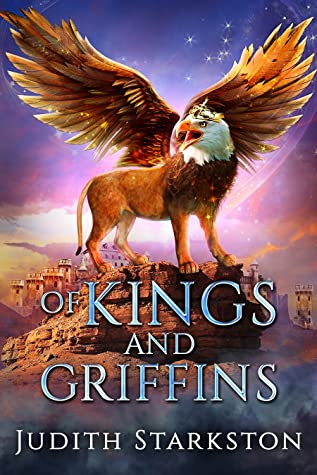
Of Kings and Griffins

Of Kings and Griffins

Of Kings and Griffins by Judith Starkston (Website, Twitter, Insta)

Genre: historical fantasy

Setting: Hitolia, the fantasy version of Anatolia, the ancient Hittite lands

I read it as a(n): ARC

Source: Helen Hollick at Discovering Diamonds 

Length: 482 pp

Published by: Bronze Age Books (13 Oct 2020)

Her Grace’s rating: 4.5 out of 5 stars

In this third instalment of Starkston’s delightful Tesha series based on ancient Hittite culture, Of Kings and Griffins picks up a few months after the events of her second book, Sorcery in Alpara. Tesha, our protagonist, is now Queen of Alpara and has given her husband, Hattu, a baby daughter, Arinnel. Hattu’s brother, the Great King, has died, leaving as heir his untested teenaged son, Urhi, who plots against Hattu’s aid. At the same time, Tesha’s blind sister, Daniti, is called by the griffin king, Bothar, to help him overcome a deadly danger in a way she is uniquely suited for.

This novel opens around a year after the events of Sorcery in Alpara. Tesha and Hattu are at the funeral of his brother, the Great King Muwatti, and Tesha, seeing that Hattu’s young nephew, Urhi, will be a problem for them, uses her magic to influence him to bend to Hattu’s will. Except Tesha, still being very young, wasn’t so subtle and got caught, thus undermining any authority Hattu might have had over Urhi. At odds with each other and his nephew, Hattu and Tesha return to Alpara to regroup. 

At the same time, Hattu’s best friend and military commander, Marik, is dealing with a mysterious illness that is striking down his troops. The court physician believes the illness to be caused by a curse from a powerful sorcerer, and that the ultimate goal is to kill Marik or Daniti next. To stop the magickal illness from killing all his troops, Marik goes on a dangerous spying mission to learn what he can and, with luck, kill the sorcerer responsible for the curse.

There are many layers to this novel, all delicately entwined and teased out over the course of the narrative. The politics involved are interesting and often very subtle. I liked the interplay between Tesha and both Urhi and the Egaryan ambassador, Ahmose. Seeing how Tesha learned to work with and, in some cases, manipulate, these men was fun to read. She has grown as a priestess, a queen, and a woman since we first met her and she’s becoming a very well rounded character. 

I always liked Daniti, so it was great to see her have such a prominent role in this novel. She has begun to manifest magic as well, not as strong as Tesha’s, but she is able to communicate telepathically a little bit over distances. She uses this skill to talk to her niece Arinnel. This ability, as well as her blindness, makes her valuable to the griffin king Bolthar, who brings her to the hidden realm of the griffins to help protect his young cubs. Daniti is certainly kinder than I would be. Bolthar needs her help and yet he is arrogant and disdainful of her practically every step of the way. It would be really hard to want to help someone who treats you like that, but Daniti has a loving heart and throws herself into the project despite Bolthar’s attitude. 

I also liked that Marak played a large role here, even more so than Hattu. Marak was all over the place in this story, from undercover spy searching for a sorcerer to leading military campaigns. It seemed like everywhere you turned, there was Marik, in the best way possible. 

I remain utterly delighted with this series. I read a LOT of fantasy, both pure fantasy and historical fantasy. A series that is based on historical context is almost always going to appeal to me greatly, like Stephen Lawhead’s Robin Hood King Raven series, or Signe Pike’s The Lost Queen Arthurian series. To have a historical fantasy series that is based on ancient Hittite culture is entirely unique. Starkston’s knowledge of the Hittites and the political events of the time period is deep. She supports her characters’ decisions and drives the plot based on her thorough research and understanding of the culture. I have read all three books that are now in the series and can honestly say they are just getting better and better. Also, these books could probably all be read as standalone stories, though you are missing out if you don’t read all of them. Including the author’s notes! Learning the real historical events and people that the Tesha series is based on adds so much depth and meaning to the story. 

Very enthusiastically recommended! 

Favorite part/ lines (potential spoilers!):

  • When searching through old scrolls and clay tablets for a binding spell, Tesha discovers a whole room of forgotten, ancient tablets. She says the old ones are the best kind. I loved this! Tesha would totally be a book nerd! 
book review · fantasy · historical fiction · Medievalism

Age of Druids

Age of Druids by Christy Nicholas (Website, Twitter)

Genre: historical fantasy

Setting: Ireland and Faerie

I read it as a(n): ARC

Source: Helen Hollick at Discovering Diamonds 

Length: 284 pp

Published by: Tirgearr Publishing (14 Oct 2020)

Her Grace’s rating: 3 out of 5 stars

Age of Druids is the ninth and final book in Christy Nicholas’s Druid’s Brooch series. In this instalment, readers are taken to early Christian Ireland, roughly 5th century, where Cliodhna struggles to come to terms with the new religion that is invading and pushing out her beloved old religion. She is accustomed to welcoming the day with the sun, feeling the spirit and energy of living things, and communicating a bit with the Fae who live in the woods near her roundhouse. To her dismay, not only do the new religion have no place for the things she loves, but her two eldest children, nearly grown themselves, are drawn to this religion and are changing because of it. On top of that, Cliodhna’s husband has been missing for months, adding a layer of suspicion through which the zealous abbot, Padraic, views her.

To try to hold on to her way of life, Cliodhna begins lessons with Adhna, a man of the Fae. He teaches her how to draw upon earth energy to revitalize plants and animals as well as to protect herself. Cliodhna soon finds herself drawn into Adhna’s world more deeply than she ever imagined possible. She will be forced to make a choice between the mortal world, full of strange new ideas and shifting loyalties, and the Fae world, utterly foreign and frightening. 

It was interesting to see how the various threads from the other books in this series were entwined throughout this novel. We learn how the brooch was created at last and how and why it was gifted to Cliodhna’s family line to begin with. Learning how her family became connected to the Faerie realm was satisfying after so many books preceding it that hinted but never confirmed. 

I have read many of Nicholas’s books and, while I greatly enjoyed this one, it was probably my least favorite of the Druid’s Brooch series. There were a few places, in particular scenes set in the Faerie realm, that I felt I had read before. I spent a lot of time backtracking my old reviews and copies of the other books to see where I had read it before. I couldn’t find any duplicated scenes, so I am clearly wrong. But there was a lot that read in a very familiar way which I hadn’t gotten from any of her other books. Maybe it was just a function of having read the other ones and Nicholas’s writing style has become familiar. That is not in itself a bad thing.

The descriptions were all top notch, both in the mortal realm and in Faerie. I liked the diversity of characters and how they changed over time. The Christian monks in general, and the Abbott in particular, were described in a pretty negative way since they were seen primarily from Cliodhna’s point of view. This negativity was explained in a later part of the plot, but devout readers, which I am decidedly not, may be a little put off by it. The villagers had a few bright spots in terms of character development as well. Ita in particular was an interesting figure and I wish there had been more scenes with her. She added a nice counterpoint to Cliodhna, who was all feisty; Ita was a good balance for her. 

The ending felt a little abrupt, but it makes sense because now the timeline starts to move forward, rather than backward. Readers could tackle the series in the reverse order of publication if they really wanted to and get a sweeping epic fantasy. Which, of course, it is anyway. I really loved the way the entire series moved backward through time to get to the genesis of the brooch that was central to the lives of the characters. I thought that was a really fun way to approach it.

One small quibble I had was the title. There really weren’t any Druids in the book. They were mentioned in passing. Druids are awesome, so I wish there had been more, or a Druid who played a main role. Cliodhna was not a Druid so she couldn’t have been the one the title implies.

Overall, this novel nicely done and provided a satisfactory summation to the entire series. Definitely recommended for fans of historical fantasy and Irish culture.