book review

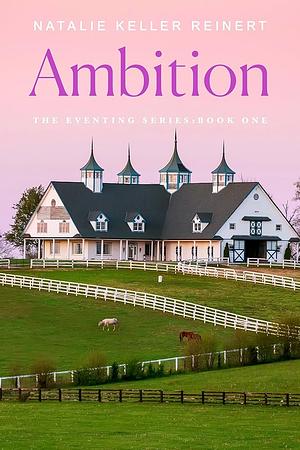
A Journey in Eventing: Review of Ambition by Natalie Keller Reinert

Ambition by Natalie Keller Reinert
Genre: contemporary fiction
I read it as a(n): paperback
Length: 358 pp
Her Grace’s rating: 4 stars
2025 Reading Challenge tasks:
Her Grace’s: #9 – Passes the Bechdel Test
TND: #17 – Animal on the cover; #34 – Starts with A or L
PS: #10 – You got it for free; #30 – Reminds you of your childhood

A few months ago, I was jonesing to read some adult horse novels. The one I read was atrocious and it made me a) definitely dumber than before I read it and b) turned me off to adult horse books in general in case they were all like that. As if horses and women can only go together in terms of vapidity and unrealistic romance. 

Then I saw reviews and recommendations for Natalie Keller Reinert’s eventing series and that it was an excellent overview of actual horse and eventing life. I decided to give it a try and am very glad I did. There was a little romance, but it was seriously like 10% of the story. The rest of the story focused on the protagonist, Jules Thornton, and her attempts to break into the upper levels of eventing while also trying to train other people’s horses AND keep her own barely-functioning farm afloat. 

Her own horse, Dynamo, has a big heart and he loves Jules as much as she loves him, but he is not talented enough to take her as far as she wants to go in competition. So Jules is thrilled when she signs on a new horse to board and train, Mickey, who is everything an eventing horse should be. Except that he’s crazy and traumatized. 

I did really enjoy this novel, enough that I placed the next one in the series on hold at my local library. It gave a good look into the actual work that goes into training horses at a very high level, some history of eventing, and the dangers involved. It is funny to me now, as an adult, to remember the horse crazy little girl I was who thought I would get to be on the US Olympic Equestrian team, despite not having remotely close to the money needed for such a sport and also the fact that my horse was too small and an entire coward. 

I definitely recommend this book if you have a love of horses and eventing, though I think if you aren’t familiar with that, or English style riding in general, it could be a bit confusing as some of the terms are not defined in context. 

book review

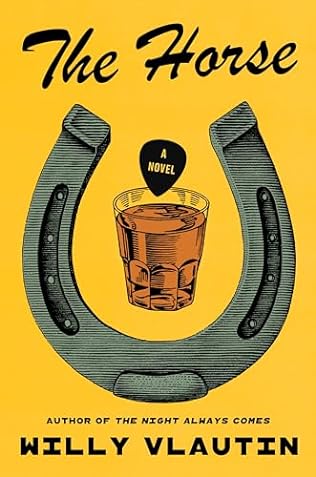
Exploring ‘The Horse’ by Willy Vlautin: A Reflection on Life

The Horse by Willy Vlautin
Genre: literary fiction
I read it as a(n): hardback
Length: 194 pp 
Her Grace’s rating: 3.5 stars 

Reading Challenge tasks: 
Her Grace’s: 13 – A book with a yellow spine
TND: 7 – A new to you author
PS: 8 – Under 250 pages

Al Ward is a 60-something alcoholic guitar player and songwriter who has hit rock bottom. He’s living in basically a shack with no electricity or running water on an old mining claim in the desert outside of Reno, NV, which he inherited from his uncle. Naturally, he’s wondering why he should bother to carry on when a random horse shows up at his door. The horse is blind, obviously old, and starving. It is also the middle of winter and Al worries that the horse will freeze to death. He decides it is his job to save the horse, but given that he has only canned condensed soup and no working vehicle, he’s in a quandary. He decides to walk 30 miles to the nearest neighbor’s farm to seek help for the animal, hoping that it will still be alive when he returns. Also, he’s hoping it’s a real horse and not a product of alcoholic hallucinations. 

In some ways, this book reads like a depressing case study in poor decisions and a life that has never had anything really go right. But it is also a deep reflection on the lived experiences of so many Americans. So many people live hand to mouth, no money, no savings, floating from one job to the next, wondering where they will sleep next or where their next meal will come from. Often it isn’t any fault of their own; they just lacked the necessary support systems to get a leg up. It also is about loneliness and people trying to make a connection with another living being, whether that is another human or a horse or something else. 

Al is a good man and sympathetic character. He never intentionally hurts anyone, he truly does try his best. He is also a highly unreliable narrator. His alcoholism becomes part of his identity and, try as he might, he is never able to totally dry out. This leads readers to question how much of his story is accurate or even real. It colors the portrayal of all the other characters in the story as well, whether they, too, are addicts in some way or not. 

The horse is more a place to hang the plot rather than being part of the plot itself. Its presence in the story is minimal and serves mainly as a way for Al to begin looking back over his own life and the choices he’s made. Anyone looking for an actual story about a horse will be disappointed. Initially, that was me, but the writing was excellent and I felt bad for Al. I wanted to know more about him and how it would end, so the lack of actual horses in the story quickly became irrelevant to its enjoyment.

book review

The Flaws of Remember Summer: A Romance Gone Wrong

Remember Summer by Elizabeth Lowell
Genre: ewww, romance
I read it as a(n): digital book from the library
Length: 384 pp 
Her Grace’s rating: 1 stars

Raine Smith is a world-class equestrian. Readers first meet her scanning the cross country obstacle course for the summer Olympics, where she is standing on a hill with a camera. The male protagonist, Cord Elliott, is an agent from a branch of the government anti-terrorist task force who is assigned to protect Raine, whose father is a bigwig in said task force. Except nobody told Raine that she has a protective detail, and someone gave Cord a terrible photo of Raine so he didn’t recognize her. Still thinking she’s alone, she reaches into her purse to grab a notebook, making Cord think she’s going for a gun – alone. On a hilltop. – and he tackles her to the ground. Two minutes later, they are making out.

I…do not understand romance books. Granted, this one was written in the 80s. But even in that strange time, I don’t think real people acted that way. Who the fuck makes out with a man who literally just attacked you? The only correct response, both in that instant and in every instance thereafter, is a solid kick to the balls.

I got this book (thankfully from the library – I spent no money on it) because I saw a review somewhere that only talked about the horse stuff. So I thought it was a horse book! For grown ups! I was a horse-crazy little girl. I still dig a good horse novel for adults, especially if it’s about English style riding or eventing. If I had known it was a romance, I would have passed on it. Because of crap like the above. There is hardly any horse stuff except in the last 10% or so, other than Raine talking or thinking about her horse. Otherwise, it could be just any kind of event or sport – fill in the blank with whatever activity you choose and you’ll have the same story.

The characters were flat and unlikable. Raine is supposed to be a world-class rider on a dangerous horse who has spent her entire life working towards this moment when she will compete in the Olympics, and yet one tackle and getting pinned to the ground by a random man turns her into a vapid cow who can only think about getting laid by said random man and who laments that her daddy doesn’t love her. 

Cord is a caveman with a gun – grunt woman mine! – who has poor communication skills and a one-track mind, if we’re being generous in factoring in his mission to kill a specific terrorist. Half-track mind if we focus only on his singular desire to drag Raine to bed by her hair and keep her there. Naturally, he also handles her horse better than she does.

I am sad that there is such a dearth of horse stories for adults, and that many of the ones that exist take the form of romance. Horses and women do not automatically have to equate to bodice-ripping, flat romance. I am definitely dumber for having read this book.

bookish things

Books for the Kentucky Derby

I am not a sports fan. Like, at all. I don’t understand sportsball in any way. No offence to any fans out there – you do you, friends. But to me, sportsball involves watching grown men in tights chase a ball around, then pat each other on the ass, while the rest of the world pays to applaud. I just don’t get it. But I do LOVE horse races in general.* I love ponies. They run fast. I can pretend they’re unicorns. The epitome of the American racing world is the Kentucky Derby, held the first Saturday in May. This year, of course, that means it will run on May 6, 2023. 

Since its inception, the Kentucky Derby has grown and changed, but it remains one of America’s favorite sporting events. Like I said, I can’t stand most sports, but I’ll be glued to the Derby Day coverage from start to finish. They have ponies! I never know anything about the horses because I don’t follow racing in general, so if there is a jockey I know riding that day, like Pat Day (aww, Pat Day. He retired several years ago) or Gary Stevens (he also retired, and to give an idea of why, his nickname is “Bionic Man” because he’s had so many joint replacements. Riding is hard on the joints, yo), then I cheer on his horse. If I don’t know any of the jockeys, I cheer for the horse I think is the prettiest and/or who has the longest odds. Then, whichever horse actually wins the Derby is the one I cheer for to win the Preakness and Belmont, because Triple Crown! It’s a really scientific method, you see. After the Triple Crown is over, I’ve hit my critical mass of sports for the year and I don’t bother again until the next first Saturday of May. 

I’m sure you all know the usual Derby things – mint juleps, bourbon balls, ladies in ridiculous hats, most exciting two minutes in sports, and so on. But here are some things you might not have known:

  • The first Kentucky Derby was run in 1875. It is the longest-running sporting event in the US. It continued even through horrible things like two world wars and the Great Depression, when other major sporting events were put on hold. 
  • The racetrack, Churchill Downs, was founded by a partnership between Meriwether Lewis Clark (his grandad was the Clark of Lewis and Clark exploratory fame) and his uncles, John and Henry Churchill, who gave him land for a racetrack. Meriwether Clark wanted to start a racing club after he had traveled to England and saw the famous Epsom Derby. Once he got the land for the track, he got a jockey club going and named it the Louisville Jockey Club, which fundraised the money for the actual track. The track didn’t get named Churchill Downs until 1883. 
  • The very first Kentucky Derby winner was a 3 year old stallion named Aristides, who ran its original distance of 1.5 miles. The distance was shortened to 1.25 miles in 1896 because experts thought 1.5 miles was too long for a 3 year old to run in early spring. 
  • Regret was the first filly to win the Derby in 1915. You go, girl!
  • In 1919, Sir Barton was the first winner of what will eventually become the Triple Crown – The Kentucky Derby, the Preakness Stakes, and the Belmont Stakes.
  • Diane Crump was the first lady jockey to ride in the Derby in 1970. Her mount, Fathom, didn’t win, but she helped put another crack in that glass ceiling. 
  • In 1973, Secretariat won the Derby, and went on to become the first Triple Crown winner in 25 years (since Citation in 1948). He won the Belmont by 31 lengths in 2 minutes 24 seconds, both records that still stand. That amazing race can be seen here: Secretariat, Belmont Stakes June 9, 1973. When he was put down in 1989 because of a debilitating hoof condition, Secretariat was buried whole at his home farm of Claiborne Farm, which is a rare honor. Most winning race horses only have their heads, hearts, and hooves buried. 
  • Seattle Slew won the Derby and went on to win the Triple Crown in 1977. His win is unique because he was the only horse to win the Triple Crown while also undefeated in any of his other races. 
  • The filly Eight Belles came in second place in the 2008 Derby, but was immediately euthanized on the track due to grievous compound fractures of both her front legs. The fractures were the same as those suffered by the 2006 Derby winner Barbaro, who died after getting the same injuries in one front leg after the Preakness in 2006. These injuries have renewed controversy among the racing industry about the conditions of the tracks as well as the care of the horses. 
  • American Pharoah is the most recent winner of the Triple Crown, taking that title in 2015. 

If you want more about the Kentucky Derby, or just about horse racing in general, check out some of these books: 

Man o’ War: A Legend Like Lightning by Dorothy Ours. Man o’ War never ran in the Derby. His owner didn’t believe in running 3 year olds 10 furlongs. Instead, he won the Preakness and then smoked the competition in the Belmont, winning that race by 20 lengths. But this is a great biography of one of horse racing’s most famous horses. 

Seabiscuit by Laura Hillenbrand. It’s hard not to be fond of a horse named Seabiscuit, really. This is the most popular book about Seabiscuit. Also, sea biscuits, AKA sand dollars, are super cute, squishy little things when they’re alive. By all accounts, the horse Seabiscuit also had a super cute and squishy personality as well. He wasn’t named for the sand dollar critters, he was named for the hardtack food sailors eat because his sire’s name was Hard Tack, but I like the squishy little critters. 

The Prince of Jockeys: The Life of Isaac Burns Murphy by Pellom McDaniels III. Isaac Murphy Burns, who had been born into slavery, was a star jockey of the late 1800s. He was the first jockey to win the Kentucky Derby three times. At one point, he was the highest-paid jockey in racing. He has a documented win record of 34.5% (his own account states it was 44%). Whichever number is correct, they are both still unmatched today. He was eventually forced out of racing when Black jockeys were excluded from racing. This book details not only Murphy’s life but the social, racial, and political issues Black jockeys had to deal with. 

Riding for My Life by Julie Krone. The biography of one of racing’s leading female jockeys. She was the first woman to win a Breeder’s Cup race as well as a Triple Crown race, which she won while riding Colonial Affair in the Belmont in 1993. 

Lord of Misrule by Jaimy Gordon. A National Book Award winner (2010) about a down on its luck racing stable in West Virginia. Told from the perspectives of several different narrators, readers get a picture of what racing was like in a small stable in the 1970s. 

Horse Heaven by Jane Smiley. A literary fiction with multiple narratives about the world of racing. The horses know what they are doing and what they want; it’s the humans who are really struggling to figure things out. I love the animals in this book and how Smiley characterizes them without anthropomorphizing them. I hate when authors do that. 

The Scorpio Races by Maggie Steifvater. Because it’s like the Kentucky Derby, but with water horses, which are different from seahorses. This is a reimagining of the Scottish fairy tale of the kelpie, and leads up to a race in which riders might live if they are lucky. The race itself isn’t the main focus of the novel, but I wanted to include it here because it is like a YA fantasy version of the behind the scenes stuff happening at the racetrack. 

*Yes, there is a lot of controversy surrounding horse racing, the ethics involved, the safety and wellbeing of the horses, and so on. Activists have steadily worked to increase the safety of racing for both the horses and the people involved. An NPR article titled “Horse racing is on the cusp of major changes in the U.S. after years of scandal” details many of the upcoming changes to the racing industry that will soon be federally mandated. It is a start, at least.