Uncategorized

The Viper Amulet

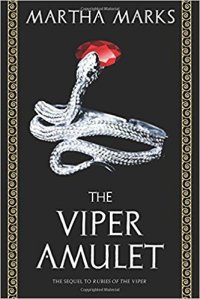
51h73vic5yl-_sx331_bo1204203200_The Viper Amulet by Martha Marks

I read it as an: ARC

Source: Helen Hollick via  Discovering Diamonds

Length: 404 pp

Publisher: Martha’s Art

Year: 2017

I definitely recommend this novel. I also feel it needs trigger warnings for rape and child harm. If it has a theme, it is all suffering, all the time, because it is rare that there is a time when at least one of the characters isn’t in some kind of pain. That isn’t preventing me from highly anticipating the final installment of the series, though!

The second novel in Marks’s early Roman Empire trilogy takes up very shortly after the end of the first. Theodosia Varro has escaped Rome along with Alexander, Stefan, and Lycos, her former slaves. They eventually land on the island of Euboea, off the eastern coast of Greece. Stefan and Alexander had previously befriended a farmer there, while Theodosia had still been in prison in the previous book, and it was to his farm that they fled. Alexander had also gone searching for his wife, who he learned had died some years previously, but he was able to use rubies that Theodosia had given him to secure a letter of manumission for his son Nikolaos. He brings the boy back with him to the farm, where Stefan has married the farmer’s daughter, and they are starting to make a grand life for themselves. Alexander takes Theodosia, who had given him a new baby son, Doros, and Nikolaos, to the city of Eretria to start a new life for his family. As the years pass, Alexander builds a large shipping business, becoming a respected member of Eretrian society. However, Nikolaos’s rage towards Theodosia and Doros for replacing his own dead mother cause familial rifts that will have devastating repercussions.

Overall, this was another excellent novel by Marks. It picked up almost immediately after the end of the previous, which is appealing. This novel covers a lot more time than the previous, which took place over a handful of years. The Viper Amulet covers close to 15 years. The sense of time is handled well, with children being born and growing but not with jarring gaps or jumps ahead in time. The characters each develop in their own ways, but in others they may take a step back. It was interesting to see how Theodosia reacted to life as a Greek woman, which was more limited than that of a Roman woman.

My favorite character was Myrene, Theodosia’s slave. She had an awful time in so many ways, but she was the strongest woman in the book and deserves all the credit for most of the good things that happened because of sheer force of will. Yes, things happened for Theodosia, but often because she played on her family’s name, not really any other reason. Myrene is the lady who gets stuff done, often while pregnant, just post-delivery, or just after any number of tragedies and traumas. She is a woman to be reckoned with and respected.

My only real quibble was with Nikolaos. Some animosity towards Theodosia and Doros when he was a child would have been understandable, at least if he had bonded with Alexander once he had been freed from his own slavery. However, it was never really made apparent that such a deep bond had occurred. If father/son bonding took place, it must have happened off the page. Then as Nikolaos aged, he should have outgrown his animosity. Possibly Alexander could have had an adult conversation with him rather than just commanding him to knock it off. If Alexander had decided to disown him in favor of Doros, for example, that would have given Nikolaos an understandable motive for his anger. The rage and hatred he harbors toward Theodosia and Doros is the catalyst for several plot points, so it is necessary, but the way it manifested – basically out of thin air and with no real explanation – got kind of old after a while.

Eventually you will be able to read this review on Discovering Diamonds.
 

Uncategorized

Trenton Makes

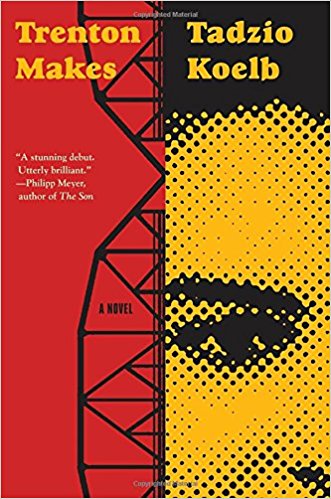
Trenton Makes by Tadzio Koelb

I read it as an: ARC

Source: my own collection/review source

Length: pp/time

Publisher: Doubleday

Year: 2018

Thoughts: A woman in post-WWII Trenton, NJ, accidentally kills her abusive husband, disposes of his body, and takes his identity. She can do this because he was apparently pretty small and she had worked in a factory during the war making wire rope and was strapping like Rosie the Riveter. She took on his identity as Abe Kunstler, moved to another part of town, went through a string of various odd jobs, and eventually is able to get work at another factory, making wire rope as he had done during the war. Abe has it pretty good until he decides that in order for his ruse to be complete, he needs a wife and child. He meets Inez, an alcoholic taxi dancer, and woos her away from her job at her dance hall. They marry and start to build a life together.  In time, Abe takes steps to start a family. After one on-the-page attempt to get Inez pregnant, the narrative then jumps ahead about 25 years to 1971. Trying for a family apparently worked, because Abe has a son, Art, who has possibly figured out Abe’s secret. Now Abe is determined to hold together everything he has struggled so hard to create.

Spoilers below cut. Continue reading “Trenton Makes”

Uncategorized

The Kill Fee

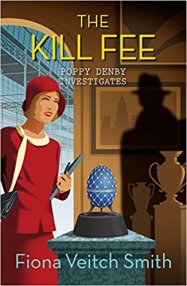
51kb9sptu2l-_sx324_bo1204203200_The Kill Fee  by Fiona Veitch Smith

I read it as a: paperback

Source: my own collection

Length: 330 pp

Publisher: Lion FIction

Year: 2016

Thoughts: The second instalment of the Poppy Denby series finds our intrepid heroine chasing down a killer who is after a stolen Faberge egg. The egg may contain a document containing information about the monarchs and other ruling members of European society, enough to destabilize every government and draw the continent back into war again. Key to finding the egg are members from a Russian noble family who were thought to have been murdered years ago. Poppy and her colleagues are trying to track down the egg and missing Russian nobility before the killer strikes again, this time at one of Poppy’s inner circle.

This book was as tautly written as the first in the series. The action was fast paced and the plot was complex without being unbelievable. The characters, including the secondary ones, were interesting and fun in their various ways. I enjoyed getting to know more about Poppy and Rollo. Rollo is my favorite, I believe, next to Poppy herself. I do enjoy a strong lady Bright Young Thing. However, not gonna lie. I just – can’t – care about the Russian stuff. It wasn’t anything the author did that I felt was badly handled or anything. I just don’t care about and have never been interested in Russian stuff, current politics excepted. Don’t know why, just not my jam. So this took me forever to read because I wasn’t all that invested in the actual plot, though it was well written.

I am, however, excited to read the next in the series, which I started today.


Uncategorized

Let the Tournament Begin!

Yay, the 2018 Tournament of Books is here! Looking forward to this year’s literary fireworks! 🙂

Uncategorized

Grimmtastic Girls #1: Cinderella Stays Late

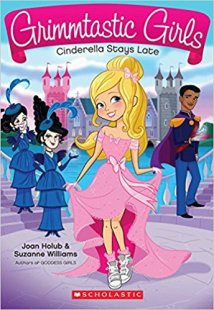
51ojqeu0dul-_sx342_bo1204203200_Grimmtastic Girls #1: Cinderella Stays Late by Joan Holub

I read it as a: paperback

Source: daughter’s personal collection

Length: 192 pp

Publisher: Scholastic

Year: 2014

Thoughts: In this introductory book to the Grimmtastic Girls series, we get to learn about the Grimm Academy, where characters from fairy tales and folklore go to school. Cinderella (call her Cinda) is just starting her first year at the Academy, having been too poor to afford tuition before now. Her mean “Steps” have attended the Academy since first grade. Cinda is quick to learn the ropes but there are so many rules and new ways of doing things that she never would have expected. This retelling of “Cinderella” sticks to the main plot points of the original tale, but includes new twists like a secret society that her stepsisters are involved with, a magical mystery, and a sentient wand instead of a fairy godmother.

This series seems like a fun way to teach younger readers about various characters from literature in a setting that is not as stuffy as some of the original fairy tales themselves. This particular book highlights themes such as perseverance, being brave in new surroundings, and making new friends. As with Holub’s other series, I appreciate the diversity shown in the characters, but there is still too much emphasis placed on who has a crush on whom, and on getting a crush on someone. Also, if romance is going to be a feature, I really think less time needs to be spent on gender norming and heteronormative social constructs. If fairy tales are going to be rewritten for the 21st century, then include characters in the LGBTQ community as well as the characters of color.