book review · weird

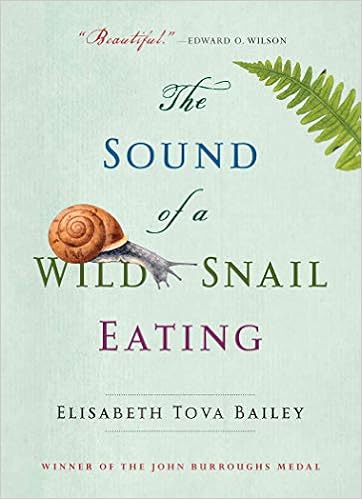
The Sound of a Wild Snail Eating

The Sound of a Wild Snail Eating by Elisabeth Tova Bailey

Genre: nonfiction/nature writing/memoir

I read it as a(n): hardback

Length: 190 pp

Her Grace’s rating: 4 out of 5 stars

When the author, Elisabeth Tova Bailey, is suddenly struck by a debilitating illness, she finds herself bedridden. One day, a visiting friend brings her a pot of flowers and a snail. At first, she was like “WTF? A snail?” but then discovers that there are many fascinating things about her weird little companion. Over the course of a year, Bailey observes and learns about her snail, even getting to witness some things not even a lot of snail scientists have seen. 

I never would have expected to get attached to a snail. But I did. I worried that the snail would die throughout the whole book, thinking it would get out and wander off and dry out, or die. I didn’t know they can live for years. Or that they have like a zillion teeth! Or that they really fucking love mushrooms. 

The writing style of this book was interesting. It mirrored the snail’s slow but steady speed while simultaneously making you feel a little bit stuck like the author was trapped in her sickbed. It was never boring but it was definitely a slower-paced book. It was also a very beautifully written book that imbued feeling into every passage with a simple observation about a falling leaf, or a hole eaten into a paper, or a snail’s tentacles waving at something new. 

Favorite lines:

  • Every few days I watered the violets from my drinking glass, and the excess water seeped into the dish beneath. This always woke the snail. It would glide to the rim of the pot and look over, slowly waving its tentacles in apparent delight, before making its way down to the dish for a drink (17-18).
  • Despite its small size, the snail was a fearless and tireless explorer (25).
  • A single portobello was about fifty times larger than my snail, and so my caregiver cut a generous slice and placed it in the terrarium. The snail loved the mushroom. It was so happy to have a familiar food, after weeks of nothing but wilted flowers, that for several days it slept right next to the huge piece of portobello… (29-30).
book review · historical fiction · Tudors

Dissolution

Dissolution by CJ Sansom

Genre: historical fiction

I read it as a(n): audiobook

Narrator: Steven Crossley

Length: 14:33:00

Her Grace’s rating: 3 out of 5 stars

The first of the Matthew Shardlake mysteries, Dissolution, features Master Shardlake being sent off to an abbey where one of the King’s commissioners had been murdered. Shardlake is a lawyer and clerk for Thomas Cromwell and is tasked with bringing the commissioner’s murderer to justice. When he arrives at the abbey, he finds it to be a seething morass of corruption, deceit, and forbidden faith. And of course the body count goes up and up the longer he’s there.

This was a good read overall. The setting was well described and the historical details were nicely researched. Sansom created a scene that easily came alive through his use of descriptive language. I am glad I don’t live in the Renaissance. The smell alone would kill me, if I somehow managed not to get burnt as a witch. 

The plot was complex and twisty without being overly complicated or unbelievable. I figured out the mystery, or one of them anyway, fairly early on but probably that’s just because I read a lot of mysteries. I was entertained throughout and the secondary plot/ mystery was one I didn’t guess before all was revealed. 

Would certainly read more in this series.

book review · fantasy

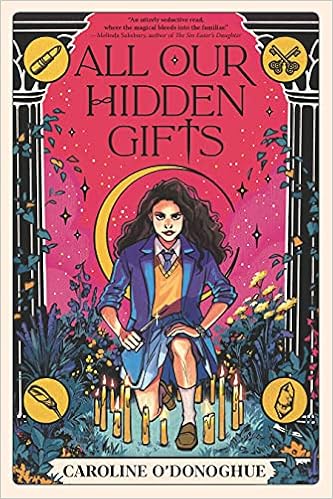
All Our Hidden Gifts

All Our Hidden Gifts by Caroline O’Donoghue

Genre: fantasy

I read it as a(n): paperback

Length: 374 pp

Her Grace’s rating: 3 out of 5 stars

Maeve is a typical teen – she likes hanging out with friends, doesn’t like school, occasionally has behavioural problems, and mainly just wants to fit in. When she randomly unearths a deck of tarot cards while cleaning out a room in detention, she discovers that she has a strange affinity and skill for reading the tarot. Maeve finds herself suddenly popular, her highly accurate tarot readings wildly in demand among her fellow students. But when a reading goes badly wrong and a girl disappears, Maeve once again finds herself on the edges of society. She finds herself assisted in some surprising ways as she struggles to fix what she broke, find the missing girl, and bring balance again to cosmic forces well beyond her understanding. 

This was a pretty fun read, though at times fairly standard. I liked that it was set in Ireland and had a plot involving some of the tensions between Catholics and Protestants. The way the author worked that into the story was nicely done. It invoked some historical elements that added some extra depth to the plot. I also liked how it seemed she was making a commentary on Christianity and how so often they are nowhere near as loving or whatever as they claim to be. 

The author also explored how being a teen is hard, yes, but it is also when you get new life experiences and the chance to have a lot of personal growth. A lot of the story revolved around this and other normal teen issues like learning how to navigate changing relationships. I think a big takeaway from it was that, even when things turn out fine in the end, that doesn’t mean they stay the same or even that they work out well. Sometimes you have to take life lessons with outcomes you don’t want. That isn’t bad, even if things hurt sometimes. It’s just the way it is. 

I read this because my daughter loved it and wanted me to read it as well. I try to read at least a few of the same books as her throughout the year. Most of the stuff she likes is sort of fluffy fantasy and this wasn’t really an exception. I like that she loves reading so I am always happy to share her books if there’s one she really enjoyed. It is one thing that I hope we will always have in common, a love of reading.

book review · sci-fi

Klara and the Sun

Klara and the Sun by Kazuo Ishiguro

Genre: sci-fi

I read it as a(n): hardback

Length: 320 pp

Her Grace’s rating: 2 out of 5 stars

Klara is an AF, or Artificial Friend. When the story opens, she’s in a store with several other AFs, waiting to be purchased so they can be a child’s companion/nanny/caregiver when their parents are busy working. Klara and friends are given turns sitting in the front display window where they are easy to see and can get the full benefit of being in the sunlight. The sun takes on the role of deity to the apparently solar-powered AFs so getting to be in the display window gives them not only a better chance to get charged up but more time to see the sun directly. Eventually, Klara is purchased for a girl called Josie, who has an unspecified disease that is likely to kill her. 

Klara learns the routines of her new household and how to care for Josie. In this particular, Klara is uniquely suited to be Josie’s AF since Klara is keenly observant, a trait not shared by most other AFs. Because of her ability to observe, Josie’s mother approached Klara with a strange request when it becomes clear that Josie isn’t likely to survive much longer. Klara agrees, but she also takes it upon herself to try to strike a deal with the sun to save Josie. 

There are a lot of complex ideas and themes in this book, which I totally expect from Ishiguro. We could discuss what it means to be human, religion, eugenics, or obsolescence. But here’s the thing – I didn’t care enough about any character in this novel to really want to do that. I found Klara to be utterly boring, Josie to be shallow and vapid, and her mother disengaged. The only character who seemed at all relatable was Josie’s friend Rick. He is an “unlifted” kid, whatever that means. It seems to be some kind of genetic enhancement to make them smarter. As a result, unlifted kids tend to be denied entry to schools or other opportunities, but the lifted ones seem to have potentially deadly side effects. It seems very eugenicist. 

The thing I thought was the most interesting was Klara’s anthropomorphization and deification of the sun. It became a living thing to her, capable of making decisions and deciding whether or not to save people from death. The deification was always present in Klara, so maybe all the AFs are programmed with a basic belief in the sun as a god. That’s super interesting since religion is entirely a man-made construct anyway. But it also was painfully ridiculous at times, the way Klara begged the sun to help Josie or to notice her, promising to do good things in return for the sun’s help. I never got a sense that Klara actually felt emotions, so her asking the sun to heal Josie felt flat rather than touching. The whole thing could easily be read that religion is similarly silly and useless as Klara’s devotion to the sun. Ishiguro himself is officially Zen Buddhist but says he and his family were really without religion; they just said Buddhist because it was required at the time for a religion to be on the birth certificate (NPR). This whole part of the novel makes me think that he was commenting on religion as an unnecessary, man-made construct, or that Klara’s programming could be analogous to the human need to find patterns and meaning in everything, the so-called “god gene” on a robotic level. For me, this was the most interesting part of the novel.

I was really disappointed with this book overall. Never Let Me Go it was not. That book was amazing and deep and dense. Klara and the Sun, by contrast, felt shallow. I’m not sure if that’s because Klara was the narrator and I found her to be supernaturally boring or if I just didn’t like it or what. Whatever it was, it made me want to reread NLMG to wash the taste of this one out of my brain. 

Reference:

“Kazuo Ishiguro Draws on His Songwriting Past to Write Novels about the Future.” NPR, NPR, 17 Mar. 2021, https://www.npr.org/transcripts/978138547.

book review · books

The Family Upstairs

The Family Upstairs by Lisa Jewell
Genre: mystery
I read it as a(n): hardback
Length: 338 pp
Her Grace’s rating: 3 out of 5 stars

Libby Jones has always known she was adopted. But upon her 25th birthday, she discovers she is apparently the sole remaining inheritor to a very large home in London’s posh Chelsea neighborhood. She also learns that her birth parents hadn’t really died in a car crash; they committed suicide in a cult. As Libby discovers more and more about her family’s dark history, with the help of a friendly investigative journalist, she finds herself enmeshed in a web of lies and deceit that could alter her entire life.

This was a fun piece of brain candy. It’s the second I’ve read by Lisa Jewell and so far I’ve enjoyed them both. I didn’t think there was a ton of character development but that’s ok. It’s a plot driven story and super in depth characters with a lot of growth throughout the book isn’t necessary for this to be a good read.

I’ve always been fascinated by cults except the cult of personality surrounding a certain orange former president. I know there are plenty of smart people who get sucked into cults so it’s weird to me how otherwise intelligent people can buy into shit like that. The cult in this story was small – just one disgusting but charismatic man and a few couples and small families – but the dynamics and deterioration from normal into crazy was horrifying and interesting all the same. Cults, man. They’re fucking weird.

Anyway, I liked the book, I’d read more by this author, and it was a nice diversion for a long weekend.