book review

The Leavers

Red book cover with a blurred man's face in the background. The text reads The Leavers A Novel by Lisa Ko

The Leavers by Lisa Ko

Genre: contemporary fiction/ literary 

I read it as a(n): hardback

Length: 335 pp

Her Grace’s rating: 3 out of 5 stars

Peilan “Polly” Guo arrives in NYC at the age of 19, pregnant and in debt up to her eyeballs to a loan shark. She left her small village in China to come to America for a better life as so many people have before her. She has her son, Deming, and works at various jobs to support him, living first in what is basically a flophouse with a dozen other women and then with her boyfriend, Leon; his sister, Vivian; and Vivian’s son, Michael. One day, Polly goes to work and doesn’t come home. Eventually, Deming is given into the foster system and adopted by the Wilkersons, a white couple living in rural upstate New York, who promptly rename him Daniel. Over the years, Deming/Daniel struggles to fit in anywhere and is haunted by the thought that his mother abandoned him.

There’s a lot we can say about this book. It is hard to organize my thoughts about it concisely so I probably won’t try too hard. But first, I thought it was just an ok novel. The book was technically well written, Ko did everything right in crafting the tale she had to tell. I just didn’t like it as well as I wanted to. It wasn’t a bad book at all, and I did like a lot about it. But I didn’t love it, and that was disappointing. 

It addresses the obvious themes of immigration and belonging, playing with the concept of home in some interesting ways. Deming, though American by birth, spent his first several years in China being cared for by Peilin’s father. He didn’t remember America before that so he felt at home in China. He felt somewhat at home in NYC with his mother once he got to know her again, but mostly that was because of their close bond. Home is where your mama is, after all. But he felt out of place in society at large, and far more so once the Wilkersons adopted him. Peilin, too, never quite fit in, partly because her English wasn’t very good and she had difficulty communicating, and partly because she didn’t fit the mold of the stereotypical Chinese woman. She’s loud and brash and fiery, and a lot of people don’t know what to do with all that. 

Peilin’s story was sad and, I suspect, mirrors the stories of thousands of immigrants. People talk about coming to America to make a better life for themselves. The American Dream, as it were. And yes, I would rather live here than in China or many other places. But I think emphasis needs to be placed upon dream in that phrase because the American Dream is really more of a pipedream than anything resembling reality. It isn’t real. Peilan wanted adventure and excitement in her life, not tedium and sameness. She went from a small village to a larger city, working in what sounded like a sweatshop and living in a dormitory of other women, on to NYC, where she also seemed to have worked in a sweatshop and piled in with a shitload of other women in a small apartment, all while owning tens of thousands of dollars to a loan shark who said he could get her legal immigration status. Really nothing changed for her, and I think I could argue that it in fact got worse for her in America. She was still working shit jobs day in and day out like she was in China. Only in America, she was also under a crushing debt while working insane hours for slave wages and hardly got to see her own child. And she was in a society that viewed her with suspicion or disdain and who didn’t speak her language. That sounds more like a nightmare to me, not a dream. 

Lisa Ko made Deming see music in color, which I thought was different. I think that condition is synesthesia, where you use one sense but process it through another. He hears music but sees colors in varying intensities, depending on what kind of music he’s listening to. It didn’t seem to be a huge component of the story, but I wonder if it was supposed to be part of the reason why Deming wasn’t a good student ever. Even before Peilan disappeared and he was happy, Deming was struggling in school and either the school lacked the resources to help him or lacked the desire to help him. Either way, I thought it was an interesting addition to the story.

This may be an unpopular opinion, but I hated the Wilkersons. I thought they were just gross. I felt deeply that they adopted Deming so they could say they adopted a non-white, underprivileged person and saved him from whatever horrible life they imagined he had before they managed to save him. They acted like they were fucking White Saviors. If I met people like them in real life, I would expect that they would say things to goad others into congratulating them on how accepting they are, how good they are to have adopted a kid who was older and a person of color to boot. Living in a rural area as they did, it was like they were putting Deming on display like an object, and he was certain to be noticed since he was one of only two people of color in the area that I noticed (his friend Roland, who was half Hispanic, was the second POC in town). Anyway, the Wilkersons take Deming and shove him into a fancy school and, when he’s college age, expect him to study what they want and go into the career they think he ought to. There is a heavy overtone of “you owe us” in their actions, a sense of obligation like Deming is indebted to them for adopting him and giving him what they consider to be a better life. I don’t feel like they actually loved him, just that they wanted to raise him up, as it were, and then make him follow in their footsteps even though he doesn’t want to, simply because he owes them.

I primarily blame the Wilkersons for Deming’s terrible choices. He is a gambling addict, which I know is a disease. He can’t help it. But the gambling, the drinking, the crappy grades, and the general failure to launch, I place that largely on the Wilkersons. There is no indication that they got Deming into therapy (if he did, then I’ve already completely forgotten that part!). Seems to me that if you adopt an older child who was abandoned and who has very recent memories of his mother you would want to get him into therapy for that. Childhood abandonment will fuck you up. It might make you feel you are not worthy of love which might manifest in, I don’t know, poor school performance or addiction. But they just dragged him to church with them right off the bat, like that’s going to help anyone, and then bemoaned their lot in their academic life. That was another thing – the Wilkersons are both professors at the local university and their whole relationship seems based on research and publishing and being very stereotypical elitist shits deep in some weird academia wankfest. It’s no wonder so many people hate liberal elites. If they were all like the Wilkersons, I’d hate liberal elites, too.

Anyway, I did like the book in general. There were a lot of great parts and vivid scenes. I got a glimpse of some elements of Chinese culture and the immigration experience, which was horrifying. No one should have to go through all that. I think it is an important book and feel that a lot of people need to read it. I just didn’t love it, and actively hated several characters.

book review · sci-fi

We Are Legion (We Are Bob)

Book cover with a blue outer space background, asteroids, and two spaceships. The text reads We Are Legion (We Are Bob) by Dennis E. Taylor

We Are Legion (We Are Bob) by Dennis E. Taylor

Genre: sci-fi

I read it as a(n): audiobook

Narrator: Ray Porter

Length: 07:57:00

Her Grace’s rating: 2 out of 5 stars

Bob Johansson signs papers that ensure he will be cryogenically frozen and then brought back to life after his death, once the technology allows such things. The day after he signs the papers, he gets creamed by a bus. When he wakes up about 150 years in the future, he is his old self only his mind has been incorporated into a ship. His mission is to go into space and look for habitable planets for humans to colonize, making copies of himself along the way for various projects. Along the way, Bob and his various copies (all with different names chosen because otherwise that would be madness) find planets, discover sentient life, entire new ecospheres, and generally try to recreate the United Federation of Planets. 

I thought this was an ok story. It was fun and in parts funny (though maybe that was more due to Porter’s narration than anything else), but overall I didn’t really see what all the hype was about. Sentient ships are nothing new, nor is colonizing planets, first contact, or just about anything else in this. Don’t get me wrong, I liked it and it was fun overall. Just not anything really to write home about. 

By far the best part about it, for me, was the continuance of Star Trek into the future. Bob, as a 21st century nerd, was reared on Star Trek, Star Wars, BSG, SG1, and a million other sci-fi shows and books. I loved the multitude of homages to all the sci-fi nerddom culture. 

Porter’s performance was, as always, superb. He has excellent comic timing and tone. 

I don’t know if it was a function of listening to this rather than eyeball reading it, but I had a really hard time keeping the Bobs separate. I know they’re all copies of the original Bob but they weren’t sufficiently different for me to tell them apart. I couldn’t keep track of who was at Delta Eridani with the Deltans or who was headed back to Sol to see what shape the Earth and humans were in – was it Riker!Bob or Bob!Bob or Milo!Bob or a different Bob? They were supposed to have different missions and thoughts but I felt that they were not actually different enough to tell them apart. Maybe it would have been easier if I had eyeball read it. 

Also, there were, like, two women in the entire book for just a couple pages each, and zero diversity. Apparently everyone in the future is white? It’s just a white gut cloning himself over and over, which I’m sure is a fantasy of many of them, especially boring rich dudes *coughelonmuskcough* but for the rest of us, it’s not something we really want to read about. Honestly, authors. At this point, you should know better. That changed my rating from a 3-star ehhh to a 2-star cringe.

As it is, while I liked this story all right, I didn’t like it enough to get the next two installations in the trilogy. I felt this one had sufficient closure at the end to forego the rest of them. If my public library had them, I would consider reading them and finishing out the series, but they don’t have ANY of Taylor’s books, so I’ll just consider this a one and done series.

book review · fantasy

These Violent Delights and Our Violent Ends

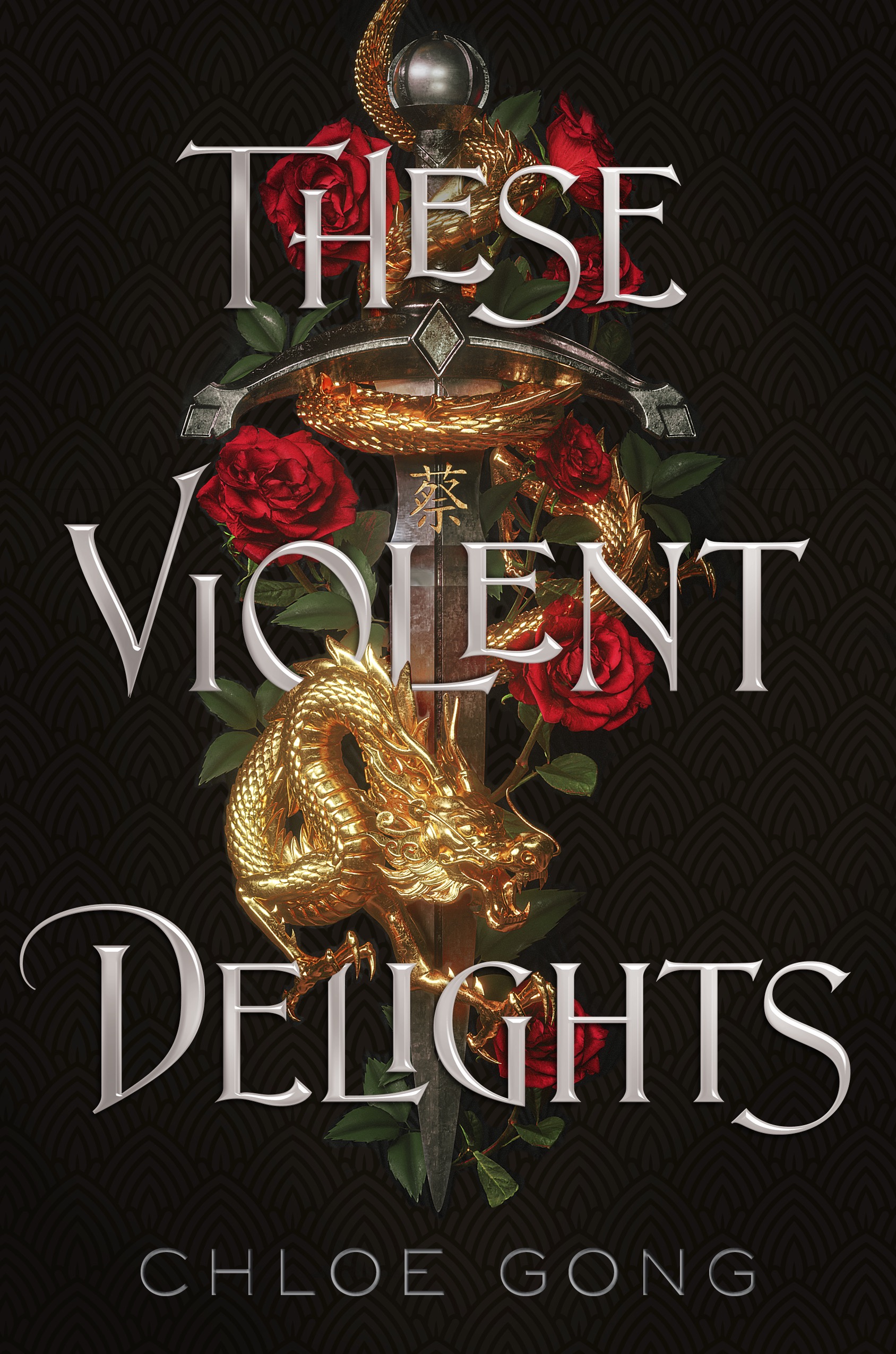
Book cover with roses twined around a sword and a golden Asian dragon. Text reads These Violent Delights by Chloe Gong

These Violent Delights by Chloe Gong

Genre: fantasy

I read it as a(n): hardback

Length: 449 pp

Her Grace’s rating: 5 out of 5 stars

Romeo and Juliet, but in 1920s Shanghai. With monsters! How can this be a bad thing? I’ll answer my own question: It can’t be a bad thing at all! 

The first book of this duology opens in September 1926. A monster has awoken in Shanghai, though no one knows it yet. Instead, the city is embroiled in the perpetual feud between the two ruling gangs: the Scarlet Gang, led by Lord Cai and his heir, Juliette; and the White Flowers, led by Lord Montagov and his heir, Roma. Juliette has recently returned to Shanghai after several years in America, where she had been sent for her own safety in the wake of a violent attack at the heart of Scarlet territory. No one knows that she and Roma have a past relationship and if it ever became known, it would bring even more violence into the feud. 

Shortly after her return, citizens of Shanghai begin to go insane and literally tear their own throats out with their own hands. Eventually, the people learn that the madness is spread by a monster living in the river that infects people through insects. As the madness spreads, the Scarlet Gang and the White Flowers warily put aside their feud and allow Roma and Juliette to work together to find a cure for the madness and kill the monster at the root of it all.

I loved this story so much. It had a cast of characters that was diverse with complicated personalities. Shanghai was very much a character in itself, vibrantly depicted and with moods of its own. The feud between the gangs is heavily influenced by politics and history, one being between Nationalists and Communists, and the other through a long history of colonization and exploitation. 

I enjoyed all the interactions between the characters. They reflect in various ways the complex histories they all share with each other, whether that history is romantic, friendly, familial, or violent. They were believable people who were all torn by duty, loyalty, and morality. 

Book cover with flames and golden dragon twined around a wreath of burnt roses and a metal lighter in the middle. Text reads Our Violent Ends by Chloe Gong

Our Violent Ends by Chloe Gong

Genre: fantasy

I read it as a(n): hardback

Length: 494 pp

Her Grace’s rating: 5 out of 5 stars

Our Violent Ends picks up right after the events of These Violent Delights. Juliette and Roma are at each other’s throats, partly from pent up desire and mostly because Juliette made a lethal decision to sacrifice her relationship with Roma to protect him from their families’ blood feud. She is now occupied with trying to prevent her cousin Tyler from taking over as Lord Cai’s heir to the Scarlet Gang. 

Roma returns her ruthlessness with interest, working hard to ensure that it is his own White Flowers who emerge from the feud on top. However, they once again are thrown into each other’s path as a blackmailer and a new set of monsters emerge to terrorize Shanghai, citizens and gangsters alike. Balancing the line between love and hate, war and peace, is always fun to read. 

As with the first book, Our Violent Ends features the same rich and complex characters, dynamic writing style, and a good blend of history, fantasy, and politics. 

And that ending – way, WAYYYY better than the original it is based on!

book review · sci-fi

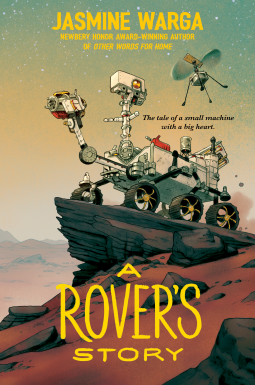
A Rover’s Story

A Rover’s Story by Jasmine Warga

Genre: sci-fi

I read it as a(n): hardback

Length: 294 pp

Her Grace’s rating: 5 out of 5 stars

This story is about a Mars rover called Resilience, which is based on real Mars rovers. He wakes up in a lab one day and learns that he is being built to go explore Mars, which is exciting to him because he was programmed a little too well and he’s developed human emotions. He develops attachments to his primary programmers, Raina and Xander, at NASA’s Jet Propulsion Lab, though they don’t know it since he can’t actually speak to them. Res is utterly determined not to disappoint them in any way and to do everything he can to live up to his name. 

I can’t remember where I first even heard about this book but as soon as I did, I put in a request for it from my library. I knew I had to read it. I went into it expecting something similar to Wall-E or Short Circuit. I didn’t know that I would be absolutely enthralled and shattered by a fictional Mars rover. This book made me cry more than once. 

Throughout, Res discovers new emotions and works through how they apply to his current situation. His friend and secondary rover, Journey, is deeply disturbed by his emotions, as is Guardian, the sentinel satellite (I guess?) in orbit around Mars. But Res persists in his exploration both of Mars and of his own inner world. I loved his thoughts about meaning in life, about death, about the importance of names. I loved his determination to live up to his own name. 

The majority of the story is from Res’s POV but interspersed throughout we also get to see journal entries from Sophie, Raina’s daughter. Sophie is about 8 years old at the beginning of the book and her chapters contribute valuable insight into the ways the rover mission is seen by the population in general as well as how it impacts her own family life. She is a little girl who misses her mom because she’s so often at work instead of, say, at Sophie’s ball games. In the same way it was fun to see Res evolve as a being, it was nice to see Sophie grow and change over the years as well. 

I loved this book so much that, if I get any gift cards for Amazon at Yule, I will be breaking my self-imposed moratorium on book buying and will get a copy of my own. This is a book I would read over, especially if I find I need a dopamine boost. 

Favorite lines/scenes:

  • “Where did you learn the term beeps and boops?”

Journey is quiet for a moment. It is not like her to be quiet. She is a fast processor. Her answers normally come at rapid speed.

“Journey?” I say.

“I created it.”

“You created it?”

“It is my phrase.”

“Oh,” I say.

“Do you think that is unscientific?”

“No,” I say without pause. “I think it is extraordinary” (24).

  • I want so badly to say, I’m going to try to be worth it (33).
  • There is clapping. Lots of it. Clapping is something I have observed that hazmats like to do. It is one of their ways to celebrate. They seem fascinated and delighted that their hands can make so much noise (79).
  • Avoid dust and see stars (124).
  • I experience the human emotion of hope. It is a sticky and strange feeling. It is a beautiful one (180).
  • I hear Xander’s words in my head. Telling me the meaning of my name. Resilience.

I must earn my name.

I must earn it over and over again (195).

  • It means something to have a name. To matter enough for someone to give you one (250).
book review · historical fiction

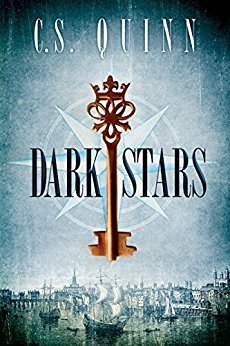
Dark Stars

Dark Stars by CS Quinn

Genre: historical mystery

I read it as a(n): audiobook

Narrator: Steve West

Length: 12:23:00

Her Grace’s rating: 2 out of 5 stars

Set a few weeks after the events of Fire Catcher, this third installation in The Thief Taker series centers around a killer who is leaving mutilated corpses to wash up around the port town of Deptford. The bodies are all marked with astrological signs that indicate a catastrophe will soon descend upon England. Charlie Tuesday teams up with Lily Bosworth to find the person responsible for the murders. In the process, he discovers that he is connected to the killer in ways beyond their shared astrological fate.

OK. So I didn’t care much for this book. I felt that the characters were surprisingly one-dimensional, especially considering that it was the 3rd book in the series. The good guys were very good, the bad guys were very bad. There were a couple others who were a little more shades of grey, but they were secondary characters that didn’t really add anything super important to the plot.

Speaking of adding to the plot – I’m sorry, but everything involving the court was basically irrelevant. What information we did learn from court could easily have been included elsewhere instead, like a rumor or intercepted letter. The side plot with the king’s mistresses and court politics was just kind of boring and didn’t, in my opinion, add anything vital to the overall story. I do not care at all about his primary mistress, Lady Castlemaine, nor the innocent young girl he fixates on later. The entire book could have been written without them in it at all, and if the rest of the court intrigue stuff had to be included, then probably 75% of it could be cut and still have retained what relevance was necessary. 

SPOILERS BELOW!

Continue reading “Dark Stars”