
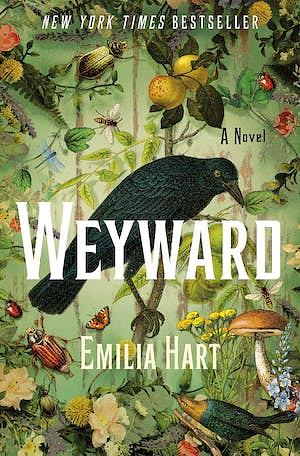
Weyward by Emilia Hart
Genre: magical realism
I read it as a(n): hardback
Length: 329 pp
Her Grace’s rating: 5 stars
2025 Reading Challenge tasks:
- Her Grace’s: #21: About witches or nuns
- TND: #35: Multiple perspectives
- PS: #24: A happily single female protagonist
Words cannot adequately express how much I fucking loved this book. I read it in less than two days, which is astonishing considering that I have recently struggled to read a scant 200-page book within the space of an entire month. But I was hooked right from the start of Weyward. This gorgeous book tells the ways in which the lives of three women in three different time periods intersect. They are all connected by a shared link to nature and abuse at the hands of men.
In 1619, Altha is a healer who is indicted for witchcraft after the husband of a childhood friend is killed. She has only ever used her skills to help her community, and they repay her by turning against her after a man falsely accuses her. Society fears female autonomy and strength, and we have the evidence of that in the witch crazes (and everything else that still persists today in how women are treated). There are references to Jennet Device and the Pendle Hill witch trial* scattered throughout Altha’s story, which is a historical reference I appreciate. Her trial for witchcraft underscores the dangers of being a woman with intelligence or independence in a world ruled by men.
In 1942, Violet chafes against the harsh restrictions imposed on her by her father and society. She uses nature to seek freedom, and she goes around her father to learn about the ecosystem and insects, doing an end-run around society’s gendered constraints. She suffers mental and emotional abuse from her father, and physical abuse and rape from her cousin. When she takes matters into her own hands, using her innate understanding of nature and her own keen intelligence, she narrowly escapes forced institutionalization. Lobotomy was the implied treatment, along with hysterectomy. Violet escapes a horrorshow life in an institution mainly because her brother stands up for her and rejects their father alongside his sister. Violet’s experiences show the ways in which women’s autonomy was stripped away under the guise of propriety.
In 2019, Kate escapes an abusive boyfriend and flees to a small cottage in the north of England that was left to her by her great-aunt. Said great-aunt happens to be Violet. When she arrives at Weyward Cottage, the wilderness surrounding the area helps her to rediscover and refine her strength and confidence. Kate’s story shows the continuing battle women have to deal with even in modern times, the constant stream of bullshit from patriarchal desires and systems that are forced on society. Seriously, why do we still have to struggle with this?
These three women are also case studies in how generational trauma works. They each have inherited both the wounds and the knowledge of their foremothers. The novel emphasizes the importance of embracing and working with that heritage. It is only by doing so that they, and we today, can find the ways to break the cycle of abuse and oppression.
Each of these women are witches in their own way – healer, scientist, mother. This is a story about the deep strength and courage of women, how we intersect with each other even across time, and the impact of the natural world on us all. Through their connection with nature, these women reclaim their identities and strength that was stripped from them. They give the finger to their abuse, abusers, and generational trauma by refusing to allow that abuse to define them. Instead, they are defined by their resilience and the way they each embraced their rewilding.
I cannot recommend this book highly enough. I think it is one that will resonate with any woman. After all, as Aunt Jet reminds us, there’s a little witch in all of us.
*Side quest: If you are interested in reading a superb historical fiction about the Pendle Hill witch trial, you will immediately go pick up Daughters of the Witching Hill by Mary Sharratt.
 Her Grace's Library
I admit I bought this book on its beautiful cover art alone. But I thoroughly enjoyed it!
LikeLiked by 2 people
That is a perfectly legit reason for buying a book! 😊I’ve done the same many times as well.
LikeLiked by 2 people