
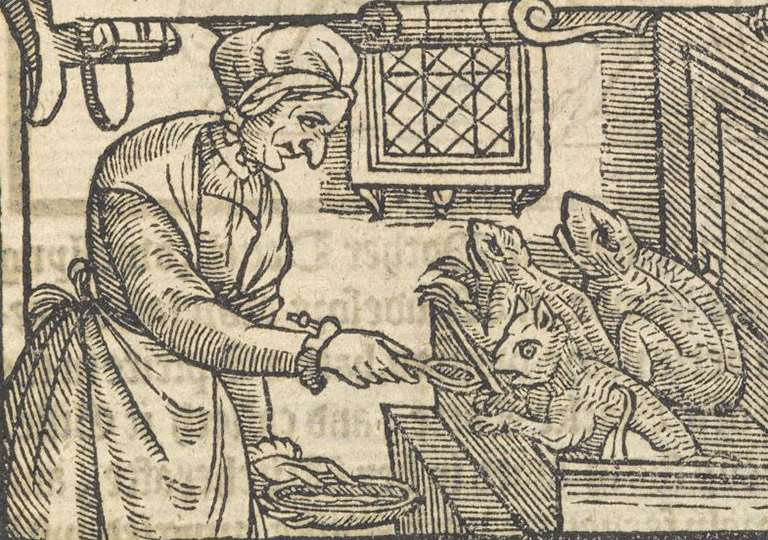
Lolly Willowes by Sylvia Townsend Warner Genre: British classics I read it as a(n): hardback Length: 222 pp Her Grace’s rating: 4 stars
This is another classic that I had never read and didn’t know anything about. I picked it to read partly because of that, and I also picked it for my book club when it was my turn because it was the very first book ever chosen by the Book of the Month Club. I thought that was cool. Also, a spinster who decides to move to the countryside and take up witchcraft? Hell, yes, sign me right up!
Laura “Lolly” Willowes is a spinster who has to go live with her brother and his family in London when their father dies. Because god forbid a woman live alone, as Lolly wanted to do. She has an affinity for the countryside and for learning about plants and herbs and animals. But she is not married and has few prospects of becoming so. I think maybe she is on the spectrum, though of course nobody knew about ASD when this book was written. Just the way she is described, though, makes me think that. She was also supremely introverted and didn’t want to go to parties or meet men to marry. Warner writes, “They had seen her at home, where animation brought color into her cheeks and spirit into her bearing. Abroad, and in company, she was not animated. She disliked going out, she seldom attended any but those formal parties at which the attendance of Miss Willowes of Lady Place was an obligatory civility; and she found there little reason for animation” (26). So, no weddings for Lolly.
She was viewed by her family as useful. The useful and doting aunt. The helpful sister. The competent household manager. Nobody ever really saw her for who she was, only for what they wanted her to be. So once her nieces and nephews were grown and no longer needed her, Lolly decided she was going to leave London and move to a town in the countryside called Great Mop, which is an awesome name, like she had wanted to do since her 20s, when she was required to move to London.
She found a room to rent as a lodger in a nice little town with a nice little lady and her husband. Where Lolly discovered that all the townspeople were witches and served Satan, so she decided to join the fun. But all she ever did with her satan witchy powers was curdle some milk, though. I mean, WHAT? If I had satanic powers (or the Force, or telekinesis, or anything of the sort) I would most definitely not just curdle milk with them. I would be visiting some politicians. “That is not the bill you are voting for. You will vote for this bill. Behave or I shall cast deep rectal itch upon you.” I would also totally make everyone on the road get out of my way. Like Fezzik in The Princess Bride.

Something I noticed throughout the book, or at least until Lolly moved back to the countryside, was that there isn’t a lot of dialogue in it. It was a blur of events and years. Even World War I took like 1 ½ pages, if that. I think Warner did that on purpose. It highlighted how dull and drifting Lolly’s life was, how empty and meaningless she felt. She was just going through the motions. She came alive when she left the city for the country, and it had little to do with giving her soul over to Satan and getting a cat. Though those things helped. Everyone needs a cat, and a dark lord.
The things Lolly noticed throughout the book were all tied to nature. She bought some fruit and jams from the grocer’s and wondered about the woman who had picked the fruit and made the jams: “A solitary old woman picking fruit in a darkening orchard, rubbing her rough fingertips over the smooth-skinned plums, a lean wiry old woman, standing with upstretched arms among her fruit trees as though she were a tree herself, growing out of the long grass, with arms stretched up like branches” (79). Sounds like some solid life goals to me!
Since Lolly knows that “nothing is impossible for a single, middle-aged woman with an income of her own” (95), she decides to stop being useful and go do what she wants. She was also 47 when she came to that decision, the same age I am. Yes, girl, rewild yourself! Her coming-of-age is very late, but it comes all the same. She figures out, finally, that she is her own person and that nobody – not her brother or nephews or nieces – could “drive her out, or enslave her spirit any more, nor shake her possession of the place she had chosen. While she lived her solitudes were hers inalienably; she and the kitten, the witch and the familiar, would live on at Great Mop, growing old together, and hearing the owls hoot from the winter trees” (159-160).
One thing I really loved is that Lolly totally had her own Barbie Speech. It is even longer than the Barbie Speech in the actual Barbie movie, but just as powerful. The Devil did tell her to talk, “not that I may know all your thoughts, but that you may” (216). And she certainly did talk. Her entire speech is still just as relevant today as it was when this book was published 100 years ago. That’s fucking infuriating. If you want to read her whole Lolly Barbie Speech, it is below the cut.
Click to reveal the spoiler
“When I think of witches, I seem to see all over England, all over Europe, women living and growing old, as common as blackberries, and as unregarded. I see them, wives and sisters of respectable men, chapel members, and blacksmiths, and small farmers, and Puritans. In places like Bedfordshire, the sort of country one sees from the train. You know. Well, there they were, there they are, child-rearing, house-keeping, hanging washed dishcloths on currant bushes; and for diversion each other’s silly conversation, and listening to men talking together in the way that men talk and women listen. Quite different to the way women talk, and men listen, if they listen at all. And all the time being thrust further down into dullness when the one thing all women hate is to be thought dull. And on Sunday they put on plain stuff gowns and starched white coverings on their heads and necks – the Puritan ones did – and walked across the fields to chapel, and listened to the sermon. Sin and Grace, and God and the –” (she stopped herself just in time), “and St. Paul. All men’s things, like politics, or mathematics. Nothing for them except subjection and plaiting their hair. And on the way back they listened to more talk. Talk about the sermon, or war, or cock-fighting; and when they got back, there were the potatoes to be cooked for dinner. It sounds very pretty to complain about, but I tell you, that sort of thing settles down on one like a fine dust, and by and by the dust is age, settling down. Settling down! You never die, do you? No doubt that’s far worse, but there is a dreadful kind of dreary immortality about being settled down on by one day after another. And they think how they were young once, and they see new young women, just like what they were, and yet as surprising as if it had never happened before, like trees in spring. But they are like trees towards the end of summer, heavy and dusty, and nobody finds their leaves surprising, or notices them till they fall off. If they could be passive and unnoticed, it wouldn’t matter. But they must be active, and still not noticed. Doing, doing, doing, till mere habit scolds at them like a house wife, and rouses them up – when they might sit in their doorways and think – to be doing still! …
Is it true that you can poke the fire with a stick of dynamite in perfect safety? I used to take my nieces to scientific lectures, and I believe I heard it then. Anyhow, even if it isn’t true of dynamite, it’s true of women. But they know they are dynamite, and long for the concussion that may justify them. Some may get religion, then they’re all right, I expect. But for the others, for so many, what can there be but witchcraft? That strikes them real. Even if other people still find them quite safe and usual, and go on poking with them, they know in their hearts how dangerous, how incalculable, how extraordinary they are. Even if they never do anything with their witchcraft, they know it’s there – ready! Respectable countrywomen keep their grave-clothes in a corner of the chest of drawers, hidden away, and when they want a little comfort they go and look at them, and think that once more, at any rate, they will be worth dressing with care. But the witch keeps her cloak of darkness, her dress embroidered with signs and planets; that’s better worth looking at. And think, Satan, what a compliment you pay her, pursuing her soul, lying in wait for it, following it through all its windings, crafty and patient and secret like a gentleman out killing tigers. Her soul – when no one else would give a look at her body even! And they are all so accustomed, so sure of her! They say: ‘Dear Lolly! What shall we give her for her birthday this year? Perhaps a hot-water bottle. Or what about a nice black lace scarf? Or a new workbox? Her old one is nearly worn out.’ But you say: ‘Come here, my bird! I will give you the dangerous black night to stretch your wings in, and poisonous berries to feed on, and a nest of bones and thorns, perched high up in danger where no one can climb to it.’ That’s why we become witches: to show our scorn of pretending life’s a safe business, to satisfy our passion for adventure. It’s not malice, or wickedness – well, perhaps it is wickedness, for most women love that – but certainly not malice, not wanting to plague cattle and make horrid children spout up pins and – what is it? – ‘blight the genial bed.’ Of course, given the power, one may go in for that sort of thing, either in self-defense, or just out of playfulness. But it’s a poor twopenny house-wifely kind of witchcraft, black magic is, and white magic is no better. One doesn’t become a witch to run around being harmful, or to run around being helpful either, a district visitor on a broomstick. It’s to escape all that – to have a life of one’s own, not an existence doled out to you by others, charitable refuse of their thoughts, so many ounces of stale bread of life a day, the workhouse dietary is scientifically calculated to support life. As for the witches who can only express themselves by pins and bed-blighting, they have been warped into that shape by the dismal lives they’ve led. Think of Miss Carloe! She’s a typical witch, people would say. Really she’s the typical genteel spinster who’s spent herself being useful to people who didn’t want her. If you’d got her younger she’d never be like that” (211-215).
And this quote really sums up not only the book but my entire worldview in a handy lil nutshell: That was one of the advantages of dealing with witches; they do not mind if you are a little odd in your ways, frown if you are late for meals, fret if you are out all night, pry and commiserate when at length you return. Lovely to be with people who prefer their thoughts to yours, lovely to live at your own sweet will, lovely to sleep out all night! (222).
Anyway, I enjoyed this book, and am eager to read more classics that I have never got around to before now.
Reference:
Warner, Sylvia Townsend. Lolly Willowes. Book of the Month, 2017.
 Her Grace's Library
This sounds like a delightful read, but I’m hesitant because of the Satanic part. Do you think I’d like it? Seriously, you just about have me convinced to give it a try. And also, I absolutely love your book reviews. You’re such a great writer.
LikeLiked by 1 person
Oooh, yes! I do think you would like it. It really isn’t about satanism. Satan is a character in the latter part of the story, but he is a metaphor more than anything. And he isn’t portrayed as an evil thing like a lot of people think. The whole witchcraft things is just a vehicle used as a means of self-discovery. The story is really about a woman finding her independence and voice and her own inner strength. It is just couched in terms of satanism because the author is also making fun of patriarchy, which she also smashes but good in this book. Considering that it is literally 100 years old, it is pretty progressive. And it’s quite funny in parts.
This article might also give you a good idea about it: How Lolly Willowes Smashed the Patriarchy by Selling Her Soul to Satan.
I’d say give it a try. The worst thing is that you decide you hate it and DNF it. Life is too short to read books you don’t like. 💖
LikeLiked by 1 person
I just added Lolly to my very long Wishlist. I’ll get to it eventually! Thanks for the recommendation!
LikeLike