book review · lifestyle · travel

Exploring Connections in ‘Landlines’ by Raynor Winn

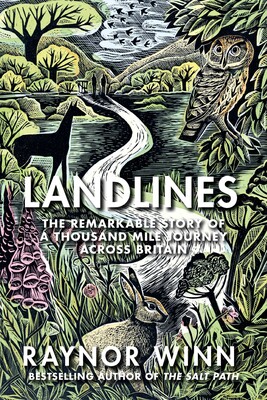
Landlines by Raynor Winn Genre: memoir/ nature writing I read it as a(n): trade paper Length: 303 pp Her Grace’s rating: 5 stars

Landlines – not just the telephones for old people! In Winn’s newest book, they are lines on maps. Lines on the land. Lines of communication. The theme of Winn’s third book are the various lines we encounter everyday and how they connect us to each other, to our home, to the places and people we love. 

Ray and Moth went walking, with the intention to walk the Cape Wrath Trail. That trail’s name sounds scary to me and I would probably die. Moth seemed to be getting worse and falling into a depression. Ray browbeat him into going walking again. At first, and for much of their trip, she felt guilty about it because Moth was convinced he was no longer able to do a long distance walk and he seemed to be genuinely miserable. But Ray, understandably, cannot give up on him or her hope. So she pushed and pulled and harangued until he kept going. And soon enough, they hit a rhythm that worked and rather than walking Cape Wrath and then going home, they decided to go to the next leg of the trail. And then the next. And the next. And ultimately they walked a thousand miles back home to Cornwall. 

As I wrote about previously, I don’t care if any of Raynor and Moth’s story is made up. I don’t think it is, but even if it is, I don’t care. I don’t think it matters. It’s memoir, not testimony, and there is still plenty of inspiration to be gleaned from any book, fiction or otherwise. I found Landlines to be just as inspiring and beautifully written as The Salt Path and The Wild Silence. I especially loved the references in this book to The Salt Path and how Ray now looks back on that time as one of the best parts of their life, even though while they were in it, it felt like one of the worst. I loved the way she weaves in reflections and memories of her life with Moth. They are all full of love, now tinged with the anticipation of dread and grief. “He reaches his hand out, and for a second I’m taking the last few steps through a freezing Arctic river and he’s pulling me up on to the bank of black ash, but that’s only a memory now” (20). 

A word I learned from this book: Moraine, an accumulation of dirt and rocks and other debris that is carried and deposited by moving glaciers. 

Some of my favorite quotes:

[Upon being given a couple bottles of beer by a stranger at a pub] “Put these in your bag, they’re for the big man later, don’t tell him ‘til tonight. What he’s doing, being out here, it’s a big thing. I might be loud, and drunk, but I know courage when I see it” (101). 

They’re the moments which turn desperate, annoying or desolate experiences into an understanding that the person you share the plastic bag with is the one, that you have the ability to laugh at anything, and that even having lost most of your material possessions you can survive on love, hope and a packet of dried noodles (105). 

“I know you’ve walked a long way.”

I look down at my clothes, muddy, ripped, smelling of dried bog-water. “I know, we do look a bit of a mess.”

“No, you can’t get away with it like that. I know who you are. Your book changed our lives – it changed the way we live our lives. We would never have given ourselves the time to just walk, not before we read your book.”

I look at the couple, heading towards middle age, but glowing from the wind, sun and enthusiasm. “The book might have given you an idea, but it didn’t change your lives.”

“How do you know that?”

“Because books don’t change lives. They can change how you think, but it’s you that changed your life” (227). 

Thousands of feet over thousands of years have trodden many of the same trails we have, tracing their passage on to the landscape, imprinting their memories into the soil. What remains are not just paths, they’re precious landlines that connect us to the earth, to our past and to each other. We’ve followed them for a thousand miles, seen so much, heard so many stories, until now, at the edge of the land, we’ve become something other than just walkers. We’re at the point where time and place and energy combine, where we become the path, the walker and the story. No need for runestones, it’s all held within us; we’re already part of our landlines, part of the song of the land (298-299).

academic · book review · bookish things · Medievalism

From Purity to Corruption: Gardens in Medieval and Gothic Stories

So this initially started as a straightforward book review. I read a book that I’m reviewing for the Historical Novel Society, called Her Wicked Roots, which is a retelling of Nathaniel Hawthorne’s short story “Rappaccini’s Daughter.” But as I worked on that review, I kept getting side-tracked and decided that I wanted to write a more in-depth article about gardens, both mediaeval and Gothic. Plus, I can’t post my HNS reviews until they publish it first. So instead I decided to remove the HNS book from this and will just post that plain review once they publish it. So now, behold! I will talk at you about gardens.

The concept of a divine garden has carried symbolic weight for thousands of years. From the gods’ garden in ancient Sumeria to the Hesperides’ golden apples, to the comparatively new Garden of Eden, stories of sacred gardens appear in myths all around the world. In medieval Europe, the image of the hortus conclusus (the enclosed garden) was particularly popular. It symbolized purity, chastity, and divine protection. In art, the Virgin Mary is often depicted sitting serenely within walled greenery, surrounded by lilies or roses that symbolize innocence and immaculate conception. The hortus conclusus was supposed to be safety itself. 

Anonymous, Madonna and saints in the Garden of Paradise (around 1410), Public Domain

But by the time Gothic literature popped up centuries later, that enclosed space had changed. The Gothic garden is the hortus conclusus inverted, a space where safety becomes confinement, purity becomes corruption, and nature no longer reflects divine harmony but human ambition, repression, and dread. It is the Upside Down of gardens! Also, humans ruin everything. 

St. Dunstan in the East, London, my own photo taken Sept 26, 2024.

Nathaniel Hawthorne’s short story, “Rappaccini’s Daughter,” portrays this transformation. Hawthorne sets his tale in a beautiful but deadly garden in mediaeval Padua, which mirrors the mediaeval hortus conclusus while also making it dark and twisty, and honestly way cooler. Rappaccini filled his garden with extremely poisonous plants and raised his daughter, Beatrice, among them until she herself literally became toxic. Birds avoid her, bugs and butterflies drop dead if they breathe near her. She is an innocent made unclean, a sort of parody of the Marian enclosed garden. Rather than a rose without blemish, Beatrice is a warped flower that was made monstrous by her father’s quest for knowledge at any cost. Rappaccini’s garden is a site of scientific overreach and destruction. It might be hidden away but it’s not protective, and its walls keep in corruption rather than keeping it out. Beatrice is just another victim of patriarchal control and as such, she is easily discarded once she is of no further use to her father or the story.

The Gothic novel frequently returns to this darker version of the garden. There are ruins, tangled vines, shadowy groves, hidden paths, and rot rather than cultivation. Nature turns into something dangerous and unhealthy. Flowers no longer symbolize purity. In Gothic hands, the garden isn’t a symbol of sanctity anymore. It becomes a mirror of humanity’s depravity. This reversal would very likely cause the Romantics to rend their garments and tear their hair. Byron would probably write super emo poems about it, for sure.

The medieval tradition makes the change in how nature is viewed even sharper. Texts such as the Song of Solomon which reads, “My sister, my spouse, is a garden enclosed, a garden enclosed, a fountain sealed up” (4.12, Douay-Rheims Bible), were read as allegories of Mary’s virginity. Poetry and iconography saw gardens as pure and contained spaces. But the Gothic imagination with its preoccupation with death and the uncanny, was, like Romanticism, a reaction against Enlightenment rationalism. As a result, the Gothic turned the idea of enclosure inside out. Enclosure meant captivity. Purity blurred into promiscuity. Now everything is all open and leaky and symbolic of corruption, specifically female corruption.

This shift tells us a lot about cultural change. The Gothic garden reflects human fears about unchecked knowledge, the danger of passion, and women’s agency. God forbid a woman have agency in any time period. These changes make sense when we view them as a reflection of the fears Enlightenment rationality and pursuit of science had upon much of society. Hawthorne’s Padua is one piece of this cultural shift, but so are the other crumbling castles, gardens, and estates that are scattered throughout Gothic fiction across the centuries.

Where the hortus conclusus invites reflection about purity, the Gothic garden forces us to reckon with corruption. Both depend on boundaries and are heavy with symbolism, but they serve opposite ends. One offers a vision of sanctity; the other, a mirror of human darkness. And yet they are inextricably linked: without Mary’s walled gardens, the poisoned gardens of the Gothic would lose their danger. The Gothic thrives on inversion, and the Gothic garden is my favorite reversal.

Further Reading:

Reference:
The Holy Bible: Douay-Rheims Version. Translated from the Latin Vulgate. Rockford, IL: TAN Books, 1971.