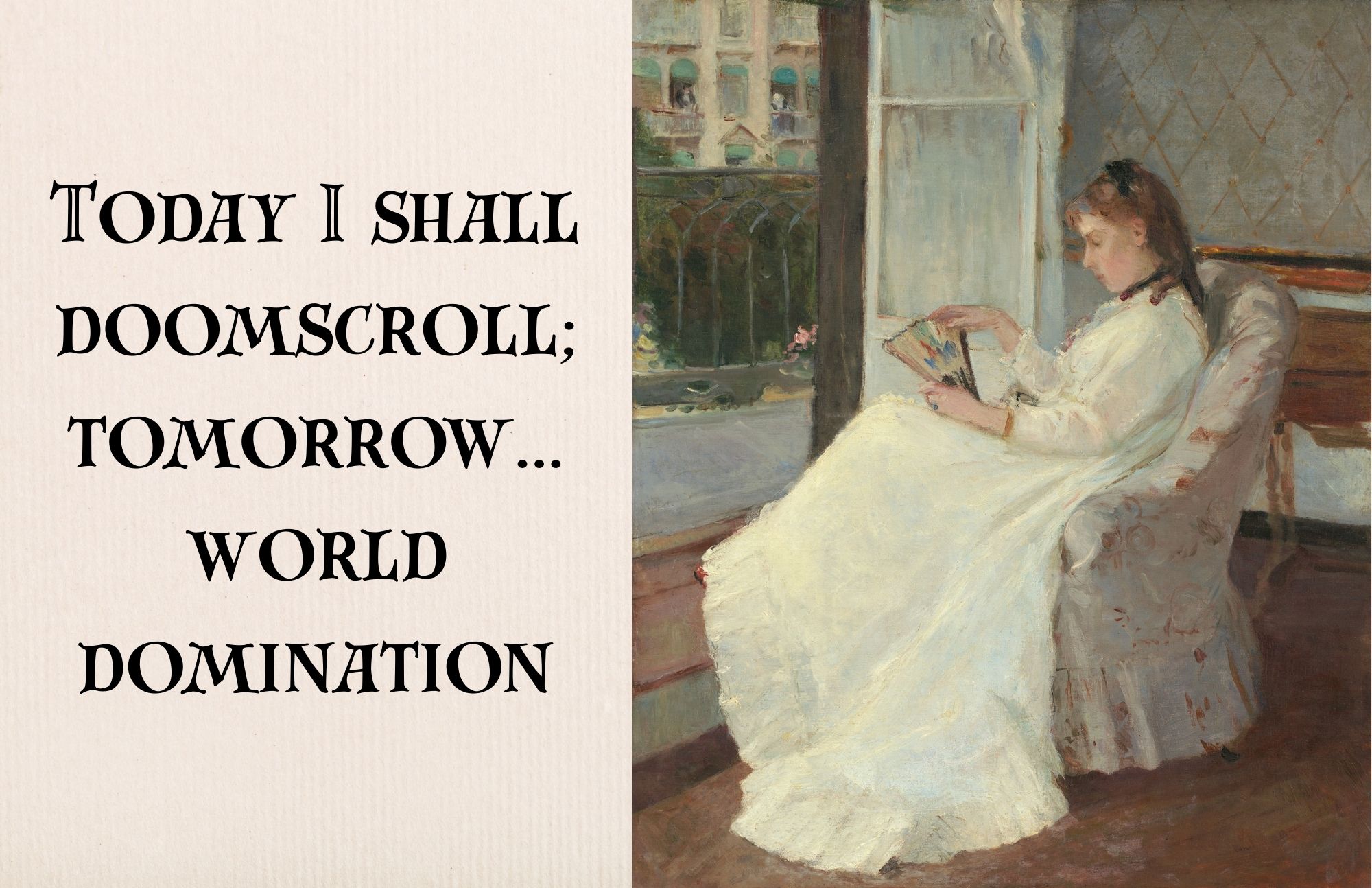
Doomscrolling. We’ve all done it. You pick up your phone to look up one small thing, open a browser, immediately forget what that thing was, yet somehow six hours later you’re still scrolling. Instagram. TikTok. A news organization’s social media page that is very carefully designed to make you angry, anxious, or afraid so you’ll keep clicking.
That’s not an accident. This is how those platforms make money, and they’re extremely good at it. They know how to grab your attention and keep you emotionally hooked, either by pushing content that makes you feel outraged and stressed out, or which gives you a big ol’ dopamine hit by confirming your biases.
A lot of people try to fight doomscrolling by carefully curating their social media feeds, like unfollowing certain accounts, avoiding news, or sticking only to content that feels light or harmless. I’ve done that, too. I don’t go on the hellsite known formerly known as Twitter at all anymore. My time on Bluesky is very limited. And my Instagram feed is aggressively curated. That’s where I go for posts about funny animals, art, travel, recipes, and crafting. No politics. No religion. Nothing designed to spike my blood pressure.
The problem is that even a carefully curated feed is still a feed. You’re still staring at a screen. You’re still scrolling. And you’re almost certainly spending more time doing it than you meant to.
What’s worked better for me is something the internet, ironically, has started calling analog doomscrolling.
I can’t believe 2025 is already over! It was a year that was simultaneously short and the longest year ever. I cannot fathom how we are…back here. Again. All I will say is that there is one very specific front-page headline that I am eagerly awaiting. You’ll know it when it happens. I have champagne waiting for the blessed event.
If you’ve stuck with me in this column, you know that I have often recommended various reading challenges to encourage us all to read outside our comfort zones, to read more diversely, and to find a new topic to learn. I believe I offered several to choose from at the start of this year or end of last year. I’ve even created my own reading challenges for a couple of years on my blog.
As is my habit, I would go through the challenges I decided to do for any given year and try to find books that would fulfill each task. I always find some great books that way. It’s interesting to me to see what I initially thought I’d read as opposed to what I actually read at the end of the year. Then, over the past couple of years, I noticed something different.
Reading, the activity I love above all things, had started to completely stress me out.
Not the act itself, but the endless choices. I had so many unread books that I couldn’t decide what to pick next, so I dithered for days between books, paralyzed by an indecision that was stealing my joy.
Eventually, I realized that I wasn’t reading for pleasure anymore or reading to learn something. I was reading only with the goal to hit an arbitrary number that I had picked based on whatever reading challenge(s) I wanted to do. Reading had become competitive, and I have never been a competitive person.
Cue my booknerd-angst. In a burst of quasi-panicked self-discovery, I realized that I didn’t actually want to do reading challenges anymore. Aside from being turned off by the competitiveness, it also felt performative. But how could that be when I loved learning about new books so much? Did not reading 100 books a year make me a bad reader? How could I be a real reader if I wasn’t wrapped up in some reading challenge or another? I told you I had angst about it.
What I eventually realized was that reading dozens of books a year might help me knock down my TBR faster, but what good did that do if I couldn’t remember a single thing about a book I’d just read? Sure, I was reading fast. I was reading a ton of wildly diverse books. But as soon as I put the book down, my brain did a big memory dump and I instantly forgot what I’d just read. Note that I didn’t say, “As soon as I finished the book.” No, it was literally as soon as I put it down to go do something else. I could be in the middle of a book and not be able tell you most of the character names or major plot points. And that was for books I was actually enjoying! If it was a bit of a slog to get through or wasn’t grabbing my attention fully, I would have been hard pressed to tell you even the title or author. It started to feel like there was no real difference between reading a book and forgetting it and not reading it at all. My “read count” might have been ticking up to 50, 80, even 100 books a year, but in actuality it was more like four, the ones I remembered because I loved and engaged with them so strongly.
I don’t think it was entirely coincidental that I was concurrently learning more about slow living and trying to apply those ideas to my life. Perhaps it was the cognitive dissonance between trying to live a slow life and also trying to burn through dozens of books a year that made me rethink my approach to reading. Mostly, it was the fact that I didn’t like reading books and then forgetting them instantly. But just like the newly apostatic, I still felt guilty about what I viewed as abandoning my beliefs and goals and the stress of it, even though it was entirely of my own making, caused me to start avoiding books altogether. At the same time, I stumbled across a couple BookTubers who reminded me that it is ok to read slowly and engage deeply with a text, to savor it, to take notes about it, to analyze it. They talked about many of the practices and habits that I used to rely on while reading, which I had fallen away from in the frenzy of reading challenges. One of them, Eddy Hood from The Read Well Podcast, even has a motto that I thought was helpful: “Read slowly. Take notes. Apply the ideas.” That simple statement kick-started me, and it felt like I was getting permission to read only twelve books a year, or six or even just one as long as I engaged with it and got something out of it. Or rather, it reminded me that I can give myself permission to slow down.
Ironically, since coming to the realization that reading challenges had become bad for me, I’ve read more books, and more deeply, than I had in the last couple years. I’ve found my joy in reading again. I’m building my new habits, or rather reviving my old ones, to think more deeply about what I read. I don’t mean that I feel the need to analyze some beach-read-brain-candy kind of book that is supposed to be read in a weekend and then passed along and never thought of again. I mean getting back into more challenging books like classics and nonfiction, maybe even some philosophy here and there. Writing down new vocabulary words, looking at the rhetorical devices used, finding symbolism and imagery, highlighting favorite quotes, disagreeing with parts of what the author says, and thinking about what I’m learning from each book. I remember why I got literature degrees in the first place. I remember why I love reading. I remember that I believe reading well is better than reading quickly.
Now if I could only find my little sticky book tabs…
Elodie Harper’s Boudicca’s Daughter tells the imagined story of two young girls who, according to Roman accounts, were ordered by Gaius Suetonius Paulinus, the Roman governor of Britain, to be raped by Roman soldiers while their mother was flogged. This atrocity became the biggest catalyst for Boudicca’s rebellion against Rome. Historically, we know almost nothing about these daughters: not their names, their fates, or even whether Boudicca had other children besides the two girls. After their assault, they disappear completely from the historical record.
That’s what makes this novel so compelling. Harper takes these nameless figures, women who were written out of history, and gives them identities, voices, and lives of their own. The book begins with the lead-up to Boudicca’s rebellion, but the uprising itself only occupies about the first quarter. The rest of the story unfolds from the perspective of her eldest daughter, who in this book is called Solina, as she navigates the aftermath of her mother’s rebellion – the trauma of the assault, the crushing defeat of her people, and her struggle to survive being sold into slavery in the heart of Rome.
One of the things I appreciated most was Harper’s willingness to explore the complexity of what happens after the rebellion ends, especially to the women who are left behind. Solina’s story feels like a reclamation of history, giving voice to those who were silenced. I’m always drawn to stories of strong women, and this one in particular highlights how resilience and strength can take many forms. Sometimes strength is quiet, sometimes it is choosing one of two evils and hoping you can live with that choice. It is aways deeply personal.
A theme that really challenged me while reading was the “enemies to lovers” dynamic. Normally, that trope doesn’t bother me when it’s something like academic rivals, sports competitors, or even just a couple of people who take an instant dislike to each other. But I’ve always been uncomfortable with stories that romanticize relationships between oppressors and victims, for example, between a Nazi officer and a Jewish prisoner. While such relationships almost certainly existed – I would think it’s a survival mechanism in at least some cases – I’ve always found that version of the trope disturbing and something I’d rather not read even if it might be historically accurate.
Yet in Boudicca’s Daughter, Harper approaches that idea in a way that made me think more deeply. When Solina forms a complicated relationship with Paulinus, the very man who ordered her rape and who destroyed her people, it isn’t presented as simple romance. If it was, it would have been unforgivably disrespectful to Solina, Boudicca, and every other woman in history who had to make a similar choice. Instead, it’s messy, painful, and psychologically complex. It made me reflect on how trauma can distort love and loyalty, how survival can blur moral boundaries, and how what we label “enemies to lovers” might sometimes be closer to a portrayal of coercion, dependency, or even Stockholm syndrome. I am still not sure what I think about Solina and Paulinus’s relationship or how honest such a relationship could ever really be.
In the end, I came away deeply impressed. Boudicca’s Daughter is not just a story about rebellion; it’s about identity and reclaiming one’s voice in the aftermath of violence. It’s powerful, unsettling, and unforgettable. I’d highly recommend it to readers who love stories about strong women, historical fiction, or anyone interested in the human side of Boudicca’s rebellion.
So this initially started as a straightforward book review. I read a book that I’m reviewing for the Historical Novel Society, called Her Wicked Roots, which is a retelling of Nathaniel Hawthorne’s short story “Rappaccini’s Daughter.” But as I worked on that review, I kept getting side-tracked and decided that I wanted to write a more in-depth article about gardens, both mediaeval and Gothic. Plus, I can’t post my HNS reviews until they publish it first. So instead I decided to remove the HNS book from this and will just post that plain review once they publish it. So now, behold! I will talk at you about gardens.
The concept of a divine garden has carried symbolic weight for thousands of years. From the gods’ garden in ancient Sumeria to the Hesperides’ golden apples, to the comparatively new Garden of Eden, stories of sacred gardens appear in myths all around the world. In medieval Europe, the image of the hortus conclusus (the enclosed garden) was particularly popular. It symbolized purity, chastity, and divine protection. In art, the Virgin Mary is often depicted sitting serenely within walled greenery, surrounded by lilies or roses that symbolize innocence and immaculate conception. The hortus conclusus was supposed to be safety itself.
Anonymous, Madonna and saints in the Garden of Paradise (around 1410), Public Domain
But by the time Gothic literature popped up centuries later, that enclosed space had changed. The Gothic garden is the hortus conclusus inverted, a space where safety becomes confinement, purity becomes corruption, and nature no longer reflects divine harmony but human ambition, repression, and dread. It is the Upside Down of gardens! Also, humans ruin everything.
St. Dunstan in the East, London, my own photo taken Sept 26, 2024.
Nathaniel Hawthorne’s short story, “Rappaccini’s Daughter,” portrays this transformation. Hawthorne sets his tale in a beautiful but deadly garden in mediaeval Padua, which mirrors the mediaeval hortus conclusus while also making it dark and twisty, and honestly way cooler. Rappaccini filled his garden with extremely poisonous plants and raised his daughter, Beatrice, among them until she herself literally became toxic. Birds avoid her, bugs and butterflies drop dead if they breathe near her. She is an innocent made unclean, a sort of parody of the Marian enclosed garden. Rather than a rose without blemish, Beatrice is a warped flower that was made monstrous by her father’s quest for knowledge at any cost. Rappaccini’s garden is a site of scientific overreach and destruction. It might be hidden away but it’s not protective, and its walls keep in corruption rather than keeping it out. Beatrice is just another victim of patriarchal control and as such, she is easily discarded once she is of no further use to her father or the story.
The Gothic novel frequently returns to this darker version of the garden. There are ruins, tangled vines, shadowy groves, hidden paths, and rot rather than cultivation. Nature turns into something dangerous and unhealthy. Flowers no longer symbolize purity. In Gothic hands, the garden isn’t a symbol of sanctity anymore. It becomes a mirror of humanity’s depravity. This reversal would very likely cause the Romantics to rend their garments and tear their hair. Byron would probably write super emo poems about it, for sure.
The medieval tradition makes the change in how nature is viewed even sharper. Texts such as the Song of Solomon which reads, “My sister, my spouse, is a garden enclosed, a garden enclosed, a fountain sealed up” (4.12, Douay-Rheims Bible), were read as allegories of Mary’s virginity. Poetry and iconography saw gardens as pure and contained spaces. But the Gothic imagination with its preoccupation with death and the uncanny, was, like Romanticism, a reaction against Enlightenment rationalism. As a result, the Gothic turned the idea of enclosure inside out. Enclosure meant captivity. Purity blurred into promiscuity. Now everything is all open and leaky and symbolic of corruption, specifically female corruption.
This shift tells us a lot about cultural change. The Gothic garden reflects human fears about unchecked knowledge, the danger of passion, and women’s agency. God forbid a woman have agency in any time period. These changes make sense when we view them as a reflection of the fears Enlightenment rationality and pursuit of science had upon much of society. Hawthorne’s Padua is one piece of this cultural shift, but so are the other crumbling castles, gardens, and estates that are scattered throughout Gothic fiction across the centuries.
Where the hortus conclusus invites reflection about purity, the Gothic garden forces us to reckon with corruption. Both depend on boundaries and are heavy with symbolism, but they serve opposite ends. One offers a vision of sanctity; the other, a mirror of human darkness. And yet they are inextricably linked: without Mary’s walled gardens, the poisoned gardens of the Gothic would lose their danger. The Gothic thrives on inversion, and the Gothic garden is my favorite reversal.
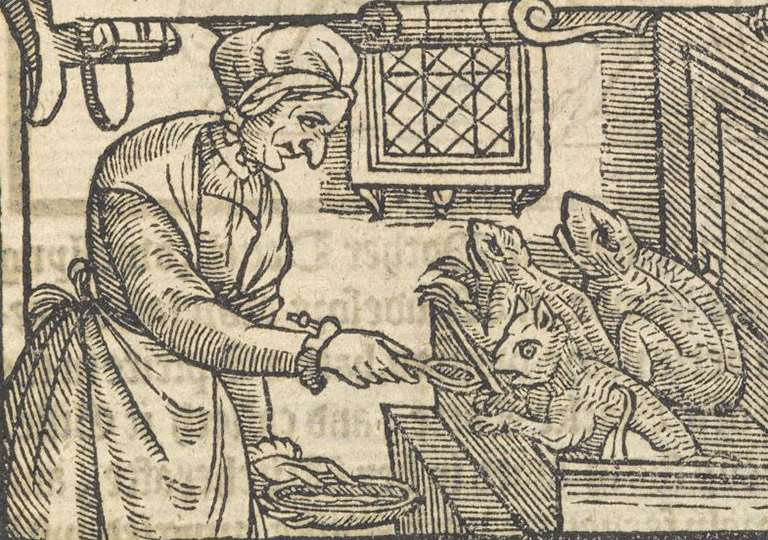
A woodcut from a 1579 pamphlet showing a witch feeding her familiars. From englishheritage.org, courtesy of The British Library
Lolly Willowes by Sylvia Townsend Warner Genre: British classics I read it as a(n): hardback Length: 222 pp Her Grace’s rating: 4 stars
This is another classic that I had never read and didn’t know anything about. I picked it to read partly because of that, and I also picked it for my book club when it was my turn because it was the very first book ever chosen by the Book of the Month Club. I thought that was cool. Also, a spinster who decides to move to the countryside and take up witchcraft? Hell, yes, sign me right up!
Laura “Lolly” Willowes is a spinster who has to go live with her brother and his family in London when their father dies. Because god forbid a woman live alone, as Lolly wanted to do. She has an affinity for the countryside and for learning about plants and herbs and animals. But she is not married and has few prospects of becoming so. I think maybe she is on the spectrum, though of course nobody knew about ASD when this book was written. Just the way she is described, though, makes me think that. She was also supremely introverted and didn’t want to go to parties or meet men to marry. Warner writes, “They had seen her at home, where animation brought color into her cheeks and spirit into her bearing. Abroad, and in company, she was not animated. She disliked going out, she seldom attended any but those formal parties at which the attendance of Miss Willowes of Lady Place was an obligatory civility; and she found there little reason for animation” (26). So, no weddings for Lolly.
She was viewed by her family as useful. The useful and doting aunt. The helpful sister. The competent household manager. Nobody ever really saw her for who she was, only for what they wanted her to be. So once her nieces and nephews were grown and no longer needed her, Lolly decided she was going to leave London and move to a town in the countryside called Great Mop, which is an awesome name, like she had wanted to do since her 20s, when she was required to move to London.
She found a room to rent as a lodger in a nice little town with a nice little lady and her husband. Where Lolly discovered that all the townspeople were witches and served Satan, so she decided to join the fun. But all she ever did with her satan witchy powers was curdle some milk, though. I mean, WHAT? If I had satanic powers (or the Force, or telekinesis, or anything of the sort) I would most definitely not just curdle milk with them. I would be visiting some politicians. “That is not the bill you are voting for. You will vote for this bill. Behave or I shall cast deep rectal itch upon you.” I would also totally make everyone on the road get out of my way. Like Fezzik in The Princess Bride.
Something I noticed throughout the book, or at least until Lolly moved back to the countryside, was that there isn’t a lot of dialogue in it. It was a blur of events and years. Even World War I took like 1 ½ pages, if that. I think Warner did that on purpose. It highlighted how dull and drifting Lolly’s life was, how empty and meaningless she felt. She was just going through the motions. She came alive when she left the city for the country, and it had little to do with giving her soul over to Satan and getting a cat. Though those things helped. Everyone needs a cat, and a dark lord.
The things Lolly noticed throughout the book were all tied to nature. She bought some fruit and jams from the grocer’s and wondered about the woman who had picked the fruit and made the jams: “A solitary old woman picking fruit in a darkening orchard, rubbing her rough fingertips over the smooth-skinned plums, a lean wiry old woman, standing with upstretched arms among her fruit trees as though she were a tree herself, growing out of the long grass, with arms stretched up like branches” (79). Sounds like some solid life goals to me!
Since Lolly knows that “nothing is impossible for a single, middle-aged woman with an income of her own” (95), she decides to stop being useful and go do what she wants. She was also 47 when she came to that decision, the same age I am. Yes, girl, rewild yourself! Her coming-of-age is very late, but it comes all the same. She figures out, finally, that she is her own person and that nobody – not her brother or nephews or nieces – could “drive her out, or enslave her spirit any more, nor shake her possession of the place she had chosen. While she lived her solitudes were hers inalienably; she and the kitten, the witch and the familiar, would live on at Great Mop, growing old together, and hearing the owls hoot from the winter trees” (159-160).
One thing I really loved is that Lolly totally had her own Barbie Speech. It is even longer than the Barbie Speech in the actual Barbie movie, but just as powerful. The Devil did tell her to talk, “not that I may know all your thoughts, but that you may” (216). And she certainly did talk. Her entire speech is still just as relevant today as it was when this book was published 100 years ago. That’s fucking infuriating. If you want to read her whole Lolly Barbie Speech, it is below the cut.
Click to reveal the spoiler
“When I think of witches, I seem to see all over England, all over Europe, women living and growing old, as common as blackberries, and as unregarded. I see them, wives and sisters of respectable men, chapel members, and blacksmiths, and small farmers, and Puritans. In places like Bedfordshire, the sort of country one sees from the train. You know. Well, there they were, there they are, child-rearing, house-keeping, hanging washed dishcloths on currant bushes; and for diversion each other’s silly conversation, and listening to men talking together in the way that men talk and women listen. Quite different to the way women talk, and men listen, if they listen at all. And all the time being thrust further down into dullness when the one thing all women hate is to be thought dull. And on Sunday they put on plain stuff gowns and starched white coverings on their heads and necks – the Puritan ones did – and walked across the fields to chapel, and listened to the sermon. Sin and Grace, and God and the –” (she stopped herself just in time), “and St. Paul. All men’s things, like politics, or mathematics. Nothing for them except subjection and plaiting their hair. And on the way back they listened to more talk. Talk about the sermon, or war, or cock-fighting; and when they got back, there were the potatoes to be cooked for dinner. It sounds very pretty to complain about, but I tell you, that sort of thing settles down on one like a fine dust, and by and by the dust is age, settling down. Settling down! You never die, do you? No doubt that’s far worse, but there is a dreadful kind of dreary immortality about being settled down on by one day after another. And they think how they were young once, and they see new young women, just like what they were, and yet as surprising as if it had never happened before, like trees in spring. But they are like trees towards the end of summer, heavy and dusty, and nobody finds their leaves surprising, or notices them till they fall off. If they could be passive and unnoticed, it wouldn’t matter. But they must be active, and still not noticed. Doing, doing, doing, till mere habit scolds at them like a house wife, and rouses them up – when they might sit in their doorways and think – to be doing still! …
Is it true that you can poke the fire with a stick of dynamite in perfect safety? I used to take my nieces to scientific lectures, and I believe I heard it then. Anyhow, even if it isn’t true of dynamite, it’s true of women. But they know they are dynamite, and long for the concussion that may justify them. Some may get religion, then they’re all right, I expect. But for the others, for so many, what can there be but witchcraft? That strikes them real. Even if other people still find them quite safe and usual, and go on poking with them, they know in their hearts how dangerous, how incalculable, how extraordinary they are. Even if they never do anything with their witchcraft, they know it’s there – ready! Respectable countrywomen keep their grave-clothes in a corner of the chest of drawers, hidden away, and when they want a little comfort they go and look at them, and think that once more, at any rate, they will be worth dressing with care. But the witch keeps her cloak of darkness, her dress embroidered with signs and planets; that’s better worth looking at. And think, Satan, what a compliment you pay her, pursuing her soul, lying in wait for it, following it through all its windings, crafty and patient and secret like a gentleman out killing tigers. Her soul – when no one else would give a look at her body even! And they are all so accustomed, so sure of her! They say: ‘Dear Lolly! What shall we give her for her birthday this year? Perhaps a hot-water bottle. Or what about a nice black lace scarf? Or a new workbox? Her old one is nearly worn out.’ But you say: ‘Come here, my bird! I will give you the dangerous black night to stretch your wings in, and poisonous berries to feed on, and a nest of bones and thorns, perched high up in danger where no one can climb to it.’ That’s why we become witches: to show our scorn of pretending life’s a safe business, to satisfy our passion for adventure. It’s not malice, or wickedness – well, perhaps it is wickedness, for most women love that – but certainly not malice, not wanting to plague cattle and make horrid children spout up pins and – what is it? – ‘blight the genial bed.’ Of course, given the power, one may go in for that sort of thing, either in self-defense, or just out of playfulness. But it’s a poor twopenny house-wifely kind of witchcraft, black magic is, and white magic is no better. One doesn’t become a witch to run around being harmful, or to run around being helpful either, a district visitor on a broomstick. It’s to escape all that – to have a life of one’s own, not an existence doled out to you by others, charitable refuse of their thoughts, so many ounces of stale bread of life a day, the workhouse dietary is scientifically calculated to support life. As for the witches who can only express themselves by pins and bed-blighting, they have been warped into that shape by the dismal lives they’ve led. Think of Miss Carloe! She’s a typical witch, people would say. Really she’s the typical genteel spinster who’s spent herself being useful to people who didn’t want her. If you’d got her younger she’d never be like that” (211-215).
And this quote really sums up not only the book but my entire worldview in a handy lil nutshell: That was one of the advantages of dealing with witches; they do not mind if you are a little odd in your ways, frown if you are late for meals, fret if you are out all night, pry and commiserate when at length you return. Lovely to be with people who prefer their thoughts to yours, lovely to live at your own sweet will, lovely to sleep out all night! (222).
Anyway, I enjoyed this book, and am eager to read more classics that I have never got around to before now.
Reference:
Warner, Sylvia Townsend. Lolly Willowes. Book of the Month, 2017.
Welcome to our 2nd annual reading challenge! I can’t believe it is 2025. That sounds like a science fiction setting. Wasn’t 12 Monkeys set in 2025? Or maybe it was Mad Max. I dunno. Probably there were a few. Anyway. Here are some new prompts for 2025.
I cheerfully admit that I totally failed to complete even my own reading challenge in 2024. I have no idea what happened or why, but I hit a BIG reading slump that lasted for several months. At one point, it took me the better part of a month to read a 300-page Star Trek book that I should have plowed through in a weekend. So that was weird. Because of that, I decided to create a smaller challenge for 2025. I did 24 challenge prompts, which will average out to 2 books a month. That is a much more doable goal at the moment, for me anyway. I threw in 2 bonus prompts as well for extra fun while completing the tasks.
Did you complete a reading challenge in 2024, whether it was this one or a different one? What are the best books you read as a result?
The Prompts:
Set in a non-patriarchal society, because FUCK the patriarchy
Set in or about nature
Reread a favorite childhood book
A nonfiction by a woman about a STEM field
By or about a person struggling with a mental illness
Recommended by a family member
A middle grade book
A nonfiction about an -ology
Passes the Bechdel Test
A book that was adapted to the screen
A book that is a novelization of a TV show or movie
A book that won an award in 2023
A book with a yellow spine
Flowers on the cover
A retelling
A banned or frequently challenged book
Explores a culture that is different from yours
Features snakes in some way (2025 is the Year of the Snake in Chinese zodiac)
Set in a utopian society, because reality is dystopian enough, thank you
Related to medicine
About witches or nuns
About geek culture
Takes place over one 24-hour period
Three or more point-of-view characters
Bonus challenge 1: Complete the challenge using books only by people who identify as women
Bonus challenge 2: Use the prompts to complete the A-Z reading challenge
The Salt Path by Raynor Winn Genre: memoir I read it as a(n): audiobook Narrator: Raynor Winn Length: 09:00:00 Her Grace’s rating: 5 stars
Raynor Winn and her husband, Moth, are in their 50s when they lose everything due to a bad business scheme their friend got them into. They find themselves with no home, no business, no money, and no one able to help. On top of all that, Moth is diagnosed with a terminal degenerative illness just days after they lost everything else. So they pack their backpacks and set off to walk the South West Coastal Path, a 600+ mile trail around the Cornish peninsula. Just like any normal person would (WARNING: sarcasm detected). Having lost all their savings, they are dependent upon the miniscule amount of government funds they’re entitled to, which is something like £20 per week.
I first became aware of this book because of an article I saw that said it was being filmed and is starring Jason Isaacs and Gillian Anderson. BOTH of my celebrity crushes in the SAME MOVIE OMFG *FLAIL* WHEN CAN I WATCH IT??
Here’s the thing, though. After reading it, it doesn’t even matter to me if Jason and Gillian are starring. At this point, I would have watched it no matter who was in the film. They could have cast Adam Sandler (shudder) and Gwyneth Paltrow (double shudder) and I would still watch it. That’s because I already know this book will top out in my 5 favorite reads of 2024.
I read this book a few weeks ago and I still can’t get it out of my head. I felt so bad for Ray and Moth. I can’t imagine how hurt and scared they must have been to be screwed over like they were by a “friend” or how unfair the legal system was to them (they had proof they were not at fault but weren’t allowed to use it because they didn’t submit a form exactly right WTF). Also, how awful it must have been for Moth to carry on when his body was betraying him.
One thing that struck me throughout the book was the casual cruelty they experienced. They could be sitting by themselves, bothering nobody, in a public park, and someone often would come along and tell them they’re disgusting for being drunk in public or sleeping in public or being crazy in public or whatever the fuck. Nevermind the fact that they were not drunk or stoned or anything like that, and they were homeless. There aren’t enough shelters or space in the existing ones. Where the fuck are they supposed to sleep, the Savoy? And what kind of judgmental jerk automatically assumes that if a person is homeless, they must also be an addict, criminal, or mental patient of some kind? I guess being poor in public is also frowned upon. The fact that these were educated, productive members of society prior to their devastating loss apparently never even occurred to any of the people who gave them grief. Also? I don’t know about you but if I were homeless, numbing all of that with drugs and alcohol probably would seem like an excellent idea.
I think the thing that made me feel the worst to hear about was when they were laying in their tent in the early morning (in a location where it is perfectly fine to pitch a tent) and waiting to get the day started when a random hiker and his dog both take a piss on their tent. I mean, who the fuck DOES that? What kind of asshole do you have to be to piss, literally, on someone’s home? See, this is an example of why I should never become a Jedi. If I had the Force, there is a 100% chance I would use it to give instant karma to assholes like that. Want to pee on someone’s tent? Cool – instant, antibiotic-resistant UTI for you. Maybe a scorching case of jock itch as well. Enjoy it, dickweed.
All that is to say that this book correctly challenges the perceptions much of society has towards people who are marginalized, whether they are unhoused, addicted, mentally ill, or anything else. People without homes are still people. People with addictions are still people. People who are impoverished are still people. The fact that this needs to be said is a pathetic indictment on humanity as a whole.
That said, they also did encounter many people who were kind and helpful along the way. Some of them were also walking the south west coast path and they ran into them more than once, though those people were all walking on vacation and only had so many days before they got into a car and drove back home. While they were generally kind and eager to share, it seemed like that was a painful encounter as well since Ray and Moth had no home to go to when they were cold or hungry or sick. Listening to it felt a little like rubbing salt in the wound.
The book is also an exploration of home and what makes a home. Initially, home was their lost farm, the place where their kids had been born and grew up, where all their things were. By the end, home was simply with each other. They learned that they needed far less than they ever thought, and got by on less than that even though it was out of necessity. As long as they were together, that was really all they needed. That was home and they can take it with them anywhere they go.
FAVORITE QUOTE
We were lightly salted blackberries, hanging in the last of the summer sun, and this perfect moment was the only one we needed.
Since I decided to make my own reading challenge for 2024, I figured it is a good idea to figure out which books I might want to use to complete the tasks. I’m going to see how many of my own TBR books I can use, first, and how many I can do with women/LGBTQ+/BIPOC authors for as many as I can. Below are some suggestions for each task. Double-dipping is totally allowed!
Also, as I researched for books to complete these tasks, I learned that I need better definitions for some things, or that some others could be worded differently, or be defined in a broader way. Sorry about that! I will try to do better for next year’s tasks.
If you have any suggestions for any of the tasks, please share them in the comments! I love book recs!
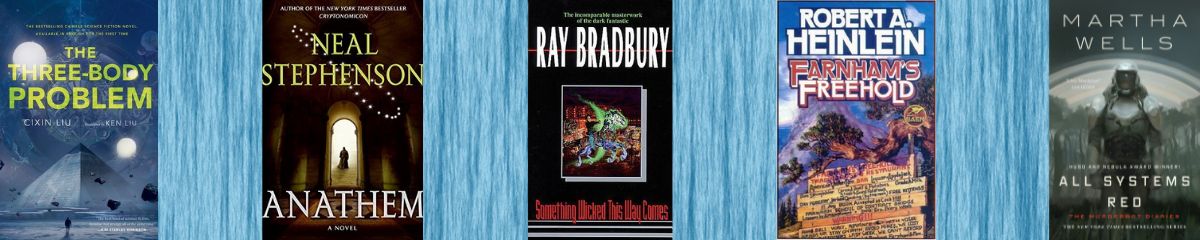
A title longer than 6 words: The Girl Who Circumnavigated Fairyland in a Ship of Her Own Making (Catherynne Valente) Written by an author with your initials: Katherine Mansfield for me The MC is an animal: The Bees (Laline Paull) or Hollow Kingdom (Kira Jane Buxton) Takes place underwater: The Mountain in the Sea (Ray Nayler), Startide Rising (David Brin), A Darkling Sea (James L. Cambias) Doesn’t have the letter “e” in the title: Hollow Kingdom (Kira Jane Buxton) or Loki’s Ring or any number of others on my list, I reckon. Or Gadsby by Ernest Vincent Wright if you want to read an entire book that doesn’t have an E anywhere. By or about being a refugee: Downbelow Station (C.J. Cherryh), Girl at War (Sarah Novic), The Amazing Adventures of Kavalier and Clay (Michael Chabon), or American Dirt (Jeanine Cummins) In translation: The Little Paris Bookshop (Nina George), The Three-Body Problem (Cixin Liu), Walking Practice (Dolki Min) A cover featuring neon colors: The Ultimate Cyberpunk Anthology The MC is a non-human entity (robot, alien, etc.): Murderbot! I plan to read the whole series this year. Other options are The Last Unicorn (Peter Beagle) or The Bees (Laline Paull). Set in space: Since I mainly read sci-fi, any number of books will complete this task. The first one that comes to mind is Downbelow Station by C.J. Cherryh. Another option is The Best of All Possible Worlds (Karen Lord). Written by an Indigenous/Native American/First Nations author: Braiding Sweetgrass (Robin Wall Kimmerer), Walking the Clouds (ed. Grace L. Dillon), or anything by Stephen Graham Jones. An anthology: Walking the Clouds or The Ultimate Cyberpunk Anthology Released in your birth month: March: Loki’s Ring (Stina Leicht), Infinity Gate (M.R. Carey), The Mimicking of Known Successes (Malka Older), Walking Practice (Dolki Min), A House with Good Bones (T. Kingfisher)
The title is a question: Do Androids Dream of Electric Sheep? (PKD) or How Long ‘Til Black Future Month? (NK Jemisin) The MC or author is transgendered: Light from Uncommon Stars (Ryka Aoki), Pet (Akwaeki Emezi), The Memory Librarian (Janelle Monae), or Bang Bang Boddhisattva (Aubrey Wood) The weather plays a significant role: The Maddaddam trilogy (Margaret Atwood), Parable of the Sower (Octavia Butler), The Broken Earth trilogy (NK Jemisin), or The Road (Cormac McCarthy) Has an unusual format (epistolary, choose your own adventure, etc.): Me Being Me Is Exactly As Insane As You Being You (Todd Hasak-Lowy, told in lists); Horrorstor (Grady Hendrix, told in Ikea catalog format) The protagonist is a plant: Semiosis (Sue Burke), Legacy of Heorot (Larry Niven), the Dragonriders of Pern (Anne McCaffrey), or the Southern Reach trilogy (Jeff VanderMeer) 2024 adaptation: The Salt Path (Raynor Wynn), The Three-Body Problem (Cixin Liu), or Mickey7 (Edward Ashton) You have no idea where you got this book: I mean, this is the majority of my TBR. I look at some of them and wonder where the fuck this book came from. The MC has a phobia: The Yellow Wallpaper (Charlotte Perkins Gilman), Murderbot Diaries (Martha Wells), or Fangirl (Rainbow Rowell) Set during your favorite holiday or event: A lot of sci-fi books have holidays such as a “Founder’s Day” or something similar. Pern has Hatching Day, so I might go with that. Or Something Wicked This Way Comes (Bradbury) A one-word title: Annihilation (Jeff VanderMeer), Anathem (Neal Stephenson), or Fingersmith (Sarah Waters) The MC is a time traveler: Long Division (Kiese Laymon), Door into Summer or Farnham’s Freehold ( both by Heinlein), or How to Live Safely in a Science Fictional World (Charles Yu) By or about a person who is asexual: The Sound of Stars (Alecia Dow) or Guardians of the Dead (Karen Hawley) A color in the title: The Woman in White (Wilkie Collins) or Red, White, and Royal Blue (Casey McQuiston), or Red Mars trilogy (Kim Stanley Robinson)
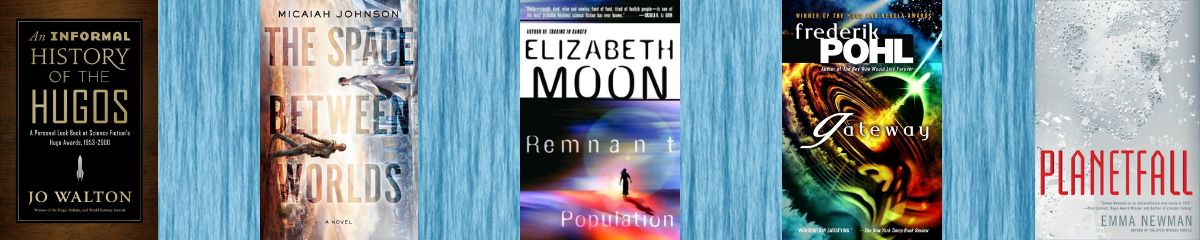
Published in the year of a big historical event in your lifetime: 1986: Count Zero (William Gibson) or The Physician (Noah Gordon) or Howl’s Moving Castle (Diana Wynne Jones) The protagonist has a weird job: The Ravenmaster (Christopher Skaife), The Trauma Cleaner (Sarah Krasnostein), or Ancillary Justice (Ann Leckie) A MC who collects something unusual: Keeper of Lost Things (Ruth Hogan) A book that has won an LGBTQ+ literary award: Dhalgren (Samuel Delany), The Female Man (Joanna Russ), or The Sparrow (Mary Doria Russell) Over 400 pages: Anathem or Cryptonomicon (Neal Stephenson) A novella: Murderbot, The Seep (Chana Porter) Written by an author who shares your zodiac sign: Richard Dawkins, Christopher Hitchens, Dan Simmons, Life on Mars (Tracy K. Smith) Features 24 (a 24-year-old MC, or was published 24 years ago, etc): 1999: Cryptonomicon (Neal Stephenson), Flashforward (Robert Sawyer) Women in STEM/ Girl coders, etc: Tomorrow and Tomorrow and Tomorrow (Gabrielle Zevin), The Calculating Stars (Mary Robinette Kowal), Braiding Sweetgrass (Robin Wall Kimmerer) An attention-grabbing title: Noor (Nnedi Okorafor), Cyteen or Downbelow Station (C.J. Cherryh), or Thistlefoot (GennaRose Nethercott) Author or MC is HIV positive: The Immortals (Tracy Hickman), Push (Sapphire), or Darker Proof (Adam Mars-Jones and Edmund White) Takes place in a haunted house: Possibly Annihilation (Jeff VanderMeer), Revelation Space (Alastair Reynolds), and there’s always The Haunting of Hill House (Shirley Jackson) Title starts with G: Gateway (Frederik Pohl), Glory Road (Heinlein), Gnomon (Nick Harkaway), Goliath (Tochi Onyebuchi)
A book of poetry: the witch doesn’t burn in this one (Amanda Lovelace), Anne Sexton’s fairy tale poems, Life on Mars (Tracy K. Smith) A microhistory: An Informal History of the Hugos (Jo Walton), Extra Virginity (Tom Mueller) By or about a neurodivergent person: Ninefox Gambit (Yoon Ha Lee), The Speed of Dark (Elizabeth Moon), Rules (Cynthia Lord), A Girl Like Her (Talia Hibbert), or Happiness Falls (Angie Kim) Book with a main character over 60 years old: Remnant Population (Elizabeth Moon), Old Man’s War (John Scalzi), The Adventures of Amina-Al-Sirafi (S.A. Chakraborthy) It has a pretty cover: The Hazel Wood (Melissa Albert), The Last Unicorn (Peter Beagle), The Sparrow (Mary Doria Russell) MC has a strange hobby: The Utterly Uninteresting and Unadventurous Tales of Fred, the Vampire Accountant (Drew Hayes), Mostly Dead Things (Kristen Arnett), The House of Small Shadows (Adam Nevill), The Taxidermist’s Lover (Polly Hall) Set in a city you’ve never visited: The House of Shattered Wings (Aliette de Bodard), The Little Paris Bookshop (Nina George) By or about a person with a mental illness: The Devil in Silver (Victor LaValle), Planetfall (Emma Newman), Outside (Ada Hoffman), Stormlight Archives (Brandon SAnderson) A title that rhymes: Eye in the Sky (PKD), Wed, Read, and Dead (V.M. Burns), To Brie or Not to Brie (Avery Aames) Set in a parallel universe: The Space Between Worlds (Micaiah Johnson), Ilium/Olympos duology (Dan Simmons), Interworld (Neil Gaiman and Michael Reeves) Published in your birth year: Dinosaur Planet (Anne McCaffrey), The Persistence of Vision (John Varley), Gateway (Pohl), Lucifer’s Hammer (Niven and Pournelle) Indie or small press published: Ancient Oceans of Central Kentucky (David Connerly Nahm), Alien Stories (E.C. Osondu), Winterset Hollow (Jonathan Edward Durham) By or about a person on the autism spectrum: Outside (Ada Hoffman), The Speed of Dark (Elizabeth Moon), 600 Hours of Edward (Craig Lancaster)
Greetings, friends! This year I thought I might try something new – creating my own challenge for 2024! I always participate in annual reading challenges. My favorites are the ones by The Nerd Daily, Book Riot, and PopSugar. It looks like The Nerd Daily hasn’t added their reading challenge for 2024 yet, so keep an eye on that site if you look forward to that particular one as much as I do.
For this year, as I did last year in the challenges I participated in, I am going to try to complete this by shopping my own TBR first. I have an unimaginably huge TBR – seriously, I think it’s about 500 books. So I am trying to pare that down and also still have some fun with reading challenges. I try, too, to make it more challenging by reading only women, BIPOC, or LGBTQ+ authors. It’ll be interesting to see if I manage to complete my own challenge. I haven’t completed a challenge in a couple years, though I did hit my Goodreads goal to read at least 50 books.
If anyone decides to try this reading challenge out, it would be awesome if you left a comment below or tagged me in one of the social media places! 💖
Also, I’ve been super into junk journaling lately, so I designed the PDF of the challenge prompts to look similar to a junk journal page. Thank you, Canva, for making design easy!
Here is a link to a basic Word doc with the prompts as well, if anyone wants that.









 Her Grace's Library