academic · book review · bookish things · Medievalism

From Purity to Corruption: Gardens in Medieval and Gothic Stories

So this initially started as a straightforward book review. I read a book that I’m reviewing for the Historical Novel Society, called Her Wicked Roots, which is a retelling of Nathaniel Hawthorne’s short story “Rappaccini’s Daughter.” But as I worked on that review, I kept getting side-tracked and decided that I wanted to write a more in-depth article about gardens, both mediaeval and Gothic. Plus, I can’t post my HNS reviews until they publish it first. So instead I decided to remove the HNS book from this and will just post that plain review once they publish it. So now, behold! I will talk at you about gardens.

The concept of a divine garden has carried symbolic weight for thousands of years. From the gods’ garden in ancient Sumeria to the Hesperides’ golden apples, to the comparatively new Garden of Eden, stories of sacred gardens appear in myths all around the world. In medieval Europe, the image of the hortus conclusus (the enclosed garden) was particularly popular. It symbolized purity, chastity, and divine protection. In art, the Virgin Mary is often depicted sitting serenely within walled greenery, surrounded by lilies or roses that symbolize innocence and immaculate conception. The hortus conclusus was supposed to be safety itself. 

Anonymous, Madonna and saints in the Garden of Paradise (around 1410), Public Domain

But by the time Gothic literature popped up centuries later, that enclosed space had changed. The Gothic garden is the hortus conclusus inverted, a space where safety becomes confinement, purity becomes corruption, and nature no longer reflects divine harmony but human ambition, repression, and dread. It is the Upside Down of gardens! Also, humans ruin everything. 

St. Dunstan in the East, London, my own photo taken Sept 26, 2024.

Nathaniel Hawthorne’s short story, “Rappaccini’s Daughter,” portrays this transformation. Hawthorne sets his tale in a beautiful but deadly garden in mediaeval Padua, which mirrors the mediaeval hortus conclusus while also making it dark and twisty, and honestly way cooler. Rappaccini filled his garden with extremely poisonous plants and raised his daughter, Beatrice, among them until she herself literally became toxic. Birds avoid her, bugs and butterflies drop dead if they breathe near her. She is an innocent made unclean, a sort of parody of the Marian enclosed garden. Rather than a rose without blemish, Beatrice is a warped flower that was made monstrous by her father’s quest for knowledge at any cost. Rappaccini’s garden is a site of scientific overreach and destruction. It might be hidden away but it’s not protective, and its walls keep in corruption rather than keeping it out. Beatrice is just another victim of patriarchal control and as such, she is easily discarded once she is of no further use to her father or the story.

The Gothic novel frequently returns to this darker version of the garden. There are ruins, tangled vines, shadowy groves, hidden paths, and rot rather than cultivation. Nature turns into something dangerous and unhealthy. Flowers no longer symbolize purity. In Gothic hands, the garden isn’t a symbol of sanctity anymore. It becomes a mirror of humanity’s depravity. This reversal would very likely cause the Romantics to rend their garments and tear their hair. Byron would probably write super emo poems about it, for sure.

The medieval tradition makes the change in how nature is viewed even sharper. Texts such as the Song of Solomon which reads, “My sister, my spouse, is a garden enclosed, a garden enclosed, a fountain sealed up” (4.12, Douay-Rheims Bible), were read as allegories of Mary’s virginity. Poetry and iconography saw gardens as pure and contained spaces. But the Gothic imagination with its preoccupation with death and the uncanny, was, like Romanticism, a reaction against Enlightenment rationalism. As a result, the Gothic turned the idea of enclosure inside out. Enclosure meant captivity. Purity blurred into promiscuity. Now everything is all open and leaky and symbolic of corruption, specifically female corruption.

This shift tells us a lot about cultural change. The Gothic garden reflects human fears about unchecked knowledge, the danger of passion, and women’s agency. God forbid a woman have agency in any time period. These changes make sense when we view them as a reflection of the fears Enlightenment rationality and pursuit of science had upon much of society. Hawthorne’s Padua is one piece of this cultural shift, but so are the other crumbling castles, gardens, and estates that are scattered throughout Gothic fiction across the centuries.

Where the hortus conclusus invites reflection about purity, the Gothic garden forces us to reckon with corruption. Both depend on boundaries and are heavy with symbolism, but they serve opposite ends. One offers a vision of sanctity; the other, a mirror of human darkness. And yet they are inextricably linked: without Mary’s walled gardens, the poisoned gardens of the Gothic would lose their danger. The Gothic thrives on inversion, and the Gothic garden is my favorite reversal.

Further Reading:

Reference:
The Holy Bible: Douay-Rheims Version. Translated from the Latin Vulgate. Rockford, IL: TAN Books, 1971.

book review · historical fiction · Medievalism

The Stone Witch: A Historical Fiction Mystery

book review · Medievalism

The Buried Giant

The Buried Giant by Kazuo Ishiguro

Genre: fantasy

I read it as a(n): hardback

Length: 317 pp

Her Grace’s rating: 2 out of 5 stars

I…did not understand this book. I’ve got plenty of game. I can talk about the allegory of the buried giant as the letting go of or forgetting of old grudges. I get that the mist is the collective forgetting that happens when we rewrite history or lose meaningful parts of history. I can understand the symbolism (So. Much. Symbolism) of the dragon, the pilgrimage, or the boatman. I can talk about how each person in the group of Axl, Beatrice, Wistan, Gawain, and Edwin represents a different social strata and that they collectively serve as a microcosm of post-Roman Britain. 

But I still do not understand this book. What even happened in it? I wanted to love it so much. I love most things even remotely related to Arthurian legend. But there was an old couple and a warrior and a kid and they all met Sir Gawain and then there’s a dragon and some monks and the kid’s weird visions and a boat and the end. All with nothing really happening. The characters were flat. Most of them were totally blank to me. I didn’t care about their quest or the fact that they couldn’t remember. The tidbits of memory from Axl were not tempting to me. There was nothing exciting, no plot progression, nada. Just, like…ok? And? 

I think people who enjoy introspective and meditative narratives will love it. That is usually me, but not this time. I could go on for days about it and still come up with nothing much. So weird.

book review · historical fiction · Medievalism

The Good Wife of Bath

good wife of bath

The Good Wife of Bath by Karen Brooks

Genre: historical fiction

I read it as a(n): paperback

Length: 541 pp

Her Grace’s rating: 5 out of 5 stars

Eleanor is the daughter of a brogger, the mediaeval term for broker, in 1380s England. Her mother dies when Eleanor is a baby and her father when she is about ten. She goes into service for the local gentlelady and from there, proceeds to have men ruin her reputation, her joy, and her sense of self. She’s married off when she’s 12 to a man who is in his 60s and, to modern audiences, it goes downhill from there. However, Eleanor finds her joy in her many marriages and the found family she gains in her long life. Her friendship with a man of the merchant class, one Geoffrey Chaucer, ensures that she remains known and beloved for all time, living as his (in)famous Wife of Bath.

Or at least, this is the fictional take on how a real-life woman might have become the Wife of Bath. 

Replete with vivid images, sights, and sounds of mediaeval England, The Good Wife of Bath takes readers on a pilgrimage through this turbulent period of history seen through the eyes of an equally turbulent character! 

It’s been a long time since I read The Canterbury Tales, but this made me want to read them again. It would have been fun to do a side-by-side readalong sort of thing. Eleanor is, of course, modelled on the Wife of Bath, but other figures in the story are also modelled on other characters from the Tales. A new interpretation of them would be fun for this book nerd.

I loved the insights we got into Eleanor’s character in the chapters that were written as letters to Chaucer while she was on one pilgrimage or another. We got to see glimpses of this woman throughout the book anyway, but much of that was the public mask she put on. Her letters revealed her innermost thoughts and they were quite something! She would be fun to have drinks with for sure. The letters showed an irreverent, irrepressible person who found a way forward regardless of what misfortunes came her way and took absolutely zero shit in the process. She really took to heart the idea that if life gives you lemons, then squirt the juice into the eyes of your enemies! 

The differences in her various marriages were really intriguing, more so because of how Chaucer’s actual Wife was written. Brooks’s Eleanor marries three times for convenience and twice for love. The love matches were hot, stinking garbage fires of a relationship and the marriages of convenience were the ones that actually resulted in a good and pretty happy life for her. In particular, I loved her first husband, Fulk Bigod, and third, Mervyn Slynge the best. The second, Turbot Gerrish, was ok in the end, though he himself was a ridiculous caricature of a man. But Fulk allowed her to tell him what to do and as a result, they got significantly wealthier. Mervyn became a genuine friend to her and, although he had other issues, was a wonderful husband. I sometimes wish a kind old rich gay man wanted to marry me for beaver cover and then leave me all his piles of money when he died. 

Her convenient marriages allowed her to have the control over her own choices that she desired. Her love marriages were far more restrictive and made her a slave in more than one way. She had far less freedom in those. It’s an interesting point and one that would make for an excellent group discussion.

Ultimately, what I think Chaucer’s Wife wanted wasn’t control, or mastery, as he wrote it, over men. What she wanted was control over her own choices, her ability to choose for herself. Sovereignty over one’s choices, one’s body, one’s relationships, one’s money, was not something most women had in 1300s Europe. Really, it is a pathetic commentary on men and modern society that a very great many women still lack these things. The ones who do have them are either single, managed to find a truly feminist partner, or are old, rich, and widowed. Not a whole lot has changed in the 700 years since Chaucer wrote the Tales. Stop the ride, I want off. 

Overall, I highly recommend this to anyone who loves mediaeval historical fiction, and especially to those of us who hold a special place in our hearts for Chaucer.

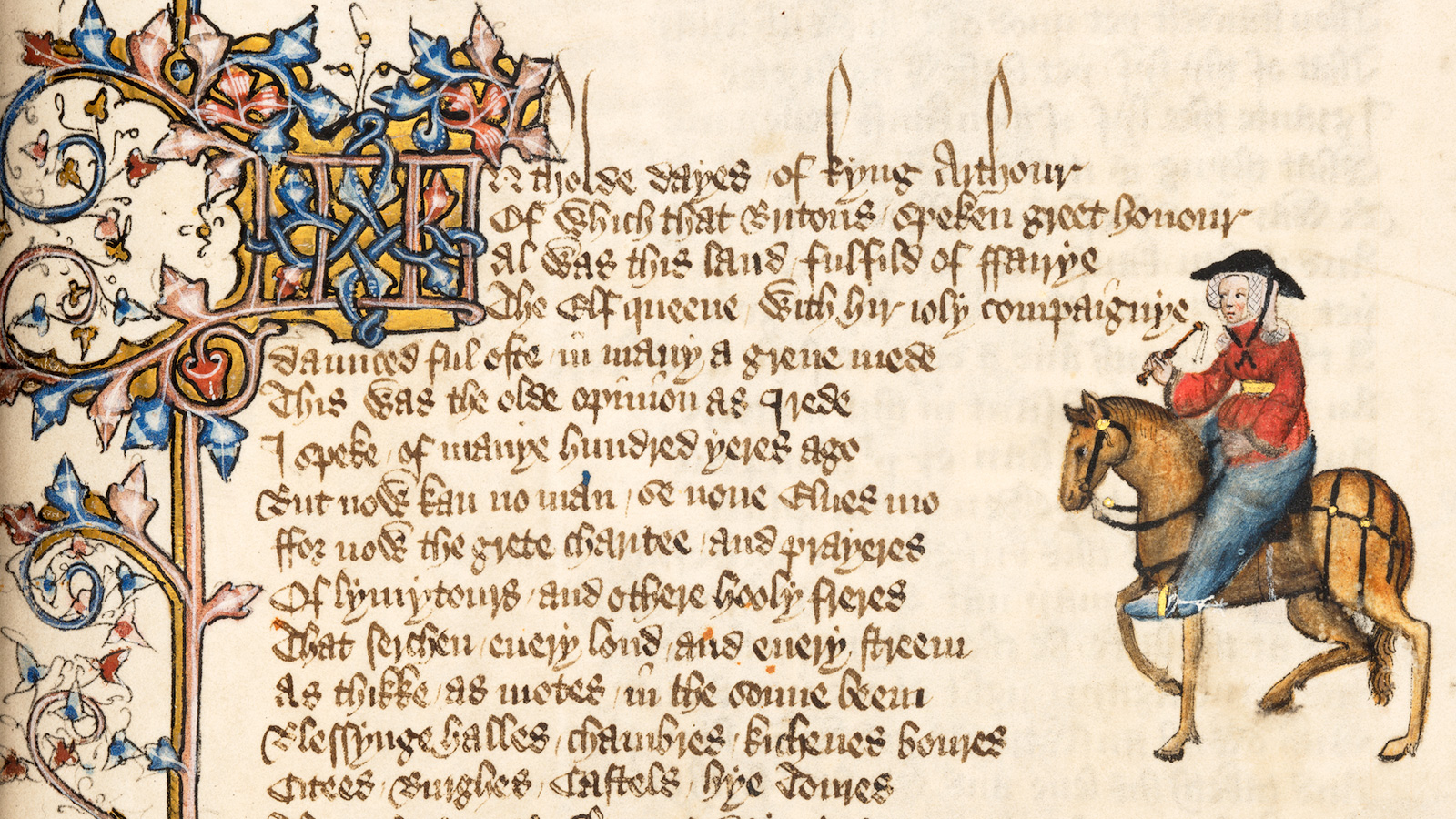
wife-of-bath-British Library

book review · historical fiction · Medievalism

Oswald the Thief

Oswald the Thief by Jeri Westerson
Genre: historical mystery
I read it as a(n): paperback
Length: 270 pp
Her Grace’s rating: 4 out of 5 stars

Oswald is a half English, half Welsh charming bastard thieving tinker who gets trapped by a corrupt noble into doing a burglary. He only has to break into The Tower and steal the Crown Jewels. So that shouldn’t be too hard, right?

This was a really fun mediaeval caper. Westerson, as always, did a great job with the research of early 14th century London. She has the map of the Tower in the front of the book along with a brief list of terms, both of which are helpful for readers who may be new to her stories. The sights, sounds, smells (ugh), and social rules of mediaeval London shine through in every page.

Similarly, the characters are well crafted and complex. An honest thief? A corrupt noble? A man with the mind of a child but the skill to pick any lock in front of him? Check, check, and check. All the characters in this book are thoughtfully detailed and never one dimensional.

One thing I really like about this book – and actually about all of Westerson’s historical fiction – is that her characters are not all just nobles, royals, or church people. They’re mainly just regular people, the Pastons instead of the Plantagenets. They’re actually people most readers can identify with in ways we cannot with those of higher rank.

I think it’s a fucking tragedy that Westerson couldn’t get a traditional publisher to pick this book up. It was intended to be the first in a new series and I really hope we will get to read more about Oswald and his adventures in the future. It was a lot of fun and it should get more attention than it has.

I highly recommend this, as I do all of Westerson’s books. They’re well researched, the writing is fast paced, and they’re all witty and funny.

book review · historical fiction · Medievalism

The Deadliest Sin

the deadliest sinThe Deadliest Sin by Jeri Westerson (Website | Twitter | IG)

Genre: medieval mystery

Setting: 14th century London

I read it as a(n): hardback

Source: my own collection 

Length: 321 pp

Her Grace’s rating: 5 out of 5 stars

In this 15th (and final) novel in the Crispin Guest medieval noir series, Crispin and his apprentice Jack Tucker are hired to help the prioress of a convent discover who is behind a series of grisly murders of her nuns. They each appear to be related to the Seven Deadly Sins, begging the question of what the victims really had to hide. At the same time, Henry Bolingbroke, the exiled son of John of Gaunt, has returned to England with an army at his back. Crispin once again finds himself in a position where he has to decide whether to support the crowned king or to commit treason again, possibly paying for it with his life this time. 

For the past 15ish years, readers have followed along on adventures with Crispin Guest, former knight and lord of the realm, disenfranchised for treason when he threw in his lot with the supporters of John of Gaunt over King Richard II. He’s gone from being angry and bitter to content and even happy and loving his role as the indulgent head of a very rowdy house full of Jack’s children. He has learned that he is quite able to make a decent life for himself through his tracking skills, and has earned the appreciation of many Londoners by helping them. Certainly, he has done more good for the citizens than the sheriffs ever did, which makes him smug. So it has been fun to watch his progression over the years. 

Same with Jack. He went from being a 10 year old mongrel street urchin who seemed to be on a glide path to the gallows for thievery to a competent apprentice tracker, loving husband, and fun loving father. His character arc was almost as big as Crispin’s and it has been a joy to see how he’s grown over the years. 

Yes, these characters feel real to me. 

The mystery in this novel was a fun and twisty one, full of murder and theft and nuns! With! Secrets! It would have been a great read on its own, but I was so focused on all the stuff with Henry Bolingbroke and Richard II that the mystery sort of fell to the wayside with me on this one. Not because it wasn’t good or anything. I just wanted to know how it would all end! After the mystery was solved, I found myself covering up any part of the page I hadn’t read yet so that I wouldn’t accidentally read too far ahead and spoil myself. I think that is a mark of a terrific story. 

I could tell you how it ended. I could tell you what I thought about it. But then maybe you wouldn’t go out and read these books for yourself, and that would truly be a loss for you. I realllllly think you should read them all. You won’t be sorry you did and then, when you get to this book, you will be on tenterhooks to see what new awful thing Westerson might do to poor Crispin! And then you can mourn the last book in the series. And then you can go out and be excited to read the other books Westerson already has, and look forward to the new Tudor series she’s got in the works!

academic · bookish things · Medievalism · Writing

It’s here!

My author’s copies of my book, The Two Isabellas of King John, arrived at my house yesterday! So exciting to get to unbox those!

PXL_20211012_222226366.PORTRAIT

book review · historical fiction · Medievalism

Spiteful Bones (Crispin Guest #14)

Spiteful BonesSpiteful Bones by Jeri Westerson (Website, Twitter, Insta)

Genre: historical fiction/ medieval noir

Setting: 14th century London

I read it as a(n): hardback

Source: my own collection 

Length: 178 pp

Published by: Severn House (1 Sept 2020)

Her Grace’s rating: 4 out of 5 stars

In this 14th instalment of Westerson’s Crispin Guest medieval noir series, some fun characters from the past feature in this story. Nigellus Cobmartin has inherited his father’s house upon the death of his older brother. He and his lover, the delightful John Rykener (under the guise of Eleanor) are in the process of restoring it, the house having fallen into disrepair. The workers discover a gruesome scene – a skeletonized body tied up within the walls of the manor house. It is determined that the body belonged to a former servant who the Cobmartin household thought stole a relic and then took off with the wife of another servant. At the same time, Nigellus and John are victims of extortion, under threat of their lifestyle being exposed if they fail to pay the unknown villain. But nothing is as it appears at first glance, and so Crispin and his apprentice, Jack Tucker, find themselves on the hunt for an extortionist who may also be a murderer. 

The character development over the course of this series has been excellent. Crispin is now in his forties and is beginning to feel the effects of a hard and active life, though he rails against it. Jack is taking on more of the lead role in the sleuthing duo and is the image of a young and vital man. There were a few times that he saved Crispin’s neck, literally and figuratively, and while it was lovely to see, I also miss little boy Jack even as I revel in the upstanding man he has become.

Crispin himself has long since accepted that he is no longer nobility and has made a family for himself with Jack, Jack’s wife Isabel, and their growing brood of children. He seems content enough with his lot and takes pleasure in the simple joys in life in ways he was unable to do before. One of his greatest joys is in his son, Christopher, who he is unable to acknowledge. His friends, too, are his joy, and he throws himself into investigating who would murder a friend’s servant, driven to protect those he loves. 

As always, Westerson creates vivid scenery in her settings. It is easy to picture the sights (and, unfortunately, the smells!) of the Shambles and other places in medieval London. The strength of her descriptive writing is exceptional and that, along with complex character development, have made Westerson one of my favorite authors. She creates characters readers genuinely care about and then develops them into rich and multidimensional people, even secondary characters. Take, for example, Nigellus Cobmartin and John Rykener. Nigellus is a fictional character, but Rykener was a real man who dressed as a woman and was a whore and a skilled embroideress. Their relationship, while it may seem implausible to us given the time period they were from, could well have happened. Rykener was listed as having a husband in one of the documents Westerson referenced, though the man was not named. Why not let the husband be Nigellus? There have always been LGBT people, even if they had been vilified, shunned, or even killed at various points in history. A lack of understanding does not mean they didn’t exist, and there is plenty of documentation to prove it. I think it is really important to discuss social issues in all their many elements, but literature is an ideal medium in which to do so. Readers get to know both Rykener and Nigellus over the course of a few books, and can see them as people rather than ideas, mere figures on a page, or solely by their sexual identity. Having other characters like Crispin sometimes struggle with how they see Rykener helps create depth but also gives a nuanced examination of our own society. A long-winded way to say that I love their relationship, the characters themselves, and how Westerson approached it.

I was sad while I was reading this story because I had thought it was the final entry in the Crispin Guest series. But I was wrong! There is one final adventure to share with Crispin, Jack, and friends, The Deadliest Sin, which Westerson’s website says will be released in 2022. 

In the meantime, I highly recommend this book, as well as the rest of the series, to anyone who loves a good, complex, brooding protagonist and a delightful cast of secondary characters.

book review · historical fiction · Medievalism

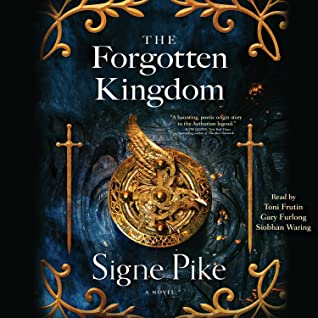
The Forgotten Kingdom

The Forgotten KingdomThe Forgotten Kingdom by Signe Pike (Website, Twitter, Insta)

Genre: historical fantasy*

Setting: 6th century Scotland

I read it as a(n): audiobook

Narrator: Toni Frutin, Gary Furlong, and Siobhan Waring

Source: my own collection

Length: 14:07:00

Published by: Simon and Schuster Audio (15 Sept 2020)

Her Grace’s rating: 4 out of 5 stars

The Forgotten Kingdom is the second instalment in Signe Pike’s Lost Queen trilogy. It picks up immediately after the events of the first book. Languoreth is imprisoned and awaiting news of a battle that holds the fates of her brother, eldest son, and husband. The land is divided and her brother, Lailoken, is battling against her husband, Rhydderch. At the same time, Languoreth’s youngest daughter, Angharad, is traveling with Lailoken to become a Wisdom Keeper. IN the chaos of battle, they become separated and Lailoken is drawn into the political and military intrigues while his young niece is lost in the wilderness and left on her own. The survivors of the battle are similarly thrown to the elements, left to fend for themselves in the Caledonian forest. 

This summary does no justice to the depth of this novel. While I liked the first book in the trilogy a bit better, this was a necessary examination of the politics and alliances Languoreth and her kin had to make to survive against the tide of the new Christian religion. Readers are introduced to Artur, who will, I’m sure, become King Arthur later. Angharad, surviving with a relative she discovered among the Pictish folk, may, I suspect, become the Lady of the Lake. I’m very curious to see if I am right, and how this will all play out.

Dumbarton Castle and Fortingal are the modern names for real places in the book. Pike set her story among these locations based on her extensive research. Clyde Rock and the kingdom of Strathclyde, as well as Languoreth’s birthplace of Cadzow, were historical sites, long since lost to history. But, as I have said in other reviews, placing a fantasy in a historical context is the best. It gives us hope that the figures and stories we love so well might not be stories at all, but are part of an actual history that has been lost or overwritten. 

Pike’s term “the forgotten kingdom” regrets to the Picts, the Scots of Dalriada, and other Brythonic peoples. Much of what we know about these people comes from Roman records, which must be taken with a large grain of salt. The Britons of the early medieval period passed knowledge primarily through oral tradition and so their histories were recorded by others. Few relics of their cultures survive. Sometimes, the best we can hope for are post holes from a building; the buildings themselves were mostly made from wood, or wattle and daub, and rotted away. Pike did a terrific job with the use of historical placenames and customs of various groups of people and of bringing the characters to life.

The politics and battles in this book were complex and dramatic. In a way, I wish this period of history was better recorded so we could know more for certain about it. But the very fact that it is not well recorded leaves rich ground for authors to craft stories around the few facts we do have. 

I highly recommend this book (though it is not really a standalone, so you’ll want to read The Lost Queen first, if you haven’t already). The only thing I don’t like is that the third book isn’t coming out until late 2023, per Pike’s website. That is so long! 

*The author’s note made an excellent argument that historical fiction is often miscategorized as historical fantasy, especially if there are references to old or other deities than those found in the Christian tradition. A character will do a chant, prayer, or spell and something happens as a result of it, so they think, and so the story is labeled fantasy. And yet, when Christian characters do the exact same things, the story is labeled historical fiction, as though the religions and beliefs of pre-Christian cultures are somehow less worthy of being considered real. Pike makes a great point with that argument. What we now consider to be mythology was once the official religion of state for the Roman Empire. It would be interesting to see what people in a thousand years will think of Christianity, Islam, or Judaism. Short of having actual magic or dragons or other similar elements of pure fantasy, I will be calling all books like Pike’s historical fiction. She made a convert out of me. Every pun intended.

book review · fantasy · historical fiction · Medievalism

Age of Druids

Age of Druids by Christy Nicholas (Website, Twitter)

Genre: historical fantasy

Setting: Ireland and Faerie

I read it as a(n): ARC

Source: Helen Hollick at Discovering Diamonds 

Length: 284 pp

Published by: Tirgearr Publishing (14 Oct 2020)

Her Grace’s rating: 3 out of 5 stars

Age of Druids is the ninth and final book in Christy Nicholas’s Druid’s Brooch series. In this instalment, readers are taken to early Christian Ireland, roughly 5th century, where Cliodhna struggles to come to terms with the new religion that is invading and pushing out her beloved old religion. She is accustomed to welcoming the day with the sun, feeling the spirit and energy of living things, and communicating a bit with the Fae who live in the woods near her roundhouse. To her dismay, not only do the new religion have no place for the things she loves, but her two eldest children, nearly grown themselves, are drawn to this religion and are changing because of it. On top of that, Cliodhna’s husband has been missing for months, adding a layer of suspicion through which the zealous abbot, Padraic, views her.

To try to hold on to her way of life, Cliodhna begins lessons with Adhna, a man of the Fae. He teaches her how to draw upon earth energy to revitalize plants and animals as well as to protect herself. Cliodhna soon finds herself drawn into Adhna’s world more deeply than she ever imagined possible. She will be forced to make a choice between the mortal world, full of strange new ideas and shifting loyalties, and the Fae world, utterly foreign and frightening. 

It was interesting to see how the various threads from the other books in this series were entwined throughout this novel. We learn how the brooch was created at last and how and why it was gifted to Cliodhna’s family line to begin with. Learning how her family became connected to the Faerie realm was satisfying after so many books preceding it that hinted but never confirmed. 

I have read many of Nicholas’s books and, while I greatly enjoyed this one, it was probably my least favorite of the Druid’s Brooch series. There were a few places, in particular scenes set in the Faerie realm, that I felt I had read before. I spent a lot of time backtracking my old reviews and copies of the other books to see where I had read it before. I couldn’t find any duplicated scenes, so I am clearly wrong. But there was a lot that read in a very familiar way which I hadn’t gotten from any of her other books. Maybe it was just a function of having read the other ones and Nicholas’s writing style has become familiar. That is not in itself a bad thing.

The descriptions were all top notch, both in the mortal realm and in Faerie. I liked the diversity of characters and how they changed over time. The Christian monks in general, and the Abbott in particular, were described in a pretty negative way since they were seen primarily from Cliodhna’s point of view. This negativity was explained in a later part of the plot, but devout readers, which I am decidedly not, may be a little put off by it. The villagers had a few bright spots in terms of character development as well. Ita in particular was an interesting figure and I wish there had been more scenes with her. She added a nice counterpoint to Cliodhna, who was all feisty; Ita was a good balance for her. 

The ending felt a little abrupt, but it makes sense because now the timeline starts to move forward, rather than backward. Readers could tackle the series in the reverse order of publication if they really wanted to and get a sweeping epic fantasy. Which, of course, it is anyway. I really loved the way the entire series moved backward through time to get to the genesis of the brooch that was central to the lives of the characters. I thought that was a really fun way to approach it.

One small quibble I had was the title. There really weren’t any Druids in the book. They were mentioned in passing. Druids are awesome, so I wish there had been more, or a Druid who played a main role. Cliodhna was not a Druid so she couldn’t have been the one the title implies.

Overall, this novel nicely done and provided a satisfactory summation to the entire series. Definitely recommended for fans of historical fantasy and Irish culture.