book review · sci-fi

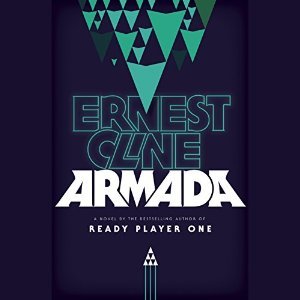
Armada

armadaArmada by Ernest Cline 

Genre: sci-fi

Setting: Portland, OR, United States, Earth, the solar system

I read it as a(n): audiobook

Narrator: Wil Wheaton

Source: my own collection 

Length: 11:50:00

Published by: Random House Audio (2015)

Her Grace’s rating: 2 out of 5 stars

Zack Lightman is super into gaming, in particular a game called Armada, which centers around an alien invasion of Earth. Players get to control various battle drones and ships to stave off the alien attack. So it is understandable that Zack thinks he’s losing his mind when he sees a spaceship exactly like those in Armada flying around outside his school window. But nope, the aliens are real and the game developers created the game, in tandem with an actual Earth Defense Alliance, to train millions of civilians to fight when the actual aliens arrive. Only of course it isn’t as straightforward as that. 

Zack has an anger problem because his father, Xavier, had died when Zack was just a baby. He died in a stupid accident at his job in a waste facility installation. He literally died getting blown up by human shit. That would cause most people some kind of angst, I would imagine. But he still managed to pass his love of gaming and 1980s pop culture to his son because Zack’s mother kept that part of her husband alive for him. His anger makes for a great gamer, though, and so when Zack learns the truth about the aliens and is recruited into the EDA, he jumps at the chance to defend Earth. 

So this book was ok but it was not nearly as good as Ready Player One. I found it to be entirely predictable. Entirely. Literally not one thing came as a surprise to me, there was no bated breath, no anxiety about what would happen, nothing. My granny could have written it, and she hates sci-fi (I’m not really sure how I’m related to her sometimes). I know the publisher’s blurb claims that it is intended to subvert a lot of sci-fi tropes. But I don’t think it did that. It basically just copied them (mostly from The Last Starfighter, Ender’s Game, and ET, from what I could tell) and provided nothing new to the genre, subversive or otherwise. I am quite disappointed since I really loved RP1 and had hoped Cline could pull this one off as well. But no. I didn’t hate it, but I didn’t like it all that much either. Mostly I kept listening because I think Wil Wheaton did a great job narrating it, as he always does. I just didn’t care about the plot or the characters enough to truly love it. Which makes me sad because I am a geek and am always ready and excited to embrace any aspect of nerdom. Oh well. Can’t always roll 20, I guess.

book review · sci-fi

Nemesis Games (The Expanse #5)

nemesis gamesNemesis Games (The Expanse #5) by James S.A. Corey 

Genre: sci-fi

Setting: spaaaaaaaaaaaaaace! 

I read it as a(n): paperback

Source: my own collection 

Length: 532 pp

Published by: Orbit

Her Grace’s rating: 4 out of 5 stars

In book 5 of The Expanse series, the crew of the Rocinante all go their separate ways. Temporarily, of course. The crew are family now and the Roci is home. That doesn’t mean they don’t still have business elsewhere to tend to, though, and they do. Holden is the only one who stays put; Naomi goes to Ceres Station to deal with a family  problem, Alex goes to Mars with a vague idea of getting his ex back, and Amos goes to Earth to make sure the death of someone he cared about was natural or not. Naturally, the entire solar system goes up in flames while the crew is scattered every which way.

The political situation is fraught in this entry. A radical branch of the OPA is behind the most devastating attack in history, their attempt to carve out a place for themselves within the larger political landscape. Because terrorism totally works. That was sarcasm for anyone who can’t parse Kristen-speak. 😊 Holden tries to work with Fred Johnson to reign in the violent nutjobs while, elsewhere, Alex researches why ships are going missing, with some help from Bobbie Draper. Amos makes an unexpected new friend. Or old friend, depending on how you look at it. And Naomi finds herself in the middle of everything in some strange ways.

The last few entries of The Expanse series, I have hoped for the other primary characters – Naomi, Alex, and Amos – to be point-of-view narrators. I got my wish in this novel! All of the POV characters were the crew of the Rocinante. We get a glimpse into their histories and some parts raised more questions. I learned, though, that there are Expanse novellas that dive into their past selves in more depth, so I have no doubt I’ll be reading those at some point as well. Because I am a giant sucker for a good back story. 

I like that there was a theme of family and home woven throughout. Everyone kept reflecting on home in terms of their past, but now that isn’t home, it isn’t their family. Home is where you make it, and family is who you choose. Birth and blood don’t really factor into either of those unless you want them to. I liked that the crew knows with a deep certainty that they are each other’s family. 

All in all, another fun entry in The Expanse series. Can’t wait to read the rest!

book review · sci-fi

Cibola Burn (The Expanse #4)

cibola burnCibola Burn (The Expanse #4) by James S.A. Corey (Website, Twitter, Expanse Twitter)

Genre: sci-fi

Setting: spaaaaaaaaaaaaaace! And Ilus/New Terra

I read it as a(n): paperback

Source: my own collection 

Length: 581 pp

Published by: Orbit (2014)

Her Grace’s rating: 4 out of 5 stars

In this 4th entry in The Expanse series, humans are moving beyond their solar system and beginning to colonize far-flung planets on the other side of the Ring. Of course, they’re doing so before having fully studied them and analysed the data. What could go wrong?

Everything, of course! A group of Belter settlers lands on a planet they call Ilus and set up camp, ready to mine the planet’s rich deposits of lithium; the UN gets a contract to mine the same lithium on the same planet, which they’ve dubbed New Terra, and proclaim the Belters as squatters. Terrorism, murder, and mayhem ensue. This is all before the weird debilitating disease strikes. And the planet itself attacks the humans. And also, the orbits of the ships are all degrading and it’s only a matter of time before they all come plummeting out of the sky, including the Roci

Naturally, Holden and crew are the only ones who can fix things. 

I think sometimes Holden comes off as sort of Gary Stu in this one, even though he isn’t written as a perfect man free of weaknesses. He has plenty of those. But is it really a weakness to be the only one who can save humanity from itself? Again? I mean, it isn’t his fault everyone else is too wrapped up in their petty quibbles and research and murder to see what’s actually important. I’m still not entirely sure Holden is really a Mary Sue despite the above, and his human frailties do keep it from going too far over the edge. But it might be nice to see someone else come charging to the rescue sometime. 

Speaking of that. I do love how every book in the series so far has different POV characters. Yes, one is always Holden, but that’s fine and only makes sense given that he really is the main character. I like how we are meeting characters in this book as POV figures who were minor characters in previous books. I dig that kind of plot continuity. I would REALLY, though, love it if Naomi, Alex, and Amos were all POV characters in at least one of the books. I like them all but I have a soft spot for Amos. He reminds me a bit of the man they call Jayne.

It was interesting to see Basia Merton as a POV character. He was the man who was friends with Prax and whose son died on Ganymede back in book 2. Basia’s been through some things and his pain makes him do some stupid, cruel things that he normally wouldn’t. His character development was certainly thorough. He was a nicely complex person and I enjoyed seeing his progression. 

Overall, another great instalment in The Expanse series! It’s been a long time since I enjoyed reading a full, long series quite as much as this one!

book review · sci-fi

Abaddon’s Gate (The Expanse #3)

abaddons gateAbaddon’s Gate (The Expanse #3) by James S.A. Corey (Website, Twitter, Expanse Twitter)

Genre: sci-fi

Setting: spaaaaaaaaaaaace!

I read it as a(n): paperback

Source: my own collection 

Length: 539 pp

Published by: Orbit

Her Grace’s rating: 4 out of 5 stars

In this third Expanse instalment, Jim Holden and the crew of the Rocinante are freelance contractors now, parted way somewhat acrimoniously with Fred Johnson and the Outer Planetary Alliance. When one of their clients, a rather shady bunch, suddenly back out of their contract with Holden, the crew discover that they are being sued by the Martian government to get the Roci, formerly a Martian Marines battle ship, back. Coming to their rescue is Monica Stuart, a journalist from the UN Public Broadcasting, who contracts Holden on an exclusive if he takes her and her team out to a mysterious ring. The ring was constructed by the protomoluecule creature that launched itself off Venus at the end of the previous book, and it is weird. It appears to be a simple ring construct, and yet ships that go through it do not come out on the other side as expected. It’s like it’s a…stargate… 

A flotilla of ships from Earth, Mars, and the OPA is on the way to the ring to investigate, each government hoping to gain the upper hand. When a person from Holden’s past sabotages his reputation, he is forced to flee with his crew and ship through the ring. What they discover on the other side is not at all what they expected. 

The thing about book series, for me, is that if they are longer than a trilogy, I tend to lose interest. Usually around book three or four. However, that isn’t close to being the case with this series. Yes, it follows the same core of characters. Yes, it has an overarching plot revolving around a weird protomolecule. But each novel has a large and diverse cast of secondary characters and a new basic plot, each different from the previous book. It isn’t a cliffhanger from one book to the next where you have to keep reading about the exact same goddamn characters over and over. Corey’s style works wonders for me.

Holden is evolving as a character in a good way. He can still be a sanctimonious bastard, but he is self-aware enough now to know it. He is making a concerted effort to be a better person, not only for himself, but for his crew, and especially his lover, Naomi. We know a bit more about Holden’s past than the other main characters, possibly because he is the captain. But we get tidbits of information about Naomi, Amos, and Alex as well. I hope we get to learn more about their past lives as the novels progress. What drove them to be on the Canterbury way back in book one? Why did they end up on a bottom-of-the-barrel ship when they all clearly have crazy skills and can do what they want in much better positions? These things, I want to know. 

The secondary cast this go round is Carlos Baca, called Bull, a security officer for the OPA. He is assigned as the security chief to the Behemoth when it heads out to the ring. He’s kind of bitter about his position since he should really have been the captain, and Fred Johnson knows it. But he’s not, because politics! Instead, some jackoff called Ashton is captain, and he seems like a skinny Trump, all ego and narcissism and demands of loyalty. We hate Ashton. But we love Bull.

Joining the Behemoth is Sam, the engineer from Tycho Station and Naomi’s best friend; Clarissa Mao, in disguise as someone called Melba Koh, who is on a private mission of vengeance against Holden for his perceived harm to her family’s good standing; and Pastor Anna, a Russian, well, pastor who is on the Behemoth because she believes God called her there to help in some way. And of course a colorful variety of various others ranging from Martian Marines to news reporters to a neurotic socialite. Each one is there for their own reasons, and each one ends up playing parts they hadn’t anticipated. 

Also, Joe Miller is a recurring presence, despite having ridden Eros on its collision course with Venus at the end of book one. So there’s that. 

The biblical and religious allusions are inescapable. I mean, it’s built right into the title. Abaddon is the Hebrew word for “place of destruction,” or hell, or the realm of the dead. Pastor Anna has a lot of things to say about the place of religion in human society, about forgiveness, and about the ways in which humans must fit in with the greater universe. It was not a “beat you over the head” sort of religious discussion. It was interesting and in the background. I’m sure others who are more inclined could find a lot more to say about it. I can, too, but find that I can’t be bothered with religion today. Suffice to say, the title is a perfect highlighting of the plot in this one. 

Themes of loyalty and bravery are front and center as well, which I’m coming to expect from this series. There are so many ways in which these characters, and those in the previous books, have displayed these concepts. I think one of the most important discussion on bravery in this instalment is when Holden figures out how scared he really is by anything to do with the protomolecule. And yet, he does whatever has to be done, despite his fear. I guess Ned Stark was right – when you’re scared, that’s the only time you can truly be brave. 

I have to take a forced break in the series to read a couple books I promised to a friend for a review, and that’s cool, but I can’t wait to get back into this series!

book review · sci-fi

Caliban’s War (The Expanse #2)

caliban's war

Caliban’s War (The Expanse #2) by James S.A. Corey (Website, Twitter)

Genre: sci-fi

Setting: spaaaaaaaaaaaace!

I read it as a(n): paperback

Source: my own collection 

Length: 595 pp

Published by: Orbit (26 June 2012)

Her Grace’s rating: 4 out of 5 stars


Ganymede, Jupiter’s largest moon, is the agricultural breadbasket for the Belt and the Outer Planets. Which is weird since it’s a ball of frozen ice for the most part, with almost no atmosphere. But thanks to giant mirror arrays, people have been able to make shit grow on it so that the people who do not live on Earth, Luna, or Mars can have something to eat. That all becomes a problem when Roberta “Bobbie” Draper, a Martian Marine stationed on Ganymede, watches helplessly as her entire platoon is annihilated by a monster that rose out of nowhere. In the process of all this, the mirror arrays get damaged as well. So now there’s no food being grown on Ganymede and it’s entirely possible the Outer Planets and Belt are basically fucked. 

Bobbie gets sent to Earth to give her view on the incident and earns the attention of Chrisjen Avasarala, the Earth government assistant undersecretary to something or other. She’s in charge of all the things. She’s also a rude and crude old granny, so right away she’s one of my favorite characters. She convinces Bobbie to come work for her, which is good because it turns out crude granny needs some armed protection, especially when they fall in with Jim Holden and the crew of the Rocinante. Holden et al have torpedoed their job with Fred Johnson of the OPA and are now working for Prax Meng, the head botanist on Ganymede. Prax’s 4 year old daughter, Mei, was kidnapped just before the shit hit the fan on Ganymede and he hires Holden to help him find her.

And naturally everyone’s paths cross, uncross, and become a Gordian knot of military and political intrigue, all while trying to fight against the protomolecule monster that evolved out of the alien virus from the previous book. Good times. 

I have really been enjoying these books. I know this is only the second one in the series, but it’s an action-packed, complex story. I love the crew of the Roci from priggish, self-righteous Holden to mechanic with a shady past Amos. Avasarala is an awesome character in this story as well. She looks like a sweet old granny until she starts talking. Then she becomes wonderfully imaginative in her use of invective and she isn’t shy about dressing down anyone who isn’t doing what she wants them to do. She runs political rings around every single person ever, whether they’re from Earth or the furthest reaches of the Outer Planets. 

I like, too, that we got a hint of Amos’s history, and a small teaser of Alex’s. I am hoping those both get fleshed out more in the future books. I didn’t expect to like a character like Amos. He is huge and violent and probably a murderer. But in this book, he reminds me a lot more of Jayne Cobb than anyone who is actually a bad guy. Now he is one of my favorites from the Roci. I think it is excellent writing when I can genuinely like a character who is so morally ambiguous, because really he isn’t. He just seems like a bad guy or former bad guy but is really someone who will protect you to his last breath. 

The action in this series is visceral and exciting. It is pretty gory but it isn’t gratuitously so. I think the action sequences truly serve a purpose here rather than being tossed in for the hell of it. I really appreciate that and feel it makes the story much more effective. I am not at all opposed to violent scenes in books, but they need to serve a purpose other than just yay violence! So in that regard, too, nicely done, authors!

I have been on a mission lately to minimize, save money, cull things, and so forth. Buying more books is not a thing I am doing right now. In fact, I am culling quite a few of my books, which is not a thing I tend to do. So naturally I went out and bought my own copies of the first three in this series. I am pretty sure I’ll be buying myself the whole series; I have the first three and the next two are on order. This series has undermined my determination to have an orderly home library and to stay inside my budget. Neat!

book review · sci-fi

Leviathan Wakes (The Expanse #1)

leviathan wakesLeviathan Wakes by James S.A. Corey (Website, Twitter)

Genre: sci-fi

Setting: spaaaaaaaaaaaaaaace!

I read it as a(n): paperback

Source: public library 

Length: 572 pp

Published by: Orbit (2 June 2011)

Her Grace’s rating: 4.5 out of 5 stars

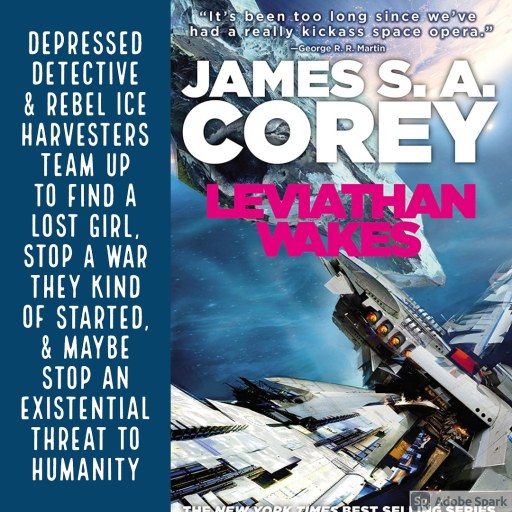
In the future, humans have colonized the solar system but we’re not cool enough yet to have warp drive or be able to get out of the solar system. Instead, we have a complex system with the inner planets of Earth, Mars, and Earth’s moon Luna, living in relative safety and security. Then there are the Belters, the people who have lived and worked in the asteroid belt for generations. Belters are taller, lighter, tough folks used to living in microgravity. Economy is based on selling air to space stations and colonized asteroids, foodstuffs to the Belt, water mined from Saturn’s rings and other asteroids. Mars and Earth have a tense political and military relationship. Most of the inner worlds ignore the Belt. And now there’s a young woman missing in the Belt who may or may not be the center of a terrible secret that has the power to kill billions.

Detective Miller is assigned to search for Julie Mao. Jim Holden is the executive officer of an ice miner. Their paths cross in some truly weird ways as they track Julie and this awful new evidence of extraterrestrial life all over the Belt and back. The ship Holden is from gets blown away to prevent them from telling the truth. Miller gets canned to prevent him from finding Julie. Everyone really likes to shoot first and ask questions later. 

This novel is, in a nutshell, a fucking awesome space opera. I have been on a big sci-fi binge lately anyway, but I am not sure how I missed this series before. I saw that there is a show based on the books and I had the thought to watch it. But books are always better so I figured I’d try it. If I was bored with the books, I planned just to watch the show. Instead, I blew through this doorstopper in just a couple days. Now I’m on the second book and almost finished with it. 

Anyway. The characters are maybe a tad stereotypical. A depressed, down on his luck detective. An unruly XO who sympathies with rebels. A girl from a rich family who gives it all up for her political views. Lots of stereotypes. But at the same time, they were well developed and very different. I enjoyed getting to know them and see how they intersected with one another’s stories. I loved the idea of basically two kinds of humans in conflict with each other in the solar system rather than humans vs aliens. 

I also loved the culture of the Belt. They have their own patois and even though I’m usually really good at figuring things out on context, even I had a hard time understanding what some of the true Belters were saying. I thought it added a layer of complexity and grit to the story overall. I loved that the Belters all really did live in the asteroid belt, that they develop differently because they don’t live in a gravity well like on Earth. The stations were vividly described to the point where I could see the crowds of people on Ceres Station, hear the hiss of air circulators, feel the way the gravity changed in relation to how close you were to the center of the spin. It was just a really fun read. I doubt the show can live up to it, though I still plan to watch it once I read all the books first. 

book review · books · sci-fi

Interdependency

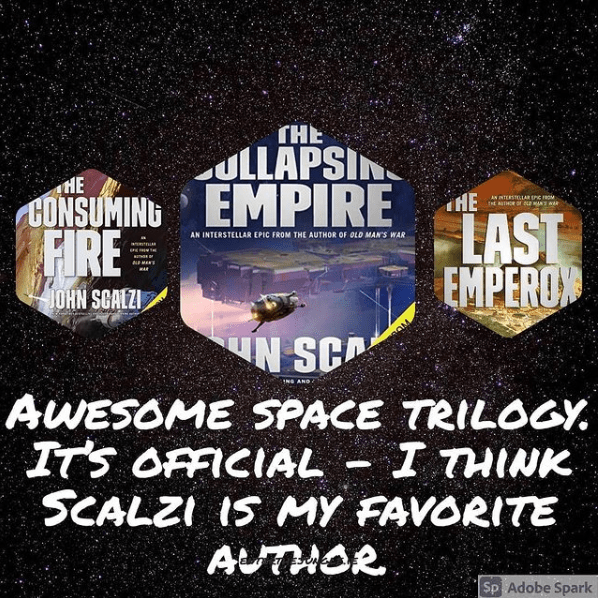
The Collapsing Empire, The Consuming Fire, The Last Emperox (The Interdependency) by John Scalzi (Website, Twitter)

Genre: sci-fi

Setting: spaaaaaaaaaaace! And various habitats, space stations, and occasional planets

I read it as a(n): audiobook

Narrator: Wil Wheaton

Source: my own collection 

Length: 9:24:00, 8:19:00, and 8:07:00, respectively

Published by: Audible Studios

Her Grace’s rating: 5 out of 5 stars, both for each book and for the series as a whole

In Scalzi’s Interdependency trilogy, humans have managed to colonize a lot of the galaxy. They do not do this, however, through the use of any sort of FTL or warp drive. The laws of physics prevent that. They do, however, have something called the Flow, which sounds a little like wormholes through which a ship can travel and arrive at a location in a matter of days, weeks, or months, depending on distance. Ships can only enter or exit at Flow shoals, and the Flow streams only go one direction. So if a Flow stream goes from Hub, the Capital of the Interdependency, to End, the one planet that supports human life and which is at the farthest reach of the Flow streams, then they need to use a different stream from End to get back to Hub. 

Oh, and the streams are beginning to collapse.

This is a problem because, as the title implies, every human habitat is interdependent upon each other for survival. The places where humans settled are all, with the exception of End, not compatible with human life. They’re either on tidally locked moons and planets, too hot or too cold to survive, or on space habitats in orbit somewhere. The Interdependency is organized around Guild Houses, each of which have a monopoly on a certain aspect of manufacturing things needed to sustain life. Once the Flow streams collapse, everyone will be well and truly fucked. 

Enter an inexperienced Emperox, Cardenia Wu Patrick (Imperial name Greyland II), a young woman who was never supposed to be Emperox and only became so when her half brother the Imperial heir died in an “accident.” The various noble Houses think this will be a good thing because they expect to be able to manipulate her. The main houses of Wu (the hereditary Imperial house as well), Lagos, and Nohamapetan, are the political powerhouses and are out for blood and profit. Also, I listened to these, so I may be WAY off on how the names are spelled. Just saying.

The Houses of Lagos and Nohamapetan are particular enemies. On one run between Hub and End, Kiva, the Lagos representative to the Guilds, learns that her House’s entire crop on End had been sabotaged and she naturally suspects the Nohamapetans. Having just spent 9 months in the Flow traveling to End, Kiva is righteously pissed because now she will have spent the best part of 2 years on a trip that is profitless. Kiva soon learns, however, that there is something wrong with the Flow and she ferries a young noble and Flow physicist, Marce Claremont, back to End to meet with the Emperox and come up with a plan to save the billions of people dependent on the Flow for survival. She also comes up with a way to make money on an otherwise failed venture, as one does. 

There’s a lot of politics in this story, but Scalzi makes it fun! Kiva is definitely my favorite character. She’s so thoroughly outspoken and rude and it’s just delightful. She’s also crazy skilled at strategy and politics and is the best person the Emperox could possibly have in her corner. Cardenia is sweet – on the outside. Then she manages to deflate the machinations of everyone conspiring against her, which is especially fun when she hamstrings the Nohamapetans. Really, the characters in this series are the best thing about it. Yes, the overarching story is bomb, and is very Scalzi-ish. But, as Renay Williams wrote, the central characters are all women, and they’re all truly awesome in their own ways. 

Also, the trilogy covers a lot of ground that lovers of sci-fi space operas will appreciate seeing, happily updated with a lot of modern thought, because actual colonialism is gross. There’s far-flung human colonization, empire, the ways in which all these things are connected and, like, interdependent on each other. It is really a good commentary on a lot of our actual current events and politics. I have screamed for years that sci-fi is the ideal medium in which to discuss and analyse current events; Scalzi’s trilogy is further proof. 

As I mentioned above, I listened to The Interdependency trilogy on audiobook. Wil Wheaton did a phenomenal job narrating. I honestly think it is one of his best performances. His timing and tone were spot on and turned elements of the book that were already amusing into laugh out loud hilarity. I loved listening to these books so much that when the third one ended, I wanted to start the series all over again. I didn’t, only because I have so very many audiobooks to listen to that I haven’t even touched yet. But I did go and buy the trilogy in paperback, even though I swore I wouldn’t buy any more books until I get through more of my TBR and cull ones I know I’m not going to read ever again. 

I can’t wait to read these again, and I can’t wait to see what Scalzi publishes in the future. If you haven’t read, or even better, listened to, this series yet, you are really missing out!

book review · sci-fi · Star Trek

Star Trek Discovery: Wonderlands

Disco WonderlandsWonderlands by Una McCormack (Website, Twitter)

Genre: sci-fi

Setting: spaaaaaaaaaaaace!

I read it as a(n): paperback

Source: my own collection 

Length: 333 pp. It’s only half evil.

Published by: Gallery Books (18 May 2021)

Her Grace’s rating: 4 out of 5 stars

Remember in the first episode of Discovery’s third season? When Burnham came plummeting out of the sky and figured out she made it nearly 1000 years into the future and her mission to stop Control from annihilating sentient life was successful? And she landed practically on Book? Then there was that year-long jump between the first and second episodes? Remember that? This is the story of that year in between. 

Michael Burnham is lost and alone in more ways than one at the beginning of this book. She’s almost a thousand years into the future from her point of view, the Federation is shattered, and Starfleet is more a figment of the imagination than a real institution. The economy is money-based and everyone is looking out only for themselves. Philanthropy on any appreciable scale is nonexistent and there are violent wannabe kings of local regions, plotting and betraying and backstabbing their way to the top of the pile. In other words, the polar opposite of the society Burnham is accustomed to. And the Discovery is nowhere to be found.

Circumstances naturally dictate that Burnham adapt to her new environment, and she does, though reluctantly. She convinces Book to help her get on her feet and get the lay of the land. She gets herself a tiny, tiny little ship of her own. She finds a Starfleet holdout in the form of one Aditya Sahil, the de facto commander of Starbase Devaloka. Burnham, being who she is, manages to browbeat everyone into at least trying things her way sometimes, just for kicks, and usually they are pleasantly surprised. It is a nice little lesson in playing nicely with others. 

This was also a rather sad book. Not sad as in pathetic. Sad as in fucking sad. She misses her chosen family, her friends, her society where everything really was better despite the Klingon War. She misses knowing the basics of technology, even though she’s the quickest study ever and gets up to speed in a flash. She misses her ship. It is an interesting commentary on how we contemplate the future. Star Trek is known for its optimism. Discovery has, from the start, turned that optimism on its head; that very darkness is why I love this series so much. Utopia doesn’t happen overnight. It isn’t without its struggles. Without that darkness, how would we ever know the light or the good? To me, that is what this series is good at – showing the good that is possible even if it isn’t there yet. 

I even wrote about this very thing about a year and a half ago for StarTrek.com. See? This Is Why Starfleet Needs Gabriel Lorca. *I* wrote it first, not that individual from Den of Geek who apparently read MY article, nicked my idea, and rewrote it a couple months ago. Fuck her.

Anyway.

There were several smaller missions, or side quests if you like, throughout the novel. Burnham (and usually Book as well) go off on various aid missions to give help to various groups. Very much in line with Star Trek ethics. I wish these could have been longer, or had a standalone book devoted to them like in the good old days of numbered Trek novels. But I suppose, because this was only one book, those side quests had to be truncated for the sake of expediency.

It is ok, though, since the novel’s true strength is in its character development. So far, all the Disco books, actually, have done a brilliant job at giving us the character development and back stories we know and love from other Trek series. I loved getting to see how Michael grew and changed in her new time, and how she tries to change it as well. I loved getting to know Book a little better. And Grudge is certainly the best character in the whole thing. 

I think the overarching theme in this story is that, when you can’t go home or have no home to go to, then you make a home as best you can, with the best people you can find to gather round you. 

Favorite part/ lines (potential spoilers!):

“They’re not doing anyone any harm.”

“Mostly harmless.” He laughed. “There are worse epitaphs, I suppose.” 

[High five to McCormack for that nod to The Hitchhiker’s Guide…! 😀 ]

book review · sci-fi

Neuromancer, and other stuff

I have been neglecting my blog a lot lately. Reading slump 1, me 0. I think I DNF’ed more books in March and April than I did in all of 2020. And then the ones I’ve finished, I haven’t really written reviews for. Oh well, I’ll get back to my usually scheduled program soon enough. The crowd, I’m absolutely sure, will go completely indifferent. 

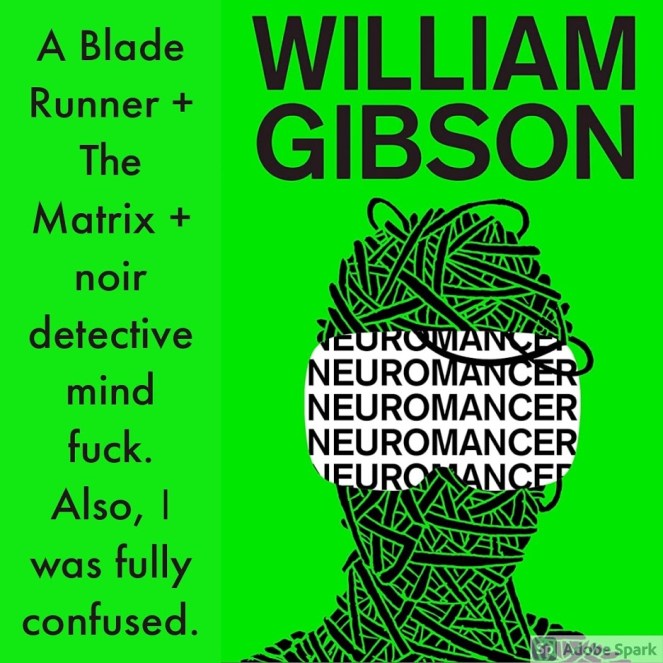
So. Neuromancer. I read this years and years ago and I do not recall being so utterly confused by it at that time. Maybe I was just cooler then. Though I’ve never been cool, so I doubt it. Maybe I only thought I read it and never did. That seems like something I’d do. But I am morally certain I read it. In any case, I can’t dislike a book that literally invented the term “cyberspace.” Even my granny knows what cyberspace is, and it started with this book. I generally love cyberpunk, but I think it was Gibson’s writing style itself that put me off. I don’t want to call it word salad, but it’s so full of invented jargon that it might as well be in parts. And then he goes in with the synesthesia and totally lost me. I do not care what blue tastes like and I’m pretty sure the rainforest glass came about after a long, bad trip of some kind. Plus awfully flat characters. But I still liked it and I really don’t know why?

My IG post sums it up better than any actual review I could write:

Neuromancer IG

book review · sci-fi · Star Trek

Star Trek TNG: Collateral Damage

ST TNG Collateral DamageStar Trek TNG: Collateral Damage by David Mack (Twitter)

Genre: sci-fi

Setting: spaaaaaaaace! And Starfleet HQ in San Francisco

I read it as a(n): paperback

Source: my own collection 

Length: 368 pp

Published by: Gallery Books (8 Oct 2019)

Her Grace’s rating: 3 out of 5 stars

In this installment of the continuing adventures of the Enterprise crew, we find Jean-Luc Picard facing something like a military grand jury to decide whether or not to court martial him for his actions in coercing the Federation’s president to resign. So he and Crusher are on Earth, dealing with lawyers. Yaaay. Meanwhile, Worf is in command of the ship and they take off to answer a distress call from a research base. The base had been attacked by Nausicaans and the dome over the base is melting because of the extreme heat of the sun. Geordi and his engineers have to figure out how to keep the dome intact until the sun goes down, which happens every 6 days by Earth-standard. Throw in some Nausicaans with a planet-killing weapon and a major desire for vengeance, and a man from Enterprise’s past who seems to throw a wrench in every plan and you have yourselves a story.

So Picard is facing the music at SFHQ for his role in the events leading up to President Zife’s forced resignation and subsequent murder. Whoops! That wasn’t very friendly. Of course, Picard mostly gets acquitted, and his lawyer did a good job proving how Picard was not at fault for the actions of his superior officers. However, I had a weird experience while reading this that I never thought I would feel towards Picard. One of the charges against him is sedition. Even though this book was published in 2019, I just now got around to reading it. The sedition element made it more visceral for me, considering the insurrection of January 6, 2021 at the US Capitol. If Picard acted in a manner even remotely similar to the inbred, mouth-breathing, Trump supporting insurrectionists, then he deserves to have the book thrown at him and spend the rest of his life in prison. I cannot recall the events that initially led to him being charged, though I remember being somewhat bored by that particular book. Also, in a way, Picard is like the Trump of Starfleet – he often breaks the rules and sometimes an admiral will yell at him for it, but mostly he gets away with everything. I didn’t like realizing that similarity at all because Picard always acts in the best interest of others, and the orange guy never does. It is still an uncomfortable realization. However, Picard’s lawyer did a good job rehashing things to give a thorough background. It became clear that he was truly unaware of the actions and results of his superiors, that he had been used as a scapegoat, and was subsequently off the hook. But still, I am conflicted about the entire thing. It’s fucked up.

The storylines with Worf and Geordi were classic Trek and a great deal of fun. It shows how much Worf has grown as a person because there were several times when he wanted to rip someone’s lungs out through their spine but he refrained. He even put on his diplomat hat and got two separate peoples to agree to a mutually beneficial arrangement, even though they were bitterly opposed to both the agreement and each other initially. 

Geordi is always a fun character to focus on, and his subplot was no less fun. He gets to save 66,000 people by preventing them from melting! That alone is worth a read. No melting people! 

Throughout both Worf’s and Geordi’s storylines, we get reunited with Thadiun Okona, who made his debut in the TNG episode “The Outrageous Okona” in season two. He’s had an…interesting…couple decades between the events of that episode and the events of this book. Life takes you in some weird directions sometimes. Ask Okona about that. He can tell you. 

It’s been a long time since I read a Star Trek novel, so maybe I’m just out of practice. But this one felt almost like an old fashioned numbered MMP that they used to make for the literary Trekverse. I miss those days bad; each book was a standalone story similar to an episode, not one part of a giant story arc where you’re completely lost if you miss reading a book. I get really tired of that kind of story, to the point where I am thinking maybe I won’t bother buying new Trek books unless they really are standalones. I also think the books should be canon. When we’ve gone years and years without any new Trek series and all we had were the books, it is kind of jarring when the new shows don’t align with the stories we’ve been given in prior years via the novels. The authors are all extremely well-versed in Trek lore, they’re not just making up random crap, so it just seems like the novels ought to be considered canon.

Anyway, this was a pretty fun book and it was good to see some other characters who’ve made appearances in the Trekverse at one time or another.