book review · sci-fi · Star Trek

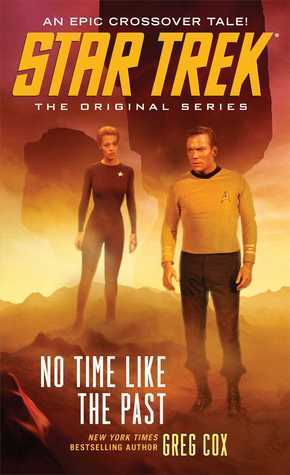
No Time Like the Past

No Time Like the Past by Greg Cox 

Genre: sci-fi

I read it as a(n): paperback

Length: 388 pp

Her Grace’s rating: 3.5 out of 5 stars

On an away mission to a planetoid with a weird reading, Seven is swept back in time to the 23rd century. Specifically, to Kirk’s Enterprise. What follows is a quest through space-time to gather the scattered pieces of the device that sent Seven back while at the same time trying not to pollute the timeline, evading a band of Orions who want Seven for themselves, dealing with an unknown traitor, and getting Seven back to her time before the lack of regeneration does her in.

This was a fun read. Not the very best Trek book ever but not even close to the worst. I don’t generally enjoy crossover novels that much – a large part of why the vast collection of relaunch books irritate me – but this one was very well done. I think the crossover aspect was partly why it took me until the end of 2022 to read this one rather than when it was actually published.

The plot was interesting, if somewhat pedestrian, and I think Cox did a great job getting the interactions between Seven and the original crew right. Seven finally understood the relationship between Tuvok and Neelix after seeing the banter between Spock and Bones. It’s always a pleasure to see Spock and Bones bicker like an old married couple, when it’s done well.

My main issue was that the Orions were like a bad rash that keeps cropping up. A couple times it felt like they were dropped into the plot just because they were the Bad Guys in this story. It was a little forced in that regard. And there were a couple other scenes that I think could have been shorter or eliminated altogether. But in the scheme of things, that’s not so bad.

My favorite part wasn’t a single part, per se. It was the jaunt back through a few of the best episodes of TOS. I loved that. I would love more of it across all the Star Trek series, even if it means crossovers. Just so long as they’re standalone stories, please.

book review · fantasy · sci-fi

The Lunar Chronicles

Cinder, Scarlet, Cress, and Winter by Marissa Meyer

Genre: sci-fi/fantasy

I read it as a(n): audiobook

Narrator: Rebecca Soler

Her Grace’s rating: 4 out of 5 stars for the series as a whole

The four main novels in the Lunar Chronicles series are all thoroughly tied up with each other, in the most delightful way possible. Cinder sets up most of the world-building and character introductions. The overarching plot is that Cinder, a young, part-cyborg mechanic from the Eastern Commonwealth (formerly China) and Kai, the Eastern Commonwealth’s Emperor, are trying to find Selene, the Lunar princess and rightful heir to Luna’s throne, who was long thought to have died in a fire as an infant. Kai doesn’t think that is true and is on a mission to find Selene and overthrow Levana, the evil Lunar Queen who killed her sister (the true queen) and her niece and took the Lunar throne for herself. The secondary plot is Levana’s determination to take over Earth, using what the Lunars call their “Gift” – the ability to sense and manipulate a person’s bioelectrical energy. As a result, Lunars can force humans or Lunars with weaker Gifts to do anything they want them to do. The Lunar gift has varying strength, apparently based on one’s social class, and the queen is the most powerful of all, followed by her thaumaturges, her highest councillors and advisors. They can force people to do anything from being silent to committing murder or suicide. The Lunar queen is one nasty bitch. Cinder plans to stop her.

Throughout the four books, Cinder is joined by Iko, the bubbly android with a faulty personality chip; Dr. Erland, the brilliant but unethical scientist trying to find a cure for a disease ravaging humanity; Carswell Thorn, an irreverent American spaceship captain who broke out of prison with Cinder; Scarlet, a French farmer whose missing grandmother knows something vital about Selene; a street fighter named Wolf who knows where Scarlet’s grandmother is; Cress, a Lunar girl who was born without the Lunar Gift and who has been kept alone on a satellite for years, forced to do technological spying for the Queen; Jason, a Royal Lunar guard who isn’t sure what side he should be on; and Winter, Levana’s stepdaughter who is slowly going insane because she refuses to use her Lunar gift.

Levana has a cure for the disease but she won’t give it to Earth unless Kai agrees to marry her and make her his Empress. Doing so will save millions of lives but also will all but ensure that Levana will kill Kai and use her power as Empress to take over Earth. She could do so through her Gift. Kai agrees to marry Levana to get the antidote, even though it’s the last thing he wants to do. Cinder, meanwhile, gets arrested for crashing Kai and Levana’s engagement ball, then breaks out and makes new friends while she is trying to help track down people who might know about the Lunar princess, Selene. 

For those folks who are unaware, the four novels in this series are retellings of the classic fairy tales – you guessed it – Cinderella, Little Red Riding Hood, Rapunzel, and Snow White. Meyer centers them all in a sci-fi setting, which is fucking awesome. It is set in some indeterminate point in the future. The years refer to the time since the 4th World War and the signing of a global peace treaty, so we don’t really know exactly how far ahead it is. The political climate is complex and nicely explained within the context of the overarching plot. I like that it doesn’t beat you over the head with billions of minute info-dump details but also doesn’t just gloss over politics altogether. Readers get a fully developed political system that is delivered as relevant bits of info throughout the series. 

Similarly, each character is a complete, complex, imperfect, and conflicted individual. They each have their own distinctive voice and ideas. Their personalities are clear – I don’t think anyone would ever be confused as to whether they were reading Cinder or Cress, Thorn or Kai. I really loved that they are all imperfect. None of them are perfectly good or always certain of the right thing to do. They all are trying to do what they think is the right thing, but what that is doesn’t always mesh with what the others think. They are all good people – well, Cinder’s group is. Levana and her Lunars are garbage and you love to hate them – but they also all do “bad” things sometimes. Then they are conflicted about the things they did and the reasons they did them. No one is 100% certain and I think that’s great. It’s so much more realistic that way. 

I also really loved the way the various characters and stories got all woven together. It was satisfying in a way the original fairy tales are not since they are self-contained stories of their own. It is more interesting when they all mingle and know each other. Kind of like the idea that the hunter who killed Bambi’s mom was Gaston from the film version of Beauty and the Beast, or that the sunken ship Ariel swims around in is the one that went down carrying Anna and Elsa’s parents. It’s all the same universe, folks. Similarly, Meyer weaves the various threads of these four fairy tales very nicely together into one satisfying Gordian knot of a bow.

The one thing I think was not at all well developed was the diversity. As in, I don’t think there was any anywhere in the entire series. Based on location and naming convention, it’s assumed that Cinder, Kai, Cinder’s stepmother and stepsisters, and Kai’s court are Asian. But there are no hints or outright descriptions of Asian culture otherwise. The same is true for all the other groups of beings as well. Nothing about them stands out as American or European or Commonwealth other than, in a couple cases, an accent. Even Cinder and Kai do not have any kind of accent that could be identified as coming from an Asian region. Winter is described as having dark skin and curly hair, and on the audiobook cover she is depicted as a young Black woman. Other than Winter, I am not entirely sure there were really any people of color in the series at all. 

The same is true for LGBTQ+ and disabled characters. There wasn’t a single one of either community in the entire series unless you want to count Winter since she’s slowly going insane. But that is an identifiable disease within the Lunar Chronicles universe and by the end of the series she’s being treated for it so she can be “normal.” Maybe she meant for Thorn to be disabled because he lost his vision? But again, that lasted for about a month and then he went back to his old sighted self. You could really, really stretch and say Cress has social anxiety disorder, but again, she’s gotten over it by the end of the series and her shyness a) isn’t a disability and b) was a direct result of being locked away and never interacting with anyone besides the thaumaturge in charge of her for like a decade. Anyone would be a little socially awkward after that. So yeah. Meyer seriously needs to do better in terms of any kind of representation. 

The lack of diversity makes me rate the series as a whole at 4 stars. I think Cinder, Cress, and Winter each rate  4 stars on their own as well. Scarlet was my least favorite of the series and I give it 3 stars. 

I read these four books via audiobook. The narrator, Rebecca Soler, did a good job. Maybe a tad over emotional in some places where it wasn’t really warranted. But overall she was a decent narrator though I don’t think she will ever be one of my favorites. 

I definitely recommend the series to all who love fairy tales and a good sci-fi space opera. It hits all those spots.

book review · sci-fi

The Magnificent Nine

Book cover with a woman in silhouette holding a shotgun upright, a man in the foreground with a yellow hat with earflaps

The Magnificent Nine by James Lovegrove

Genre: sci-fi

I read it as a(n): hardback

Length: 331 pp

Her Grace’s rating: 4 out of 5 stars

Temperance McCloud, an old flame of Jayne Cobb, lives a quiet life with her daughter on Thetis, a far off settler’s planet. Until Elias Vandal and his gang of Scourers come to her town of Coogan’s Bluff, that is. Vandal sets himself up as the ruler of Thetis and he’s going to enforce that position by taking control of all the water on the desert-like planet. Temperance convinces Jayne and the crew of Serenity to come to their aid. But not everything is what it seems, including Temperance’s daughter…Jane.

This novel was so fun, just life an episode of Firefly in print. There really wasn’t anything too special about the plot; if you paid attention, there really weren’t any surprises and you know of course that the crew are all going to survive. But it doesn’t matter because it is just fun to read and it’s a bit of nostalgia to reunite with a beloved cast from a greatly missed show. 

I know there are other books in the series and I’m going to read them all. But I hope there will be more as well. There are books for Mal, Jayne, Inara, Zoe, and River. But what about Wash, Kaylee, Simon, and Book? A couple of the others seem to be ensemble books featuring the whole crew equally but it would be awesome if the rest of the crew could each get their own story to finish out the novels. Probably it won’t happen, but as the saying goes, if wishes were horses, we’d all be eating steak.

Favorite lines:

  • “Just tell me this: when did a shipload of criminals, desperadoes, and fugitives become such a bunch of do-gooders?”

Inara had the answer. “When their captain showed them how” (42).

  • They’ll pick up a half-dozen, maybe a dozen recruits each time. Folks who fancy being on the winning team. Folks who were perhaps never that popular in their hometown. The dregs, the losers. They see something they like in the Scourers and they latch onto it (66). [Just like a certain political group I can think of.]
  • “That was a good dodge, that one,” Jayne said. “We printed up Miles Davis labels and stuck ’em on Kenny G vinyl” (86). 
  • Seriously, keep this up and I’ll rip your arm out of its socket and beat you to death with the wet end (93).
  • I fought at Serenity Valley. It ain’t about optimism. It’s about doin’ what’s right even when everything’s stacked against you (143).
book review

The Leavers

Red book cover with a blurred man's face in the background. The text reads The Leavers A Novel by Lisa Ko

The Leavers by Lisa Ko

Genre: contemporary fiction/ literary 

I read it as a(n): hardback

Length: 335 pp

Her Grace’s rating: 3 out of 5 stars

Peilan “Polly” Guo arrives in NYC at the age of 19, pregnant and in debt up to her eyeballs to a loan shark. She left her small village in China to come to America for a better life as so many people have before her. She has her son, Deming, and works at various jobs to support him, living first in what is basically a flophouse with a dozen other women and then with her boyfriend, Leon; his sister, Vivian; and Vivian’s son, Michael. One day, Polly goes to work and doesn’t come home. Eventually, Deming is given into the foster system and adopted by the Wilkersons, a white couple living in rural upstate New York, who promptly rename him Daniel. Over the years, Deming/Daniel struggles to fit in anywhere and is haunted by the thought that his mother abandoned him.

There’s a lot we can say about this book. It is hard to organize my thoughts about it concisely so I probably won’t try too hard. But first, I thought it was just an ok novel. The book was technically well written, Ko did everything right in crafting the tale she had to tell. I just didn’t like it as well as I wanted to. It wasn’t a bad book at all, and I did like a lot about it. But I didn’t love it, and that was disappointing. 

It addresses the obvious themes of immigration and belonging, playing with the concept of home in some interesting ways. Deming, though American by birth, spent his first several years in China being cared for by Peilin’s father. He didn’t remember America before that so he felt at home in China. He felt somewhat at home in NYC with his mother once he got to know her again, but mostly that was because of their close bond. Home is where your mama is, after all. But he felt out of place in society at large, and far more so once the Wilkersons adopted him. Peilin, too, never quite fit in, partly because her English wasn’t very good and she had difficulty communicating, and partly because she didn’t fit the mold of the stereotypical Chinese woman. She’s loud and brash and fiery, and a lot of people don’t know what to do with all that. 

Peilin’s story was sad and, I suspect, mirrors the stories of thousands of immigrants. People talk about coming to America to make a better life for themselves. The American Dream, as it were. And yes, I would rather live here than in China or many other places. But I think emphasis needs to be placed upon dream in that phrase because the American Dream is really more of a pipedream than anything resembling reality. It isn’t real. Peilan wanted adventure and excitement in her life, not tedium and sameness. She went from a small village to a larger city, working in what sounded like a sweatshop and living in a dormitory of other women, on to NYC, where she also seemed to have worked in a sweatshop and piled in with a shitload of other women in a small apartment, all while owning tens of thousands of dollars to a loan shark who said he could get her legal immigration status. Really nothing changed for her, and I think I could argue that it in fact got worse for her in America. She was still working shit jobs day in and day out like she was in China. Only in America, she was also under a crushing debt while working insane hours for slave wages and hardly got to see her own child. And she was in a society that viewed her with suspicion or disdain and who didn’t speak her language. That sounds more like a nightmare to me, not a dream. 

Lisa Ko made Deming see music in color, which I thought was different. I think that condition is synesthesia, where you use one sense but process it through another. He hears music but sees colors in varying intensities, depending on what kind of music he’s listening to. It didn’t seem to be a huge component of the story, but I wonder if it was supposed to be part of the reason why Deming wasn’t a good student ever. Even before Peilan disappeared and he was happy, Deming was struggling in school and either the school lacked the resources to help him or lacked the desire to help him. Either way, I thought it was an interesting addition to the story.

This may be an unpopular opinion, but I hated the Wilkersons. I thought they were just gross. I felt deeply that they adopted Deming so they could say they adopted a non-white, underprivileged person and saved him from whatever horrible life they imagined he had before they managed to save him. They acted like they were fucking White Saviors. If I met people like them in real life, I would expect that they would say things to goad others into congratulating them on how accepting they are, how good they are to have adopted a kid who was older and a person of color to boot. Living in a rural area as they did, it was like they were putting Deming on display like an object, and he was certain to be noticed since he was one of only two people of color in the area that I noticed (his friend Roland, who was half Hispanic, was the second POC in town). Anyway, the Wilkersons take Deming and shove him into a fancy school and, when he’s college age, expect him to study what they want and go into the career they think he ought to. There is a heavy overtone of “you owe us” in their actions, a sense of obligation like Deming is indebted to them for adopting him and giving him what they consider to be a better life. I don’t feel like they actually loved him, just that they wanted to raise him up, as it were, and then make him follow in their footsteps even though he doesn’t want to, simply because he owes them.

I primarily blame the Wilkersons for Deming’s terrible choices. He is a gambling addict, which I know is a disease. He can’t help it. But the gambling, the drinking, the crappy grades, and the general failure to launch, I place that largely on the Wilkersons. There is no indication that they got Deming into therapy (if he did, then I’ve already completely forgotten that part!). Seems to me that if you adopt an older child who was abandoned and who has very recent memories of his mother you would want to get him into therapy for that. Childhood abandonment will fuck you up. It might make you feel you are not worthy of love which might manifest in, I don’t know, poor school performance or addiction. But they just dragged him to church with them right off the bat, like that’s going to help anyone, and then bemoaned their lot in their academic life. That was another thing – the Wilkersons are both professors at the local university and their whole relationship seems based on research and publishing and being very stereotypical elitist shits deep in some weird academia wankfest. It’s no wonder so many people hate liberal elites. If they were all like the Wilkersons, I’d hate liberal elites, too.

Anyway, I did like the book in general. There were a lot of great parts and vivid scenes. I got a glimpse of some elements of Chinese culture and the immigration experience, which was horrifying. No one should have to go through all that. I think it is an important book and feel that a lot of people need to read it. I just didn’t love it, and actively hated several characters.

book review

The Uncommon Reader

An Uncommon Reader by Alan Bennett

Genre: literary fiction

I read it as a(n): audiobook

Narrator: Alan Bennett

Length: 2:41:00

Her Grace’s rating: 4.5 out of 5 stars

This was a totally delightful little diversion. The Queen has discovered a love of reading and it’s affecting her ability to do – or rather, her interest in doing – her royal duties. Her family, government officials, and courtiers are Not Amused by her newfound obsession, either.

Mostly I thought this was a witty little story with several places that made me laugh out loud. I admit I know little of Queen Elizabeth’s personal life so I have no idea if she was never a reader until later in her life or not. I do know she basically had to ask to be educated because she wasn’t supposed to be the monarch and then, well. Whoops. So maybe she wasn’t much of a reader. What was funny though was that all her snobby officials and courtiers didn’t have a clue what she was talking about when making references to some very famous authors and their books. So they came across as boneheads, which I am sure was Bennett’s intention. 

I did think it was kind of sad too that no one other than Norman, the former kitchen boy, was at all supportive of her reading. They all treated her like either a dumb old woman in need of humoring or someone who shouldn’t have any personal interests and just do boring duties 100% of the time. I don’t care who you are, everyone ought to have interests outside of work and support of friends or family. 

There is a lot of social commentary in this small book, from class and social rank to the obligations a ruler owes to their country to the many virtues of literature. Lots to think about. My book club picked this as our next read and I’m glad. I imagine it will generate some great discussion.

book review

Bewilderment

Bewilderment by Richard Powers

Genre: sci-fi? Maybe political fiction? Maybe dystopian?

I read it as a(n): hardback

Length: 278 pp

Her Grace’s rating: 3 out of 5 stars

Theo Byrne is a struggling single father. His son, Robin, has behavioural issues and seems to be on the spectrum. They are both grieving the loss of Robin’s mother, Alyssa, who died in a car accident a few years previously. Theo is an astrobiologist and uses computer programs to theorise about the climates of other planets. The information is then used to try to help correct Earth’s own climate crisis, which is worsening rapidly thanks to a belligerently anti-science government and a rise in religious fundamentalism.

If it sounds familiar, it should. This book was clearly written in response to the four horrendous years of the Trump administration, their ignorant and anti-scientific approach to as many things as possible, the sharp rise in Christian nationalism (AKA, Nazism), and the global climate crisis speeding up. 

This book made me mad and it made me scared. I was already mad and scared enough as it was, so this was not, perhaps, the best thing for me to read when I am already stressed out and anxious. I do think this should be on the curriculum for all contemporary literature classes, and it could probably find a place in at least the recommended reading of environmental science and behavioural science programs. 

The plot itself is fine. It was really sort of a modern take on Flowers for Algernon, so in that, it was pretty predictable. I felt bad for Theo because he had such a hard time finding help for Robin. I 100% disagreed with his surprisingly anti-medicine attitude, though. He didn’t want to give Robin vaccines because of the miniscule amount of mercury in some of them. I think there is more mercury in the fish we eat than what’s in vaccines. There was also a line in there about how no doctor can diagnose his son better than he can. Well, yes. Yes, they can. A parent is obviously more familiar with the kinds of emotional and behavioural outbursts a kid has, but unless they are also a doctor with a specialty in XYZ issues, then no, they can’t diagnose their own kids just as well as a doctor can. It’s why we have doctors in the first place. So that part really turned me off.

Overall, I liked it but the more I think about it, the more I realise that is all. I liked it, I didn’t love it as much as I wanted to. 

Favourite lines:

  • I wanted to tell the man that everyone alive on this little fluke planet was on the spectrum. That’s what a spectrum is. I wanted to tell the man that life itself is a spectrum disorder, where each of us vibrated at some unique frequency in the continuous rainbow (5). 
  • I’d visit Enceladus and Europa and Proxima Centauri b, at least via spectroscopy. I’d learn how to read the histories and biographies of their atmospheres. And I’d comb through those distant oceans of air for the slightest signs of anything breathing (48). 
  • …God isn’t something you can prove or disprove. But from what I can see, we don’t need any bigger miracle than evolution (59). 
  • The library was the best dungeon crawl imaginable: free loot for the finding, combined with the joy of leveling up (76).
  • Had mass extinction ever once felt real? (81).
  • In such steadiness, there was no great call to assist or improvise or second-guess or model much of anything.
  • He thought about that. Trouble is what creates intelligence?
    • I said yes. Crisis and change and upheaval.
    • His voice turned sad and wondrous. Then we’ll never find anyone smarter than us (114).
  • You know how when you talk to someone stupid and it makes you stupid, too? (116).
  • Have you ever considered what is going on inside a leaf? I mean, really thought about it? It’s a total mind-fuck (185).
  • Almost nobody knows this, but plants do pretty much all the work. Everybody else is just a parasite (215).
  • I knew then why these men wanted to kill this project. The cost overruns were just an excuse. The country’s ruling party would have opposed the Seeker even if it were free. Finding other Earths was a globalist plot deserving the Tower of Babel treatment. If we academic elites found that life arose all over, it wouldn’t say much for humanity’s Special Relationship with God (218).
book review · historical fiction · Medievalism

Oswald the Thief

Oswald the Thief by Jeri Westerson
Genre: historical mystery
I read it as a(n): paperback
Length: 270 pp
Her Grace’s rating: 4 out of 5 stars

Oswald is a half English, half Welsh charming bastard thieving tinker who gets trapped by a corrupt noble into doing a burglary. He only has to break into The Tower and steal the Crown Jewels. So that shouldn’t be too hard, right?

This was a really fun mediaeval caper. Westerson, as always, did a great job with the research of early 14th century London. She has the map of the Tower in the front of the book along with a brief list of terms, both of which are helpful for readers who may be new to her stories. The sights, sounds, smells (ugh), and social rules of mediaeval London shine through in every page.

Similarly, the characters are well crafted and complex. An honest thief? A corrupt noble? A man with the mind of a child but the skill to pick any lock in front of him? Check, check, and check. All the characters in this book are thoughtfully detailed and never one dimensional.

One thing I really like about this book – and actually about all of Westerson’s historical fiction – is that her characters are not all just nobles, royals, or church people. They’re mainly just regular people, the Pastons instead of the Plantagenets. They’re actually people most readers can identify with in ways we cannot with those of higher rank.

I think it’s a fucking tragedy that Westerson couldn’t get a traditional publisher to pick this book up. It was intended to be the first in a new series and I really hope we will get to read more about Oswald and his adventures in the future. It was a lot of fun and it should get more attention than it has.

I highly recommend this, as I do all of Westerson’s books. They’re well researched, the writing is fast paced, and they’re all witty and funny.

book review · fantasy

Nettle and Bone

Nettle and Bone by T. Kingfisher
Genre: fantasy
I read it as a(n): hardback
Length: 243 pp
Her Grace’s rating: 5 out of 5 stars

Marra is a princess of a small, unimportant kingdom that has the misfortune to also have the best harbor in the world. To keep the kingdom safe, her eldest sister is married to the prince of the Northern Kingdom. When she dies without a child, Marra’s next sister is married to him. Marra is sent to a convent where she will be out of the way but that doesn’t prevent her from learning a dark, centuries-old secret.


To save her sister and her kingdom, Marra sets off to kill her brother-in-law with the help of a scary dust-wife, an addled and wicked-but-doesn’t-want-to-be godmother, a quasi-suicidal warrior, a dog made of bones, and a demon-possessed chicken. It is exciting for everyone.


I loved this book so much! It was a great dark fantasy that read very similarly to something Neil Gaiman might have written. That is never a bad thing.


The story was exciting with lots of references to traditional fairy tales made along the way. There’s a little Goblin Market, a little zombie apocalypse, a little tatterskin, a little Sleeping Beauty, just a little of everything mixed into a fun and original tale.


I definitely plan to read anything else by this author and strongly recommend that everyone else do the same.

Favorite lines:

  • It was a cruel spirit that would punish starving people for what they had been forced to eat, but the spirits had never pretended to be kind (4).
  • He was a good dog. He had excellent bones and even if she had used too much wire and gotten it a bit muddled around the toes and one of the bones of the tail, she’d think that a decent person would stop and admire the craftsmanship before they screamed and ran away (21).
  • Then again, peasants and princesses all shit the same and have their courses the same, so I suppose it’s no surprise that babies all come out the same way, too. Having thus accidentally anticipated a few centuries’ worth of revolutionary political thought, Marra got down to the business of boiling water and making tea (36-37).
  • …the baby emerged into the world, looked around, burst into tears. “You get used to it,” the Sister told the infant… It was bloody and wrinkly and reddish gray and looked like the sort of thing you would drive back to hell with holy water (37).
  • The flat stones made for uneven footing. … They rattled and slid underfoot, talking to each other in stone language, saying all the words they had been saving up until the next time a human walked across them (66).
  • The old woman had not struck her as religious.
    But I could easily imagine someone making a saint out of her, a hundred years hence. Maybe some of the saints were like that, too – cranky, old women with strange gifts (77).
  • “How did you get a demon in your chicken?”
    “The usual way. Couldn’t put it in the rooster. That’s how you get basilisks (82).
  • “Enough of this place,” said the dust-wife. “Everyone have their souls still? Shadows still attached? Then let’s go before that changes” (97).
  • What did the abbess used to say? That our own flaws infuriate us in other people? (132).
  • Nothing is fair, except that we try to make it so. That’s the point of humans, maybe, to fix things the gods haven’t managed (181).
  • Injustice and the desire for revenge age the body, but they keep the soul going halfway to forever (199).
book review · sci-fi · Star Trek

Revenant

Revenant (Deep Space 9) by Alex White

Genre: sci-fi

I read it as a(n): paperback

Length: 308 pp

Her Grace’s rating: 4 out of 5 stars

Revenant is set during the early 4th season of Deep Space Nine and follows Jadzia Dax to Trill. An old friend of hers comes to ask for her help in tracking down his wayward granddaughter, Nemi, who ran off after being denied twice to be joined with a symbiont. Upon finding the young woman, whom Jadzia views as a younger sister, she realizes there is something very wrong with Nemi. Scans reveal that Nemi has a symbiont and no life signs of her own. Horrified, Dax returns to Trill to unearth a centuries-long conspiracy which involves not only Jadzia, but at least two of Dax’s previous hosts as well.

I loved this story from the plot to the title. A revenant is someone who returns from death, like a zombie. Or Jesus. You know. As one does. I thought the idea of an evil symbiont who takes over a body and reanimates it is so interesting and I’m honestly not sure why since I generally think zombie stories are dumb. But this wasn’t a zombie story, per se. It was a glitch with the Trill and their symbionts and the ones like Nemi weren’t all corpsified and gross like other zombie stories. 

I’ve always thought the Trill are an interesting species and this book reinforces that interest. The idea of hosts and symbionts can make for some terrific discussion on identity and mortality. How does it affect one’s perception of time if you get a really old symbiont? What becomes important? 

Dax’s condemnation of the Symbiosis Commission also raised some good points about the elitism of joined Trill. The Commission always matches symbionts with the best and brightest young Trill, those who excel in their field in some way. I can see their point in doing so – I suppose you wouldn’t want to join a symbiont with the Trill equivalent of a maga hillbilly or something – but there is no reason not to allow a regular person to be joined. Sure, join them with astrophysicists and doctors and diplomats, but maybe also join them with housewives and schoolteachers and mechanics sometimes, too. It takes all kinds. 

The hive mind element was also intriguing. In Star Trek, when you hear hive mind your first thought usually is, “Borg! Run away!” But this was more like a telepathic fungus and made me think a bit of Mexican Gothic by Silvia Moreno-Garcia. I’m not sure if that was intentional on White’s part or not but I thought it was a cool connection regardless. 

I’m super behind in reading the newest Trek novels, so maybe more of them are like this, but I am digging the apparent return to episodic, one book equals one story format. The relaunch books were nice but I never liked how you had to read all of them to know what the fuck was going on. Episodic novels are way better IMNSHO. 

It was also fun to see an early side to the Worf/Jadzia relationship. I never cared one way or another for that ship but I know it was popular and sad so it was fun to see a new story about them from early on. 

At any rate, this was a really fun story. Enthusiastically recommended for any Star Trek fan!

book review · books

Catch-Up Round: There There and Running with Sherman

There There by Tommy Orange

Genre: contemporary literature/ Indigenous

I read it as a(n): paperback

Length: 294 pp

Her Grace’s rating: 4 out of 5 stars

This novel highlights the lives of 12 people and how they intersect at the Big Oakland Powwow. There are people whose lives have been ruined by alcohol, drugs, the murder or suicide of loved ones, and somehow they still manage to keep going. There is an underlying discussion about generational trauma, especially among the Native tribes. There is also vast systemic racism, which impacts people in so many ways, sometimes in ways no one even is aware of. 

This was a short but powerful book. It was a fast read as well, but not an easy one. It is hard to read about the suffering of others and to know how very privileged you are by comparison. 

I always love reading about a culture I’m not that familiar with. Even though I live in the Southwest and there are several different Native American tribes in the area, I don’t know anyone personally who is Native. My exposure to actual Native culture is mostly confined to the occasional powwow I go to and reading books written by Native authors. 

Definitely recommended!

Running with Sherman by Christopher McDougall

Genre: nonfiction

I read it as a(n): audiobook

Length: 12:13:03

Her Grace’s rating: 2.5 out of 5 stars

Christopher McDougall and his wife, Mika, are tired of living in Philly so they buy a place in Amish country and basically now have a hobby farm. One of the neighbors tells McDougall that one of the members of his church needs help and that he’s an animal hoarder. McDougall goes with his friend to the hoarder’s farm and they rescue a little donkey who was severely ill, standing on horrifically overgrown hooves in filthy straw in a tiny stall. McDougall and his friends and family rally to take care of the donkey, who they name Sherman, and eventually he gets better. Then McDougall learns about donkey racing. 

This was not exactly what I thought it would be. I heard about it in an article I read somewhere recently and I thought it was about the Born to Run guy teaching the donkey how to go running with him, like you take your dog running with you. I had visions of a fuzzy donkey trotting alongside McDougall on the road and it is something I would desperately love to see. But no. Apparently there is a whole community of donkey racers who, from what it sounds like, allow their donkeys to drag them up hills and mountains in some kind of hard core trail running crossed with Mountain Man stuff. Much like running a marathon, it doesn’t sound at all fun. 

I thought this book was only OK, partly because I misunderstood the premise of running with Sherman and partly because it kind of dragged in a lot of places. There wasn’t as much about Sherman as I would have liked; instead, there was a lot about the people involved, the training involved, the stories of the people involved, and I just didn’t care that much about them. I stuck through to the end because I did want to see how Sherman did in his big donkey race in Colorado, and parts of it were funny, but overall I thought it was just mediocre.