book review · weird

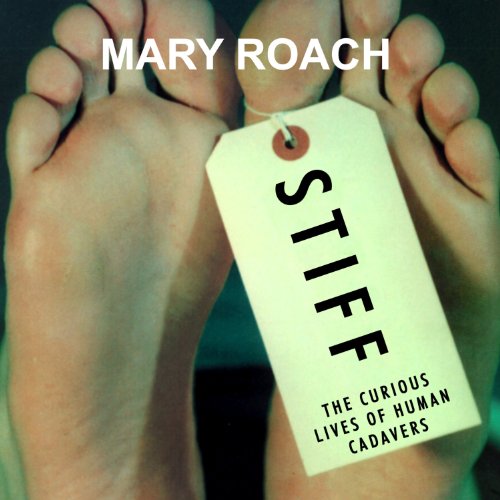
Stiff: The Curious Lives of Human Cadavers

Stiff: The Curious Lives of Human Cadavers by Mary Roach

Genre: nonfiction/science

I read it as a(n): audiobook

Narrator: Shelly Frasier

Length: 8:00:00 

Her Grace’s rating: 3 out of 5 stars

Do you ever wonder what happens to the body if its owner has donated it to science? If so, this is the book for you. Author Mary Roach covers the uses of cadavers ranging from medical/surgical practice to body snatching, crash test dummies to a new residence at the Body Farm, and many topics in between. Always respectful but lightening the subject with her typical humor, Roach guides readers through the many relevant roles cadavers have in their post-mortem, well, lives. 

I had read this book years ago for my book club and remember being kind of bored with it. I listened to it this time on audio and I think the problem before was that I skimmed some of the parts that were horrifying to me and I was more focused on that than on the actual topic. This time, I didn’t skim or skip sections and the experience this go round was difficult in places. I am terrified of flying, for example, and so the chapter discussing the ways forensic examiners look at bodies in plane crashes to figure out what happened was really anxiety-making for me. A couple other sections made me lose my appetite. 

This still wasn’t my favorite book by Mary Roach. I haven’t read all of them yet, but of the ones I have read, I think my favorite is Packing for Mars. If a person has never read one of her books, I likely wouldn’t recommend this one as their first. That said, I was a lot more engaged and interested this time. In horror, I laughed out loud a few times. I definitely learned a lot. 

And yes, I still plan to donate my body to science when the time comes.

book review · sci-fi

The Fall of Hyperion

The Fall of Hyperion by Dan Simmons

Genre: sci-fi

I read it as a(n): paperback

Length: 517 pp

Her Grace’s rating: 4 out of 5 stars

The Fall of Hyperion picks up right where Hyperion left off. The Shrike pilgrims are entering the Time Tombs, war is brewing, and political machinations are at peak levels. The pilgrims are tasked with carrying on, regardless of what else is happening on the planet Hyperion or in the greater universe. The CEO of the Hegemony, Meina Gladstone, is working furiously to prevent a full-scale war with the Ousters while simultaneously trying to decide what choice to make to save humanity. Either way, she’s pretty screwed. 

The main focus of this book was less on the pilgrims themselves and more on the political climate as a character in itself. War is looming, then erupts, Hyperion is getting a raw deal both in terms of the war, which is taking place in part directly above and on it, as well as the Shrike going completely ape and raining down terror on the inhabitants of the planet. We get to see a lot more scheming and bargaining behind the scenes in this book than we did in Hyperion. Reading about fictional politics can get boring real fast if not done well; Simmons knows how to do it well. The war and the shocking secret CEO Gladstone learns are just a part of the overall story.

The structure of Fall of Hyperion necessarily does not resemble The Canterbury Tales in space as Hyperion did. I really, really loved the way Hyperion was structured, but I also really, really love The Canterbury Tales. So maybe I’m a little biased. But I also loved how much of Fall of Hyperion was crafted through the perspective of Thomas Severn, a cybrid based on the poet John Keats. Actually, it isn’t his POV so much as his dreams that connect the politics of the greater Hegemony with the goings-on of the pilgrims. So that was nifty. 

There were a lot of themes going on, from religion to literature to environmentalism to technology. I particularly enjoyed the themes of becoming overly reliant on technology and the impact on the environment such reliance can have. The farcasters the citizens of the Hegemony use to travel vast distances instantly are awesome, but it’s revealed they don’t really know how they work. It’s like the Pakleds on Star Trek – they take and use technology they have limited understanding of, and it never works out well for them. Learning the hard way is really the only way to truly learn something and the Hegemony is in the “find out” phase of things throughout this novel. Just like we are in real life, I’m afraid. 

Anyway, Simmons has penned a fantastic book. He’s become one of my favorite sci-fi writers. His work is intelligent, fun, and deep all at once. There’s plenty here to make readers think and discuss. Definitely recommended, and I am looking forward to reading the other books in the series.

book review · historical fiction · Tudors

Dissolution

Dissolution by CJ Sansom

Genre: historical fiction

I read it as a(n): audiobook

Narrator: Steven Crossley

Length: 14:33:00

Her Grace’s rating: 3 out of 5 stars

The first of the Matthew Shardlake mysteries, Dissolution, features Master Shardlake being sent off to an abbey where one of the King’s commissioners had been murdered. Shardlake is a lawyer and clerk for Thomas Cromwell and is tasked with bringing the commissioner’s murderer to justice. When he arrives at the abbey, he finds it to be a seething morass of corruption, deceit, and forbidden faith. And of course the body count goes up and up the longer he’s there.

This was a good read overall. The setting was well described and the historical details were nicely researched. Sansom created a scene that easily came alive through his use of descriptive language. I am glad I don’t live in the Renaissance. The smell alone would kill me, if I somehow managed not to get burnt as a witch. 

The plot was complex and twisty without being overly complicated or unbelievable. I figured out the mystery, or one of them anyway, fairly early on but probably that’s just because I read a lot of mysteries. I was entertained throughout and the secondary plot/ mystery was one I didn’t guess before all was revealed. 

Would certainly read more in this series.

book review · fantasy

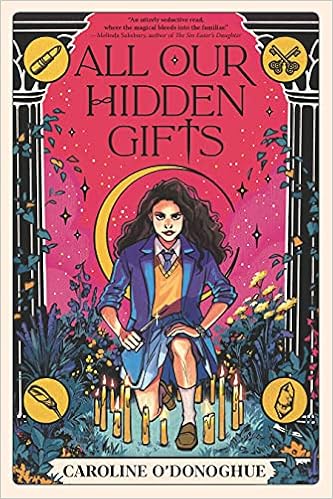
All Our Hidden Gifts

All Our Hidden Gifts by Caroline O’Donoghue

Genre: fantasy

I read it as a(n): paperback

Length: 374 pp

Her Grace’s rating: 3 out of 5 stars

Maeve is a typical teen – she likes hanging out with friends, doesn’t like school, occasionally has behavioural problems, and mainly just wants to fit in. When she randomly unearths a deck of tarot cards while cleaning out a room in detention, she discovers that she has a strange affinity and skill for reading the tarot. Maeve finds herself suddenly popular, her highly accurate tarot readings wildly in demand among her fellow students. But when a reading goes badly wrong and a girl disappears, Maeve once again finds herself on the edges of society. She finds herself assisted in some surprising ways as she struggles to fix what she broke, find the missing girl, and bring balance again to cosmic forces well beyond her understanding. 

This was a pretty fun read, though at times fairly standard. I liked that it was set in Ireland and had a plot involving some of the tensions between Catholics and Protestants. The way the author worked that into the story was nicely done. It invoked some historical elements that added some extra depth to the plot. I also liked how it seemed she was making a commentary on Christianity and how so often they are nowhere near as loving or whatever as they claim to be. 

The author also explored how being a teen is hard, yes, but it is also when you get new life experiences and the chance to have a lot of personal growth. A lot of the story revolved around this and other normal teen issues like learning how to navigate changing relationships. I think a big takeaway from it was that, even when things turn out fine in the end, that doesn’t mean they stay the same or even that they work out well. Sometimes you have to take life lessons with outcomes you don’t want. That isn’t bad, even if things hurt sometimes. It’s just the way it is. 

I read this because my daughter loved it and wanted me to read it as well. I try to read at least a few of the same books as her throughout the year. Most of the stuff she likes is sort of fluffy fantasy and this wasn’t really an exception. I like that she loves reading so I am always happy to share her books if there’s one she really enjoyed. It is one thing that I hope we will always have in common, a love of reading.

book review · sci-fi

Klara and the Sun

Klara and the Sun by Kazuo Ishiguro

Genre: sci-fi

I read it as a(n): hardback

Length: 320 pp

Her Grace’s rating: 2 out of 5 stars

Klara is an AF, or Artificial Friend. When the story opens, she’s in a store with several other AFs, waiting to be purchased so they can be a child’s companion/nanny/caregiver when their parents are busy working. Klara and friends are given turns sitting in the front display window where they are easy to see and can get the full benefit of being in the sunlight. The sun takes on the role of deity to the apparently solar-powered AFs so getting to be in the display window gives them not only a better chance to get charged up but more time to see the sun directly. Eventually, Klara is purchased for a girl called Josie, who has an unspecified disease that is likely to kill her. 

Klara learns the routines of her new household and how to care for Josie. In this particular, Klara is uniquely suited to be Josie’s AF since Klara is keenly observant, a trait not shared by most other AFs. Because of her ability to observe, Josie’s mother approached Klara with a strange request when it becomes clear that Josie isn’t likely to survive much longer. Klara agrees, but she also takes it upon herself to try to strike a deal with the sun to save Josie. 

There are a lot of complex ideas and themes in this book, which I totally expect from Ishiguro. We could discuss what it means to be human, religion, eugenics, or obsolescence. But here’s the thing – I didn’t care enough about any character in this novel to really want to do that. I found Klara to be utterly boring, Josie to be shallow and vapid, and her mother disengaged. The only character who seemed at all relatable was Josie’s friend Rick. He is an “unlifted” kid, whatever that means. It seems to be some kind of genetic enhancement to make them smarter. As a result, unlifted kids tend to be denied entry to schools or other opportunities, but the lifted ones seem to have potentially deadly side effects. It seems very eugenicist. 

The thing I thought was the most interesting was Klara’s anthropomorphization and deification of the sun. It became a living thing to her, capable of making decisions and deciding whether or not to save people from death. The deification was always present in Klara, so maybe all the AFs are programmed with a basic belief in the sun as a god. That’s super interesting since religion is entirely a man-made construct anyway. But it also was painfully ridiculous at times, the way Klara begged the sun to help Josie or to notice her, promising to do good things in return for the sun’s help. I never got a sense that Klara actually felt emotions, so her asking the sun to heal Josie felt flat rather than touching. The whole thing could easily be read that religion is similarly silly and useless as Klara’s devotion to the sun. Ishiguro himself is officially Zen Buddhist but says he and his family were really without religion; they just said Buddhist because it was required at the time for a religion to be on the birth certificate (NPR). This whole part of the novel makes me think that he was commenting on religion as an unnecessary, man-made construct, or that Klara’s programming could be analogous to the human need to find patterns and meaning in everything, the so-called “god gene” on a robotic level. For me, this was the most interesting part of the novel.

I was really disappointed with this book overall. Never Let Me Go it was not. That book was amazing and deep and dense. Klara and the Sun, by contrast, felt shallow. I’m not sure if that’s because Klara was the narrator and I found her to be supernaturally boring or if I just didn’t like it or what. Whatever it was, it made me want to reread NLMG to wash the taste of this one out of my brain. 

Reference:

“Kazuo Ishiguro Draws on His Songwriting Past to Write Novels about the Future.” NPR, NPR, 17 Mar. 2021, https://www.npr.org/transcripts/978138547.

book review · books

The Family Upstairs

The Family Upstairs by Lisa Jewell
Genre: mystery
I read it as a(n): hardback
Length: 338 pp
Her Grace’s rating: 3 out of 5 stars

Libby Jones has always known she was adopted. But upon her 25th birthday, she discovers she is apparently the sole remaining inheritor to a very large home in London’s posh Chelsea neighborhood. She also learns that her birth parents hadn’t really died in a car crash; they committed suicide in a cult. As Libby discovers more and more about her family’s dark history, with the help of a friendly investigative journalist, she finds herself enmeshed in a web of lies and deceit that could alter her entire life.

This was a fun piece of brain candy. It’s the second I’ve read by Lisa Jewell and so far I’ve enjoyed them both. I didn’t think there was a ton of character development but that’s ok. It’s a plot driven story and super in depth characters with a lot of growth throughout the book isn’t necessary for this to be a good read.

I’ve always been fascinated by cults except the cult of personality surrounding a certain orange former president. I know there are plenty of smart people who get sucked into cults so it’s weird to me how otherwise intelligent people can buy into shit like that. The cult in this story was small – just one disgusting but charismatic man and a few couples and small families – but the dynamics and deterioration from normal into crazy was horrifying and interesting all the same. Cults, man. They’re fucking weird.

Anyway, I liked the book, I’d read more by this author, and it was a nice diversion for a long weekend.

book review · fantasy

A Dance with Fate

A Dance with Fate by Juliet Marillier

Genre: historical fantasy

I read it as a(n): paperback

Length: 491 pp

Her Grace’s rating: 4 out of 5 stars

The second installation in Marillier’s Warrior Bards series begins with a fighting competition and tragic accident. Liobhan, daughter of Blackthorn and Grim, and Dau, both Swan Island warriors, are participating in a training exercise when Dau slips, hits his head hard, and wakes up blind. Dau’s father, a local chieftain, blames Liobhan and demands that she serve a year as a bonded servant in his household as payment, along with a handsome sum of silver coins. Liobhan readily agrees to that, even though she knows Dau’s blindness was an accident. Dau’s father insists, too, that he be returned to his family home to be cared for. This is a problem since Dau’s family, in particular his older brothers, are sick twists who love to hurt people. Going to his family’s home is the very last thing on earth Dau wants to do. But his chieftain father prevails and Dau is packed off home along with Liobhan, who is already being treated like a slave. During their time there, Dau and Liobhan have to learn to navigate the family dynamics, survive their abuse, and in the process, uncover a deep and dangerous secret involving the Crow Folk.

I have yet to read a book by Juliet Marillier that I don’t like. There are some I like more than others but I unreservedly recommend all of her books to anyone who likes the historical fantasy genre. This one was another hit for me. I liked the way the character development happened, especially with Dau. I thought it was interesting how he learned to adapt to his new circumstances and how his Swan Island training carried him through even the worst times. Seeing very strong characters like him and Liobhan become more vulnerable is always a thought provoking experience for readers. 

This novel was told from the POV of Liobhan, Dau, and Liobhan’s brother Brocc, who lives in the Otherworld, married to the queen of the fae. I generally enjoy when stories alternate perspectives like that, and this was no different. I didn’t like the parts with the Otherworld as much as in the “real” world, I think because I just don’t like the queen, Eirne, at all. I do think Brocc is an interesting figure and love that his voice can be a weapon or a balm. I like, too, Rowan and True. But unless the Otherworld time was primarily with those three, I didn’t care much for those characters or what happens to them, mainly because Eirne is such a dick. I suppose that is a sign of good writing, though, that I feel so strongly about a fictional character! 

I’m off to read the third book in this series, A Song of Flight. I hope Marillier writes a new book soon. I get so happy when I get to read her work!

book review · sci-fi

Hyperion

Hyperion by Dan Simmons

Genre: sci-fi

I read it as a(n): paperback

Length: 482 pp

Her Grace’s rating: 3.5 out of 5 stars

The planet Hyperion is under threat, partly from a brewing interstellar war and mainly from the Shrike, a quasi-mythical creature from the planet’s Time Tombs. The Church of the Shrike allows a certain number of pilgrims each year to make a pilgrimage to the Time Tombs and to make a wish to the Shrike. However, given the war and the fact that the Shrike is now loose and wreaking murderous havoc on Hyperion, only one last group of pilgrims will be permitted. Seven people with wildly different backgrounds have been selected to travel on the final pilgrimage. Along the way, they share their stories of what led them to be selected.

This book is basically The Canterbury Tales in space, so naturally I really liked it. As with the Tales, there were some stories I found to be more interesting than others and one I just didn’t really get. I think my favorites were Sol Weintraub’s and Brawne Lamia’s. Probably my least favorite was the Consul’s. Everyone else’s was fun and interesting to varying degrees. 

Giving the characters their turns to tell a story allowed Simmons to give more depth to each character than maybe he could have if he had simply told a story from 3rd person omniscient. I liked the different narrators and think he did a great job with creating a unique voice for each pilgrim. 

I had a hard time picturing some things in the settings, though. Like farcasters. Are they like doors but you go through and go to a different planet? And the actual planetary settings never quite gelled in my head either. Maybe I was distracted when reading parts of this or something but I wanted more in that regard. “New Earth” doesn’t mean much to me. Is it a place just like Earth or is it just called that because that’s where humans landed after Earth Actual was destroyed? 

Similarly, I wanted a little more depth on the politics of the story. Maybe there is more detail in the second book but I wanted to know more about all the machinations, how the AIs and Ousters fit in (and who WERE the Ousters? Are they other humans who want nothing to do with the Hegemony? Aliens? If they’re humans, why are they apparently so much more advanced than the other humans?), and why there was a spy. I actually feel like it might have been better to leave at least some of these things out entirely and just focus on the pilgrims but then it would make one pilgrim’s story less relevant. 

The things I felt were lacking, like an actual resolution to the plot once the pilgrims get to the Time Tombs, can be overlooked if you figure the journey rather than the destination is the important part. But even with a plot that is supposed to span across a few books, I feel like each book ought to have a solid conclusion that leaves readers largely satisfied if they choose not to continue the series. I do feel somewhat unsatisfied with the ending since they arrived at the Tombs and then…what? We don’t get to find out. I did truly enjoy the book, but it left me hanging and that makes me crazy. 

This was actually the first book by Simmons that I’ve read but I have a couple of his others. I’m looking forward to those as well. I thought I had read Hyperion years ago but even with my forgetfulness, I don’t think I ever did actually read it. I’m glad I did, not just because it’s basically a sci-fi requirement but because it really was a fun story. I’m trying to go back through a lot of the sci-fi from the ‘70s and ‘80s that I missed and this was one of them. 
Now I’m trying to decide whether I should read the rest of the books in the trilogy or whether I should let it go and actually read more from my ridiculous TBR pile. Being who I am, I’ll probably buy the books and let them sit in my TBR for years before getting around to them, like I did with Hyperion in the first place. LOL.

book review · books · lists

Bigass Catch-Up Round

I have been extremely lazy about blogging and book reviews lately. I am not sure why, but I am going to try to be better. My goal has always been to do a review for every book I read even if not one person reads my blog, so I’ve clearly failed at that recently. But I am also way too lazy to do a full review for… let me count… 19 different books. So I’mma rush through! Yay, slipshod blogging!

Dreamsnake by Vonda McIntyre

Genre: fantasy

Length: 9:41:00

Her Grace’s rating: 4 out of 5 stars

A fantasy set on a ruined Earth, Snake is a healer who, through the ignorance of others, loses one of her most effective and rare instruments of healing. This is the story of her quest to find another. The narrator was a little meh for me but despite that, this ended up on my “top books of 2022” list. 

The Cybernetic Tea Shop by Meredith Katz

Genre: sci-fi

Length: 112 pp

Her Grace’s rating: 3.5 out of 5 stars

Restless wanderer meets outdated but sentient robot and the two strike up an unlikely friendship. Lots of themes to unpack, including LGBT/ace relationships, hate crimes, and what it means to be human.

Children of Men by PD James

Genre: sci-fi

Length: 241 pp

Her Grace’s rating: 2 out of 5 stars

The youngest person on the planet is now in their 20s because no one can have babies anymore. Aside from the idea that not having so many freaking babies would be a good idea right now, this was one of the most boring books I ever actually completed. 
Continue reading “Bigass Catch-Up Round”

book review

Mona at Sea

mona at seaMona at Sea by Elizabeth Gonzalez James (Website)

Genre: contemporary fiction

Setting: Tucson, AZ

I read it as a(n): audiobook

Narrator: Aida Reluzco

Source: public library

Length: 08:02:00

Her Grace’s rating: 2 out of 5 stars

Mona Mireles is a 23-year-old recent grad. She has her degree in finance from U of A in hand and a posh job lined up in NYC. Then the recession hit and Mona, like millions of other people, found herself jobless and living back at home with her parents. Cue the angst and entitlement.

I don’t like to be hard on authors, especially debut authors. It is scary to put a large piece of yourself out there for all and sundry to read. It takes a lot of bravery. But this book… there was not one character I cared about, most of them I outright disliked, and it kind of highlights many of the reasons why so many people don’t care much for Millennials. 

Mona is a whiny little bitch for all of this book. She seems to think she deserves to get her dream job right out of college, with zero actual working experience in her field. She whines that she HAD a job lined up but it evaporated when the recession hit. So instead of her fancy job as a hedge fund whatever, she winds up with a minimum wage job at a call center trying to talk people into giving a donation to some charity or other, which she thinks she is too good for. Guess what, peaches? Same thing happened to millions of people, most of whom probably had a lot more usable experience than you. I hate to be insensitive, or sound like a Republican, but you’re not special and the world owes you fuck-all. 

To deal with her angst, Mona likes to do self-harm. She cuts her thighs, where it is easy to hide. But since art is her True Calling, not finance that she just spent 4 years in college working towards (and honestly, how did she go from art to finance? There was very little discussion on that, so it felt like a Plot Twist for the Sake of a Plot Twist), she doesn’t just cut. She is carving a Mona Lisa face into her leg. So, ok. I have no experience with cutting and to my knowledge, none of my friends ever did either. But I have read other books dealing with self-harm by authors who are open about their own self-harm experience. This read more like it was written by someone with a weird vicarious interest in cutting rather than by someone who actually knows what she’s talking about. If I’m wrong, then I am sorry; I do not mean to belittle her trauma. But I just don’t buy it as written. She made it sound cute. If the author has a history of self-harm and this is how she refers to it in her own head, ok. But if not, then it seems really patronizing to those people who do have issues with self-harm and it feels like it minimizes their pain and experience.

All of the characters were shallow and uninteresting in general. I didn’t really find any of them that believable. Maybe I just didn’t care about the plot and that translated into not caring about the characters. I don’t know. Either way, this one wasn’t my cup of tea.