book review

Katherine

Katherine by Anya Seton

Genre: historical fiction

I read it as a(n): audiobook

Narrator: Wanda McCaddon

Length: 23:44:00

Her Grace’s rating: 3 out of 5 stars

Katherine is the classic novel by Anya Seton that follows the life of Katherine Swynford, most famous as the long-time mistress of John of Gaunt. The novel begins as Katherine is heading to court after having lived for years at a convent. Naturally, she is young and beautiful and so must, therefore, get a husband. Some younger knights and squires turn her head but the intimidating Duke of Lancaster, John of Gaunt, catches her eye more than others. She knows better, and he is married, but likes him anyway. Katherine is horrified, though, when one of Lancaster’s knights, Hugh Swynford, asks to marry her. It is an advantageous marriage and it is quickly arranged. She goes with her new husband to his home at Kettlethorpe and has two babies and that, she thinks, is that. But then Hugh gets sick in France while in service to Lancaster and sends for her, and dies soon after. Woo hoo! Now she and Lancaster can get it on if they want to, since his wife, too, had died. The rest, as they say, is history.

This novel was first written in 1954 and it shows in a lot of ways. Sometimes, the women seemed infantilized in ways that they are not in newer historical fiction. No, there was no such thing as feminism in the Middle Ages, and no, the women tended not to ever act or speak in terms like we would today. But they are not always depicted quite as the meek and submissive women that they often were in Seton’s novel. It felt very much like The Good Housewife’s Guide from, well, the 1950s. LOL gross. 

This was a very well researched book, though. It didn’t feature any battle scenes or gore, which makes sense since it was centered around Katherine. She wouldn’t have had first hand knowledge of anything like that. We got a lot of the day-to-day of women’s lives in this, which was interesting. The historical record doesn’t actually go into much detail about women’s lives since they weren’t the ones in power. There’s a lot about war and men and the church instead. I think the lack of actual record makes for a great way for a skilled author to bring to life aspects of a time that we may not know very much about. 

Though this wasn’t my favorite book I’ve ever read, it was enjoyable enough and the narrator, Wanda McCaddon, did a good job in her performance. Probably I would read or listen to other of Seton’s mediaeval books, though I’m not sure I liked this one well enough to branch out into her works set in later (i.e., less interesting to me) time periods.

book review · historical fiction · Tudors

Dissolution

Dissolution by CJ Sansom

Genre: historical fiction

I read it as a(n): audiobook

Narrator: Steven Crossley

Length: 14:33:00

Her Grace’s rating: 3 out of 5 stars

The first of the Matthew Shardlake mysteries, Dissolution, features Master Shardlake being sent off to an abbey where one of the King’s commissioners had been murdered. Shardlake is a lawyer and clerk for Thomas Cromwell and is tasked with bringing the commissioner’s murderer to justice. When he arrives at the abbey, he finds it to be a seething morass of corruption, deceit, and forbidden faith. And of course the body count goes up and up the longer he’s there.

This was a good read overall. The setting was well described and the historical details were nicely researched. Sansom created a scene that easily came alive through his use of descriptive language. I am glad I don’t live in the Renaissance. The smell alone would kill me, if I somehow managed not to get burnt as a witch. 

The plot was complex and twisty without being overly complicated or unbelievable. I figured out the mystery, or one of them anyway, fairly early on but probably that’s just because I read a lot of mysteries. I was entertained throughout and the secondary plot/ mystery was one I didn’t guess before all was revealed. 

Would certainly read more in this series.

book review · books

The Family Upstairs

The Family Upstairs by Lisa Jewell
Genre: mystery
I read it as a(n): hardback
Length: 338 pp
Her Grace’s rating: 3 out of 5 stars

Libby Jones has always known she was adopted. But upon her 25th birthday, she discovers she is apparently the sole remaining inheritor to a very large home in London’s posh Chelsea neighborhood. She also learns that her birth parents hadn’t really died in a car crash; they committed suicide in a cult. As Libby discovers more and more about her family’s dark history, with the help of a friendly investigative journalist, she finds herself enmeshed in a web of lies and deceit that could alter her entire life.

This was a fun piece of brain candy. It’s the second I’ve read by Lisa Jewell and so far I’ve enjoyed them both. I didn’t think there was a ton of character development but that’s ok. It’s a plot driven story and super in depth characters with a lot of growth throughout the book isn’t necessary for this to be a good read.

I’ve always been fascinated by cults except the cult of personality surrounding a certain orange former president. I know there are plenty of smart people who get sucked into cults so it’s weird to me how otherwise intelligent people can buy into shit like that. The cult in this story was small – just one disgusting but charismatic man and a few couples and small families – but the dynamics and deterioration from normal into crazy was horrifying and interesting all the same. Cults, man. They’re fucking weird.

Anyway, I liked the book, I’d read more by this author, and it was a nice diversion for a long weekend.

book review · historical fiction · Medievalism

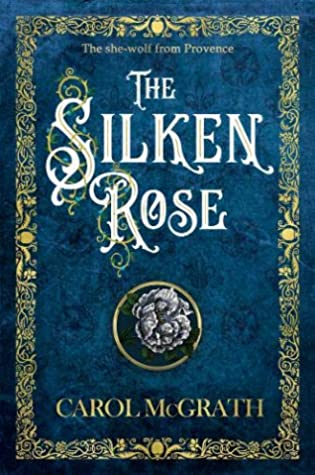
The Silken Rose

The Silken RoseThe Silken Rose by Carol McGrath (Website, TwitterFacebook)

Genre: historical fiction

Setting: 1300s England

I read it as a: digital copy

Source: Helen Hollick at Discovering Diamonds 

Length: 355 pp

Published by: Accent Press Ltd. (23 July 2020)

Her Grace’s rating: 3-4 out of 5 stars*

This novel, the first of a planned trilogy, focuses on Eleanor of Provence, the wife of Henry III, beginning with her journey to England to marry a man who was more than 15 years her senior. In this book, she is called Ailenor. The narrative brings readers along as Ailenor learns first how to be a wife and queen and then a mother. It gives us a varying perspectives, from Ailenor to Eleanor (sister of Henry III, wife of Simon de Montfort) and a fictional embroideress, Rosalind, and covering a variety of the events that plagued Henry III’s reign. The trilogy plans to take a look at the women who have been termed “She-Wolves” for various reasons. This first installment takes care of Eleanor of Provence and her reign as Queen Consort.

First, the good. There were many, many enjoyable things about this book. I loved how much detail there was. In every scene, McGrath evoked imagery, scents, sounds of daily life in medieval London. I especially loved the details with herb and flower gardens. I can practically smell the lavender and rosemary. Similarly, the descriptions of the street scenes in London were pretty evocative as well. 

I also really appreciated other small details, such as the use of relics, in particular the Virgin’s girdle, as charms for a safe childbirth experience. The churching ceremony after giving birth was not given a lot of detail, but it was mentioned a few times throughout the novel and it added extra depth. Also, a queen’s role as intercessor was mentioned several times. I’m fascinated by the queens’ intercessory role throughout time and how it changed, helped, or hindered politics. Little things like this make readers like me happy. I know not everyone cares about historical accuracy when they read a book for pleasure (*horror!*), but I am always deeply appreciative of authors who are accurate anyway. The readers like me will be happy and the readers who don’t care will still read the book and enjoy it regardless. 

A few quibbles. The writing here was clear and easy, flowing smoothly from one perspective to another. The main POV character was, of course, Ailenor, but Rosalind and Nell also got a good deal of time. I was glad, though, that the chapter headings indicated when a change of perspective happened because I didn’t find there was always a lot of variance in the voices between the three women. Ailenor, Nell, and Rosalind often sounded similar and could be hard to tell apart if it were not for chapter headings.

By the same token, I felt that Rosalind was the only one who really had any character development. Ailenor, by contrast, sounded like a fully mature woman even on her journey to meet her husband-to-be when she was only 12 years old. Rosalind, on the other hand, started as a young and shy embroideress but grew into a confident and respected woman, wife, and mother. I did wish a little more of her story had been given to us. She was probably my favorite character in the book. It felt a little incomplete because there were some fairly substantial jumps in the events of her life. However, since she was NOT the primary focus of the novel, it is understandable why the author decided not to make her a larger figure. 

The novel ended with the promised betrothal of Edward to Eleanor of Castile in roughly 1254. This was about ten years before the start of the Second Barons’ War. I was a little disappointed that the novel didn’t cover that time period since I think a lot of interesting content could have been written about Ailenor during that time period. She was considered one of the She-Wolves, and the Barons’ War and Simon de Montfort’s role was a major element within Henry’s reign. It would have been particularly interesting to see Rosalind’s role in that. Even though she is fictional, sometimes those are the best characters through which to explore an historical event or person. Again, I understand why it wasn’t included. It would have been a tome otherwise! 

Overall, I enjoyed this novel. It was a fast, easy read and gives an interesting glimpse into a fascinating period of England’s history. 

*N.B.: I am unclear if the copy I received to review was supposed to be a finished copy or if it was an edited digital galley. The book was already published (in the UK, at least) when I got the file to review, but it was a PDF which is usually how I get galleys. I mention this because if it was a finished copy, then there were numerous places throughout where the text was positively jumbled up and sentences were a mash-up of words. For example: “I think it safer and the apartments there of the City. Without destruction remained have been redecorated.” And “He could not change his mind, had he so wished. as they fell resounding from the ancient A squire always followed his knight.” These are just two of several such examples that were scattered throughout the text. If I got an unedited galley, then never mind, these errors would be corrected upon editing. If it is supposed to be a finished copy, then that is not good and would certainly cause me to greatly reduce my rating of the book. 

book review · historical fiction · Medievalism

Bright Blade (Byrhtnoth Chronicles #3)

Bright Blade coverBright Blade by Christine Hancock 

Her Grace’s rating: 3.5 out of 5 stars

Genre: historical fiction

I read it as an: ARC

Source: Helen Hollick at Discovering Diamonds 

Length: 398 pp

Published by: Madder Press (8 Oct 2019)

Thegn Byrhtnoth owes allegiance to his lord, Ealdorman Athelstan, and his king Eadred. He is, however, less than thrilled to be ordered to participate in Ealdred’s attempt to retake the Northumbrian kingdom from the self-styled King of York. In the war, Eadred pits his army not only against the political North, but its people as well, giving his soldiers free reign to plunder, pillage, and rape indiscriminately. Byrhtnoth has issues with this, partly because it goes against his personal sense of honor. When Eadred assigns him to repair ships in Devon to bring to the war effort, Byrhtnoth finds himself in the middle of a battle to revenge himself upon a man who harmed his wife (in a previous book) and a quest to find his long-lost father. 

This novel is the third in the Byrhtnoth Chronicles series. While it was very readable and told a fast-paced story, I don’t think it is really good as a standalone. There are references to events from the prior two books that attempt to fill in the gaps, but it wasn’t really adequate for readers who haven’t read the whole series. Additionally, there were a few anachronisms, such as the term ‘girlfriend,’ which didn’t come into use until the 20th century. These are relatively minor quibbles, though, as the plot and action were engaging and the characters are generally intriguing enough to make readers want to learn more about them and what happens in their lives. 

The historical detail in this novel was precise and layered. I enjoyed reading about the Anglo-Saxon culture and the ways in which their political system worked. Some references to other very well-known texts, such as Beowulf, added depth to the story. Additionally, the details of the treatment of one specific wound (which I won’t detail further to avoid spoilers!) aligns with archaeological evidence from the Wharram Percy site, to the northeast of York. It always thrills me to read historical fiction that blends in actual practices and is based on evidence from the historical record. 

I didn’t see a lot of character development in this novel, but much of it may have occurred in the previous books. The story and writing were compelling enough that I plan to backtrack and read the first two installments in the series. The writing itself and structure of the book draw readers in and encourage them to keep reading, as the chapters are quite short. 

Overall, a very pleasing read about one of the most famous Anglo-Saxon lords. I look forward to reading the rest of the series, and the fourth book, anticipated later in 2020.