book review · bookish things · historical fiction

Boudicca’s Daughter by Elodie Harper — Giving a Voice to the Forgotten

Elodie Harper’s Boudicca’s Daughter tells the imagined story of two young girls who, according to Roman accounts, were ordered by Gaius Suetonius Paulinus, the Roman governor of Britain, to be raped by Roman soldiers while their mother was flogged. This atrocity became the biggest catalyst for Boudicca’s rebellion against Rome. Historically, we know almost nothing about these daughters: not their names, their fates, or even whether Boudicca had other children besides the two girls. After their assault, they disappear completely from the historical record.

That’s what makes this novel so compelling. Harper takes these nameless figures, women who were written out of history, and gives them identities, voices, and lives of their own. The book begins with the lead-up to Boudicca’s rebellion, but the uprising itself only occupies about the first quarter. The rest of the story unfolds from the perspective of her eldest daughter, who in this book is called Solina, as she navigates the aftermath of her mother’s rebellion – the trauma of the assault, the crushing defeat of her people, and her struggle to survive being sold into slavery in the heart of Rome.

One of the things I appreciated most was Harper’s willingness to explore the complexity of what happens after the rebellion ends, especially to the women who are left behind. Solina’s story feels like a reclamation of history, giving voice to those who were silenced. I’m always drawn to stories of strong women, and this one in particular highlights how resilience and strength can take many forms. Sometimes strength is quiet, sometimes it is choosing one of two evils and hoping you can live with that choice. It is aways deeply personal.

A theme that really challenged me while reading was the “enemies to lovers” dynamic. Normally, that trope doesn’t bother me when it’s something like academic rivals, sports competitors, or even just a couple of people who take an instant dislike to each other. But I’ve always been uncomfortable with stories that romanticize relationships between oppressors and victims, for example, between a Nazi officer and a Jewish prisoner. While such relationships almost certainly existed – I would think it’s a survival mechanism in at least some cases – I’ve always found that version of the trope disturbing and something I’d rather not read even if it might be historically accurate.

Yet in Boudicca’s Daughter, Harper approaches that idea in a way that made me think more deeply. When Solina forms a complicated relationship with Paulinus, the very man who ordered her rape and who destroyed her people, it isn’t presented as simple romance. If it was, it would have been unforgivably disrespectful to Solina, Boudicca, and every other woman in history who had to make a similar choice. Instead, it’s messy, painful, and psychologically complex. It made me reflect on how trauma can distort love and loyalty, how survival can blur moral boundaries, and how what we label “enemies to lovers” might sometimes be closer to a portrayal of coercion, dependency, or even Stockholm syndrome. I am still not sure what I think about Solina and Paulinus’s relationship or how honest such a relationship could ever really be.

In the end, I came away deeply impressed. Boudicca’s Daughter is not just a story about rebellion; it’s about identity and reclaiming one’s voice in the aftermath of violence. It’s powerful, unsettling, and unforgettable. I’d highly recommend it to readers who love stories about strong women, historical fiction, or anyone interested in the human side of Boudicca’s rebellion.

(Image credit: duncan1890 via Getty Images)
book review · Tudors

The Tragic Tale of Mark Smeaton: A Historical Fiction Review

The Queen’s Musician by Martha Jean Johnson
Genre: historical fiction
I read it as a(n): digital ARC 
Length: 344 pp 
Her Grace’s rating: 5 stars
2025 Reading Challenge tasks: PS: #31 – music plays a prominent role 

Spanning the years 1529 to 1536, The Queen’s Musician follows the story of Mark Smeaton, one of the musicians who played for Henry VIII and Anne Boleyn. The novel follows his meteoric rise from total obscurity to fame. Much of his success, at least in this book, stemmed from being in the right place at the right time as much as his genuine musical talent. However, what goes up must come down and his tragic fall from favor was catastrophic and swift. Alongside Smeaton, the novel also follows Madge Shelton, cousin and courtier to Anne Boleyn, whose own path is shaped by the strict rules and expectations of class as well as by rumors. Through the perspectives of these two historical figures, Johnson takes readers on a deep and thoughtful exploration of the perils of the Tudor court.

Anyone familiar with Tudor history knows the fate of Anne Boleyn and the men accused of being her lovers. Smeaton was the lowest-born among them, an easy target for manipulation. Little is known about his life before court, but Johnson vividly imagines what it might have been, filling his world with music that feels as essential as breathing. The novel highlights how deeply Smeaton connected with his art, not just as a performer but as someone who saw music as his true language. His passion for his subject extends beyond the demands of his life as a royal musician. His admiration for composer John Taverner reflects his appreciation for the era’s greatest musical minds. The gentleness written into his character, especially his love for music, people, and, most touchingly, his horses, makes his fate even more devastating. I felt absolute rage on his behalf. 

Music was central to the Tudor court, not just as entertainment but as a reflection of power and prestige. Henry VIII himself was an accomplished musician and composer, and courtiers were expected to be well-versed in music. While some composers of the time, like Thomas Tallis and John Taverner, left behind enduring legacies, no known compositions of Smeaton’s survive. If he did write his own music, as Johnson imagines in the novel, it has been lost to time. This adds to the novel’s poignancy – Smeaton’s talent, like his life, was ultimately erased by history.

Similarly, little is known about Madge Shelton’s early life. At various points, there were rumors that she was briefly Henry VIII’s mistress, but her real experiences are largely unknown. Johnson brings her to life as a woman navigating court politics, her innocent romance with Smeaton offering a brief moment of sweetness amid the court’s poisonous gossiping and currying favor. Even though their social classes made it impossible for them to consider a future, or even a genuine friendship, it was nice to have that hope for just a moment. Their entwined story felt like a rare and delicate thing in a world where relationships were mostly transactional. 

The characters are vibrant and deeply human. Some secondary characters, such as Smeaton’s friend Paul, are a delight on the page and bring a lot of warmth to the story. Others, such as Cromwell and the head musician at court (I’m totally blanking on his name now), give a masterclass in villainy and are the sort of characters you love to hate. Johnson excels at making readers care about them, drawing us into a world where we already know the outcome, but nonetheless making us hope for a minute before slowly shattering our hearts. We know how this journey ends, but the path to that end is gut-wrenching, beautiful, and filled with moments of quiet grace.

Highly recommended for anyone who loves Tudor history or anyone who, like me, enjoys being completely destroyed by a story.

book review · historical fiction · Medievalism

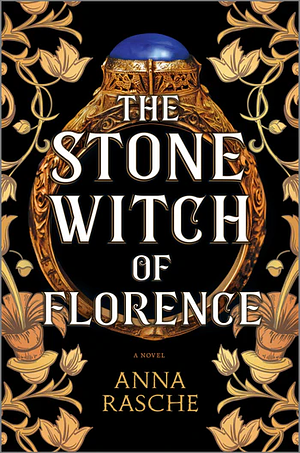
The Stone Witch: A Historical Fiction Mystery

book review

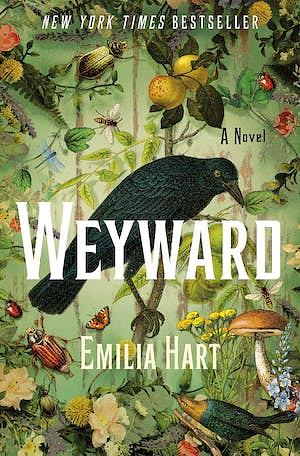
Women, Witches, and Weyward: Exploring Nature, Patriarchy, and Resilience

Weyward by Emilia Hart
Genre: magical realism
I read it as a(n): hardback
Length: 329 pp
Her Grace’s rating: 5 stars 
2025 Reading Challenge tasks: 

  • Her Grace’s: #21: About witches or nuns
  • TND: #35: Multiple perspectives
  • PS: #24: A happily single female protagonist

Words cannot adequately express how much I fucking loved this book. I read it in less than two days, which is astonishing considering that I have recently struggled to read a scant 200-page book within the space of an entire month. But I was hooked right from the start of Weyward. This gorgeous book tells the ways in which the lives of three women in three different time periods intersect. They are all connected by a shared link to nature and abuse at the hands of men. 

In 1619, Altha is a healer who is indicted for witchcraft after the husband of a childhood friend is killed. She has only ever used her skills to help her community, and they repay her by turning against her after a man falsely accuses her. Society fears female autonomy and strength, and we have the evidence of that in the witch crazes (and everything else that still persists today in how women are treated). There are references to Jennet Device and the Pendle Hill witch trial* scattered throughout Altha’s story, which is a historical reference I appreciate. Her trial for witchcraft underscores the dangers of being a woman with intelligence or independence in a world ruled by men. 

In 1942, Violet chafes against the harsh restrictions imposed on her by her father and society. She uses nature to seek freedom, and she goes around her father to learn about the ecosystem and insects, doing an end-run around society’s gendered constraints. She suffers mental and emotional abuse from her father, and physical abuse and rape from her cousin. When she takes matters into her own hands, using her innate understanding of nature and her own keen intelligence, she narrowly escapes forced institutionalization. Lobotomy was the implied treatment, along with hysterectomy. Violet escapes a horrorshow life in an institution mainly because her brother stands up for her and rejects their father alongside his sister. Violet’s experiences show the ways in which women’s autonomy was stripped away under the guise of propriety.

In 2019, Kate escapes an abusive boyfriend and flees to a small cottage in the north of England that was left to her by her great-aunt. Said great-aunt happens to be Violet. When she arrives at Weyward Cottage, the wilderness surrounding the area helps her to rediscover and refine her strength and confidence. Kate’s story shows the continuing battle women have to deal with even in modern times, the constant stream of bullshit from patriarchal desires and systems that are forced on society. Seriously, why do we still have to struggle with this? 

These three women are also case studies in how generational trauma works. They each have inherited both the wounds and the knowledge of their foremothers. The novel emphasizes the importance of embracing and working with that heritage. It is only by doing so that they, and we today, can find the ways to break the cycle of abuse and oppression. 

Each of these women are witches in their own way – healer, scientist, mother. This is a story about the deep strength and courage of women, how we intersect with each other even across time, and the impact of the natural world on us all. Through their connection with nature, these women reclaim their identities and strength that was stripped from them. They give the finger to their abuse, abusers, and generational trauma by refusing to allow that abuse to define them. Instead, they are defined by their resilience and the way they each embraced their rewilding.

I cannot recommend this book highly enough. I think it is one that will resonate with any woman. After all, as Aunt Jet reminds us, there’s a little witch in all of us.

*Side quest: If you are interested in reading a superb historical fiction about the Pendle Hill witch trial, you will immediately go pick up Daughters of the Witching Hill by Mary Sharratt.

book review · historical fiction

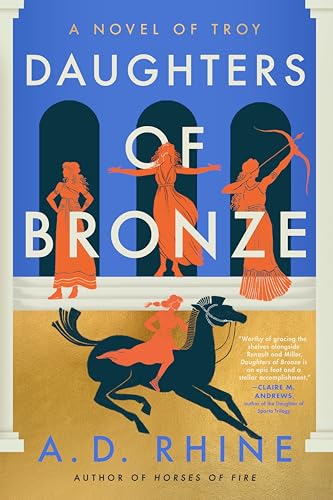
Exploring Women’s Voices in The Iliad’s Retelling

Daughters of Bronze by A.D. Rhine
Genre: historical fiction
I read it as a(n): digital ARC
Length: 512 pp
Her Grace’s rating: 5 stars

In Daughters of Bronze, A.D. Rhine (the penname of writing team Ashlee Cowles and Danielle Stinson) continues their feminist retelling of The Iliad, focusing on four women: Rhea, Andromache, Helen, and Cassandra. This second* novel brings their stories to the forefront, challenging the traditional male-dominated narrative.

Helen, often blamed for the Trojan War, is portrayed as a victim of Paris, who took her against her will. Rhine gives Helen a voice, exploring themes of female agency and resilience.

Andromache, usually seen as Hector’s wife and Astyanax’s mother, is depicted as a complex character, fiercely protecting her family and city. Her story delves into motherhood, duty, and honor.

Cassandra, the seer cursed to be ignored, is shown as a character of heartbreaking vision. Her voice is repeatedly silenced, often by other women, yet she remains devoted to the truth. Her story highlights the consequences of ignoring or marginalizing women.

Rhea, a refugee turned spy for Troy, plays a crucial role in the war. She and other brave women work to undermine the Greeks, risking their lives and highlighting the invisibility of women in historical narratives. If Helen, Andromache, and Cassandra are the warp of this story, Rhea is the weft that binds them together.

Rhine’s novel is rich with themes that resonate deeply in contemporary discourse. The author uses the framework of The Iliad to explore issues of gender, power, and agency. Each character’s story is a testament to the strength and resilience of women, challenging the patriarchal structures that seek to confine them. By giving voice to Rhea, Andromache, Helen, and Cassandra, Rhine underscores the importance of listening to and valuing women’s experiences and perspectives.

The novel also discusses the personal cost of war, not just for the men who fight, but for the women who endure its aftermath. The emotional and psychological toll of the Trojan War is vividly portrayed through the eyes of its female characters, offering a stark reminder of the often-overlooked victims of conflict.

Rhine’s prose is lyrical and evocative, capturing the grandeur of the ancient world while providing intimate glimpses into the lives of its characters. The alternating viewpoints of Rhea, Andromache, Helen, and Cassandra are seamlessly woven together, creating a tapestry of interconnected stories. This narrative structure not only highlights the individuality of each character but also emphasizes their collective experiences and struggles.

Daughters of Bronze is a powerful and thought-provoking retelling of The Iliad that places women at its heart. A.D. Rhine’s novel is a celebration of female strength, resilience, and agency, offering a fresh perspective on a timeless epic. By reimagining the stories of Rhea, Andromache, Helen, and Cassandra, Rhine provides readers with a deeper understanding of the human experience and the enduring impact of women’s voices in history. This novel is a must-read for fans of historical fiction, feminist literature, and anyone seeking a more inclusive and nuanced take on classic tales.

*I somehow missed that this was the second installment, but it didn’t matter. The narrative is tight, and anyone familiar with The Iliad can jump right in. However, some backstory from the first installment, Horses of Fire, might further enhance the reading experience.

A version of this review was originally published at the Historical Novel Society.

book review · historical fiction

I Am Rome

I Am Rome by Santiago Posteguillo
Genre: historical fiction
I read it as a(n): digital ARC
Length: 634 pp 
Her Grace’s rating: 5 stars

The end of the Roman Republic was a time of great strife and even greater corruption. Members of the ruling classes clashed with the regular population in terms of what taxes and rights each social class had. A prime example of this corruption was Gnaeus Cornelius Dolabella, close advisor to the dictator Sulla and governor of Macedonia. During his stint as governor, Dolabella abused his position to gain tremendous wealth, ignoring his duties in favor of abusing the people under his care and stealing taxes. He was charged in Rome with corruption, theft, and rape. However, since it was an age rife with general corruption, all of the jurors and judges were bribed to exonerate him. No one wanted to step into the role of prosecutor since doing so would not only effectively end a man’s political career but also very likely terminate his life. Except one young and inexperienced man decided he would do it. Gaius Julius Caesar was his name.

This novel was a 600+ page doorstopper – and I read it in just a few days. The story flowed rapidly and engaged my interest from page one. The novel’s structure was divided into sections dedicated to Dolabella’s trial mixed with flashbacks from various characters’ perspectives of events that led up to the trial over the course of many years. Readers are introduced to the main players and given glimpses into their motivations based on their experiences. 

The action-heavy scenes and battles are vividly depicted and exciting. This is definitely the novel’s strength. Many techniques the Romans were famous for, such as the testudo formation, are described here in detail, enhancing the action without slowing it down. The military strategies used throughout the novel would be familiar to students of Rome or military history. To the uninitiated, these details merely add to the excitement of the moment. 

The main drawback to Posteguillo’s novel is that there is little in the way of actual character development. Caesar largely remains the same throughout the book even though he is shown at various ages from childhood to early adulthood. Similarly, the dialogue is a little lacking and feels a bit stilted in places. It was great fun, though, to see Posteguillo’s young Caesar reflecting about how he will never be known as a military genius like his uncle Marius, or how he will never amount to anything if he loses the case against Dolabella. It is also always interesting when other real-life figures make appearances, such as Cicero here and there throughout the trial. 

I don’t usually look at any other reviews before I read a book, and I didn’t this time, either. I did, though, look at some after I finished. It seems that some readers felt the book was very inaccurate and played fast and loose with historical events. Normally I am a stickler for high fidelity in historical fiction since it will make historians happy and the rest of us won’t know any different. Perhaps this book is inaccurate, but I happily fall into the latter camp despite having taken 7 years of Latin throughout my college and grad school career. I just thought it was a great read and I would happily read more of Posteguillo’s works if they ever get translated into English. 

All in all, I thought this was a highly enjoyable novel, even if it had some flaws and inaccuracies. Definitely recommended. 

book review

The Prince and the Coyote

The prince and the coyoteThe Prince and the Coyote by David Bowles
Genre: historical fiction
I read it as a(n): ARC
Length: 424 pp
Her Grace’s rating: 3 out of 5 stars

Set in 1418, pre-Columbian Mexico, a young nobleman comes of age in a time of tremendous upheaval. The Mexican national hero, Nezahualcoyotl, a dreamer and poet as well as the Crown Prince of Tetzcoco (modern Texcoco), is sent to an elite school to learn the many duties of being a royal. His world is shattered when an uprising, led in part by his illegitimate half-brother, leads to the deaths of all of Nezahualcoyotl’s family and sends Nezahualcoyotl himself into exile. Complex political strategy, military brilliance, and sheer stubborn determination to reclaim his throne keep Nezahualcoyotl going as he forges new alliances and fights for his rightful throne.

The world building in this novel was exceptional. Bowles took great pains to create a living, breathing world that appeals to modern readers. The labyrinthine politics involved in the relationships between the various city-states of Mexico at the time are fascinating. That aspect of the novel was certainly the strongest. The battle scenes, though sometimes feeling a little rushed, were exciting and detailed. Learning more about the weapons and battle tactics of this time period was intriguing and made me want to learn more. Similarly, I appreciated learning about daily life for this region and time period.

I have two minor quibbles: the book is marketed as a YA but because of the complexity of the plot, it definitely reads like an adult novel. I think a lot of younger readers would be bored with this.

Also, even though the story quickly grabbed my attention, I was almost undone by the names. While I appreciate, and usually insist upon, historical accuracy, this might be an instance where it would be acceptable to shorten some names to make this book more readable, even if that isn’t technically accurate. It would have been so much easier to read and keep straight all the characters if they were actually called Fasting Coyote or whatever the translation of their name would be. 

Overall, The Prince and the Coyote is a gripping, enjoyable epic through a period of history that the U.S. largely skips right over. Warmly recommended. 

book review

Catch-up reviews

Romeo + JulietRomeo and Juliet by David Hewson
Genre: Historical fiction
I read it as a(n): audiobook
Narrator: Richard Armitage
Length: 11:05:00
Her Grace’s rating: 5 out of 5 stars

Hewson took the Bard’s play and turned it into a narrative historical fiction. I loved the touches of actual history, such as talking about the Borgia Pope or the occasional outbreak of bubonic plague. Beginning with this story, or reading it in tandem with the play, would make it so much more fun for high school students just learning about Shakespeare. That, and let them swear all they want if they use only Shakespearean swears. 

I listened to this as an audiobook and now I would listen to Richard Armitage read the phone book if that was all that was available. 

Seveneves by Neal Stephenson
Genre: SF
I read it as a(n): audiobook
Narrator: Mary Robinette Kowal and Will Damron
Length: 30:00:00
Her Grace’s rating: 3 out of 5 stars

I really wanted to love this book but I only mostly liked it. I really enjoyed the first three-quarters or so of it. All the parts where they were figuring out the logistics of getting as many people off Earth as they could before the Hard Rain began. I liked the complexities of the politics and the more sciency aspects of the story. Once the plot jumped ahead in time, though, I lost interest. I didn’t like the characters as much then and felt that ending the novel before the time jump would have made it ambiguous and generally better.

The Invisible HourThe Invisible Hour by Alice Hoffman
Genre: magical realism
I read it as a(n): hardback
Length: 252 pp
Her Grace’s rating: 5 out of 5 stars


Alice Hoffman does it again – a magical and lyrical story about a woman just trying to do the best she can for her child. Problem is, she gets sucked into a cult, which is not good for anyone. Her daughter takes stock of the life she leads and makes her own decisions from there. It is full of Hoffman’s typical atmosphere of magic hovering just at the edge of your vision. I loved it so much.

A Stitch in Time by Andrew Robinson
Genre: SF/ Star Trek DS9
I read it as a(n): audiobook
Narrator: Andrew Robinson
Length: 12:28:00
Her Grace’s rating: 5 out of 5 stars

This may very well be a perfect audiobook. Andrew Robinson, who authored and narrated this, also played Garak. So having him be Garak while reading Garak’s story to us is just *chef’s kiss* to this Trekkie. 

Screenshot 2023-10-16 160640

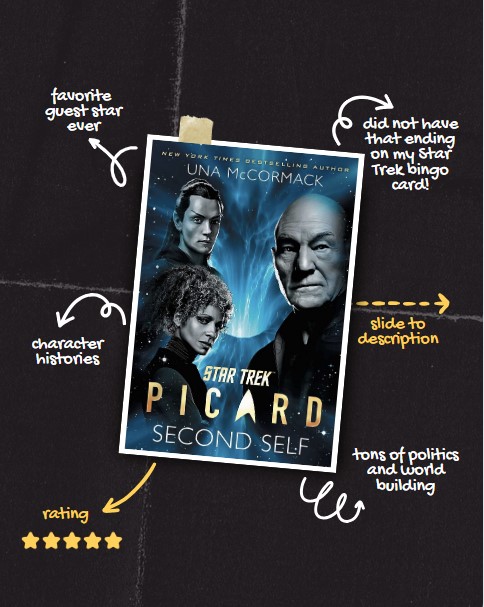
Second Self by Una McCormack
Genre: SF/ Star Trek Picard
I read it as a(n): hardback
Length: 305 pp
Her Grace’s rating: 5 out of 5 stars


Another terrific story and it happened also to feature Garak. I didn’t realize when I started reading it that he was in this one. So I accidentally had a Garak readalong of some kind. This one was a wonderful insight into Raffi’s character. I liked the dual timeline and how it resolved at the end, though McCormack went and killed one of the best characters in the book and that made me sad.  

Girls and Their Horses by Eliza Jane Brazier
Genre: contemporary/mystery
I read it as a(n): hardback
Length: 400 pp
Her Grace’s rating: 4 out of 5 stars


Toxic horse rich person environment on full display! I burned through this book – I am an adult lady who loves horses and horse books – but even if it wasn’t about horses, the writing style made it imminently readable. I enjoyed the mystery, lowly finding out who the dead person was in the barn and who killed them. I figured that all out before the end, though whodunnit was easier to figure than whohaditduntothem. 

Mercy Rule by Tom Leveen
Genre: YA
I read it as a(n): hardback
Length: 436 pp
Her Grace’s rating: 5 out of 5 stars

When I first bought this book, I had thought it was a horror since the other books my Tom Leveen I’ve read were horror. So I was a bit confused at first. But it didn’t matter because this is one of the best, most anxiety-making books I read this year. Told from multiple points of view, it is the events and wind-up to a school shooting. Every character was unique and well-crafted – they were all individual people, not one of whom was a blank or someone you could confuse with another. I liked most of them, except a couple that maybe you weren’t supposed to, and one in particular was my very favorite. Heartbreaking book, but a very necessary story to read. 

book review · historical fiction

Daughter of Black Lake

daughter of black lake

Daughter of Black Lake by Cathy Marie Buchanan

Genre: historical fiction

I read it as a(n): hardback

Length: 320 pp

Her Grace’s rating: 5 out of 5 stars

Set in the 1st century CE, Daughter of Black Lake centers on a small village to the northwest of Londinium. The Roman invasion is in process, though the villagers don’t really seem to care much. Most see it as an opportunity to make some money by trading with a nearby outpost town. When an unhinged Druid, Fox, comes along, trying to incite the tribesmen to band together and rise against the Romans, things get dangerous. One woman, Devout, and her daughter, Hobble, find themselves in the middle of a power struggle between the Druid and the leader of the village, in part because of Hobble’s ability to See the future. Devout, though, also has secrets of her own that may destroy the peace of the village and doom Fox and the rest of the Druids’ plans to overthrow the perceived shackles of their oppressors. 

At first, I wasn’t sure if I was going to like this book. It felt like a lot of not much was happening. But the characters were deeply developed and I got invested in their stories. Then Fox came along and I wanted to see what would happen with him. He was a hateful character, which was weird for me since I usually really like Druid characters. Of course, the Druid figures in other stories I’ve read were more like Merlin or Gandalf, so naturally I would like them. Fox, not so much. He was a fundy zealous dick. 

I liked Hobble a great deal. She was a healer, like her mother, and had vast knowledge for such a young girl. I cared less about her ability to see the future, especially since it was never really explained why she had the ability. Fox wanted to use her ability to help rally the tribes to the Druids’ cause and go to the aid of the Iceni queen, Boudicca, but Hobble couldn’t do that. She could see that the Romans were going to kick their asses. And historically, they did. Boudicca came damn close to winning but in the end, she didn’t. 

I really liked the writing style. It was almost dream-like. It felt similar to The Buried Giant by Kazuo Ishiguro, but I didn’t care for that story and I did like Daughter of Black Lake. Maybe comparing it to The Mists of Avalon would be more accurate. At any rate, I really liked this one. It’s certainly making my favorite books of 2023 list. 

book review · Medievalism

The Buried Giant

The Buried Giant by Kazuo Ishiguro

Genre: fantasy

I read it as a(n): hardback

Length: 317 pp

Her Grace’s rating: 2 out of 5 stars

I…did not understand this book. I’ve got plenty of game. I can talk about the allegory of the buried giant as the letting go of or forgetting of old grudges. I get that the mist is the collective forgetting that happens when we rewrite history or lose meaningful parts of history. I can understand the symbolism (So. Much. Symbolism) of the dragon, the pilgrimage, or the boatman. I can talk about how each person in the group of Axl, Beatrice, Wistan, Gawain, and Edwin represents a different social strata and that they collectively serve as a microcosm of post-Roman Britain. 

But I still do not understand this book. What even happened in it? I wanted to love it so much. I love most things even remotely related to Arthurian legend. But there was an old couple and a warrior and a kid and they all met Sir Gawain and then there’s a dragon and some monks and the kid’s weird visions and a boat and the end. All with nothing really happening. The characters were flat. Most of them were totally blank to me. I didn’t care about their quest or the fact that they couldn’t remember. The tidbits of memory from Axl were not tempting to me. There was nothing exciting, no plot progression, nada. Just, like…ok? And? 

I think people who enjoy introspective and meditative narratives will love it. That is usually me, but not this time. I could go on for days about it and still come up with nothing much. So weird.