book review · Tudors

The Tragic Tale of Mark Smeaton: A Historical Fiction Review

The Queen’s Musician by Martha Jean Johnson
Genre: historical fiction
I read it as a(n): digital ARC 
Length: 344 pp 
Her Grace’s rating: 5 stars
2025 Reading Challenge tasks: PS: #31 – music plays a prominent role 

Spanning the years 1529 to 1536, The Queen’s Musician follows the story of Mark Smeaton, one of the musicians who played for Henry VIII and Anne Boleyn. The novel follows his meteoric rise from total obscurity to fame. Much of his success, at least in this book, stemmed from being in the right place at the right time as much as his genuine musical talent. However, what goes up must come down and his tragic fall from favor was catastrophic and swift. Alongside Smeaton, the novel also follows Madge Shelton, cousin and courtier to Anne Boleyn, whose own path is shaped by the strict rules and expectations of class as well as by rumors. Through the perspectives of these two historical figures, Johnson takes readers on a deep and thoughtful exploration of the perils of the Tudor court.

Anyone familiar with Tudor history knows the fate of Anne Boleyn and the men accused of being her lovers. Smeaton was the lowest-born among them, an easy target for manipulation. Little is known about his life before court, but Johnson vividly imagines what it might have been, filling his world with music that feels as essential as breathing. The novel highlights how deeply Smeaton connected with his art, not just as a performer but as someone who saw music as his true language. His passion for his subject extends beyond the demands of his life as a royal musician. His admiration for composer John Taverner reflects his appreciation for the era’s greatest musical minds. The gentleness written into his character, especially his love for music, people, and, most touchingly, his horses, makes his fate even more devastating. I felt absolute rage on his behalf. 

Music was central to the Tudor court, not just as entertainment but as a reflection of power and prestige. Henry VIII himself was an accomplished musician and composer, and courtiers were expected to be well-versed in music. While some composers of the time, like Thomas Tallis and John Taverner, left behind enduring legacies, no known compositions of Smeaton’s survive. If he did write his own music, as Johnson imagines in the novel, it has been lost to time. This adds to the novel’s poignancy – Smeaton’s talent, like his life, was ultimately erased by history.

Similarly, little is known about Madge Shelton’s early life. At various points, there were rumors that she was briefly Henry VIII’s mistress, but her real experiences are largely unknown. Johnson brings her to life as a woman navigating court politics, her innocent romance with Smeaton offering a brief moment of sweetness amid the court’s poisonous gossiping and currying favor. Even though their social classes made it impossible for them to consider a future, or even a genuine friendship, it was nice to have that hope for just a moment. Their entwined story felt like a rare and delicate thing in a world where relationships were mostly transactional. 

The characters are vibrant and deeply human. Some secondary characters, such as Smeaton’s friend Paul, are a delight on the page and bring a lot of warmth to the story. Others, such as Cromwell and the head musician at court (I’m totally blanking on his name now), give a masterclass in villainy and are the sort of characters you love to hate. Johnson excels at making readers care about them, drawing us into a world where we already know the outcome, but nonetheless making us hope for a minute before slowly shattering our hearts. We know how this journey ends, but the path to that end is gut-wrenching, beautiful, and filled with moments of quiet grace.

Highly recommended for anyone who loves Tudor history or anyone who, like me, enjoys being completely destroyed by a story.

book review · Elizabethan England · historical fiction

Black Death

44597455Black Death (A Tudor mystery featuring Christopher Marlowe)* by MJ Trow

I read it as an: ARC

Source: Netgalley

Length: 224 pp

Publisher: Severn House

Year: 2019

Robert Green and Christopher Marlowe are not friends. But when Green believes someone is trying to kill him, he sends a desperate letter to Marlowe, behind for his help. When Green is found dead, Kit believes it is his duty to discover who murdered Green and so undertakes the investigation. At the same time, stage manager Ned Sledd is wrongly taken to Bedlam in lieu of an escaped inmate just days before the opening of one of Marlowe’s new plays. Marlowe has to find the connection between all these events and help his friend. And also, the Spymaster, Robert Cecil, is taking an inordinate interest in things. And there’s plague. What could go wrong?

This is a short, quick read and like other MJ Trow novels I’ve read, it is a fun and witty tale as well. The plot is full of twists and turns and not all is as it appears. The characters, especially Marlowe, are all multidimensional. I really love the little digs at William Shakespeare (spelled here as Shaxper) throughout and the subtle shade thrown on the authorship of his works. There are many literary gems hidden in these pages that appeal to any Anglophile.

The descriptions of Elizabethan London are also vivid and gritty. So much of that period is romanticized but here, we get the more realistic portrayal of what it might have actually been like – dirty, smelly, and depressing. Oh, and don’t forget the plague!

A fun and fast read, highly recommended for any lovers of Marlowe, Shaxper :-), or Elizabethan English history in general.

book review · Elizabethan England · Tudors

The Creation of Anne Boleyn

15814396The Creation of Anne Boleyn: A New Look at England’s Most Notorious Queen* by Susan Bordo

I read it as a: paperback

Source: my own collection

Length: 345 pp

Publisher: Mariner

Year: 2013

The Creation of Anne Boleyn is a study on the woman, in all her various incarnations, who was wife to a king, a catalyst to the English Reformation, and mother to Elizabeth I. The book covers a wide range of areas ranging from actual history to literature, film, TV, and pop culture interpretations of Anne Boleyn.

There were some enjoyable things about this book. Bordo takes a feminist approach to her writing and interpretation of Anne, which of course is something I appreciate. She is a women’s studies professor, so approaching the topic of Anne Boleyn from the perspective of gender studies rather than a pure historian’s point of view is a nice change of pace from some of the recent things I have read on the subject. I also think that, because the writing tone is engaging and entertaining, it might entice other readers who are new to the topic of Tudor studies to be inspired to learn more about the subject on their own as a result.

There were many issues throughout the book as well, though. As many others before her, I think Bordo leans too heavily on Eustace Chapuys’s letters about Anne. It is true that he did not like her and had many reasons to hope for her downfall. However, although Bordo frequently states in one way or another that Chapuys shouldn’t be trusted in regard to his opinion on Anne, not once did she mention that he only had a couple interactions with Anne directly. Most of his information about Anne came second- and third-hand from others, which she did mention in passing, but I think it is important to remember that his whole job was to report to his boss, Charles V, what was said at court. Chapuys was Charles’s ambassador, so he was likely repeating many of the things he had heard; he was doing his job when he said that “a gentleman known to me” called Anne a whore or said that she had adulterous relations or whatever else. We cannot possibly know that he was “gleeful” when Anne’s downfall came, because unless one is a time traveling mindreader, there’s simply no way to know what he was thinking. I think we really have to take much, if not most, of what Chapuys says in his letters about Anne with a grain of salt. No, he probably didn’t like her at all, but it doesn’t necessarily follow that every single word he wrote about her were his own true thoughts, either.

The book also had a tendency to attack authors with whom Bordo disagreed, which I don’t think is the most professional approach. She makes a lot of valid points about many popular authors who seem to think their historical fiction books are the same as gospel truth and are well researched, when in fact neither is true. I won’t say which authors Bordo takes such exception to, only that I completely agree. They, at least, tell a good story even if it’s totally inaccurate. Bordo, however, champions some authors who also have problems as well, if not to the same degree as the others. The difference seems to be that the ones she champions are ones who paint Anne in a very positive light rather than as the traditional Jezebel or even as a flawed and imperfect woman. Her own bias comes through the most strongly here. Also, Bordo herself does the same things she accuses others of doing, which is to make declarations of historical fact without supporting evidence, or making claims that are contrary to evidence in hand. At one point, she calls Henry a pussy-whipped husband, which is really unlikely to be true, don’t you think? There is evidence that he was ruthless and even brutal when he needed or wanted to be long before he met Anne. Similarly, her treatment of Katherine of Aragon and Mary is really bad. You don’t have to be Team Katherine to be able to acknowledge that Henry treated his first wife and daughter abominably. Fighting to keep a marriage and position to which she was born does not make Katherine stubborn or self-righteous, as Bordo suggests. It makes for good historical fiction, perhaps, but not really for nonfiction. Additionally, I really don’t think quoting people from one’s own Facebook page is adequate for a “scholarly” book. I was really annoyed by that and disappointed that this book was passed off as scholarly. It’s kind of the equivalent of “My mom thinks my story is cool,” and it doesn’t pass muster. For someone who is a doctorally prepared professor, she should do better than resorting to ad hominem attacks on authors or scholars whose positions she disagrees with, and use better supporting evidence.

At the end of the day, this is far more a pop culture commentary than a biography. It is useful in its way for a starting point into further, more academic studies by actual Tudor scholars. It was interesting as a feminist cultural study, but I wouldn’t recommend it as a source for any theses.

book review · books · Elizabethan England · historical fiction

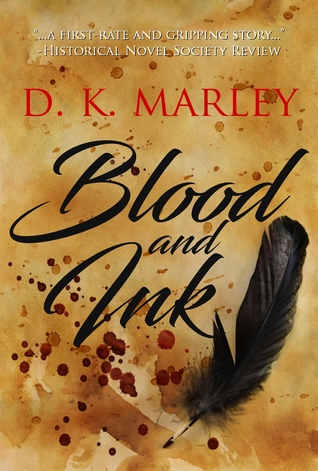
Blood and Ink

40821110Blood and Ink by DK Marley

I read it as an: ARC

Source: Helen Hollick at Discovering Diamonds.

Length: 414 pp

Publisher: CreateSpace Independent Publishing

Year: 2018

Blood and Ink by DK Marley is the tale of Christopher “Kit” Marlowe, Renaissance poet and playwright, near contemporary of Shakespeare. In Marley’s novel, our playwright is an unwanted child who is effectively sold to Sir Francis Walsingham, Queen Elizabeth’s spymaster, who noticed the boy’s intelligence when he visited a local school. Placing the young Marlowe under the mentorship of poet and spy, Sir Phillip Sydney, Marlowe continues his education as well as learns how to be a spy for Walsingham. As the years progress, Marlowe convinces Elizabeth to support his plays on-stage in exchange for his services to her. However, when factions more loyal to money and personal advancement than to the Queen step in, Marlowe makes a sacrifice that alters everything he has understood about the world, his writing, and himself.

christopher_marlowe
Christopher Marlowe. I love that the portrait has “Quod me nutrit me destruit” in the upper left. That would make a cool tattoo…

This was an interesting novel and can potentially be classified as alternate history, depending on one’s perspective. It takes one of the more popular theories about Shakespeare, which is that Marlowe was actually the author of his works, and runs with it in a way that is believable. There are theories that Marlowe didn’t actually die at the inn in Deptford and that his death was, in fact, staged so that he could go either into hiding, exile, or continue his spy work for Walsingham. The author poses some of the more common and interesting questions in her note at the end of the book, including why Shakespeare, one of the greatest playwrights of his day, was buried in a common churchyard rather than in a glamorous cemetery; why the Queen provided her own coroner to preside over the inquest of Marlowe’s death when it wasn’t in her purview to do so; why we never heard anything at all about Shakespeare until after Marlowe’s death; the education of Shakespeare and Marlowe (Marlowe had a degree from Cambridge, Shakespeare was relatively uneducated); and why was Shakespeare’s grave dug 12 feet deep instead of only the usual 6 feet? Marley takes pains to answer these questions and more in the novel and does so quite thoroughly. She also is careful to note that she herself is a Shakespearean, at least until there is solid proof that someone else was the author. But it makes for a good story.

220px-shakespeare
William Shakespeare

Various themes were at play throughout the novel, ranging from nature vs. nurture to loyalty to ambition to betrayal. The ways in which all these themes intertwine and influence one another are fascinating and very finely wrought, particularly the ways Marlowe had to balance his work as a spy with his calling as a playwright. The mix of blood and ink throughout the narrative is a stark reminder that his dreams come at a steep price, one that may be too much to bear. Overall, I think some of the characters were a tad one-dimensional, though Marlowe himself and the major secondary characters like Walsingham or Queen Elizabeth are complex figures. Shakespeare was the next most well-fleshed character besides Marlowe, which makes sense, though his motives were only apparent near the end of the novel. The last quarter or so of the book felt unnecessarily long and dragged down the pacing somewhat. However, the attention to historical detail was excellent and made for an immersive read. I particularly enjoyed all the bits and pieces of plays and poems scattered throughout the narrative. It was fun to see words that we automatically credit to Shakespeare coming from Marlowe’s pen or lips in this story, and it definitely reminds me that it’s time to reread the plays again. It has been too long. I look forward to more from this author in the future.