book review · historical fiction

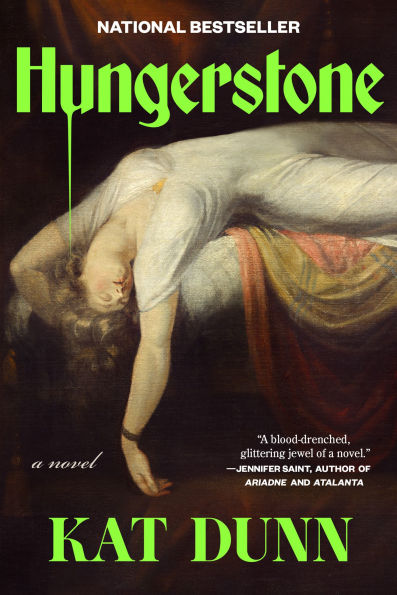
Hungerstone: A Feminist Retelling of Carmilla

Hungerstone by Kat Dunn
Genre: Gothic historical
I read it as a(n): Digital ARC 
Length: 336 pp 
Her Grace’s rating: 4.5 stars
2025 Reading Challenge tasks: TND: #1 – a 2025 release 

Lenore Crowther learned at a young age that nobody can save her but herself. She spent her childhood after the death of her parents learning everything a titled lady would need to know, secured herself a wealthy but untitled husband, and carried out a campaign to ingratiate him into the social circles that he craved. 

Ten years later, the shine is worn off the marriage and she has no children to occupy her time like a proper Victorian wife should have. When her husband, Henry, buys a large estate, Nethershaw, Lenore is hopeful it will be just what she needs to break the doldrums. 

However, the decrepit mansion is not at all what she’d hoped for, and the arrival of a mysterious woman who survived a carriage wreck only brings about more dissatisfaction. 

This atmospheric novel drips with the Gothic elements that so many of us love. The mansion isn’t a dark and drafty castle, but it is dilapidated and a sad shadow of its former imposing glory. The place is surrounded by misty heaths, treacherous cliffs, and windswept fields. The landscape and mansion are both characters in themselves, which is always a fun experience for readers, though significantly less so for the characters. 

Lenore tries her hardest to conform to the Victorian ideal of the Angel in the House, but as we read on, we learn that underneath her soft outer layers is a ruthless core of iron. Carmilla, the carriage-crash survivor who is recuperating at Nethershaw, is strange and defies every social convention there is. She awakens previously unknown desires in Lenore that are catalysts for her drastic change throughout the novel. 

This story is so much more than a retelling of Carmilla, as it is marketed, or even about hunger, as indicated in the Author’s Note. It is an examination of demand and dependency, societal expectation, and the injuries that cause invisible damage to us all. It is a commentary of society today as well. There is one quote that perfectly encompasses every issue the novel tackles: “What is a monster but a creature of agency?” Women’s agency, independence, intellect, women who decide for themselves what they want rather than allowing men to do it for them – all can be seen as monstrous depending on who’s doing the interpreting. What makes a monster or a savior is, in this novel, entirely in the eye of the beholder. 

Highly recommended for lovers of Gothic fiction, social commentary, and women who proudly identify as a problem.

book review · books · historical fiction

Carmilla: The Sapphic Vampire Classic

Carmilla by J. Sheridan Le Fanu
Genre: horror/Gothic/Classics
I read it as a(n): e-book
Length: 108 pp
Her Grace’s rating: 3.5 stars
2025 Reading Challenge tasks:
Her Grace’s: #10 – A book that was adapted to screen
TND: #9 – Author starting with J; #48 – Under 250 pages
PS: #39 – A classic you never read (I guess technically, I read it in college but I definitely didn’t pay attention to it then)

Predating Stoker’s Dracula by about 25 years, Carmilla is the Gothic Sapphic story you are looking for. Though by no means the oldest vampire story (that honor falls to Sekhmet from Ancient Egypt, circa 1500 BCE), Le Fanu’s novella highlights many of the now-familiar tropes within the vampire canon. Mysterious, highly attractive stranger? Check. Dark and spooky castle/forest/chateau/moors setting? Check. Weirdly incestuous vibes? Shuddercheck! Homoerotic fixation? Double check! 

Le Fanu opens his story with the narrator (her name is Laura but we don’t know that until about halfway through the story) reminiscing about a past experience that has haunted – literally and figuratively – her life ever since. The story is told in snapshots of memory as though written in a letter or diary format. Or as if we are sitting with Laura and she is telling the story to us. In any case, the format of the storytelling adds to the atmospheric setting overall. 

Laura is a young girl when she first meets Carmilla, or so it is implied. She seems to meet her in a dream, though as we read, it seems more likely that Carmilla found her in real life and had somehow marked her as her own. When they meet several years later, the intensity of the connection between Laura and Carmilla reads, at times, like long-lost friends as much as lovers. And there were a LOT of Sapphic vibes throughout this short book. Laura finds herself struck dumb more than once at Carmilla’s beauty, though savvy modern folks know that’s just what vampires do. They charm us. See? 

But seriously, that guy could charm me all he wants. 

Anyway. Carmilla’s victims that we know about are all young women or children who are young enough to still be fairly androgynous. That part is super creepy. Also creepy are the incestuous vibes when the General talks about his ward, who he views as his daughter, and who was unfortunately one of Carmilla’s victims. That’s a common vampire trope, so it isn’t out of the ordinary here, except when we consider that this is one of the earlier vampire stories we have and it was written in the Victorian Era, that period of supremely repressed sexual desire and general moral chucklefuckery. 

I decided to read Carmilla because I am reviewing a retelling of it for the Historical Novels Society and wanted a refresher. I’ll post that review once it goes live on the HNS site. For now, I am glad that I reread Carmilla; it is easy enough reading, once you get used to the very long sentences, and short enough to read in one sitting.