bookish things · Reading Challenges

Why Reading Challenges Can Hinder Your Love for Books

From Pixabay, courtesy of prettysleepy

If you’ve stuck with me in this column, you know that I have often recommended various reading challenges to encourage us all to read outside our comfort zones, to read more diversely, and to find a new topic to learn. I believe I offered several to choose from at the start of this year or end of last year. I’ve even created my own reading challenges for a couple of years on my blog.

As is my habit, I would go through the challenges I decided to do for any given year and try to find books that would fulfill each task. I always find some great books that way. It’s interesting to me to see what I initially thought I’d read as opposed to what I actually read at the end of the year. Then, over the past couple of years, I noticed something different.

Reading, the activity I love above all things, had started to completely stress me out.

Not the act itself, but the endless choices. I had so many unread books that I couldn’t decide what to pick next, so I dithered for days between books, paralyzed by an indecision that was stealing my joy.

Eventually, I realized that I wasn’t reading for pleasure anymore or reading to learn something. I was reading only with the goal to hit an arbitrary number that I had picked based on whatever reading challenge(s) I wanted to do. Reading had become competitive, and I have never been a competitive person.

Cue my booknerd-angst. In a burst of quasi-panicked self-discovery, I realized that I didn’t actually want to do reading challenges anymore. Aside from being turned off by the competitiveness, it also felt performative. But how could that be when I loved learning about new books so much? Did not reading 100 books a year make me a bad reader? How could I be a real reader if I wasn’t wrapped up in some reading challenge or another? I told you I had angst about it.

What I eventually realized was that reading dozens of books a year might help me knock down my TBR faster, but what good did that do if I couldn’t remember a single thing about a book I’d just read? Sure, I was reading fast. I was reading a ton of wildly diverse books. But as soon as I put the book down, my brain did a big memory dump and I instantly forgot what I’d just read. Note that I didn’t say, “As soon as I finished the book.” No, it was literally as soon as I put it down to go do something else. I could be in the middle of a book and not be able tell you most of the character names or major plot points. And that was for books I was actually enjoying! If it was a bit of a slog to get through or wasn’t grabbing my attention fully, I would have been hard pressed to tell you even the title or author. It started to feel like there was no real difference between reading a book and forgetting it and not reading it at all. My “read count” might have been ticking up to 50, 80, even 100 books a year, but in actuality it was more like four, the ones I remembered because I loved and engaged with them so strongly.

I don’t think it was entirely coincidental that I was concurrently learning more about slow living and trying to apply those ideas to my life. Perhaps it was the cognitive dissonance between trying to live a slow life and also trying to burn through dozens of books a year that made me rethink my approach to reading. Mostly, it was the fact that I didn’t like reading books and then forgetting them instantly. But just like the newly apostatic, I still felt guilty about what I viewed as abandoning my beliefs and goals and the stress of it, even though it was entirely of my own making, caused me to start avoiding books altogether. At the same time, I stumbled across a couple BookTubers who reminded me that it is ok to read slowly and engage deeply with a text, to savor it, to take notes about it, to analyze it. They talked about many of the practices and habits that I used to rely on while reading, which I had fallen away from in the frenzy of reading challenges. One of them, Eddy Hood from The Read Well Podcast, even has a motto that I thought was helpful: “Read slowly. Take notes. Apply the ideas.” That simple statement kick-started me, and it felt like I was getting permission to read only twelve books a year, or six or even just one as long as I engaged with it and got something out of it. Or rather, it reminded me that I can give myself permission to slow down.

Ironically, since coming to the realization that reading challenges had become bad for me, I’ve read more books, and more deeply, than I had in the last couple years. I’ve found my joy in reading again. I’m building my new habits, or rather reviving my old ones, to think more deeply about what I read. I don’t mean that I feel the need to analyze some beach-read-brain-candy kind of book that is supposed to be read in a weekend and then passed along and never thought of again. I mean getting back into more challenging books like classics and nonfiction, maybe even some philosophy here and there. Writing down new vocabulary words, looking at the rhetorical devices used, finding symbolism and imagery, highlighting favorite quotes, disagreeing with parts of what the author says, and thinking about what I’m learning from each book. I remember why I got literature degrees in the first place. I remember why I love reading. I remember that I believe reading well is better than reading quickly.

Now if I could only find my little sticky book tabs…

book review · lifestyle · travel

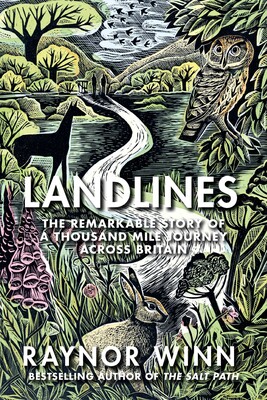
Exploring Connections in ‘Landlines’ by Raynor Winn

Landlines by Raynor Winn Genre: memoir/ nature writing I read it as a(n): trade paper Length: 303 pp Her Grace’s rating: 5 stars

Landlines – not just the telephones for old people! In Winn’s newest book, they are lines on maps. Lines on the land. Lines of communication. The theme of Winn’s third book are the various lines we encounter everyday and how they connect us to each other, to our home, to the places and people we love. 

Ray and Moth went walking, with the intention to walk the Cape Wrath Trail. That trail’s name sounds scary to me and I would probably die. Moth seemed to be getting worse and falling into a depression. Ray browbeat him into going walking again. At first, and for much of their trip, she felt guilty about it because Moth was convinced he was no longer able to do a long distance walk and he seemed to be genuinely miserable. But Ray, understandably, cannot give up on him or her hope. So she pushed and pulled and harangued until he kept going. And soon enough, they hit a rhythm that worked and rather than walking Cape Wrath and then going home, they decided to go to the next leg of the trail. And then the next. And the next. And ultimately they walked a thousand miles back home to Cornwall. 

As I wrote about previously, I don’t care if any of Raynor and Moth’s story is made up. I don’t think it is, but even if it is, I don’t care. I don’t think it matters. It’s memoir, not testimony, and there is still plenty of inspiration to be gleaned from any book, fiction or otherwise. I found Landlines to be just as inspiring and beautifully written as The Salt Path and The Wild Silence. I especially loved the references in this book to The Salt Path and how Ray now looks back on that time as one of the best parts of their life, even though while they were in it, it felt like one of the worst. I loved the way she weaves in reflections and memories of her life with Moth. They are all full of love, now tinged with the anticipation of dread and grief. “He reaches his hand out, and for a second I’m taking the last few steps through a freezing Arctic river and he’s pulling me up on to the bank of black ash, but that’s only a memory now” (20). 

A word I learned from this book: Moraine, an accumulation of dirt and rocks and other debris that is carried and deposited by moving glaciers. 

Some of my favorite quotes:

[Upon being given a couple bottles of beer by a stranger at a pub] “Put these in your bag, they’re for the big man later, don’t tell him ‘til tonight. What he’s doing, being out here, it’s a big thing. I might be loud, and drunk, but I know courage when I see it” (101). 

They’re the moments which turn desperate, annoying or desolate experiences into an understanding that the person you share the plastic bag with is the one, that you have the ability to laugh at anything, and that even having lost most of your material possessions you can survive on love, hope and a packet of dried noodles (105). 

“I know you’ve walked a long way.”

I look down at my clothes, muddy, ripped, smelling of dried bog-water. “I know, we do look a bit of a mess.”

“No, you can’t get away with it like that. I know who you are. Your book changed our lives – it changed the way we live our lives. We would never have given ourselves the time to just walk, not before we read your book.”

I look at the couple, heading towards middle age, but glowing from the wind, sun and enthusiasm. “The book might have given you an idea, but it didn’t change your lives.”

“How do you know that?”

“Because books don’t change lives. They can change how you think, but it’s you that changed your life” (227). 

Thousands of feet over thousands of years have trodden many of the same trails we have, tracing their passage on to the landscape, imprinting their memories into the soil. What remains are not just paths, they’re precious landlines that connect us to the earth, to our past and to each other. We’ve followed them for a thousand miles, seen so much, heard so many stories, until now, at the edge of the land, we’ve become something other than just walkers. We’re at the point where time and place and energy combine, where we become the path, the walker and the story. No need for runestones, it’s all held within us; we’re already part of our landlines, part of the song of the land (298-299).

academic · bookish things · Medievalism · Writing

Writing Things

I’m holed up in our cabin in the woods, working on my book. These are just a few of the things I’ve read in the past week. I need to format it right. Send halp and booze.

Boethius. The Consolation of Philosophy. Translated by Richard Green, Martino Publishing, 2011. 

Brewer, Jessica. “Etheldreda: Queen, Abbess, Saint.” Medievalists.net, 23 Feb. 2019, http://www.medievalists.net/2019/02/etheldreda-queen-abbess-saint/.

Cartwright, Mark. “The Daily Life of Medieval Nuns.” Ancient History Encyclopedia, Ancient History Encyclopedia, 10 Mar. 2020, http://www.ancient.eu/article/1298/the-daily-life-of-medieval-nuns/.

Clark, Christine G. “Women’s Rights in Early England.” BYU Law Review, 1995 March; 207(1): 206-236.

Crosby, Everett U. “Children of the Middle Ages.” Review of Medieval Children by Nicholas Orme. The Virginia Quarterly Review, Autumn 2002, vol 78 issue 4, p. 766-773.

Cybulskie, Danièle. “Royalit: What Did Medieval Kings Read?” Medievalists.net, 14 Apr. 2018, http://www.medievalists.net/2016/04/royalit-what-did-medieval-kings-read/.

Dawkins, Richard. Outgrowing God. New York: Random House, 2019.

Dragnea, Mihai. “The Influence of the Bible on Medieval Women’s Literacy.” Medievalists.net, 14 July 2014, http://www.medievalists.net/2014/07/the-influence-of-the-bible-on-medieval-womens-literacy/.

Dresner, Samuel H. “Barren Rachel.” Judaism. Fall91, Vol. 40 Issue 4, p 442. 

FitzGerald, Brian D. “Medieval Theories of Education: Hugh of St. Victor and John of Salisbury.” Oxford Review of Education, vol 36 issue 5, October 2010, p. 575-588.

Friehs, Julia Teresa. “What Did People Read in the Middle Ages? Courtly and Middle-Class Reading Matter.” Die Welt Der Habsburger, http://www.habsburger.net/en/chapter/what-did-people-read-middle-ages-courtly-and-middle-class-reading-matter.

Frijhoff, Willem. “Historian’s Discovery of Childhood.’ Paedagogica Historica Vol. 48, No. 1, February 2012, 11–29.

Gordon, Edward E. Centuries of Tutoring: A Perspective on Childhood Education. 1988. Loyola University, PhD Dissertation. 

Green Richard. “Introduction.” In Boethius’s The Consolation of Philosophy, translated by Richard Green, Martino Publishing, 2011.

Guillelmi de Conchis’s Dragmaticon. Translated by Italo Ronca, University of Notre Dame Press, 1997.

Harvey, Katherine. “Episcopal Virginity in MEdieval England.” Journal of the History of Sexuality, 2017 May ; 26(2): 273–293.

John of Salisbury (1962 [1159]) The Metalogicon of John of Salisbury: a twelfth-century defense of the verbal and logical arts of the trivium. Translated by D. McGarry. Berkeley, University of California.

Kuefler, Mathew S. “‘A Wyred Existence’: Attitudes Towards Children in Anglo-Saxon England.” Journal of Social History. Summer91, Vol. 24 Issue 4, p823-834. 

Lewis, Katherine J. “Model Girls? Virgin-Martyrs and the Training of Young Women in Late Medieval England.” In Young Medieval Women, edited by Katherine J. Lewis, Menuge Noël James, and Kim M. Phillips. St. Martins Press, 1999: 25-46.

Lewis, Mary, Fiona Shapland, and Rebecca Watts. “On the Threshold of Adulthood: A New Approach for the Use of Maturation Indicators to Assess Puberty in Adolescents from Medieval England.” 2016. American Journal of Human Biology, 28:48-56.

Otten, Willemien. “Christianity’s Content: (Neo)Platonism in the Middle Ages, Its Theoretical and Theological Appeal.” Numen 63 (2016): 245-270. 

Potkay, Monica Brzezinski and Regula Meyer Evitt. Minding the Body: Women and Literature in the Middle Ages, 800-1500. London: Twayne’s Women and Literature Series, 1997.

Riches, Sam and Miriam Gill. “Saints in Medieval Society.” Pilgrims and Pilgrimage, http://www.york.ac.uk/projects/pilgrimage/content/med_saint.html.

Riches, Sam and Miriam Gill. “Saints in Medieval Society.” Pilgrims and Pilgrimage, http://www.york.ac.uk/projects/pilgrimage/content/med_saint.html. 

Salih, Sarah. “Saints and Sanctity in Medieval England.” The British Library, 4 Jan. 2018, http://www.bl.uk/medieval-literature/articles/saints-and-sanctity-in-medieval-england#. 

Shapland, Fiona, Mary Lewis, and Rebecca Watts. “Lives and Deaths of Young Medieval Women.” Medieval Archaeology, vol. 59, 2015, pp. 272-289.

Stevenson, Cait. “The Holy Spirit in Female Form: Medieval Tales of Faith and Heresy.” Medievalists.net, 29 Aug. 2019, http://www.medievalists.net/2019/08/the-holy-spirit-in-female-form-medieval-tales-of-faith-and-heresy/.

Vauchez, André. Sainthood in the Later Middle Ages. Cambridge: University Press; 1997.

Vincent, Nicholas. “The Great Lost Library of England’s Medieval Kings?: Royal Use and Ownership of Books, 1066-1272.” 1000 Years of Royal Books and Manuscripts, edited by Kathleen Doyle and Scot McKendrick, British Library, 2013, pp. 73-112.

Wilkinson, Louise. “Isabella, First Wife of King John.” Magna Carta Trust, https://magnacarta800th.com/schools/biographies/women-of-magna-carta/isabella-of-gloucester/