I love you more than books.
A Six Word Story #1
I love you more than books.
A place of wildly diverse book reviews sprinkled with frequent swears, opinions, and general nerdery

I love you more than books.
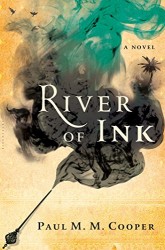
This debut novel, set in 13th-century Sri Lanka, is the story of court poet Asanka. When his king is usurped by a tyrant from the mainland, he is commissioned by the new king to translate a holy Sanskrit text into the local Tamil language. Asanka at first makes some minor mistakes in translation, which then become deliberate and subversive alterations to the text. Through his work, Asanka becomes the reluctant catalyst for rebellion.
Cooper’s novel is written in gorgeous, lyrical first person as a one-sided narrative directed to Asanka’s mistress, Sarasi. Through Asanka’s eyes, readers see the changing political climate he struggles through, his role as a figurehead of insurrection, and his overarching desire to be reunited with Sarasi. Woven wonderfully throughout the novel is the theme of the change poetry can create, a stark counterpoint to Asanka’s own claim that “poetry makes nothing happen.” This novel is highly recommended for its lush imagery, unique narrative format, and strong theme of human creativity and endurance.

Morgan Llywelyn reminds readers why she is the mistress of Irish historical fiction with this newest addition to her extensive body of work, which weaves Irish myth with historical and archaeological evidence into a complex and fascinating tale of mythic prehistoric Ireland. Told largely from the perspective of Joss, a young man of the Túatha Dé Danann struggling to figure out his place in the changing world, the novel covers the conquest of the Túatha Dé Danann and the settlement of the Gaels in Ireland. It is rich with Irish mythology, as is any novel worth its salt that’s written by this author.
The character development is detailed and satisfying throughout. Readers see Joss grow from a child to a leader and deal with joy and tremendous loss. Eremon and Amergin are similarly complex and conflicted figures. Secondary characters such as Shinnan, the Dagda, and Sakkar are nearly as well-fleshed as primary characters and add depth because they make readers genuinely care about them. A third category of characters that is particularly intriguing are the inanimate ones, such as Ierne (Ireland) and the harp, Clarsah. Giving names and traits to inanimate objects gives them power, and the same holds true here as well. The land and the harp both hold subtle but prominent places within the narrative, and the novel would not have quite the same lovely otherworldly tone without their voices. One line is particularly beautiful: “The harp, if it was a harp, added other themes. The music, if it was music, gave voice to sunshine. And moonlight. A woman’s exultant cry as she bore a child. The clashing antlers of rutting stags. Hope and fear and courage… That is more than music; it represents an entire world.”
This beautiful novel is highly recommended for lovers of Irish mythology, magical realism, and those who hold out hope that they may themselves be descendants of the ancient noble blood.

The Killing Land is set in the Arizona territory in the 1880s, and opens with an intriguing hook that snags the reader’s attention quickly. Mary MacGreggor is a pioneer from the East Coast who moves in with her aunt and uncle after the death of her parents. Cal Davis is a rich cattle baron who is suspected of driving homesteaders off the land he wants. As expected, Call and Mary become entangled, each bringing their own baggage into the mix with them. Along the way are the requisite complications, misunderstandings, and potential other love interests of the standard romance novel.
Seewald does a fine job with character development, including with her secondary characters. Several are intriguing and complex, in particular Wolf, Billy, and Rebecca. The plot itself is quite detailed as well, with fairly believable twists and action. Seewald is rather vague and loose with Arizona geography, though perhaps only a fourth-generation native such as myself would know it. She does well with some of the state history, such as the Tewksbury and Graham clan feud. Fans of western romance should be pleased with this novel.

Official HNS review: https://historicalnovelsociety.org/reviews/frontier-highlander/
Frontier Highlander is the fourth book in Wiley’s American Wilderness Romance Series, featuring Artis McKay and Daniel “Bear” McKee. Both were born and bred in the Scottish highlands, each forced to relocate to America because of the Clearances of the 18th and 19th centuries. Where Bear finds a family to raise him, Artis serves as an indentured servant for seven years. They grow up and learn how to survive as adults in their new country. Eventually, of course, the two meet and the plot proceeds predictably from there.
The basic story is not bad at all but the plot lacks a depth of conflict. For example, Bear decides it is time he finds a wife. A few days later, he sets eyes on Artis and from then on, no other woman exists for him. Similarly, Artis has no other love interests to create any tension or concern that she and Bear might not be destined for each other. The revenge plots with Stellan and the thieves failed to cause any concern for Artis or Bear’s safety, and all turns out as blissfully happy as expected. But having said that, for die-hard pure romance fans, this should hold plenty of appeal and be high on the ‘love at first sight’ list.
For readers hoping for more complexity or historical context, it falls short – but that is the difference between straight historical fiction and ‘romance’ historical isn’t it?

Official HNS link: https://historicalnovelsociety.org/reviews/a-brothers-oath/
A Brother’s Oath is the first of a trilogy about brothers Hengest and Horsa, Scandinavian raiders who were instrumental in the migration of the Vikings to England. This tells the story of their youth, which is unrecorded, and is thus rich subject matter for authors of historical fiction. The novel opens with good action, though it stalls a bit while the characters are built up and the various plot lines are introduced with approximately a third of the way through the pace picking up again. Once it did, this was an exciting read.
Hengest, the favoured elder son of a local warlord, and his brother, Horsa, fall out of favour with their father. Horsa decides, sooner than Hengest, to find his own way in the world and makes a name for himself as a raider. Hengest eventually makes a life with a woman of his own choosing. The brothers are reunited years later through treachery, hardship, and adventure.
Thorndycroft does a nice job throughout of showing the action rather than telling about it, and the imagery is vivid. Character development is similarly thorough, though parts felt more rushed than necessary. The book could do with another copy edit as there were quite a few minor punctuation errors, though they did not detract from the story itself.
The details of Viking culture are well researched and draw on extant Anglo-Saxon literature as a primary source. I especially enjoyed the poetry and phrases Thorndycroft worked into the dialogue and at the beginning of each new section.

Set in London in 1388, The Silence of Stones is the exciting eighth installment of the Crispin Guest series. The novel opens, as anticipated, with action, in this case an explosion, after which it is discovered that the Stone of Destiny has been stolen from the coronation chair and replaced with a replica. King Richard II tasks Crispin with finding the Stone, which is thought to create kings. To “encourage” Crispin’s best efforts, Richard imprisons his apprentice, Jack Tucker, with the threat of a traitor’s death if Crispin doesn’t find the Stone in three days.
Crispin himself seems to be growing as a character, for he is less bitter about his situation in life than in previous books. His tracking skills are as keen as ever, though, and help make his compelling characteristics shine. Jack Tucker also is growing both as a character and as a boy. He manages a wonderful side job of his own, despite being under lock and key. It is wonderful to see him stretch his wings as a tracker and as a boy becoming a man.
Henry Bolingbroke, Katherine Swynford, and, delightfully, John Rykener all make important appearances throughout the book as well. Despite his squeamishness, Rykener makes a terrific and funny sidekick, one who will hopefully continue the role in future novels, though of course not to replace Jack. For readers less familiar with Rykener, he was a 14th-century cross-dressing prostitute. Westerson’s author’s note goes into further detail about this intriguing historical figure. This is a satisfying and fast-paced tale, complete with Westerson’s typical dry humor and thorough research.
Link to official HNS review: https://historicalnovelsociety.org/reviews/the-silence-of-stones-a-crispin-guest-mystery/
 Her Grace's Library