
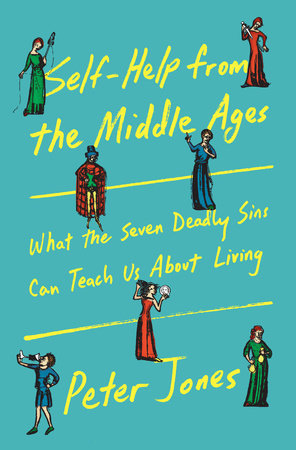
Title: Self-Help from the Middle Ages: What the Seven Deadly Sins Can Teach Us About Living
Author: Peter Jones
Genre: nonfiction/history
I read it as a(n): hardback
Length: 360 pp
Her Grace’s rating: 4 stars
First, let me clarify that I really enjoyed this book, even though I fully reject the idea of sin. And religion. And gods of any variety. Peter Jones did a great job making relevant, modern connections to the seven deadlies and ways to view them. Also, there was at no time even a whiff of a religious agenda or proselytizing of any kind. So big kudos for that as well.
Reading this was a surprisingly fun exercise. Also, I am absolutely guilty of Pride, Sloth, and a fair amount of Gluttony as well.
Most of the things in this book are familiar to me as a medievalist. Some I had forgotten but a couple things I hadn’t known before, so that was fun to learn. For example, the Parisian theologian Jean de la Rochelle believed that each of the seven deadlies was “a form of distorted love” and that when we feel a desire for something too strongly, that is when it becomes sinful (Jones 24). Later, Thomas Aquinas said that “‘every hatred arises from some love’ and because it was ‘impossible for an effect to be stronger than its cause,’ then it would always be ‘impossible for hatred to be stronger than love’” (qtd. in Jones 206). That’s a nice sentiment which I will take with a huge grain of salt, considering Aquinas’s views on homosexuality. Sloth is the only one that is separate from the other seven deadlies in that it isn’t grounded in a form of distorted love.
Going out of order here, in terms of the severity of the sins, we often think of gluttony as constantly overeating. But that was only part of it to a mediaeval person. They also would think of a skinny person as a glutton. It’s not just overconsumption, but rather a preoccupation with food, being fussy about it instead of just eating what is offered, or not eating some things in favor of others. Also, being an expert or connoisseur about food. Thinking about food all the time. GUILTY! I spend an inordinate amount of time thinking about food. I wish I had known that so much of my adult life would be spent thinking about food, planning menus full of food, and cooking the food.
Pope Gregory the Great listed five kinds of gluttony: quantity, haste, desire, sumptuousness, and daintiness. Quantity is straightforward and should require no explanation. Haste is “wanting to eat or drink something when you’re not actually hungry or thirsty” (Jones 201-202). Well, yeah. How will I know if I even want chips if I don’t eat 15 or 20 of them first? Desire means that you have “a burning ferocity to get the food or drink you want, precisely at the time you want it” (Jones 202). Cravings, anyone? Just keep eating until you figure out what it is that you really want. Sumptuousness can mean “either connoisseurship or a devotional attitude to food” (Jones 202). This means that maybe you only make sandwiches with a specific kind of bread, or you won’t eat a roast because it is too fancy. Mainly, though, sumptuousness is going out of your way to get the food you want. I think that is rather unfair. I have literally driven two hours just for specific tacos. I want what I want. Daintiness is “a level of fuss over food or drink that takes the mind away from the things that really matter” (Jones 203). I think these are the people who order at restaurants like, “I want the fillet seared on the outside and still mooing on the inside but make it with butter instead of olive oil and instead of peas I want carrots but make them with cream instead, and also mashed potatoes instead of baked, but instead of sour cream I want plain Greek yogurt, and blah blah blah,” ad infinitum. You know. The ones who must get their food spat in all the time.
At the very opposite end of the gluttony spectrum, and an extreme example of food fuss, is Catherine of Siena, who not only managed to starve herself to death at the ripe old age of 33, she also decided that it would be a good idea to drink scabby, pus-laden leper water from a bowl after she washed a leper’s sores. Mmmm, leper water. Sometimes she licked the pus directly from putrefying wounds. Not only was Catherine of Siena certainly anorexic, I fail to see how she wasn’t also completely stark raving mad. Caroline Walker Bynum wrote what is still one of the seminal works of mediaeval women’s scholarship, Holy Feast and Holy Fast, all about the weird shit mediaeval female mystics did to themselves with food in the name of religion. If you haven’t read that, you really should. It’s fascinating.
Sloth is a surprisingly complex issue. It is laziness for sure, but it can also be a general lack of interest, sadness, malaise, boredom, lack of care, indifference, and so on. It honestly sounds like clinical depression in a lot of ways. I’m not sad. But lazy? Bored? Full of malaise? GUILTY! I have lost my gumption and can’t remember where I put it.
Originally, Sloth was referred to as acedia, which is a lack of care, and it has three main elements. The first is restlessness or boredom, the second is inertia, and the third is sadness. Jones explains that acedia is “an absence of love, a paralysis of care, a vacuum of the spirit. It’s when all the things that used to light up your day now leave you cold and indifferent. It’s the colour draining from your eyes, the taste dissolving from your tongue. It’s when every song on your playlist sounds like a drone” (133). That makes sense. Boredom is when you are ready to sell everything and move to get away from how bored you are, the urge to get out of every situation. Yes. Also, that is a sign of introversion. I, too, want to get out of every situation. Please cancel all of the plans! The inertia part of it is when you feel like you’re just spinning your wheels and not going anywhere, or “giving up on doing anything productive with your time” (Jones 133). Sadness is the final stage, exactly what it sounds like, the stage when you think everything good is damaged beyond repair. Mediaeval people thought that, to get over acedia, you had to learn to fall in love with things again which, as Jones notes, “If this sounds simple, it also sounds impossible” (135). Mediaeval folks also loved lists, and there were lists and lists of different aspects of acedia, as well as different kinds of tears. The highest form of tears are what Catherine of Siena called “tears of great peace” and that is “when we come to see ourselves in a more compassionate way. … We see ourselves as another soul, a creature who deserves as much love and care as anybody else” (Jones 165). Mostly, for me, acedia is about boredom, not doing things that I ought to, and not wanting to do things I enjoy. I definitely want to sell everything and move, though that might be more a function of the vast hellscape we live in more than anything actually slothful about me.
The big one for me is Pride, or superbia. Today we tend to equate pride with self-esteem or confidence, and if you are proud of an accomplishment that you worked hard on, that’s great. That doesn’t mean you’re doing the “worst” of the seven deadlies, so long as you aren’t being arrogant about it, or taking all the credit, or deciding you don’t need people. But do you feel impatient with people? Look down on some for whatever reason? GUILTY! I have tried harder in recent months to think more kindly. Not that I’m not kind but I get super impatient and frustrated with people when they can’t figure things out. Like, where is your critical thinking? It’s not hard, give it a try! It isn’t very nice of me to think poorly of others even if I would never actually say anything to them or be mean to anyone. Sometimes, though, it’s like people go out of their way to irritate me. Though, to be honest, if you voted for the bloated, rotting, syphilitic, dementia-ridden, sub-literate, child-raping, moronic, malignant narcissist in office, then my opinion of you and your stupidity is firmly and forever set. Deal with it.
Anyway. One thing that caught my attention, particularly in the Pride chapter, was actually something that was missing. I think Jones needed to take into account the BIG role that conformity played in mediaeval society. Jones says that, to medievals, Pride, or superbia, has 12 steps and the first is curiosity. This is not a trait that was commonly encouraged. It was uppity to question one’s place, which would go against the Divine Order, and curiosity implies that we are “mildly dissatisfied” with things and wonder how they could be better (Jones 57). While this is entirely accurate for the mediaeval mindset, to me, it is repugnant. Curiosity is why we don’t still live in caves. It’s why we know about the cosmos and the human body and our planet. People who lack curiosity are among the dumbest people I know (yes, yes, I know, Pride and all that. I already said I’m guilty). I truly believe that curiosity is the greatest trait to have.
More than that, though, is the fact that curious people tend to be a lot harder to control. They do things like read and think critically, which makes them challenge and question authority, specifically the authority of the Church. We know the priests can’t get a free cushy ride if people start questioning and stop tithing. So curiosity was quickly squashed when there was evidence of it in mediaeval society. It’s why so many people who went against doctrine were tried as heretics and many of them burnt at the stake. Can’t champion heliocentrism, folks, it means we’re not the center of the entire universe. How am *I* guilty of Pride when people actually believed this? Thinking humans and Earth are the most important things ever made and we’re at the center of everything seems pretty damn arrogant to me.
Another example, number five of superbia, is eccentricity, or “the exhibitionist habit of doing things our own special way” (Jones 58). Some people today think eccentric people are weird. Some of them are. But usually that isn’t necessarily seen as bad, just different, and not something in need of punishment. Not so in mediaeval society. Again with the nonconformity. It is frowned on. Be like everyone else!
I mock (kind of), and our modern society generally tends to value curiosity and individualism. Unless you vote Republican, which I believe I’ve already addressed. But to mediaeval society, the idea was that there is an Ideal Christian ManTM and Ideal Christian WomanTM. Naturally they were supposed to be like Jesus or the Virgin Mary. It was everybody’s job to be as close to those ideals as possible. They structured society and hierarchies on this conformity and failure to adhere to social expectations came with strong objections, shunning, ostracism, getting kicked out of your guild, being excommunicated, and even being executed as a heretic or traitor. Gender roles were heavily enforced, strict hierarchies of social classes remained static for centuries until the Black Death came along and carried off half the population. Yay, social mobility! But even then, hierarchy, social and gender roles, religious authority and ritual, and the idea that there were three orders of people (those who prayed, who ruled, and who worked) were expected and enforced. So when a person exhibited tendencies like curiosity or questioning the order of things, it was viewed as a deviation from a literal divine structure. Hence, conformity. I’m glad this level of conformity isn’t expected or enforced today. I would be burnt at the stake for sure.
Throughout the book, the rest of the seven deadlies get similarly thoughtful analyses. I’m not going to go into all of them since I’m not as interested in them, but I really appreciated the connections Jones made to modern life for all of them. I wonder how a mediaeval person would think of them if they arrived in our time period.
Jones’s writing style is straightforward and easily accessible even to people who are not medievalists. The connections he made make sense and would be an interesting guide if one were to follow a mediaeval approach to living in the 21st century. I have no intention of doing anything of the sort, but it’s still a fun thought experiment.
My very favorite thing about this book is that Jones made reference to a LOT of other works of literature and art. I love it when books refer to other books. I’ve discovered some of my favorite things ever because of a random mention in another book. Some of these I have already read, but some are ones I have not read, and others I’ve never heard of before now and plan to look them up. All of the literary works, authors, works of art, and artists he mentioned that I took note of are:
- The Ark of Wisdom (Liber Arcis Sapientiae in the Vatican Library)
- The Divine Comedy and La Vita Nuova by Dante
- The Canterbury Tales by Chaucer
- Jan van Eyck
- Rogier van der Weyden
- The Consolation of Philosophy by Boethius
- Romance of the Rose by Guillaume de Lorris and Jean de Meun
- Antirrhêtikos (Talking Back) by Evagrius Ponticus
- The Aeneid by Virgil
- Nicomachean Ethics by Aristotle
- Seneca
- Epictetus
- Cicero
- Summa of Vices and Summa of Virtues by William Peraldus
- The Garden of Delights by Abbess Herrad of Landsberg
- Mechtild of Magdeburg
- Confessio Amantis by John Gower
- “Li dis dou miroir” by Jean de Condé
- The Steps of Humility and Pride by Bernard of Clairvaux
- The murals of the Arena Chapel in Padua, painted by Giotto and Cimabue
- Santa Trinita Maesta by Cimabue
- Metamorphosis by Ovid
- Meeting at the Golden Gate by Giotto
- The Garden of Earthly Delights by Hieronymus Bosch
- The Golden Legend by Jacobus of Voragine
- Francesco Petrarch
- The Decameron by Boccaccio
- Septuplum by John Ayton
- Experimenta by Arnaud de Vilanova
- Melancholia by Albrecht Dürer
- The Dialogue between a Sinner and Reason by Ralph of Battle
- Pearl, anonymous
- The Boke by Margery Kempe
- Arthurian Romances by Chrétien de Troyes
- Complaint of Nature by Alain de Lille
- Summa Theologiae, Summa contra gentiles, and Disputed Questions on Evil by Thomas Aquinas
- Tractatus, a French recipe book
- Curye on Inglysch, an English recipe book
- The Archpoet
- Carmina Burana
- Catherine of Siena
- Francis of Assisi
- The Mirror of Human Happiness by Conrad of Megenberg
- The Wilton diptych
- The Hereford Mappa Mundi
Reference
Jones, Peter. Self-Help from the Middle Ages: What the Seven Deadly Sins Can Teach Us About Living. Doubleday, 2026.

