book review · sci-fi · Star Trek

To Lose the Earth (Star Trek VGR)

ST VGR to lose the earthTo Lose the Earth by Kirsten Beyer

Genre: sci-fi

Setting: spaaaaaaaaaaaaace!

I read it as a(n): paperback

Source: my own collection 

Length: 354 pp

Published by: Gallery Books (2020)

Her Grace’s rating: 2 out of 5 stars

**Spoilers abound!**

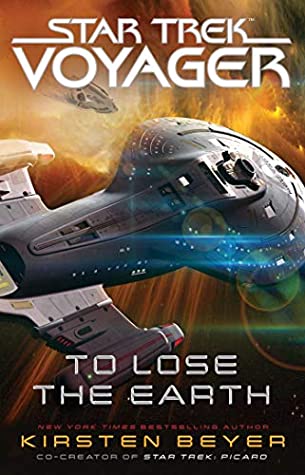
This Voyager novel, roughly two years in the making, continues the story of the Full Circle Fleet, led by Admiral Kathryn Janeway and Captain Chakotay. Here, Lt Harry Kim had been aboard the medical ship Galen to visit his girlfriend, Nancy Conlon and their baby, who had been placed in a gestational incubator. Suddenly, the Galen explodes. Or seems to. In reality, it was transported thousands of light-years away from the rest of the fleet by an alien species of unimaginable power. Now the crew of the Galen has to try to repair their supremely damaged ship, figure out where they are and how to get back to the fleet, and what the hell the aliens want.

So, it’s known among my Star Trek-loving friends and family that I have never cared very much for Beyer’s Voyager novels. I liked Christie Golden’s a lot better. I get impatient with story arcs that go over a dozen books and a decade or more to complete. That seems to be the way Trek novels are going to go forever now, though, and I hope that changes. I miss the old numbered paperbacks where one book equals one story, for the most part. Anyway, Beyer is not a bad writer. At all. I just don’t care for her take on VGR. I think she did a much better job writing for the Discovery series. 

That all isn’t really relevant to this novel, though, just general griping. For THIS book, Beyer’s author’s note implies that this is the final Voyager novel. All I can really think of to sum up my thoughts on that is, “That’s finally over with.” I should feel sad about it, because I loved Voyager, but I don’t. This one ended with so many unanswered questions and loose ends. If it really is the final VGR novel, then it was terribly done. Maybe S&S plans to pass the torch to another author to finish up or carry on the VGR storyline. If so, then I have a list of things I hope to have explained:

  • I’m still waiting to hear how a couple in the 24th century accidentally gets pregnant. Surely by then they can turn off someone’s ovaries or something until she is ready and willing to conceive. That is still a plot device I simply can’t buy.
  • Where is Reg Barclay going to go? His decision was left hanging.
  • What about Gwyn? Her connection to the fetus was never explained to Harry or Nancy. Is she going to get to be involved in the child’s life? Will Harry transfer his affections to her since Nancy finally figured out that none of this is what she wanted and bailed?

That’s just a start. I’m sure I can come up with some more.

Also, this book had so. Much. Technobabble. I get that technobabble is fun and it is a very Star Trek thing to do. Normally I don’t mind it; I even like it. But there was so much here that I found myself skimming over many rather large sections just because the technobabble was ridiculous. It felt like filler. As a writer, I get that writing is really hard. But please, if you are struggling with the plot and feel the need to fill it with pretty unnecessary stuff to get from point A to point B, take a break and put it down and figure out what to do better.

I’ve never been a Janeway/Chakotay shipper, though I know many Trekkies are. I just never thought they had romantic chemistry at all. So their whole relationship is not a thing I care about one whit. That said, I do feel bad for the folks who ARE J/C shippers. They waited years, not only for that relationship but for this specific book, and all they get in the end is a single page wedding at the end? No conversation among the characters about it? Nothing? That is really not cool. 

So yeah, this was one of my least favorite Trek books, in any series, in quite some time. If this is the end, then I’m not sorry to see it go after all this. 


Even the books I don’t like often have some great lines. Some of my favorites from this book are below:

  • Intelligent life exists on a continuum. …I didn’t know…how far humanity had yet to go or how mortified I could be by our ignorance. It’s simply intolerable. … It turns out humanity has spent too much time in the children’s section of the universal library, and I’m not content to allow that state of affairs to continue indefinitely. Why are we here if not to transcend ourselves? And how are we to do so if we shrink from the work transcendence requires? (90)
  • Fear was a powerful thing. It led people down paths that felt true, even if they were lies. (98)
  • But the whole thing with new people, aliens or not, is that you can’t go in just looking at the ways you are different and decide you’ll never get along. You have to look for the ways you are the same. They can be hard to find but they are almost always there. And once you find a little common ground, that’s how you get to know each other better. (177)
  • But for now, and probably forever, it’s just going to be you and me. It might be a long time before you even realize that’s unusual. Although it isn’t, necessarily. Lots of children are raised by one parent, even if their parents are married. Some families have more than two parents in a relationship. The Andorians come to mind. Anyway, point is, families come in all kinds of shapes and sizes and for now, we are a family of two. (348)
book review · sci-fi

Armada

armadaArmada by Ernest Cline 

Genre: sci-fi

Setting: Portland, OR, United States, Earth, the solar system

I read it as a(n): audiobook

Narrator: Wil Wheaton

Source: my own collection 

Length: 11:50:00

Published by: Random House Audio (2015)

Her Grace’s rating: 2 out of 5 stars

Zack Lightman is super into gaming, in particular a game called Armada, which centers around an alien invasion of Earth. Players get to control various battle drones and ships to stave off the alien attack. So it is understandable that Zack thinks he’s losing his mind when he sees a spaceship exactly like those in Armada flying around outside his school window. But nope, the aliens are real and the game developers created the game, in tandem with an actual Earth Defense Alliance, to train millions of civilians to fight when the actual aliens arrive. Only of course it isn’t as straightforward as that. 

Zack has an anger problem because his father, Xavier, had died when Zack was just a baby. He died in a stupid accident at his job in a waste facility installation. He literally died getting blown up by human shit. That would cause most people some kind of angst, I would imagine. But he still managed to pass his love of gaming and 1980s pop culture to his son because Zack’s mother kept that part of her husband alive for him. His anger makes for a great gamer, though, and so when Zack learns the truth about the aliens and is recruited into the EDA, he jumps at the chance to defend Earth. 

So this book was ok but it was not nearly as good as Ready Player One. I found it to be entirely predictable. Entirely. Literally not one thing came as a surprise to me, there was no bated breath, no anxiety about what would happen, nothing. My granny could have written it, and she hates sci-fi (I’m not really sure how I’m related to her sometimes). I know the publisher’s blurb claims that it is intended to subvert a lot of sci-fi tropes. But I don’t think it did that. It basically just copied them (mostly from The Last Starfighter, Ender’s Game, and ET, from what I could tell) and provided nothing new to the genre, subversive or otherwise. I am quite disappointed since I really loved RP1 and had hoped Cline could pull this one off as well. But no. I didn’t hate it, but I didn’t like it all that much either. Mostly I kept listening because I think Wil Wheaton did a great job narrating it, as he always does. I just didn’t care about the plot or the characters enough to truly love it. Which makes me sad because I am a geek and am always ready and excited to embrace any aspect of nerdom. Oh well. Can’t always roll 20, I guess.

book review · books · fantasy

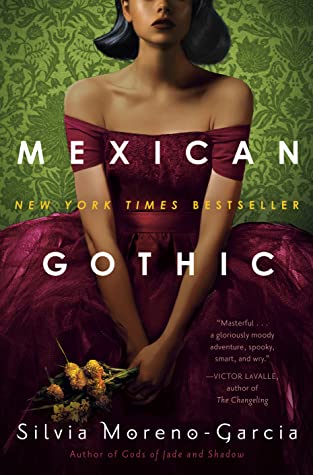
Mexican Gothic

mexican gothicMexican Gothic by Silvia Moreno-Garcia (Website, Twitter, IG)

Genre: Gothic fantasy

Setting: 1950s Mexico

I read it as a(n): hardback

Source: my own collection

Length: 301 pp

Her Grace’s rating: 3 out of 5 stars

Noemi Taboada is a young socialite in 1950s Mexico City. Her father is a wealthy merchant and the head of the family. As such, he is concerned about image and avoiding scandal. So, when his niece Catalina sends a letter to him that sounds completely unhinged, he wants to get to the bottom of that and fix whatever needs fixing before it hits the society pages in the newspaper. He sends Noemi to visit Catalina in her husband’s home manor of High Place in the remote Mexican countryside. Things go downhill from there. 

I really loved the first part of this novel. It was everything a proper Gothic novel should be – eerie, mysterious, dark, neglected, and so on. Very much felt like a Mexican Jane Eyre. I kind of lost the Gothic feel around 2/3 of the way through, when I think it felt more like a straight horror novel than Gothic. That said, I still really loved all of it, it just felt like it switched genre a little bit in the middle there. I wouldn’t even care that much except I’m not a huge fan of horror. 

I thought Noemi was a very believable character. She was sort of shallow and vain at first, but then we learn she wants to go to university to get a master’s degree in anthropology. She is something of a flirt and prefers the chase or courtship to being caught in her relationships, but she is self-aware enough to know it. She had hidden depths that reveal themselves nicely throughout the novel. She was a really well-developed character.

I didn’t think that so much about Catalina. I know that her flat personality was actually a part of the plot, but the glimpses we got from Noemi’s perspective about her were not really enough to give her much depth or make her into a fully-fleshed person in the story for me. She felt more like a prop than a person. 

The rest of the characters – Virgil, Francis, Florence, and Howard – were suitably developed for the roles they played in the novel. I don’t think they were super deep but they all did have certain nuances to their personalities and were fine for the purposes they served.

I especially loved how the house, High Place, was described. It was in the tradition of the best Gothic manor homes, like a cross between Thornfield Hall and the Haunted Mansion. Old, dusty, neglected, falling apart, mouldy, and of course it had a cemetery! Minus the mould, I would love to have a house like that. I’d put just enough money into it that it had proper amenities but keep the abandoned Gothic feel. 🙂 

Overall, I thought this was a fun read. Didn’t blow me away, but it was fun. Would certainly recommend.

book review · sci-fi

Nemesis Games (The Expanse #5)

nemesis gamesNemesis Games (The Expanse #5) by James S.A. Corey 

Genre: sci-fi

Setting: spaaaaaaaaaaaaaace! 

I read it as a(n): paperback

Source: my own collection 

Length: 532 pp

Published by: Orbit

Her Grace’s rating: 4 out of 5 stars

In book 5 of The Expanse series, the crew of the Rocinante all go their separate ways. Temporarily, of course. The crew are family now and the Roci is home. That doesn’t mean they don’t still have business elsewhere to tend to, though, and they do. Holden is the only one who stays put; Naomi goes to Ceres Station to deal with a family  problem, Alex goes to Mars with a vague idea of getting his ex back, and Amos goes to Earth to make sure the death of someone he cared about was natural or not. Naturally, the entire solar system goes up in flames while the crew is scattered every which way.

The political situation is fraught in this entry. A radical branch of the OPA is behind the most devastating attack in history, their attempt to carve out a place for themselves within the larger political landscape. Because terrorism totally works. That was sarcasm for anyone who can’t parse Kristen-speak. 😊 Holden tries to work with Fred Johnson to reign in the violent nutjobs while, elsewhere, Alex researches why ships are going missing, with some help from Bobbie Draper. Amos makes an unexpected new friend. Or old friend, depending on how you look at it. And Naomi finds herself in the middle of everything in some strange ways.

The last few entries of The Expanse series, I have hoped for the other primary characters – Naomi, Alex, and Amos – to be point-of-view narrators. I got my wish in this novel! All of the POV characters were the crew of the Rocinante. We get a glimpse into their histories and some parts raised more questions. I learned, though, that there are Expanse novellas that dive into their past selves in more depth, so I have no doubt I’ll be reading those at some point as well. Because I am a giant sucker for a good back story. 

I like that there was a theme of family and home woven throughout. Everyone kept reflecting on home in terms of their past, but now that isn’t home, it isn’t their family. Home is where you make it, and family is who you choose. Birth and blood don’t really factor into either of those unless you want them to. I liked that the crew knows with a deep certainty that they are each other’s family. 

All in all, another fun entry in The Expanse series. Can’t wait to read the rest!

book review · fantasy

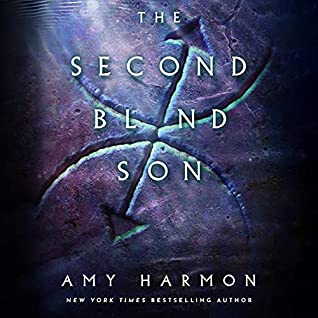
The Second Blind Son

the second blind sonThe Second Blind Son by Amy Harmon (Website, Twitter, IG)

Genre: fantasy

Setting: Saylock

I read it as a(n): audiobook

Narrator: Rob Shapiro

Source: my own collection 

Length: 15:58:00

Published by: Brilliance Audio (2021)

Her Grace’s rating: 4 out of 5 stars

The Second Blind Son is a sequel of sorts to Amy Harmon’s earlier novel, The First Girl Child. I say of sorts because this story ran concurrently to the events of TFGC, rather than portraying a continuation of that story. In this, the focus is on Hod, a blind man who is raised to be a Keeper of the Temple by Arwin, a cave keeper. Arwen has taught Hod how to listen, smell, feel in ways that are uncanny to help him compensate for his blindness. As a result, Hod is adept at hunting and fighting through the use of his heightened senses. He can identify the heartbeats of individual people, their specific scent, and so forth. And then one day, he rescues a girl who washes up near his cave from a shipwreck. Ghisla is the sole survivor from her people, the Songers, whose voices are ethereally beautiful, and she wants to die. Slowly, she and Hod become the best of friends and, when she uses a rune carved upon her hand, Hod is able to see. Their paths are often separated but they retain their connection through the years, through political upheaval, and across vast distances.

I loved this book so much. I really liked the way it wove into the earlier story of TFGC and made you remember events from that story alongside this new one. I hadn’t realised it was that sort of timeline, so I kind of wish I had reread TFGC before jumping into this one, but it in no way hindered the ease of following the story. It is just a thing I would have done to refresh my own memory. And yes, it can probably be read as a standalone, but I truly think readers are short-changing themselves not to read TFGC first. Not only will you become familiar with the world of Saylock, but the characters from that book who make appearances in this one are familiar and welcome. You’d miss out on that if you only read TSBS as a standalone.

The narration was excellent as well. The narrator did some different voices for various characters, but only enough to differentiate them within the scene. He didn’t go crazy with melodrama, he just read the story in an engaging way. There were times when he sounded just like Tuvok, though, so that was a bit of cognitive dissonance. I kept expecting Star Trek. 

The character development throughout was decent, though I would have liked to get more scenes with the other Daughters of the Temple. They were an important part of the story but I feel like I didn’t get to know them very well. Maybe future Saylock books will focus on them more in some way. Ghisla becomes one of the Daughters when she is forced to leave Hod’s cave and is given in lieu of a clan chieftain’s daughter to the Keepers. There, she is known as Liis of Leok and no one learns her true identity. Hod is the only one who knows her real story. Also, YAY for the book sample on Amazon having the spelling of characters’ names! I would not have gotten some right from just listening to it.

I thought it was interesting how King Banruud was a hateful, horrible person but Ghisla could help keep him from raging too much with her music. I don’t remember his madness at all from TFGC, but here it struck me as horrific, persistent tinnitus. I know that can make people crazy – mine sometimes wakes me up – but if one is already crazy and cruel to begin with, what new horrors could the condition bring about? Doesn’t make his actions at all ok, but I thought it was an interesting reading of madness. 

Keeping Hod and Ghisla apart in distance but giving them the means with which to communicate with each other was a great touch. It allowed them to grow and mature, and their relationship did likewise. The rune magic that helped them speak to one another really keeps things humming along for readers so we can sense their desire to be together but we don’t get bored by the separation. 

Probably there is a message in there about how true love doesn’t need to see to recognize one’s beloved. Or something. Ick. I don’t really do romance, though I find this sort of non-melodramatic, non-bodice-ripping romance within many fantasy novels to be entirely acceptable. 

Overall, a thoroughly lovely story, nicely paced, and I can’t wait to read more of Harmon’s fantasy novels!

book review · sci-fi

Cibola Burn (The Expanse #4)

cibola burnCibola Burn (The Expanse #4) by James S.A. Corey (Website, Twitter, Expanse Twitter)

Genre: sci-fi

Setting: spaaaaaaaaaaaaaace! And Ilus/New Terra

I read it as a(n): paperback

Source: my own collection 

Length: 581 pp

Published by: Orbit (2014)

Her Grace’s rating: 4 out of 5 stars

In this 4th entry in The Expanse series, humans are moving beyond their solar system and beginning to colonize far-flung planets on the other side of the Ring. Of course, they’re doing so before having fully studied them and analysed the data. What could go wrong?

Everything, of course! A group of Belter settlers lands on a planet they call Ilus and set up camp, ready to mine the planet’s rich deposits of lithium; the UN gets a contract to mine the same lithium on the same planet, which they’ve dubbed New Terra, and proclaim the Belters as squatters. Terrorism, murder, and mayhem ensue. This is all before the weird debilitating disease strikes. And the planet itself attacks the humans. And also, the orbits of the ships are all degrading and it’s only a matter of time before they all come plummeting out of the sky, including the Roci

Naturally, Holden and crew are the only ones who can fix things. 

I think sometimes Holden comes off as sort of Gary Stu in this one, even though he isn’t written as a perfect man free of weaknesses. He has plenty of those. But is it really a weakness to be the only one who can save humanity from itself? Again? I mean, it isn’t his fault everyone else is too wrapped up in their petty quibbles and research and murder to see what’s actually important. I’m still not entirely sure Holden is really a Mary Sue despite the above, and his human frailties do keep it from going too far over the edge. But it might be nice to see someone else come charging to the rescue sometime. 

Speaking of that. I do love how every book in the series so far has different POV characters. Yes, one is always Holden, but that’s fine and only makes sense given that he really is the main character. I like how we are meeting characters in this book as POV figures who were minor characters in previous books. I dig that kind of plot continuity. I would REALLY, though, love it if Naomi, Alex, and Amos were all POV characters in at least one of the books. I like them all but I have a soft spot for Amos. He reminds me a bit of the man they call Jayne.

It was interesting to see Basia Merton as a POV character. He was the man who was friends with Prax and whose son died on Ganymede back in book 2. Basia’s been through some things and his pain makes him do some stupid, cruel things that he normally wouldn’t. His character development was certainly thorough. He was a nicely complex person and I enjoyed seeing his progression. 

Overall, another great instalment in The Expanse series! It’s been a long time since I enjoyed reading a full, long series quite as much as this one!

book review · lifestyle · travel

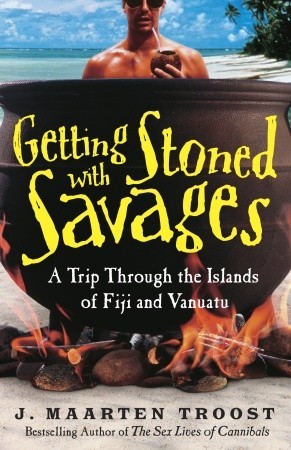
Getting Stoned with Savages

getting stoned with savagesGetting Stoned with Savages by J. Maarten Troost 

Genre: memoir/ travel writing

Setting: Vanuatu and Fiji

I read it as a(n): audiobook

Narrator: Simon Vance

Source: public library 

Length: 07:25:00

Published by: Blackstone 

Her Grace’s rating: 2 out of 5 stars

This memoir/ travel writing narrative is the follow-up to Troost’s debut, The Sex Lives of Cannibals. I didn’t read that one, though I know several people who did and enjoyed it. I love travel writing in general. This one focused on Troost’s experiences in Vanuatu and Fiji, where he and his wife lived when she got a job of some kind there. I don’t think I paid attention to it as well as I should have. 

There were some undeniably funny parts. Troost has a dry wit that I generally appreciate. I found that I didn’t really care much about him or his adventures here, though, and I’m not really sure why. It wasn’t the best travel narrative I’ve ever read, but it didn’t suck or anything. It just didn’t light my fire like I had hoped. 

I saw several reviews saying that it is very racist. I didn’t think it was; it was discussing the racism in other groups that he noticed while traveling, but he himself didn’t strike me as a racist at all. I think a lot of people objected to the title of the book. But helloooo, it’s supposed to be a play on words and pique readers’ interest. You can’t judge another time period (irrelevant in this book) or another culture (super relevant in this book) by our own. 

Something that I did find to be a major turn-off was Troost’s description of his first night in Fiji. He was wandering around looking for just a basic bar or pub to sit in and have a drink and relax after a long day of travel. I get that. Instead, he encountered some male prostitutes who kept trying to take him into the jungle. At least, according to his recollection. He remembered thinking that he was nervous and that getting sodomized wasn’t something high on his list of things to do. OH, IS THAT SO? And getting raped and/or sodomized is something that IS high on the list of every woman who’s had to endure it? Or even the worry that you could get raped? I don’t think I know ANY woman who hasn’t been worried or scared about being assaulted in some form or another. Soooo… now you know how it feels, my dude? I’m sorry he had that scary experience but there was a tone deafness to that whole section that put me off. It seemed never to occur to him that such experiences are commonplace among women. Fucking derp. 

After listening to this, the main takeaway I have is that neither Vanuatu or Fiji are places I want to go. Like, ever. Nor do I understand why anyone would want to visit, let alone LIVE there. Which is too bad because they are probably both cool places to visit. But between the earthquakes, mudslides, volcanoes, and foot-long centipedes, I’m inclined to call the entire region a hard pass. Maybe I’ll stumble across a different narrative that will change my mind, but for now, I think I’ll keep my vacations outside the Ring of Fire, unless I’m going to Australia or New Zealand. I don’t think this was the best book to read for boosting tourism to the South Pacific.

book review · historical fiction

The London Monster

The London MonsterThe London Monster by Donna Scott (Website, Twitter, IG)

Genre: historical mystery

Setting: Late Georgian London

I read it as a(n): ARC

Source: Helen Hollick at Discovering Diamonds

Length: 322 pp

Published by: Atlantic Publishing

Her Grace’s rating: 5 out of 5 stars

In Late Georgian London, a man dubbed as “The London Monster” was attacking women, assaulting first their ears and sensibilities with terribly vulgar come-ons and, when those inevitably failed to win the lady’s affection, he stabbed at her with a dagger. Most of the women only had their dresses torn, though a few were cut on their hips and fortunately, none of them died. It is unlikely that the correct man was ever arrested, though one man did serve time in Newgate as the Monster. Author Donna Scott takes this historical figure out for a ride in her new novel, The London Monster.

Sophie Carlisle, daughter of a minor noble, wants nothing more than to become a journalist. Unfortunately, not only is that a profession forbidden to women, she is also betrothed to Cuthbert “Bertie” Needham, her childhood friend. To attempt to get her articles written and published, Sophie goes around London dressed as a boy, researching and following leads. In the course of her journalistic adventures, Sophie meets and befriends Maeve, an Irish prostitute. Tom Hayes, meanwhile, is the son of a filthy rich merchant with aspirations to a seat in the House of Commons. Tom is haunted by his mother’s murder, which happened before his own eyes when he was ten. To atone for his past helplessness, Tom now is a pugilist and vigilante, determined to catch the Monster before he can hurt any more women. Their paths intersect in so many ways, some entirely unexpected. 

First of all, I loved this book. I actually read it in one sitting, which hasn’t happened with a book in a long time for me. I found the writing to be highly descriptive and engaging, the characters complex, and tone perfectly balanced to reflect a variety of tensions. Sophie is a charming and irrepressible figure. Tom appears to be one of those mythical creatures – a man who is handsome, intelligent, AND genuinely kind all rolled into one. Maeve is salty and pragmatic yet still retains a deep sense of hope despite life having taught her not to bother. Each one of these characters are flawed in some way, but it serves to highlight the strengths of their personalities rather than their weaknesses. 

Speaking of weaknesses. Bertie. Bertie, Bertie, Bertie. He had great potential as a man but he’s just so gross and frankly kind of pathetic. I don’t think readers are really supposed to like him, and certainly I did not. If he had even a little more self-awareness and consideration for others, he might have been a totally sympathetic character. As it was, he came off as more of a self-centered whiner who tried to make Sophie love him even while thinking about how marrying her would solve his family’s debt crisis. Not sure you can truly love a person if you want them for their money, no matter how hard he tries. And perhaps he really did love her, but it always seemed tinged with a variety of desperation. Super not attractive. 

As with any book, I’m not sure if the author wrote about certain themes intentionally or if I am imposing my own interpretation upon the story. However, I picked up some strong themes of consent and safety throughout this book. There was obviously no consent at all in the Monster’s attacks on his victims; they all roundly rejected him and he forced violence upon them anyway. Maeve occupies a liminal space of consent – she is a prostitute so her consent is implied through her vocation, but she hates it and is ashamed, so her consent is grudging at best. To me, I think that equates to NOT giving consent. Sophie wants to help catch the Monster in part because of a frightening experience she had at a party several years earlier when a gentleman she flirted with tried to rape her. At one point, she also tells Tom that she wants the Monster to be caught and imprisoned because she wants him and all men to know that they can’t make women feel they can’t be kind or polite without risking assault. Oh hi, modern women’s continuing issue! Women today STILL can’t be friendly to so many men without them thinking we are flirting and they are entitled to get some. 

Linked to that is a strong sense of shame. Sophie feels ashamed of the incident at the party, despite the fact that it was in no way her fault. No matter what a woman says or does, whether she’s flirting or not, at some point a man makes the decision to assault or rape a woman. It is entirely on him. Yet even today, where there is not nearly the stigma surrounding rape that there once was, many women still are too scared or ashamed to report their assaults. Those who do are often not believed, contributing further reasons for women not to bother. If it’s still like that now, I can only imagine how much worse it would have been in the 1780s. And, as explained in the Author’s Note, while there were more than 50 reported cases of women being attacked by the Monster, the true figure is actually unknown – some women almost certainly never reported their attacks, and others falsely reported an attack. Also like today’s society, some people will say anything to get a little attention, to get their 15 minutes of fame. Shame is carried out further in Maeve’s character. She is a prostitute and she does what she does to survive and to provide money to her young daughter, in the care of another family. But she doesn’t want to be a prostitute and, despite some very frank language about sex from her and other sex workers in the book, Maeve is deeply ashamed of what she does and dreams of a day when she might save enough money to pay off her debts to her madame and leave to do other work instead. 

I also felt there was a strong theme of Otherness and acceptance. Sophie at one point thought about how she would never have tolerated a prostitute near her and would never have thought she would even speak with one. Then she met Maeve and got to know her. The two became true friends, despite the huge gap in their social class, and Sophie found she would go to great lengths to help her friend. See what happens when we get to know people? They turn out to be people with their own feelings and hopes and fears, just like the rest of us! Getting to know people is one of the greatest killers of prejudice and bigotry there is, and the friendship between Sophie and Maeve provided a great example of that. I wish it happened more in real life.

Overall, I devoured this book and can’t wait to read more by Donna Scott. Highly recommended!

book review · sci-fi

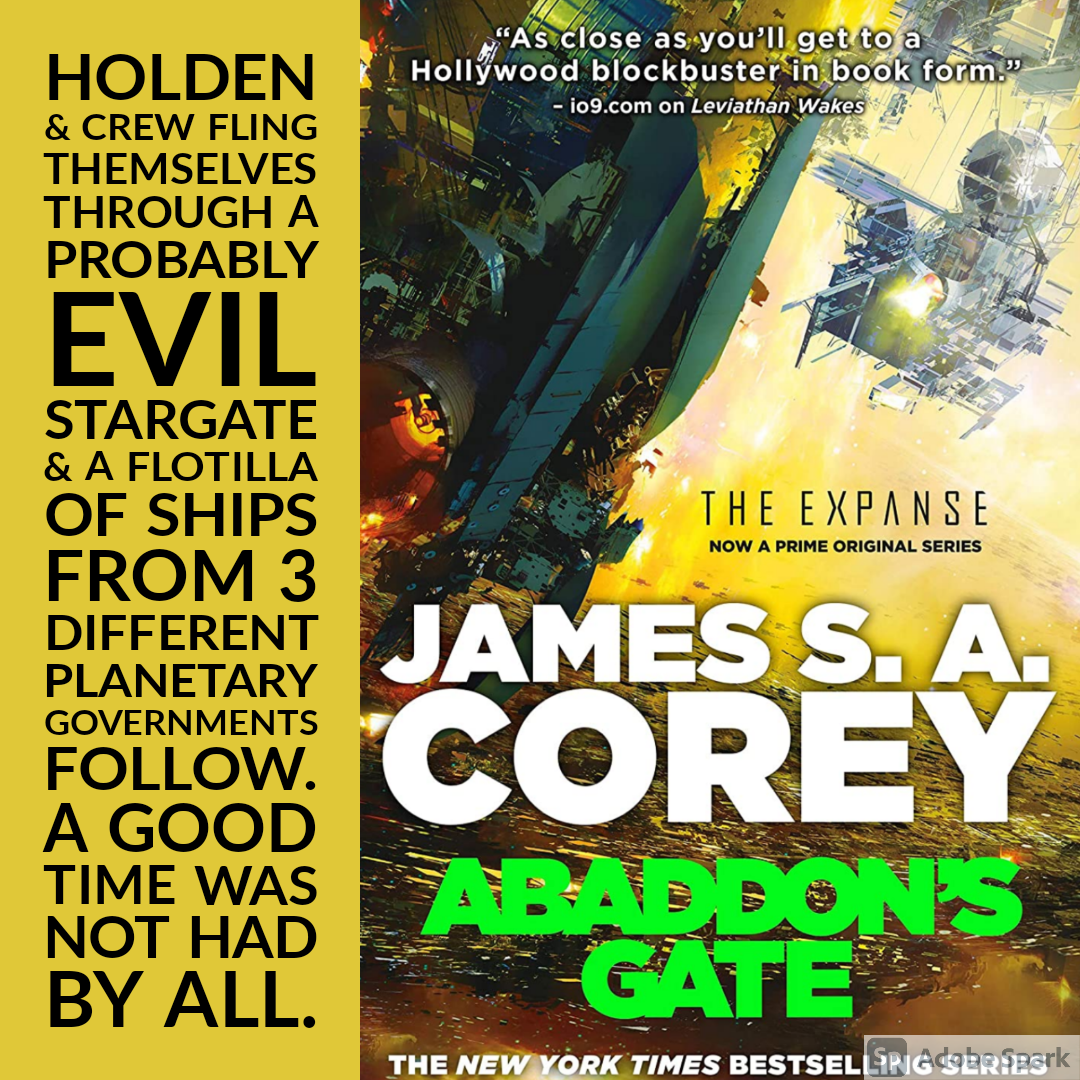
Abaddon’s Gate (The Expanse #3)

abaddons gateAbaddon’s Gate (The Expanse #3) by James S.A. Corey (Website, Twitter, Expanse Twitter)

Genre: sci-fi

Setting: spaaaaaaaaaaaace!

I read it as a(n): paperback

Source: my own collection 

Length: 539 pp

Published by: Orbit

Her Grace’s rating: 4 out of 5 stars

In this third Expanse instalment, Jim Holden and the crew of the Rocinante are freelance contractors now, parted way somewhat acrimoniously with Fred Johnson and the Outer Planetary Alliance. When one of their clients, a rather shady bunch, suddenly back out of their contract with Holden, the crew discover that they are being sued by the Martian government to get the Roci, formerly a Martian Marines battle ship, back. Coming to their rescue is Monica Stuart, a journalist from the UN Public Broadcasting, who contracts Holden on an exclusive if he takes her and her team out to a mysterious ring. The ring was constructed by the protomoluecule creature that launched itself off Venus at the end of the previous book, and it is weird. It appears to be a simple ring construct, and yet ships that go through it do not come out on the other side as expected. It’s like it’s a…stargate… 

A flotilla of ships from Earth, Mars, and the OPA is on the way to the ring to investigate, each government hoping to gain the upper hand. When a person from Holden’s past sabotages his reputation, he is forced to flee with his crew and ship through the ring. What they discover on the other side is not at all what they expected. 

The thing about book series, for me, is that if they are longer than a trilogy, I tend to lose interest. Usually around book three or four. However, that isn’t close to being the case with this series. Yes, it follows the same core of characters. Yes, it has an overarching plot revolving around a weird protomolecule. But each novel has a large and diverse cast of secondary characters and a new basic plot, each different from the previous book. It isn’t a cliffhanger from one book to the next where you have to keep reading about the exact same goddamn characters over and over. Corey’s style works wonders for me.

Holden is evolving as a character in a good way. He can still be a sanctimonious bastard, but he is self-aware enough now to know it. He is making a concerted effort to be a better person, not only for himself, but for his crew, and especially his lover, Naomi. We know a bit more about Holden’s past than the other main characters, possibly because he is the captain. But we get tidbits of information about Naomi, Amos, and Alex as well. I hope we get to learn more about their past lives as the novels progress. What drove them to be on the Canterbury way back in book one? Why did they end up on a bottom-of-the-barrel ship when they all clearly have crazy skills and can do what they want in much better positions? These things, I want to know. 

The secondary cast this go round is Carlos Baca, called Bull, a security officer for the OPA. He is assigned as the security chief to the Behemoth when it heads out to the ring. He’s kind of bitter about his position since he should really have been the captain, and Fred Johnson knows it. But he’s not, because politics! Instead, some jackoff called Ashton is captain, and he seems like a skinny Trump, all ego and narcissism and demands of loyalty. We hate Ashton. But we love Bull.

Joining the Behemoth is Sam, the engineer from Tycho Station and Naomi’s best friend; Clarissa Mao, in disguise as someone called Melba Koh, who is on a private mission of vengeance against Holden for his perceived harm to her family’s good standing; and Pastor Anna, a Russian, well, pastor who is on the Behemoth because she believes God called her there to help in some way. And of course a colorful variety of various others ranging from Martian Marines to news reporters to a neurotic socialite. Each one is there for their own reasons, and each one ends up playing parts they hadn’t anticipated. 

Also, Joe Miller is a recurring presence, despite having ridden Eros on its collision course with Venus at the end of book one. So there’s that. 

The biblical and religious allusions are inescapable. I mean, it’s built right into the title. Abaddon is the Hebrew word for “place of destruction,” or hell, or the realm of the dead. Pastor Anna has a lot of things to say about the place of religion in human society, about forgiveness, and about the ways in which humans must fit in with the greater universe. It was not a “beat you over the head” sort of religious discussion. It was interesting and in the background. I’m sure others who are more inclined could find a lot more to say about it. I can, too, but find that I can’t be bothered with religion today. Suffice to say, the title is a perfect highlighting of the plot in this one. 

Themes of loyalty and bravery are front and center as well, which I’m coming to expect from this series. There are so many ways in which these characters, and those in the previous books, have displayed these concepts. I think one of the most important discussion on bravery in this instalment is when Holden figures out how scared he really is by anything to do with the protomolecule. And yet, he does whatever has to be done, despite his fear. I guess Ned Stark was right – when you’re scared, that’s the only time you can truly be brave. 

I have to take a forced break in the series to read a couple books I promised to a friend for a review, and that’s cool, but I can’t wait to get back into this series!

book review · fantasy

Elatsoe

elatsoeElatsoe by Darcie Little Badger (Website, Twitter, IG)

Genre: MG fantasy

Setting: slightly different America/ Texas

I read it as a(n): audiobook, then switched to a physical book

Narrator: Kinsale Hueston

Source: public library 

Length: 09:01:00 / 360 pp

Published by: Dreamscape Media (22 Sept 2020)

Her Grace’s rating: 2 out of 5 stars

Elatsoe “Ellie” is a Lipan Apache who is able to raise the ghosts of dead animals. She comes from a long line of family members with this talent, back to her great-great-great-great-great-great grandmother, who her family calls Six Great, also Ellie’s namesake. Ellie’s constant companion is the ghost of her dog, Kirby. When Kirby freaks out, Ellie soon learns that her cousin Trevor was killed in a car accident, but it was a cover-up to his murder. When Trevor’s ghost visits Ellie and asks her to help take care of his wife and baby son, Ellie and her best friend Jay try to figure out what really happened to Trevor, and how a white man called Abe Allerton from Willowbee, TX is involved. Dark, ancient secrets then threaten to consume Ellie and all her family as she digs deeper to uncover the truth about Trevor’s death.

There was a lot to like about this book. For one thing, I think it’s good that Ellie identifies as asexual and not one person in her circle gives a toss or makes a big deal out of it. It is just pure acceptance and it is part of who she is, no questions asked and no one trying to tell her she’ll change her mind once she’s older. 

There was also a lot of tradition and stories from Ellie’s Apache heritage. I know absolutely nothing about this, so I’m just going to assume that it is at least partially true, considering that Darcie Little Badger is Apache herself. The elders, the way they are so highly respected, and the various stories are all awesome.

Related to Ellie’s knowledge of her Native culture is her experience with racism. That is not a pro – for those sitting in the back, racism is bad! – but the discussions that came with her experiences are important and necessary. I liked that Jay was shown as a generally real, clueless white dude who has never had to experience racism of any kind. He means well and doesn’t have a mean or racist bone in his body, but he is utterly unaware of why he would have to convince a store clerk to sell him anything because “we haven’t done anything wrong.” Ellie’s response to him is somewhat amused eye rolling, which in real life doesn’t help much of anything, but in the story, it gets the discussion onto the page for readers to ponder over. 

Also, how can a story involving the ghosts of fossilized animals not be cool on at least some levels? Ellie brings back the ghost of a trilobite, for fuck sake! And there’s a wooly mammoth ghost! That is rad!

There was a lot, though, that I definitely did not like, and I mostly feel that it outweighed the good things that I did like. For one thing, this book was marketed as a YA. However, it read as way, way younger than that. Middle grade would have been far more accurate. I often had to remind myself that Ellie and Jay were both 17 and nearly through with high school. For example, when the ball at Allerton’s mansion was in swing and vampires were killing, Jay’s older sister wanted to keep Ellie from seeing. She responded that she and Jay were at least at a PG-13. Um, yes. Considering that you are actually 17, it would make sense that a PG-13 scene would be something ok for them to see. I mean, what? 

Also, Ellie and Jay are described as being best friends from birth, having met when their mothers were in the same birthing class. And yet they don’t know some very basic things about each other. Out of the blue, Jay tells Ellie he is a descendant of Oberon and that was a huge surprise to her. You wouldn’t know your best friend is descended from the most famous fairy king ever? Really? And Jay didn’t know “Ellie” is short for Elatsoe. Things like that are little facts about a person you learn when you are first becoming friends, not when you have grown up with someone. At one point, Ellie asked Jay if he had other sisters. The way it was written made it unclear if she was joking in that moment or if she was being serious. Given the lack of knowledge they have about each other, I think the confusion is understandable. Which leads me to the next reason I didn’t like this.

LAME DIALOGUE! OMG so lame. Ellie and Jay would literally be in media res and trying to fend off bad guys – and they engage in witty banter? Which isn’t actually witty? No. Just no. It might have worked if this was something like The Princess Bride or Indiana Jones but here? It just came across as immature. Also, one character made actual use of the phrase “meddling kids.” Like from Scooby-Doo. The dumb witty banter would have been fine in that children’s cartoon as well. But here, it kind of just smacked of the author needing to work on aging up her dialogue a lot more. 

And finally, the audio book. I had started this as an audio book. The narrator was so awful that, if I hadn’t been reading this for book club, I would not have bothered to continue. Since it WAS for my book club, I got a hard copy from the library and read that instead. It was better and far more interesting to eyeball read it. I would not listen to another book read by the same narrator. She made what was already a mediocre book for me almost unbearably boring. 

So ultimately, this was a solid meh for me. I didn’t hate it, I think it had some good things in it, but I definitely did not love it. 

All that said, I did find Little Badger’s short storyNkásht íí online. I thought it was pretty good.