book review · books

Small Country

36750086Small Country by Gaël Faye

I read it as a: hardback

Source: my own collection (BOTM selection)

Length: 192 pp

Publisher: Hogarth

Year: 2018

Small Country is Gaël Faye’s debut novel, and it is a gutpunch. The novel is told through the eyes of a ten year old boy, Gaby, who is the child of a French father and Rwandan mother. He and his younger sister, Ama, live a fairly privileged life in a neighborhood of ex-pats, relatively sheltered from much of the political instability and poverty that the rest of the country is subject to. Gaby’s father actively discourages him from listening to or learning about politics and doesn’t believe children should join in adult conversations, so for the first half of the book, most of the political events are filtered through the lens of a child who doesn’t really understand what is going on. Gaby’s main sources of concern are his parents’ fracturing relationship and maintaining his friendships with Gino and the other children in his neighborhood. When the war touches his family, though, Gaby grows up faster than any child should ever have to.

This was a difficult read, obviously. The topic alone would make it so, but seeing it through a child’s eyes made it worse. It was obvious that Gaby had no real idea what was happening and that his life was a lot more sheltered than the lives of many of those around him, including his household staff. Gaby’s home was in a fairly exclusive, guarded, safe-ish area. The cook and gardener who worked at his house everyday lived in a different area and were in danger every time they set foot in their homes. I don’t think Gaby ever fully realized that. It was just that one day, he noticed Donatien and Prothe were not there anymore and he wondered where they were. The political events were similarly vague until near the end of the book. They were all filtered through Gaby’s childish ignorance, which wasn’t all his fault. His father kept his children ignorant of politics, whether for their own safety or for some other reason, we never really know. Clearly, it didn’t work to keep them safe or clear from war. It came to them anyway. It stripped Gaby of his childhood, brutally. The writing reflects the way Gaby tried to cling to his childhood, wanting to keep things the way they were, just wanting to play with his friends and not worry about protecting his street or neighborhood. One of the most poignant lines of the book was when Gaby told his friends Gino and Francis, “You’re my friends because I love you, not because you’re from one ethnic group or another. I don’t want anything to do with all that!” (153). He is clinging to a childhood that has already deserted him, but he has not yet realized it, and it is heartbreaking.

How much of Gaby’s childhood was taken from him is really highlighted in the letters he exchanges with his French pen pal, a ten year old girl named Laure. In one of his letters, Gaby told Laure about the elections held in Burundi and how the people turned out in their droves to vote, told her about the political parties in the country, the candidates, and who ultimately won the election and why it was such a big deal to the people. In return, Laure sent a three-line letter, telling him she was having a fun vacation at the beach and that what he had written to her was funny. What Gaby wrote didn’t even register to Laure as an actual event, or that another child the same age as her could be living through something as impactful as a democratic election, as horrific as a genocide. It makes me think of this when he is thinking to himself, years later, “I used to think I was exiled from my country. But, in retracing the steps of my past, I have understood that I was exiled from my childhood. Which seems so much crueler.” (179).

This is a book that I will be thinking about for a long time.

book review

Dragon’s Code

51m5loezfzl-_sx327_bo1204203200_

Dragon’s Code by Gigi McCaffrey
I read it as a: digital galley
Source: Netgalley
Length: 272 pp
Publisher: Del Rey
Year: 2018

A NEW PERN BOOK!! *FLAILS*

Ahem. Dragon’s Code, set in the Ninth Pass of the Red Star, returns readers to the characters Lady Anne originally wrote – F’lar, Lessa, Master Robinton, the Oldtimers. Here, young harper Piemur, whose voice had previously been glorious until its adolescent break, has been somewhat adrift for the past three years. While waiting for his voice to settle, he has been mapping the Southern Continent for Robinton, but has been pining for his lost voice and his harper’s trade. He feels bereft and useless, something no one enjoys. Robinton, really the Pern equivalent of Francis Walsingham, spymaster extraordinaire, has learned of a plot against Jaxom, the young Lord of Ruatha. This is based in part on the theft of Ramoth’s queen egg by the desperate Oldtimers, an event that could drive dragon to fight dragon, and which is very familiar to long-time Pern fans. In response, Robinton sends Piemur and Sebell, his own journeyman, into Nabol, from whence the threat arises. While there, Piemur and Sebell encounter the worst people Nabol has to offer, enduring abuse and worse. Piemur has to learn the lesson that sometimes revenge serves no justice and can cause further damage. Ultimately, he finds his voice – in an unexpected way.

This was a wonderful addition to the Pern canon. I admit that part of it is pure nostalgia because no one can write Pern as well as Lady Anne herself, not even her daughter. The Ninth Pass is my favorite, mostly because that is what Lady Anne wrote mostly, and what she wrote first, and what most readers were introduced to when first encountering Pern. It’s the “right” time to be in. It felt good to come home to the Ninth Pass.

I also loved seeing Piemur grow from a lost, and let’s face it, kind of whiny kid to a young man full of purpose and drive. There was a lot to be said of his path in this story. It is not just a traditional bildungsroman, which would have been boring, indeed. He learned to lean on his friends and family, to trust himself, and when in doubt, always listen to your mother. I loved the bits of wisdom Ama doled out – it felt like those might have been things Lady Anne said to Ms Gigi and Todd as they grew up. It was like a little bit of Anne coming back to talk to her readers, and whether it is true or not, it was delightful. My favorite was:

I don’t think, my Pie, that any of us could be happy in life by doing just one thing. Through all these long Turns I’ve lived, I’ve grown to see some parts of my life very clearly. It was the unlikely choices I made – where the sights I set my aim at were hardest to reach – that became the most highly valued feats of my life. Maybe it’s because the goals were hard-won. I could not say for certain. … You’ll be fine, my Pie. Just be yourself, and always listen to your instincts…and you’ll be fine. (Kindle loc 3421)

Piemur took these words to heart and managed to find his voice, literally and figuratively, in a way that is perfect for him. I can’t wait to see what the next installment has in store.

The book played on themes of honor and trust throughout, which is directly related to the titular dragon’s code. The code that has to be upheld for Pern’s way of life to work has been violated on both sides – Oldtimer and modern riders alike have acted wrongly. The trust the crafters and holders place in the dragons has been broken. The honor of the dragonfolk has been bent, if not broken as well, and all must learn to work together to repair the code.

At first, there was a little too much telling and not showing, especially for readers already intimately familiar with Pern. It took a little while, but Ms. Gigi did eventually hit her stride and the pacing got much better. Some things are a little inaccurate based on her mother’s previous books. For example, Silvina is the Harper Hall’s headwoman, not Fort’s. The Hall and Fort are separate, though adjacent, so each would have their own headwoman. Totally minor, though, and not anything that took away from the overall story.

Overall, I HIGHLY recommend this book – I already preordered the hardcopy for my own collection – and was absolutely beside myself to see a new Pern book on the market. I devoutly hope there will be more Pern books, and soon, from Ms Gigi. I was fine when Todd was writing Pern books, because any Pern book is better than none. But I didn’t care for his nearly as well as I did for this one. I thought Ms Gigi’s was better written, and I admit that I prefer those that are set in the Ninth Pass.

Dear Ms Gigi – PLEASE write more Pern books! I loved this and miss the people of the Ninth Pass terribly. They are real people, you know, and we need to visit our friends. I can’t wait to see what Piemur’s new career has in store for him! Love, Me.

book review · books

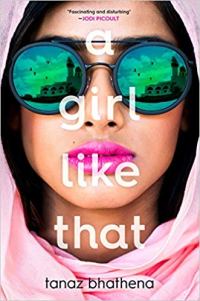
A Girl Like That

51h8gf05wjl-_sx329_bo1204203200_A Girl Like That  by Tanaz Bhathena

I read it as a: hardback

Source: library

Length: 384 pp

Publisher: Farrar Strauss

Year: 2018

Sixteen year old Zarin Wadia is a girl caught between family, social, and peer pressures. Orphaned at four, being raised by her hateful aunt and spineless uncle, Zarin has never really remembered a time when she felt loved. Her only friend is a boy she sees from her balcony who waves to her as he heads out to school each morning. When her aunt and uncle move her from her hometown of Mumbai to Jeddah, Saudi Arabia, Zarin has even more rules to follow, for interactions between men and women in Saudi are highly regulated and women are closely guarded. Zarin begins rebelling against the societal boundaries, learning to avoid the religious police as well as her aunt, just for an hour or two of unsupervised freedom. When she encounters Porus, a young man working at the neighborhood deli, they each recognize each other as the balcony friends they had been in Mumbai ten years earlier. Porus, against his mother’s wishes, stands by Zarin through bullying, slandering, assault, and abuse, determined to be everything for her that she never had before. When the two of them die in a horrific car accident (not a spoiler, it happens on the first page), the pieces of their stories come together in astonishing ways, revealing slowly just how Zarin came to be known as “a girl like that,” and how very, terribly wrong rumors and reputations can be.

This book was devastating. Utterly, completely, beautifully devastating. The pain the Zarin endured for so much of her life was tangible and leapt from the page. The bullying the girls at school put her through is something kids today across the world might be familiar with, which is disgusting as it is. Added to that was the way misogyny and violence towards women is codified into so much Arabic law. No, there was no hint of Islamophobia in this novel, as some reviews implied. It doesn’t make the author anti-Muslim to point out that Saudi Arabia actually has plenty of misogynistic laws reinforced by religious police. It was interesting to learn more about the region, and the various other cultural groups that live there besides Muslims. Zarin and her family are Zoroastrians, a small minority within the community. They don’t speak Arabic, or at least not well enough to defend themselves if they had been detained by the religious police. They spoke Hindi and Gujarati, mostly, and a little Arabic and Avestan. In my ignorance, I had never heard of Gujarati or Avestan in my entire life before reading this book. So I learned a few things, which is always good.

There were too many things that were sad and mad me cry in this. I loved the parts that made me happy, too. Porus is such a sweet character. We need more like him. The one thing I wanted more of was to know why her aunt was the way she was. Did she have schizophrenia? Early onset? Was she just an evil person? What happened to make her like that? What happened to Zarin’s uncle to make him lose his balls and not defend a child under his care from abuse? We also only got a little closure with the schoolmates. I get that the story was Zarin’s and not theirs, but they contributed to the misery of her life, so it would have been nice to know what happened to them beyond just a couple. I suppose we had some answers regarding the biggest offender, but I still wanted more about the other girls in the end.

I cannot overstate how much I enjoyed this book, how gutwrenching it was, and how important I think it is that everyone read it. It’s a major discussion on a multitude of topics from bullying to rape culture and toxic masculinity to the long term impact of an abusive home environment. It pulls no punches, nor should it.

book review · books

We Should All Be Feminists

51uuww2g32l-_sx342_We Should All Be Feminists by Chimamanda Ngozi Adichie

I read it as an: audiobook

Narrator: Chimamanda Ngozi Adichie

Source: library

Length: 45 min

Publisher: Random House Audio

Year: 2017

I’ve meant to read this book the split second it hit the shelves, and I haven’t got around to it until just now. Fail. But that doesn’t change the fact that this is a book I feel should be compulsory reading for every young person entering high school, and given as a graduation gift to every graduating student as well. I don’t mean just handing it to them and hoping they read it. I mean requiring active and participatory discussion. Make them think about what they read. Make your husbands read this with you. Make your daughters and sons read it with you and make them pay attention and make sure they understand that men as well as women can, and should, be feminists. Make sure they know that it is not unmanly, and indeed is a requisite life skill, to be able to cook and feed yourself, not something to depend on another person to do for you. Do not thank a father for participating in the caregiving of his own child – it’s called parenting, and it’s required. Do not ignore a woman when she enters with a man, as though she is a non-entity. Demanding these things does not make a woman an angry feminist or a man-hater. It means she respects herself and her sister women enough to expect that others treat her with respect as well. It is not acceptable that so many people do not understand this, or worse, do understand but simply don’t care or feel it is worthy of consideration. As Chimamanda Ngozi Adichie states, we all must do better.

book review · books · historical fiction

Pachinko

33905162Pachinko by Min Jin Lee

I read it as an: audiobook

Narrator: Allison Hiroto

Source: library

Length: 18:16:00

Publisher: Blackstone Audio

Year: 2017, listened to 7/2/18 – 7/13/18

Pachinko is a multigenerational saga about a family of Koreans who have to move to Japan because…reasons. Initially, Sunja, the beloved daughter of two older parents (older in that they were early 20s when she was born in the early 20th century), gets pregnant. Her lover, she discovers after it’s too late, already has a wife in Japan. One of the boarders at her parents’ boardinghouse, a preacher traveling to his new church, offers to marry her. She accepts and goes with him to make a new life in Japan. Together, they raise their sons in Japan and the story follows four generations of their family, navigating through wars, cultural upheaval, and constantly being viewed as outsiders even when one is born in Japan.

It’s been a really interesting read, though I am finding that I’m just not generally a fan of multigenerational narratives. Not in one book, anyway. This started out strong and then got rushed near the end, like there are too many stories, too many characters, and too much to say to give much attention to any one of them. The same thing happened with Homegoing. I loved the first half of the book and then it just got too rushed and I didn’t get to know the characters as well. I think doing multigenerational sagas over several books is a better way to go.

That said, this was an excellent read, especially the first half, and I learned a ton about Korean culture that I had no idea about before. I didn’t know so many Koreans had moved to Japan, nor that Japan had occupied Korea. Education fail in a big way! The way some of the people felt like they had to “pass” as Japanese just to be allowed to live in peace and make a life for themselves was so sad. Now I want to reread Passing.

Overall, though I had my quibbles with it, I thoroughly enjoyed Pachinko and would recommend it as an excellent and eye-opening read.

book review · books · lifestyle

French Women Don’t Get Fat

1320781French Women Don’t Get Fat by Mireille Guiliano

I read it as a: paperback

Source: my own collection

Length: 304 pp

Publisher: Vintage

Year: 2007

This book is about the French culture and how they manage to eat the foods they eat – lots of rich sauces and breads and wine and chocolate – without becoming obese the way so many Americans are. It’s the French Paradox, although I think that specific term was only used once in the whole book. I think that some people – a lot of people, actually, based on some of the criticism this book has received – might get defensive about what they view as an attack on American culture, or see it as fat shaming. But let’s face it: she’s right about a lot of things, like it or not. The main premise is simply to eat fresh, seasonal foods in moderation, get up off your lazy ass, eat with purpose and at an actual table off of actual plates with actual silverware, and drink a shitload of water. This isn’t a difficult concept to grasp, but I think American ideas of what is a portion are so overinflated that a correct portion seems like starvation rations. The entire framework requires a shift in mindset. It really struck me when Mireille wrote that French women are always thinking about good things to eat and American women are worrying about bad things to eat. I think that is true for many people, even those who are thin.

Throughout the book, Mireille tried to highlight the idea that food and eating should bring pleasure, not stress, anxiety, or shame. At the same time, she also stressed that there is no reason that pleasure from food implies it shouldn’t also be healthy. The concepts she claims are cultural to the French are very much common sense things that my own mother taught me. If you overindulge one day or one week, cut back a little until you feel back in balance. Don’t starve yourself. Have a good variety of foods that are in season. Eat lots of fruits and veggies. Walk or ride your bike to as many places as you can. I have a hard time with this one simply because it’s too hot to do that all the time where I live, and I also live in the suburbs. But when it isn’t over 90 (more often over 100), I do walk several times a week to the grocery store to buy what I need for a couple days. I make up for the lack of walking, which I love doing when it isn’t so hot it triggers a migraine, by going to my all-women’s studio gym, which I also love. I know Mireille hates the gym but I love beating the shit out of the mannequin Bob. I’m nicer after boxing. I take the stairs when I can, and I don’t park as close as I possibly can. I park where there is shade, no matter how far it is from where I need to go. When it gets cooler, I plan to get a bike and start riding it to the weekly farmer’s market. It should be fun, and buying fresh, local food items is a thing I support anyway. I’m rather looking forward to it!

There is also a huge component to eating at home and preparing your own meals. I think people now view cooking and food preparation as a tedious chore that has to be done, or else they don’t bother at all and just go out all the time or buy garbage you can throw in a microwave. And then kids have behavior problems because diet is absolutely linked to behavior. When my own kid eats healthy, she minds a lot better. She also has a healthier appetite when I don’t let her snack. She gets breakfast, lunch, a small afternoon snack, and dinner. She whines about it sometimes, especially if she’s been at my mom’s a lot because my stepdad eats constantly and she sees that bad example. When she gets back on a proper eating schedule, she eats well, and she is a lot more willing to try new foods. She also likes to  help me fix the meals on occasion, though I’m still trying to get her to understand that she has to follow a recipe until she learns what actually goes well together. But I try to make it fun and when she is able to make something well, she feels proud of herself. Cooking with my daughter is a lot of fun and is something I look forward to. It is my job to teach her how to be well and I see no reason why it should be a chore to do. There are a lot of recipes that were included in this book that we can try together that she would like. I also have a large collection of cookbooks that I use all the time, and I like to teach her how I plan a menu. She likes to pick out recipes so when I let her do that, it adds to her enjoyment of food and learning that it is a pleasurable thing to cook.

I liked that Mireille was careful to note that of course not every single French woman is thin. Being overweight or obese is a universal issue and not confined to American culture. It is, however, a lot more rare in France, where it is culturally ingrained to eat smaller portions, eat fresh and seasonal fruits and vegetables, walk everywhere as much as possible, linger over meals rather than cramming them down like you’re starving, drink tons of water, and any number of other things that Americans in general simply don’t do. Like it or not, the observations made in the book about American culture are pretty accurate. Some things may be a little out of touch, but overall, I thought this was a great intro to changing one’s mindset and relationship to food. Regardless of one’s social class or income, I think these basic rules are things most people can follow in their everyday life. It is just a matter of whether you want to or not.

book review · books · historical fiction · Medievalism

Misfortune of Time (Druid’s Brooch #6)

40176383Misfortune of Time by Christy Nicholas

I read it as an: egalley

Source: Helen Hollick at  Discovering Diamonds. 

Length: my file only gave Kindle locations, not page numbers. Super annoying.

Publisher: Tirgearr Publishing

Year: 2018

*Minor spoilers ahead. You have been warned.*

In this sixth installment of Christy Nicholas’s Druid’s Brooch series, Etain, a 12th century Irish woman, has the ability not to age thanks to the magic she draws from her Druid’s brooch. The brooch is an heirloom inherited from her mother, passed down the family line, first given to her family by a Druid in thanks for saving his life. Etain is able to change her appearance at will, so she can age herself appropriately over the years, but her natural appearance is of a woman around 30 years old. In truth, she is around 150. She has had many husbands, many children, and has had to leave them all behind in her long life to avoid being discovered and killed as a witch or Fae. Her current husband, Airtre, is a mentally and physically abusive putrescence of a man, a Christian priest whose primary goal is to move up in the Church to a bishopric. Etain stays only to protect her young grandson, Maelan, from Airtre. When events explode, Etain is forced to flee, getting help from some unexpected allies, including other priests and monks, as well as a few kindly Fae.

I have read several books by Christy Nicholas, including some in the Druid’s Brooch series, and I must say I think this is my favorite one so far. The characters were all multidimensional and interesting, for the most part, and I enjoyed seeing a variety of people mingling together in the villages Etain traveled to, even if life wasn’t really like that in 12th century Ireland. I think she captured the fear and ambivalence of an abused woman well, though I hope I never truly understand that. Etain had a horrific life and it speaks to the strength of her spirit that she kept going and trying to survive rather than just giving up and letting some mad horde kill her as a witch, for the brooch can’t protect her from death.

I loved the theme of tolerance woven throughout, as well as the Gaelic hospitality. There were many instances of travelers or even old friends being offered food, drink, and washing water the moment they set foot indoors. I loved that because that’s how I was raised and it felt like home to see it reflected on the page. As well, the tolerance was a thread throughout. Etain has lived long enough to know that belief isn’t what is important, it is people who are important. She tells Maelan that “a little kindness can have unexpected rewards,” and often she herself has to remember her own lesson and take the kindness of others. Later, Maelan’s wife, Liadan, tells her, “Before I met [Aes], I didn’t realize pagans were just normal people like you and me.” Learning that people have more similarities than differences is a vital life lesson that many people today still need to learn.

The one thing I wish was different was that some of the narrative felt rushed. When Etain left Faerieland and settled in the ringfort, working in the kitchens, for example, little time was spent there, little real detail. The same happened before she entered Faerieland, when she was in the village and traded all her herbs for a cow. I wanted more detail and time spent in those places. Doing so, I feel, would give more of a sense of loss, of fatigue, because Etain was happy in both of those places and then was forced to go again. But these are minor quibbles in my overall enjoyment of this very engaging historical fantasy.

Also, it totally made me think of Dar Williams’ song The Christians and the Pagans.

book review · books · historical fiction

Mrs. Zant and the Ghost

28262527Mrs. Zant and the Ghost by Wilkie Collins

I read it as an: audiobook

Narrator: Gillian Anderson

Source: my own collection

Length: 01:37:00

Publisher: Audible Studios

Year: 2015

Mrs. Zant and the Ghost starts off with a chance encounter in Kensington Park between Mrs Zant and Mr Rayburn and his daughter. Mrs Zant appears to be mad to young Lucy Rayburn and she is initially frightened by her. When Mr Rayburn approaches her, he realizes she might perhaps be ill and takes it upon himself to find where she lives so he might make sure she is being cared for. He becomes swept up in Mrs Zant’s drama, trapped in the clutches of her brother in law, who took over her care after his brother died just weeks after marrying Mrs Zant. She is convinced, and rightfully so, that the ghost of her husband is guiding her and protecting her. Ultimately, Mr Rayburn and Mrs Zant uncover the truth about her visions and her BIL’s motives.

A good old fashioned Gothic ghost story, told with the lovely, overblown language I expect from Victorian literature. I have to say that I do not understand Victorian mannerisms; Mr Rayburn would be a stalker today if he had followed some random woman home, no matter what his motives. To modern sensibilities, he seems pushy and nosy, but of course times change and we can’t judge another time by our own standards. Maybe it was better then since he is obviously concerned for her and acts upon it. Today, people ignore each other or hurt each other.

For sure, the best part was Gillian Anderson narrating this. I cheerfully admit I only got this because she was the narrator, but I enjoyed the story anyway. Her voice adds to the overall otherworldliness of the book’s tone. I don’t know if that’s a lingering effect of her being Scully or if it’s just because she has a nice voice but it worked. It is also fun to hear her natural British accent since she has been classified as bi-dialectical. I used to think first of Scully when I think of her, but more and more I’m thinking of her as DSI Stella Gibson than Dana Scully.

Overall, this was an interesting and fast read. Listen. Whatever. I was in the mood for a Victorian story and this scratched that itch quite nicely.

book review · books

Coraline

13634292Coraline by Neil Gaiman

I read it as an: audiobook

Narrator: Neil Gaiman

Source: public library, though I own a paperback copy that I flipped through as he read it to me

Length: 3:36:00

Publisher: Harper Audio

Year: 2003

Coraline Jones’s new flat has 13 doors that open and close. The 14th door is locked, and when Coraline’s mother uses the key to it, it opens onto a brick wall. She assumes it would have adjoined the empty flat next door but when Coraline goes exploring, she finds a hallway to another flat mirroring her own. In it are another mother and another father and all the same things Coraline is familiar with, only they are altered in a fundamental way. Everything is darker and more sinister. Her other mother wants to keep Coraline with her forever. To force Coraline to stay, the other mother steals Coraline’s real parents and hides them. Coraline, with the help of a very special cat, engages the other mother in a battle of wits to find the souls of three children she encountered while exploring the other world in exchange for her and her parents’ freedom.

I’ve read this many times before but don’t think I’ve ever actually reviewed it. Huh. Naturally, I loved it. In true Gaiman style, Coraline is a study in darkness and strangeness and creepy-crawly feelings that the things you thought you knew are just a little bit off somehow. It is just scary enough to be horrifying to younger readers but delightful to adults. Button eyes ought to be terrifying to anyone. I love the themes of liminal space, which Gaiman always includes in his writing and which he handles so beautifully. It is also an interesting thought exercise on what happens if you can get different parents, which is surely a thought that every child has had at one point or other. Who hasn’t thought at least once that they wish they could have parents that let them have everything they wanted? Coraline’s other mother tried it, though darkly, and Coraline herself came to the conclusion that nobody actually wants everything they want, they want to want everything they want. There’s a big difference, and it is an important lesson to learn the distinction between the two.

It was funny because I chose to listen to it on audiobook this time and one night around midnight, my phone randomly turned itself on and started playing this book. Normally, it would have scared the bejesus out of me to hear a voice talking in the middle of the night. However, I recognized Neil’s voice and it didn’t scare me at all. I thought it was lovely. Instead, it worked itself into my dreams and I had an anxiety dream because I was in the middle of replacing my floors and my house was a mess and my furniture was all over the house and covered in tile dust and my overriding worry was, “Where am I going to have Neil Gaiman sit?? I don’t have anywhere for him to sit that’s clean!” And then I woke up and realized that he wasn’t actually at my house, though that would have made my entire life, it was just my phone reading to me in the middle of the night in his voice.

book review · books

Ellie’s Story

22238177Ellie’s Story by W. Bruce Cameron

I read it as a: hardback

Source: my daughter’s collection

Length: 208 pp

Publisher: Starscape

Year: 2015

My daughter and I read books together at bedtime, and we take turns picking which book to read. Last time, I chose The Hobbit; this was the one she chose to read. It is a cute story for little kids about a search and rescue dog named, surprisingly, Ellie. The narrative takes us from the time she’s a pup with her littermates to her first trainer, Jakob, learning how to do her job, and on to her second and presumably final trainer, Maya. Jakob teaches Ellie how to be a search and rescue dog, what it means to Work, and Find, and Show in relation to lost people. When Jakob is shot in the line of duty and retires, Maya takes Ellie and becomes her new partner. They work together for many years until an injury forces the police department to retire Ellie herself. Rather than not having any job for her dog to do, Maya convinces the PD to let her use Ellie as an outreach program dog, teaching the community about the important work search and rescue dogs do every day.

My daughter ate this book up. It took a while to get through it since we only read it together at night before bed, but it was sufficient to keep her engaged. It is definitely written for much younger or less skilled readers; I mostly found the stories of the rescues to be repetitive and a little boring after a while, but the basic story was good, and since it is for children, that’s just fine.

One thing I particularly liked was that there was room for discussion with my daughter about some of the bad things that can happen. When Ellie and Maya went to the site of an earthquake to search for people, there were a lot of casualties. It was not a gory or very upsetting scene, likely because the narrator is Ellie herself and she didn’t quite understand that the people she found were dead. She only thought they smelled odd and they weren’t happy to be found like normal, so that was upsetting to her. But I thought it was important to include a scenario in which not everyone was found, or wasn’t found alive. That’s real life and I think it’s important not to shelter children from that. We talked about that a little bit so that she could understand that sometimes bad things happen, but I also took that opportunity to remind her about Mr Rogers and the helpers.

Something I think was not at all well done was the way body image was addressed with regard to Maya. It is written in a way that makes her sound inadequate compared to her male counterparts who are also out of shape. She is described as being unable to keep up with Ellie or with other officers out in the field, huffing and puffing and often in pain, whereas the men are rarely described as such. It was particularly gross when her mother told her now that she got certified to be Ellie’s handler, she needs to eat, making it sound as though she was starving herself to lose weight. Not a good message to send to young children. The only good thing about it at all was showing how hard Maya worked to get in shape, but even that has some drawbacks in that it highlights how her body was somehow imperfect or not up to par the way it was. It was obviously good enough to be a patrol officer, so she can’t have been too terribly out of shape to begin with given that there are physical fitness requirements for that position, but it made her sound like she belonged on My 600-Pound Life or something. This could have been handled better.

Overall, Ellie’s Story was a cute book to read together with my kid, and it offered some decent material for discussion with her. She had read it before on her own, which is fine, though I am glad I could read it with her so we could talk about some of the things I felt were important to address.