book review · books · historical fiction · Uncategorized

Update Round: Dodging and Burning; Finding the Way

35004938Dodging and Burning by John Copenhaver

I read it as an: ARC

Source: HNS

Length: 365 pp

Publisher: Pegasus Crime

Year: 2018

Copenhaver’s debut novel gives readers a gorgeous, critical look at the LGBTQ community in post-WWII society, revolving around a murder. In Royal Oak, VA, three friends – Jay Greenwood, Bunny Prescott, and Ceola Bliss – spend the summer of 1945 trying to solve the apparent murder of a young woman who Jay photographed. As they investigate, it becomes clear that there is layer upon layer of deceit involving Jay, the woman in the photo, and Ceola’s brother, who had gone missing in action in the Pacific theater two years earlier. As events unfold, Jay’s wartime traumas surface, Ceola struggles to understand the beloved brother she thought she knew, and Bunny sets into motion a chain of reactions that will have ramifications for them all for decades.

Dodging and Burning has some absolutely lovely writing, filled with deep imagery and complex, living characters. The society is richly depicted, from the salt of the earth working poor to the upper middle class people of the town to the gay and lesbian people in the DC underground. The way the LGBTQ community was portrayed in the novel mirrors social mores of the time, which makes for some really intense and upsetting scenes. There is a lot of excellent, much-needed social commentary woven throughout. One character speaks for the LGBTQ community when he says, “If you’re afraid for long enough, you grow numb to it” (289). Another character later on summed up much of mainstream society when he said, “You’ve been blind from the beginning. When you look at Cee or me or anyone, all you see is what you want” (312). The final few pages were an absolute gutpunch, one which was vital. This is a book that must be read and discussed with as many people as possible. 
38993264

Finding the Way by Wayne Ng

I read it as an: egalley

Source: HNS/Netgalley

Length: 324 pp

Publisher: Earnshaw Books

Year: 2018

Written mostly in flashback, Ng’s lyrical debut is the story of Lao Tzu’s vibrant and turbulent life. Readers initially meet Lao Tzu as an old man riding into a military camp on the back of a water buffalo. The captain of the camp is at first understandably untrusting, for spies take all manner of guises in his world. But he soon realizes that the old man is who he claims to be – the renowned scholar Lao Tzu – and he quickly commands for a scribe to come and record his tale of escape from the royal Zhou palace and remarkable life story. Lao Tzu and the captain’s tales are closely linked, to the captain’s astonishment, proving to him that The Way has many wandering paths that diverge and intersect but all have a larger purpose in life.

Ng’s novel is a superbly written tale, full of intrigue and drama and rich with cultural narrative. All of the main characters are vivid and multidimensional, and even the secondary characters are distinct and memorable. I think some of the tertiary characters get a little lost, but even they are not just faceless beings in a crowd.

The writing itself is lovely. There are so many turns of phrase throughout this novel that are simply pretty that I took quite a long time to read this, just because I spent a lot of time highlighting things as I read. The philosophical discussions embedded within are welcome food for thought, and I learned a lot about Taoism through reading this. It piqued my interest to learn more, which I think is the highest praise I can give to any book, that it inspired me to go learn something new because of it. 
book review · books · historical fiction · Medievalism

The Deepest Grave

51x-w2n9cgl-_sx318_bo1204203200_The Deepest Grave by Jeri Westerson

I read it as a: galley

Source: Netgalley

Length: 224 pp

Publisher: Severn House

Year: 2018

In this latest installment of Westerson’s Crispin Guest medieval noir series, the timeline skips ahead about a year from the previous novel, Season of Blood. The Deepest Grave opens (haha, see what I did there?) with one Father Bulthius coming to Crispin, seeking answers to the mystery of revenants – corpses rising from the grave and walking at night – in the small church of St. Modwen. Naturally, Crispin is skeptical but he takes the case. While he is out, a person from his past comes calling for aid. Philippa Walcote, Crispin’s former lover, comes begging for help, for her young son stands accused of murdering a neighboring fabric merchant and competitor to his father’s business. Crispin is reluctant to become entrenched with Philippa again in any way, but as his apprentice Jack Tucker reminds him, a client is a client, and the Walcotes are wealthy clients indeed. Crispin and Jack embark on a quest to solve the case of wandering corpses, save a child from the hangman’s noose, and figure out why the relic of St. Modwen herself keeps following Crispin around, to his supreme consternation. Continue reading “The Deepest Grave”

book review · books

#FearlessWomen Blog Tour: Starless by Jacqueline Carey Excerpt, Review, and Giveaway

FRIENDS!! YOU GUYS! Jacqueline Carey has a new stand-alone fantasy out, titled Starless, which was released this past Tuesday. Starless is part of #FearlessWomen, Tor Books’ celebration of sci-fi/fantasy books by women. How much more awesome do you want it? More? Ok, then. Ask and ye shall receive.

First of all, I get to be part of a blog tour for this book, which is rad. Readers get to participate in a giveaway for a Starless swag bag for playing, which one lucky person will get to snag! The swag bag will include: a Starless quote postcard, hawk feather, #FearlessWomen sticker, #FearlessWomen pen, and star confetti! Just leave me a comment below, and the random.org gods will decide who wins. I’ll leave the giveaway open until June 18, 2018.

Don’t forget to check out the other awesome blogs that participated in this blog tour as well:

Monday, June 11    Fantasy Cafe

Tuesday, June 12    Utopia State of Mind

Tuesday, June 12    If the book will be too difficult

Wednesday, June 13  Bibliophibian

Thursday, June 14   Between Dreams and Reality

About Starless

In the world of STARLESS the gods have been cast down to earth by Zar the Sun for their rebellion. Born during a solar eclipse, Khai has trained his whole life in the arts of killing and stealth by a warrior sect to prepare him to serve as protector of the princess Zariya. But when the dark god Miasmus rises Khai and Zariya join an unlikely crew of prophecy-seekers on a journey that will take them farther beneath the starless skies than anyone can imagine.

In addition to Carey’s standard incandescent prose, rich world-building, and complex characters, which are just expected for any of her works, Starless has a wonderful focus on gender norms and self-identity. I think these issues are highly relevant, charged topics in today’s society, and couching them in a fantasy setting allows a certain distance from which readers can perhaps more comfortably analyze them.

I loved the structure of the book as well. While I love a good series as much as the next person, sometimes I just want one book that tells one story and that doesn’t leave on a cliffhanger or with a never-ending story arc that just goes on ad infinitum. That Starless is a stand-alone novel is a huge plus in my opinion. I also loved that it was set up in three main parts, which should also appeal to those of us who love a good trilogy as well. Each section has its own main theme and feels, to me, almost like its own separate novel. The first section focuses on Khai and his training. The middle section sees Khai leave the desert and go to the palace, meeting Zariya for the first time. It is also where gender identity comes more into focus, as well as themes of friendship and companionship. The final section continues the discussion of companionship while traveling the world with the prophecy-hunters, seeing various peoples and places. I actually liked this part the best because it reminded me of travel writing and travel narratives I’ve read, though I don’t think the deep bonds between the characters was quite as well detailed here.

Additionally, and I have NO idea if this was intentional on Carey’s part or not, but this book felt like a quasi-Middle Eastern setting, which I really appreciated. It ties in to my earlier comment about how sci-fi/fantasy is ideal for discussing social issues. Placing the novel in a setting reminiscent of the Middle East might create a situation that causes readers to become more empathetic to real life events. And isn’t gaining empathy and learning more about the human condition really what good literature is all about?

I think Jacqueline Carey has written just about a perfect fantasy novel for our time. I have loved her writing since Kushiel’s Dart, and Starless is no disappointment. The vivid landscapes, detailed world, and rich characters combine to immerse me in a completely new world, something I intensely crave when reading fantasy. You will not be sorry if you just run out and buy it forthwith!

Read an excerpt of Chapter Three below. Continue reading “#FearlessWomen Blog Tour: Starless by Jacqueline Carey Excerpt, Review, and Giveaway”

book review

Introducing Kids’ Corner!

Welcome to Kids’ Corner, where we will feature exclusive book reviews written by children. This is a space we’ve designed specifically to encourage children to read more books! Reading is a skill which hones critical thinking, empathy, and a variety of social requirements. Reading from a young age helps to foster these vital skills keenly. When children read books they choose for themselves and are interested in, it contributes to a sense of empowerment, accomplishment, and helps to create lifelong readers, as well as improving vocabulary, developing empathy, and teaching valuable life lessons. We are excited to work with young readers in this project and are eager to help a new generation get started on the path to becoming lifelong readers!

book review

If We Were Villains

51atvtzdzkl-_aa300_If We Were Villains by M.L. Rio

I read it as an: audiobook

Narrator: Robert Petkoff

Source: library

Length: 12:51:00

Publisher: Macmillan Audio

Year: 2017

I loved this book so much I went out and bought my own copy of it, even though this is supposed to be my year of not buying anything. This was a tale of madness and obsession and ALL the Shakespeare! A group of theatre students at a prestigious college, nearing graduation, are coming unraveled and their places in their group are not as secure as they once thought. Tensions come to a head when they receive their role assignments for a major play in the fall and not all goes as they expect. Soon after, one of their troupe ends up dead and the others know more than they are willing to admit. Someone has to take the fall for what turns out to be a killing rather than an accidental death, and the resolution does indeed “make mad the guilty, and appall the free.”

There was almost nothing I didn’t love about this book. The characters were well developed and complex. They all had flaws and some were just downright nasty. Some were confusing – I do NOT understand Oliver’s motivations at all, nor why certain others remained silent. I loved all the Shakespearean quotes scattered throughout the text. I also loved the behind the scenes views of how Shakespearean actors learn how to BE Shakespearean actors. I know, for example, that they don’t actually hit each other on stage, but I never really thought about just how much choreography and practice it takes to make a slap look real, or how to do a punch differently than a slap and make that look real as well. Practicing with swords and foils and and voice coaches to learn difference of accent and dialects, all these things are just part of it. Then there is the history and social commentary woven into each play. It was a flashback to some of my better literature classes from my undergrad years. I loved it!

I listened to this as an audiobook, so it was really enriched because Robert Petkoff, the narrator, is a Shakespearean actor himself. He nailed the voice of every character in the book, giving each person richness and depth. There literally couldn’t have been a better narrator for this story short of someone like Sir Patrick Stewart, Mark Rylance, or Dame Judi Dench reading it to me. Petkoff did a superb job and I look forward to listening to more of his narration. To my delight, several of the books he reads are Star Trek, so a delightful bonus for me!

The only thing I didn’t absolutely love was sometimes I felt it got a little too long when the characters were acting the plays within the narrative of the novel. There was a lot of direct quoting from the plays themselves. Just, maybe, sum up. We’ve all read those, we don’t need a whole act copied out again. But then again, it was fun to see how these characters interpreted the plays, what differences they made to a scene that maybe I had seen some other actor do differently or might have done otherwise myself if I were an actor. The way they interact on the stage is a central component to the book. So maybe these scenes, replete with long passages of the Bard’s own words, aren’t as drawn out and long as initially thought. They are also a loving homage to the man himself. Throughout, the tension and the action and setting were all brilliant and I adored the final twist in the last lines. I simply can’t wait to read more by this very talented young author.

book review · Uncategorized

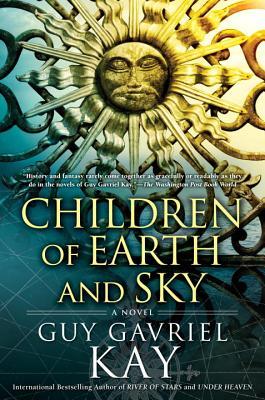
Children of Earth and Sky

25938417
Cover image from Children of Earth and Sky

I’m a big fan of magical realism and what I call near-fantasy, where things are familiar and close but just different enough to make you remember you aren’t actually in your own world. Guy Gavriel Kay is a master of creating this type of world (as are Neil Gaiman and Kelly Link). His newest novel, Children of Earth and Sky, is another example of his creative skill and delightful storytelling ability.

This book creates such a lovely, rich world full of complex and interesting people. Kay’s main characters in this novel are fascinating and multifaceted. He has a wonderful ability to make you get attached to them quickly, which isn’t always a good thing when some of them die right away. Only it is, because it’s awesome when a book gives you the feels right away and DOESN’T FREAKING STOP. The characters are all well rounded and interesting throughout, even the minor characters. You can’t help but care about them, even ones you don’t think you want to care about. Danica, Marin, Pero, Leonora, Neven, they are all vibrant and living people, each with their own path to take, and I genuinely cared about each of them every step of the way.

Kay gives a tale of a quasi-Renaissance Europe that is rife with political turmoil and intrigue, complete with his usual flair for weaving in elements of magical realism. The world he creates is just on the edge of recognition, which I absolutely love about all of his works that I’ve read. I always get the feeling that I’ve been there or studied this in history before, but then he pulls a literary stunt to remind me that I’m actually reading a really well crafted fantasy, like a dead relative cohabiting in someone else’s mind with them. This was the perfect escapism fantasy for me. I want to reread all of Kay’s other novels now!

book review · historical fiction · Uncategorized

Only the Stones Survive

only-stones-survive-morgan-llywelyn

Morgan Llywelyn reminds readers why she is the mistress of Irish historical fiction with this newest addition to her extensive body of work, which weaves Irish myth with historical and archaeological evidence into a complex and fascinating tale of mythic prehistoric Ireland. Told largely from the perspective of Joss, a young man of the Túatha Dé Danann struggling to figure out his place in the changing world, the novel covers the conquest of the Túatha Dé Danann and the settlement of the Gaels in Ireland. It is rich with Irish mythology, as is any novel worth its salt that’s written by this author.

The character development is detailed and satisfying throughout. Readers see Joss grow from a child to a leader and deal with joy and tremendous loss. Eremon and Amergin are similarly complex and conflicted figures. Secondary characters such as Shinnan, the Dagda, and Sakkar are nearly as well-fleshed as primary characters and add depth because they make readers genuinely care about them. A third category of characters that is particularly intriguing are the inanimate ones, such as Ierne (Ireland) and the harp, Clarsah. Giving names and traits to inanimate objects gives them power, and the same holds true here as well. The land and the harp both hold subtle but prominent places within the narrative, and the novel would not have quite the same lovely otherworldly tone without their voices. One line is particularly beautiful: “The harp, if it was a harp, added other themes. The music, if it was music, gave voice to sunshine. And moonlight. A woman’s exultant cry as she bore a child. The clashing antlers of rutting stags. Hope and fear and courage… That is more than music; it represents an entire world.”

This beautiful novel is highly recommended for lovers of Irish mythology, magical realism, and those who hold out hope that they may themselves be descendants of the ancient noble blood.

book review · historical fiction · Medievalism

A Morbid Taste For Bones

321545

As a die hard fan of medieval mysteries, I feel a great deal of gratitude to Ellis Peters for essentially starting the genre with this, the first entry in the Brother Cadfael series.

And what a treat it is! For a tiny book that inexplicably took me an inordinate length of time to read, this was really a fun story. Cadfael is a terrific character, full of quirks and orneriness. Love it! He’d be fun to hang out with.

The secondary characters were nicely developed. Brother John was awesome, and his minor story arc was delightful. Sioned was a strong, wonderful woman and I was glad to see her story have enough twists and turns to give her some adventure during her journey.

I liked that the bad guys weren’t so blatantly bad that Whodunnit was immediately obvious. There were some nice moral dilemmas and grey areas, which are really still relevant today.

Can’t wait to read the rest of the stories in this series.

book review · editorial · random · Uncategorized

I Really, Really Hate The Poky Little Puppy

Recently, my daughter needed to cull her books, because, at five years old, she is a very good reader and has long outgrown many of the board books and younger story books that cluttered her bookshelves. So together, we sat down and went through them, using it as a wonderful opportunity to teach about giving to others because not everyone is as fortunate as we are to have a small home library of their own, and that some other child might really love getting her board book versions of Jane Eyre and Dracula or the 48 point font version of Pixar’s Brave. She had long since mastered those. Then we came across a book that she hadn’t read in ages, but could technically have kept but decided she wanted to get a new book instead, so she opted to part with it in return for a new one. It was The Poky Little Puppy. Before it went into the pile for Goodwill, she wanted to read it again one last time because she loves puppies. Fair enough. We settled onto the couch for a reading.

I remembered then why I never read that book to her. Continue reading “I Really, Really Hate The Poky Little Puppy”

book review

Mistress of Mourning

Mistress of Mourning was the second novel I have read by Karen Harper. It was set in the earlier days of the Tudor dynasty, in the reign of Henry VII, and focused largely on the death of Arthur, Prince of Wales. The premise was interesting – a widowed chandler, Varina Westcott, is hired by the queen, Elizabeth of York, to carve effigies of her dead children and her missing brothers, the Princes in the Tower. Varina becomes the queen’s confidant and she is hired, along with the king’s man Nick Sutton, to go to Wales to investigate the death of Arthur, whom the queen believes did not die of illness but of foul play. Along the way, of course, are the requisite bad guys, traitors, and love stories.

The idea that Arthur was poisoned is intriguing. I am not sure I believe it myself, but Harper makes a compelling argument in favor of it. Given the prince’s poor health throughout his life, a Yorkist assassin slipping in a deadly herb that would cause symptoms resembling any number of illnesses isn’t too much of a stretch to be unrealistic. I suppose it could happen.

The issue with the Princes in the Tower felt a little rushed in the end. Henry’s confession felt a tad contrived, the explanation for their deaths too convenient. But I liked the homage to Henry II and Thomas Becket’s feud, and how Henry VII’s “confession” was similar to Henry II’s “order” to kill Becket.

In general, I liked the characters, though I felt they all needed more development. I thought that was a little odd since the other book I’d read by Harper had extremely well developed characters. Varina and Nick were, of course, the most thoroughly fleshed-out, though they still lacked some depth and had questions left unanswered. It wasn’t enough to detect from the overall plot, just something that was a bit strange considering the experience I had with her other book, Mistress Shakespeare.

Overall, a quick, fun read. Recommended for fans of Tudor history.