book review · fantasy · historical fiction

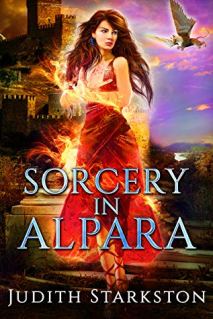
Sorcery in Alpara

47870793._sy475_Sorcery in Alpara by Judith Starkston (website, Twitter, Facebook)

Her Grace’s rating:  5 out of 5 stars

Genre: historical fantasy

I read it as an: ARC

Source: digital ARC from the author

Length: 439 pp

Published by: Bronze Age Books (14 Oct 2019)

This second novel in Starkston’s Tesha series picks up right where the first story, Priestess of Ishana, left off. Tesha and Hattu are newly married and traveling to Alpara, his capitol city. Tesha is to be crowned as Hattu’s queen and rule beside him. Instead, as they travel through hostile lands, a dark force attacks Hattu and his army. Tesha frees the army through the use of her skills as a priestess of Ishana, but at a steep price. Tesha is drained of her strength and power, unable to move or speak. As she gradually recovers, under the care of her sister Daniti, it becomes clear to Tesha that Hattu has been overcome by the same dark force. Tesha must struggle against betrayals that take everything she holds dear from her, save Hattu and her new kingdom, without sacrificing herself in the process. 

Second novels in a trilogy often struggle with a sluggish plot in some odd sort of literary ‘middle child syndrome.’ Sorcery in Alpara definitely does not suffer from this problem. From the start, it is full of action and magic, love and despair. Readers get several gut-punches as Tesha fights to save those she loves, even while being unjustly accused of a crime she didn’t commit. 

A major subplot of the novel involves Tesha’s older sister, Daniti, who was taken captive by a faction of Hattu’s enemies. Daniti uses all her considerable skills to delay her captors from carrying out their plans. Helping her is Marak, Hattu’s second-in-command, who had allowed himself to be taken hostage to protect Daniti. Their whole story, while not quite as fraught as Tesha and Hattu’s, is intriguing and highlights some of the facets of being disabled in the ancient world. Daniti’s blindness doesn’t hinder her ability to be a formidable ally to Tesha and fierce enemy to Paskans and others who would overthrow her brother-in-law. 

Hattu’s people, the Hitolians, are based on the ancient Hittites. Starkston does a masterful job weaving in elements of their culture and religious practices throughout her writing. The religious rituals the Hittites practiced lend themselves extraordinarily well to creating the magic spells Tesha and other priestesses use in this series. Using historically accurate details to turn them to one’s own purpose in a story really helps create a richer reading experience. Starkston has this practice well in hand and she uses her impeccable research on the Hittite culture to modify and implement magic rites within the world she has built around Tesha, who is herself based on a real life Hittite queen, Puduhepa. 

In short, this is an excellent addition to the Tesha series. I can’t wait to buy a hard copy for my own library. Strongly recommended to anyone who loves historical fantasy, or who has an appreciation for well researched books with a seriously fun plot. 

PLEASE NOTE: If you go to the author’s website, you can preorder a copy of this book for $2.99 on kindle. When you preorder Sorcery in Alpara, you get a free short story which continues the narrative of Anna, a prequel story to the Tesha series. The first short story installment comes when you sign up for Judith’s newsletter. I’ve received both and the short story and the newsletter are entirely worth your time. 

book review · fantasy · sci-fi

Suspicious Minds (Stranger Things #1)

40535559._sy475_Suspicious Minds by Gwenda Bond (website, Twitter)

Her Grace’s rating: 3.5 out of 5 stars

Genre: sci-fi/fantasy/horror

I read it as a: hardback

Source: my own collection

Length: 301 pp

Published by: Del Rey (7 Feb 2019)

*SPOILERS BELOW!*

Set in 1969, this first official Stranger Things novel focuses on Terry Ives, Eleven’s mother, and how she becomes entangled with Dr Martin Brenner and his MKUltra experiments. An ad in a local paper promises $15 (around $100 today) for each week a person participates in a top secret experiment. Terry joins the group and is subjected to Brenner’s work which involves loading up test subjects with LSD and other stimuli, including electroshock, to see if any specific combination will bring forth special powers. Terry and her friends – a motley group of people from various backgrounds – quickly figure out that Brenner is operating under the radar to perform morally compromised tests. The group struggles to find a way to escape Brenner’s control while also striving to bring him down and free a child who is trapped in his grasp.

This is a difficult review to write. On the one hand, I was delighted to read a Stranger Things novel. On the other hand, it was kind of a hot mess. If I didn’t pay attention to anything but the story, it was an ok read. But ONLY ok. If I pay attention to writing, plot holes, and lack of answers, this is a terrible book.

Let me first say this is in no way a personal attack on the author. However, what the fuck was Netflix thinking in hiring an author who, previously, has exclusively written YA?? Stranger Things is most definitely NOT a YA show, nor is it appropriate for children to watch. The books should similarly reflect the darkness and danger of the show. But this book barely touched on most of what we have come to love about the show, and is written in a very simplistic style, which one might expect for a YA novel or younger. 

I had hoped to get some answers that we missed in the show, such as more about Brenner himself. That was entirely missing from this book and Brenner remains as mysterious as ever, but not in a good way. The other people who joined Terry in the lab experiments – Gloria, Alice, Ken – were all very flat characters overall, as was Terry’s boyfriend Andrew, and even Terry herself. None of them seemed to have much depth. Terry even had a thought early in the book about how Andrew actually ended up having an interesting personality, opposite what she had experienced before with boyfriends, and yet we don’t get to see said interesting personality. He is vaguely anti-Vietnam, and yet he doesn’t hesitate when he’s called up for the draft and goes off to war with only a little backward glance. His draft lottery being pulled up was manipulated by Brenner, and then he dies in Vietnam. Everything about him is just too easy and convenient. The other people of the group are delivered to us as instant friends once Terry meets them, a pretty tired YA trope (insta-friends, insta-love, insta-hate, etc.). They aren’t developed enough as characters for me to care about them, not even when it’s discovered that one is being electrocuted in the lab. I didn’t even care about Kali, and she is just 5 years old in this novel.

In short, all the characters were just a facade with no depth, character growth, or personality traits to make them seem like real people with whom readers can form attachments. 

Nothing is really shown to us; we are told about things, emotions characters are feeling, etc, but it falls flat since little actual emotion goes into it. Terry was filled with rage. How do I know? Because the text says, ‘Terry was filled with rage.’ There are no indicators otherwise, such as clenched fists or stiff posture, to indicate her anger. Telling us she was filled with rage might work fine for a YA audience, but for most adults, this isn’t sufficient. We get beaten over the head that this is set in the 60s – yes, I know, there’s the moon landing; I know, there’s Woodstock; I know, there’s Vietnam and the draft – but there is very little feeling of the 60s about this novel. We want to be shown, not told. 

Brenner is the biggest letdown of all. He was not the creepy, dangerously calm man we see in the show. He was hardly even competent in this book. He was tricked into letting Terry join the experiment, even though she was found out to have switched spots with her roommate early on, and he appears to have little control over his staff. The plot to rescue Kali/008 was half-assed and yet it fooled Brenner quite easily. Yes, he still retains control in the end, but the fact that he was tricked at all by a bunch of mediocre undergrads doesn’t mesh with what we know of him. He didn’t get any of his back story filled in at all, which was kind of implied this book would focus on heavily. Also, holy lack of security on your top secret experiment, Batman! If it’s so top secret, why were any of the participants allowed to know each other? Why were they able to sneak out of their rooms and go gallivanting about whenever they wanted? Why weren’t they isolated and locked in their rooms each time at a minimum?

Also, I get that this was supposed to be a different time and people didn’t talk about pregnancy and/or birth control like we do now, but honestly. How does a woman not know she’s pregnant for seven months? Even if you don’t show a lot, you’ll show some, and there are other changes that might trigger normal women to at least see what happens if they pee on a stick. You don’t notice that your boobs hurt, that you are breaking out like a teenager, the crushing fatigue? This must be written by someone who has never had a baby and didn’t think to research the common signs of pregnancy. Similarly, why didn’t the scientists at the lab notice that the subjects were remarkably lucid and check that they had actually taken the LSD? Didn’t they monitor them for things like pupil dilation or other autonomic responses that can’t be faked? Why didn’t they stay with their assigned subject the whole time they were there each week to monitor things and make sure they didn’t OD or something? Worst scientists ever. 

If you want to read this purely because you’re a huge Stranger Things fan, like I am, and just want to read a Stranger Things book no matter what and don’t plan to read too deeply into the story, you’ll probably be moderately entertained by this. If you expect something actually good that answers questions you have from the show, and you can’t overlook the glaring plot holes and other problematic areas, get ready for disappointment.

book review · fantasy

Beautiful

45367879._sx318_Beautiful* by Juliet Marillier(website, Facebook)

Her Grace’s rating:  3.5 out of 5 stars

Genre: fantasy

I read it as an: audiobook, which is the only way it’s available currently

Narrator: Gemma Dawson

Source: my own collection

Length: 07:18:00

Published by: Audible Originals (5/30/19)

In this audio-only story, Marillier takes the fairy tale ‘East of the Sun, West of the Moon’ and delves into the story of the troll princess who is shunned by the handsome prince who turns into a bear. Hulde is a princess, hidden away from the world by her mother, who becomes more abusive as the years pass. Hulde is given human servants to tend to her needs, and for one month every three years, Hulde has a friend, Rune, who comes to visit her. Her mother doesn’t allow mirrors in the Glass Mountain, where they live. Hulde has no real idea she is that different from the humans, and she has been raised to believe that she will marry a beautiful prince on her 16th birthday. When she learns that the prince in question had been cursed by her own mother, Hulde helps his fairy tale come true and then goes on a quest of her own to learn about the outside world, her own people, and how to be brave. 

I really liked that Marillier focused on a character who is generally overlooked in the fairy tale. Hulde would never have been the protagonist in a traditional tale, so giving her the spotlight is a good twist for the continuation of ‘East of the Sun, West of the Moon’. I do think people will get more out of this story if they already have an understanding of ‘East of the Sun, West of the Moon’ but certainly it isn’t necessary. Knowing the fairy tale just gives it more depth. 

I think it’s a great message that Hulde is shooting for bravery rather than beauty. Despite the title of the book (which I think may be more tongue in cheek than anything?), the focus is not on the way heroine are traditionally beautiful and married to the handsomest prince ever. Hulde learns how to be brave and to appreciate her strength during the course of her quest, including the fact that trust in others is a part of being brave. She also learns that a beautiful person does not always mean they are a good person or are somehow more worthy of love and attention than others. 

The emphasis on storytelling woven throughout this story is delightful. It’s almost meta in the references to storytelling and the bards or memorykeepers who deal with stories. Marillier does this a bit in her other works as well, but it just struck me more strongly in this one. A story about a girl who loves stories and uses them to guide her quest in the presence of a troll-bard who tells her stories to help her keep going. Love it!

 This story felt a little younger than Marillier’s usual work, but it was still a thoroughly enjoyable tale. Perhaps it’s because it is only available as an audiobook/ Audible Original that it wasn’t quite as nuanced as her usual style. In any case, it was pleasing to this long-time fan, and would make a great intro to her for younger listeners. While not a children’s story, I would have no hesitation at all letting my young daughter listen to this. 

*Amazon affiliate link.

book review · fantasy · historical fiction

A Brightness Long Ago

41458663._sy475_A Brightness Long Ago* by Guy Gavriel Kay

I read it as an: ARC

Source: a friend who lent me her ARC

Length: 423 pp

Publisher: Berkley

Year: 2019

In Kay’s newest historical fantasy set in a quasi-Renaissance version of Italy, themes of memory and fate are woven throughout the tale in the memories of Guidanio Cerra. Cerra recalls his life, starting with the day he helped the highborn Lady Adria di Ripoli get away after assassinating a tyrant. From there, his life brings him into contact with Folco Cino and Teobaldo Monticola, both mercenary leaders and bitter rivals. They all revolve around one another’s lives, orbiting around the shared sphere of power, dominance, and subtle machinations of politics and war, through the lens of distant memory. Most of the events are viewed from Cerra’s point of view as his life touches Cino’s, Monticola’s, and Adria’s, along with some more minor characters such as the healer Jelena or a young cleric.

The pseudo-Renaissance Italian land of Batiara is richly described with a deep history of its own. The land and settings are life-like and made me feel as though I’d fallen through the pages into the scene directly; I could see and smell and feel everything he described as though I was really there. Every character, no matter how minor they first seem, is fully developed and identifiable. I love the way Kay takes these minor characters and later shows their connection to the main events, or has them come back in unexpected ways. He provides an interesting discussion on the concept of fate and choice, and how even seemingly small choices can have a dramatic impact on the course of one’s life. Everything is connected and has a purpose in his writing, and Kay is a master at teasing out every bit of detail from a scene. 

I’ve always found Kay’s writing style to be really interesting. In the hands of a different author, it might not work for me, but Kay can transport me into his carefully crafted world, full of a multitude of characters, without confusing me or disrupting the narrative flow. He uses language alternately to soothe and to jar the reader into a deeper reflection of the overarching themes in his works. His ability to do so with singular skill is rare, and an utter delight to read.

This works as a standalone novel, though it would be excellent to read along with Kay’s Sarantium Mosaic since they are connected. Very highly recommended.

Favorite line(s):

  • We are always the person we were, and we grow into someone very different, if we live long enough. Both things are true.
  • The sailors say the rain misses the cloud even as it falls through light or dark into the sea. I miss her like that as I fall through my life, through time, the chaos of our time.
  • Shelter can be hard to find. A place can become our home for reasons we do not understand. We build the memories that turn into what we are, then what we were, as we look back. We live in the light that comes to us.
book review · fantasy

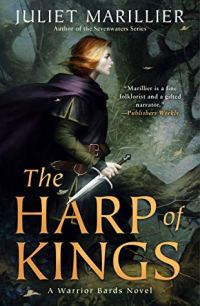
The Harp of Kings

43316755._sy475_The Harp of Kings (Warrior Bards)* by Juliet Marillier

I read it as an: ARC

Source: Netgalley 

Length: 464 pp

Publisher: Ace

Year: 2019

Liobhan has dreamed of joining the elite group of warriors from Swan Island since she was a little girl. She and her brother Brocc, both talented musicians, have gained places in the newest group of Swan Island trainees and she is determined to earn a permanent position there. Another trainee, Dau, seems by turns as determined as Liobhan to win a spot as he does to make sure she does not. When their trainers Innan and Archu decide that these three trainees will accompany them on an actual mission to the kingdom of Briefne to retrieve the magical Harp of Kings, required to coronate the new king Rodan, Liobhan learns the true meaning of what it will mean to become a Swan Island warrior. 

I am always thrilled to get a new Juliet Marillier book and I enjoyed this one immensely. I did think the writing wasn’t as tight as many of her previous books, in particular Daughter of the Forest or the Blackthorn and Grim series. However, this was still a great story with interesting new characters and quite a few easter eggs for her long-time readers. 

Each chapter is told from the first person point of view of one of the trainees. I’ve read other books that do this as well and they often become garbled or indistinguishable from one another. That was not the case here; each character was so well developed that readers can identify who is speaking even without the benefit of dialogue. Liobhan is the saltier of the two siblings and has a thread of impatience and recklessness running through each of her chapters. Brocc is a gentle soul who prefers music to fighting, even though he is adept at it, and his chapters seem almost dreamy at times. Dau has a lot of anger and bitterness in him, and it is clear he has a history he wants to keep hidden or tamped down. Seeing events through each of their eyes makes for an interesting read since each chapter switches from one to another. It gives a nice mix for readers and lets us get to know the characters closely as well as see their growth as people.

The secondary characters were often intriguing. I thought the best one was Mistress Juniper, though Aislinn came in a close second. I kind of want to be a mix of Mistress Juniper and the Aunts from Practical Magic when I grow up. I felt that a few details were left unanswered, such as who Juniper really was, whether Aislinn will get to leave or not, and why exactly Rodan was so monstrous and whether he’ll chill out since events panned out the way they did. I also wanted to know more about the Crow Folk. Speculation from the various characters was all well and good, but I wanted a more definitive answer than I got. In any case, it had an ending that was exciting enough and makes it easier to overlook the few minor quibbles I had with the plot. I am hopeful we will learn more about these things in subsequent books, at least about the Fair Folk and the Crow Folk. 

Overall, a very enjoyable read, perfect for a weekend indulgence or fantasy break.