books · historical fiction

Round-Up: Christy Nicholas books

One of my favorite authors, still sadly an obscure name, is Christy Nicholas. I had the good fortune to review a few of her books for Discovering Diamonds. A few of her other books are also reviewed on DDRevs by my fellow reviewers which I didn’t read, but they are worth checking out for sure. One reason I enjoy Nicholas’s books so much is because she imbues them with so much feminine power. They are accurate within the scope of their timeframe, yet the women in each one are strong, bold, as feminist as possible. She pushes the boundaries of creating feminist characters and isn’t shy to use mythical characters, such as The Morrigan, to be more feminist. I fucking love it. 

Below are a couple reviews, submitted as a guest post by Cathy Smith, who is also a reviewer at DDRevs. My own reviews of Nicholas’s books that have already been posted can be found both on DDRevs as well as on this blog. 

26309658

Legacy of Hunger: Druid’s Brooch Series: 1

Reviewed by: Cathy Smith

Read it as a: digital galley

Source: Helen Hollick at Discovering Diamonds.

Length: 306 pp

Publisher: Tirgearr Publishing

Year: 2015

Legacy of Hunger, book one of Christy Nicholas’s Druid’s Brooch Series, takes readers on an unforgettable quest from the shores of 1846 America to the distressed Irish countryside of Valentina McDowell’s ancestors. Driven by her mother’s legends and a desire to find an old family brooch, Valentina finds early on in her quest that she will discover friendship and come to realize the betrayal of enemies. She will see beauty and face tragedy. Guided by her mystical visions, Valentina’s journey is filled with joy and sorrow as each step of the quest prepares her for what awaits at the end.

Nicholas does an excellent job developing the story by painting detailed descriptions of the characters themselves, their past, and their present. Readers also feel the intensity of the characters’ personalities through the descriptive images of the ship’s voyage across the sea and of the Irish villages and countryside. Nicholas stays true to the history of 19th century Ireland. She uses this history, as well as the legends from the ancients, to provide readers with a real-world sense of Valentina’s adventures.

As I experienced Valentina’s journey to find the answers to the mysteries that haunted her from childhood, I thought of a time when my own father told me the story of his grandmother who came to America as an indentured servant during the An Gorta Mór – The Great Hunger. He told the story of how she met my great-grandfather while working off her servitude in a well-known Colorado bar.  As I read Nicholas’ story, I realized that the legacy of hunger is a legacy that affects generations of people even into the 21st century.

Although Nicholas provides closure in the last chapter and epilogue, the happily or not so happily ever after resolutions of the individual character stories left me with deeper questions.  It is my hope to see future novels that develop some of these characters’ journeys.

Legacy of Hunger is the story of the Irish people who suffered during the Great Hunger.  It is the story of how Valentina McDowell journeys to find her strength, courage, and inner soul by overcoming the challenges to complete a quest that reveals her destiny.

Other books by Christy Nicholas:

30283385._sy180_
Legacy of Truth: Druid’s Brooch Series: 2I don’t have a link to any DDRevs review of this one.
33189717._sy180_
Legacy of Luck: Druid’s Brooch Series: 3. I don’t have a link to any DDRevs review for this one, either.
36587709._sy180_
Misfortune of Vision: Druid’s Brooch Series: 4. You can read the review on my blog, since I’m the one who wrote it for DDRevs. 
38595279._sy180_
Misfortune of Song: Druid’s Brooch Series: 5. I don’t have a link to any DDRevs review for this one. I should see about getting this to do a review.
40176383._sy180_
Misfortune of Time: Druid’s Brooch Series, 6. Again, you can read it on DDRevs, linked above, or the exact same one on my blog since I wrote the review for them. 

Nicholas also has a standalone novel that I reviewed for DDRevs as well, Call of the Morrigu. The full review is here, as I forgot to post it to my own blog before now. 

35213101

Call Of The Morrigú

I read it as a: digital galley

Source: Helen Hollick at Discovering Diamonds.

Length: 217 pp

Publisher: Tirgearr Publishing

Year: 2017

In late 1700s Ireland, rebellion against oppressive English rule was on the rise. In one quiet corner, however, society was still relatively peaceful. Theodosia “Dosey” Latimer lives with her grandfather in their family’s country estate of Strokestown. On the property, they discover a mysterious cave filled with ancient carvings and decide to try to excavate it. In the process, they accidentally awaken The Morrigan. Yes, that Morrigan. The mythical Irish war goddess. Now it is up to Dosey and her grandfather to teach Morrigan how to behave like a proper 18th century lady – and keep her out of the rebellion coming their way.

This was, simply put, a remarkably fun read. Author Christy Nicholas weaves in mythology and history smoothly throughout the narrative. Readers are given glimpses of Celtic myth alongside bits of information about the 1798 Irish Rebellion, led by Wolfe Tone. Parts of the story were surprisingly funny as well. Morrigan learning 18th century table manners is exactly what you would hope for.

The parts of the book that I most appreciated were its many feminist elements. Feminism was a necessary component of the plot for Dosey to be able to grow as a character and a woman. She also was a product of her time and none of her actions were unbelievable or out of place in the story. However, it’s hard for me not to cheer and fall in love with characters who make comments like “I do not understand the shame your society has for the body. It is a glorious thing, full of life and pleasure” or “You are power. You are woman. All woman are power.” Here, Morrigan was reflecting what was understood to be the typical pre-Christian culture of ancient Ireland (or at least the author’s interpretation of it), but it remains highly relevant in today’s society where women’s rights are still challenged and threatened by the patriarchy. Having a mythical character speak the words makes them no less relevant, and allows a certain safe distance from which we can examine our modern morals and values. I loved it.

My only criticism is that I felt some of the secondary characters could have been developed a little more. I wanted to get to know Nan better, and Cillian and Marcus. They were fine, but they felt like they were placeholders or extras just playing a necessary part in a formula. However, they were not totally flat or one-dimensional, either, and they served their respective purposes well enough.

Overall, I loved this book and look forward to reading more by this author. Strongly recommended for anyone who is interested in Irish mythology, history, or the influence of women on either subject.

book review · books · Elizabethan England · historical fiction

Blood and Ink

40821110Blood and Ink by DK Marley

I read it as an: ARC

Source: Helen Hollick at Discovering Diamonds.

Length: 414 pp

Publisher: CreateSpace Independent Publishing

Year: 2018

Blood and Ink by DK Marley is the tale of Christopher “Kit” Marlowe, Renaissance poet and playwright, near contemporary of Shakespeare. In Marley’s novel, our playwright is an unwanted child who is effectively sold to Sir Francis Walsingham, Queen Elizabeth’s spymaster, who noticed the boy’s intelligence when he visited a local school. Placing the young Marlowe under the mentorship of poet and spy, Sir Phillip Sydney, Marlowe continues his education as well as learns how to be a spy for Walsingham. As the years progress, Marlowe convinces Elizabeth to support his plays on-stage in exchange for his services to her. However, when factions more loyal to money and personal advancement than to the Queen step in, Marlowe makes a sacrifice that alters everything he has understood about the world, his writing, and himself.

christopher_marlowe
Christopher Marlowe. I love that the portrait has “Quod me nutrit me destruit” in the upper left. That would make a cool tattoo…

This was an interesting novel and can potentially be classified as alternate history, depending on one’s perspective. It takes one of the more popular theories about Shakespeare, which is that Marlowe was actually the author of his works, and runs with it in a way that is believable. There are theories that Marlowe didn’t actually die at the inn in Deptford and that his death was, in fact, staged so that he could go either into hiding, exile, or continue his spy work for Walsingham. The author poses some of the more common and interesting questions in her note at the end of the book, including why Shakespeare, one of the greatest playwrights of his day, was buried in a common churchyard rather than in a glamorous cemetery; why the Queen provided her own coroner to preside over the inquest of Marlowe’s death when it wasn’t in her purview to do so; why we never heard anything at all about Shakespeare until after Marlowe’s death; the education of Shakespeare and Marlowe (Marlowe had a degree from Cambridge, Shakespeare was relatively uneducated); and why was Shakespeare’s grave dug 12 feet deep instead of only the usual 6 feet? Marley takes pains to answer these questions and more in the novel and does so quite thoroughly. She also is careful to note that she herself is a Shakespearean, at least until there is solid proof that someone else was the author. But it makes for a good story.

220px-shakespeare
William Shakespeare

Various themes were at play throughout the novel, ranging from nature vs. nurture to loyalty to ambition to betrayal. The ways in which all these themes intertwine and influence one another are fascinating and very finely wrought, particularly the ways Marlowe had to balance his work as a spy with his calling as a playwright. The mix of blood and ink throughout the narrative is a stark reminder that his dreams come at a steep price, one that may be too much to bear. Overall, I think some of the characters were a tad one-dimensional, though Marlowe himself and the major secondary characters like Walsingham or Queen Elizabeth are complex figures. Shakespeare was the next most well-fleshed character besides Marlowe, which makes sense, though his motives were only apparent near the end of the novel. The last quarter or so of the book felt unnecessarily long and dragged down the pacing somewhat. However, the attention to historical detail was excellent and made for an immersive read. I particularly enjoyed all the bits and pieces of plays and poems scattered throughout the narrative. It was fun to see words that we automatically credit to Shakespeare coming from Marlowe’s pen or lips in this story, and it definitely reminds me that it’s time to reread the plays again. It has been too long. I look forward to more from this author in the future.

book review · books · historical fiction

Priestess of Ishana

Priestess of Ishana by Judith Starkston

I read it as an: ARC, finished as a paperback

Source: from the author, and I bought a copy for my own collection

Length: 453 pp

Publisher: Bronze Age Books

Year: 2018

Tesha is the 15 year old high priestess of the goddess Ishana, a deity of war and love. Her duties and devotion to the goddess are strong and she carries out her role faithfully at the temple, believing she knows her life’s role. Until one day, two shepherds discover the charred remains of a man’s body in a cave, who had been killed by sorcery, a crime punishable by death. When the Great King’s younger brother, Hattu, arrives to Tesha’s city to deliver a great treasure to the temple as a sign of his devotion to Ishana, he is arrested for the murder of the man in the cave. Tesha and her blind sister, Daniti, are convinced that Hattu is innocent, but their father, Pentip, the Grand Votary and High Priest, believes otherwise. Acting against her father, Tesha meticulously searches for the truth that will set Hattu, with whom she shares an inexplicable bond and visions, free of his prison and save him from execution at his own brother’s command.

You guys. YOU GUYS! This novel is Hittite historical fantasy! Let me say that again:

HITTITE. HISTORICAL. FANTASY!

This is exactly the historical fantasy novel you were looking for to round out your 2018 reading! The world building is intricate and painstakingly drawn, which is always pleasing. The pacing has a nice blend of faster action sequences combined with complex (but not convoluted) politics and religious rites. Each character has depth and personality, some of whom you love to hate. I thought Tesha in particular was a complex person, a woman in her own right who had some power as a respected priestess, but who was also a woman in a very different and much earlier society who adhered to some patriarchal rules. It was fascinating to see her carry out her duties as well as her investigation within the scope of the limits her society imposed upon her.

The excellent author’s note at the end gives further insight into both the creation of the novel itself as well as the Hittites. I think a lot of people don’t know about the Hittites at all, or else only what is mentioned about them in the Bible. But their civilization was enormous and they had a ton of influence on the ancient world. They were literally lost to the sands of time and were only relatively recently rediscovered. There is still a lot we can learn about them, and frankly, learning history by way of well written fantasy novels isn’t a bad way to go. I think Judith Starkston has struck on a totally unique niche within the historical fantasy genre, and I can’t wait to see what she comes up with in her next installation in the series!

**A slightly different, probably longer and better version of this review will also be posted at the very awesome book review site Discovering Diamonds. You should go check them out.

book review · books · historical fiction

Doc: A Novel

8911226Doc: A Novel by Mary Doria Russell

I read it as an: audiobook

Narrator: Mark Bramhall

Source: library

Length: 16:38:00

Publisher: Random House Audio

Year: 2011

This historical fiction novel focuses on the life of John Henry “Doc” Holliday from his early years, before he was famous for his role in the gunfight at the OK Corral. He was born to be a Southern gentleman, but he moved to Texas in hopes that the hot, dry air would ease the tuberculosis that was already ravaging his lungs. When the job market proved to be less than he had hoped, he started professionally playing poker. At the urging of Kate Harony, the Classically trained Hungarian whore he lives with, Doc and Kate move to Dodge City, KS and start fresh. And Doc becomes friends with a young man named Morgan Earp and his brothers Wyatt and James and the rest, as they say, is history. Or is it?

This book! I read this book just to check off the “Read a Western” box on the Read Harder challenge, and it was the only one immediately available that sounded remotely interesting. I’m not a fan of westerns. I did not expect to enjoy it all that much, it was just something to get through. I had no idea that I would discover the book that is probably my favorite book of 2019! This novel was just absolutely delightful. Doc Holliday was not the man he is portrayed by history, at least not according to Mary Doria Russell. He was a quiet, mild mannered, Southern gentleman who loved playing the piano, reading Classical literature, and speaking Latin. He was born with a cleft palate, and he was one of the first babies the have his fixed. He was fiercely loyal and did not seek out fame or notoriety. This Doc Holliday was a person I genuinely cared about.

The narrator, Mark Bramhall, delivered a superb performance. He shifts seamlessly from Doc’s slow Georgia drawl to the sharper twang of the Texas cowboys to the cheerful Irish brogue of the local town drunk. He gives dry wit a biting edge that made me laugh out loud more than once, and imbued his voice with such sadness or nostalgia at times that only the coldest person would remain untouched. I hope he narrates other books, because I definitely want to hear his voice again.

There was almost nothing I didn’t love about this book. Some of my favorite scenes were when Doc fixed Wyatt’s teeth and gave him dentures to replace his missing teeth. Wyatt was so happy to see his own smile, it was heartbreaking. He had to practice saying his S’s and TH’s and he was determined to get it right, which was also somehow endearing. Doc was proud of his work and delighted to be able to give a person back some of their self confidence and health, which he vigorously defended later to Kate when she was nagging him about how dentistry doesn’t pay any money. I also loved the scene near the end when Doc was playing The Emperor piano concerto. That whole scene made my face leak on my drive to work. I want to buy this for my own collection. I would listen to it again, or eyeball read it. It was enthralling.

book review · books · Elizabethan England · historical fiction · Tudors

A Murder by Any Name

51orh40ubylA Murder by Any Name by Suzanne M. Wolfe

I read it as an: ARC

Source: Publisher/HNS

Length: 336 pp

Publisher: Crooked Lane Books

Year: 2018

In this series debut, Nicholas Holt, the younger son of a fictional nobleman, is a soldier as well as a spy for William Cecil. He is home in London to report on his mission from the Continent when he is instead assigned to investigate the brutal murder of Queen Elizabeth’s youngest, most innocent lady in waiting, right in the heart of the court. The murder is disturbing, not only because it strikes at a young and innocent girl, but because the body was posed in the chapel in a gruesome imitation of prayer. When a second lady in waiting is murdered shortly after the first, the stakes get even higher for Nick, whose loyalty as a member of a recusant family might be in question if he cannot discover the identity of the  murderer. The political overtones imply that someone is striking now at Elizabeth herself, implying that her reign is illegitimate and that Catholics should be ruling England. Nick relies on the help of his friends – Spanish Jewish doctors Eli and his beautiful twin sister Rivkah, his childhood friend John, and his faithful and well trained wolfhound Hector – to hone in on a cold-blooded killer who won’t stop until forced to by the Queen’s executioner.

A Murder by Any Name was a fast-paced and entertaining read. It held my attention throughout, even though I totally figured out who the killer was quite early on. I’ve read too many mysteries to be surprised by very much, and this plot was really pretty standard. However, the historical details and character development were really well done and more than made up for any lack of surprise for me. Wolfe’s attention to detail was such that I could practically smell the stench of the Thames – or Elizabeth’s breath from her black and rotting teeth! Gnarly. The atmosphere she created was rich and full of emotion, enhanced by the physical details surrounding the characters. The brittle cold, icy water, foggy riverbanks, echoing chambers or chapels, all contributed encompassing the feelings of fear and paranoia that pervaded society at the time. So often, the Jewish communities were the scapegoats for anything that went wrong, as Eli and Rivkah had painful reason to know. Skillfully, Wolfe crafted a protagonist who was sympathetic as well as empathetic while retaining historical accuracy, a tremendous balancing act in itself. Nick Holt was a product of his time, but he was not hardened or indifferent to the suffering of those beneath him on the social scale. I thought Wolfe did a fantastic job of weaving feminism into her story while still being accurate to the social mores of the time. I thought that was excellent. Nick was a wonderful, sensitive, believable character, and I wish there were more period pieces with men like him in them as opposed to sexist men who are written like barbarians simply because the author seems to think that is how it was back in the day, or maybe because an author is himself a sexist. Instead, A Murder by Any Name is the best of what happens when you get a woman to write a well-researched historical fiction. I am looking forward to reading more books in this series, and I can happily recommend this one.


book review · books · historical fiction

A Missed Murder

51htbmniokl-_sx315_bo1204203200_A Missed Murder by Michael Jecks

I read it as a: galley

Length: 224 pp

Publisher: Severn House

Year: 2018

Jack Blackjack, which is either a really cool name or a really lame one, is an assassin in the employ of the historic figure John Blount. Blount somehow managed to convince Jack to be an assassin for him, even though Jack is squeamish around blood and is an indifferent assassin at best. He really takes the job only because he would get paid a lot of money and he’s jonesing for better food, nicer clothes, and a big house (not that I blame him for that), and because he is rightfully concerned that Blount will kill him for turning him down. Jack is also a complete fuck-up. He was ordered to kill a guy, then that order was countermanded, but Jack manages to kill him anyway, completely by accident. All that happened even though he had really hired the father of his lover to do the actual killing for him. See above re: squeamish about blood. Now Jack is trying to get out of his self-inflicted mess alive. The plot thickens as he scrambles to do a job, avoid a job, and not become his own next victim.

It sounds pretty fun, right? You would be wrong. This was the first book by Michael Jecks I have read and I have to say, I think it will be the last. It’s disappointing, too, because the blurb honestly sounded like it would be so good. I thought Jack was not merely an unlikable character but a revolting one. I am so incredibly sick of male narrators who are braggarts and arrogant and view women as objects. Within just the first few pages, there were a shit ton of comments made by the narrator about women and their vacant eyes and how that was a turn-on. Seriously, what the fuck? Additionally, there were tons of incredibly juvenile euphemisms for sex – hide the sausage, pounding the mattress, mattress galloping,  that might appeal to immature audiences, but not, I think, to most adults. There were men in the 16th century would have appreciated a woman with some wits about her, who wasn’t just some vapid cow. So this attitude – by the narrator? By the author? – didn’t really capture the sense of the social mores. Women at the time were, indeed, not equal to men, and were sometimes viewed as objects. Hey, kinda like today! But there are plenty of examples, both from the contemporary literature and real life, of men who valued a strong, intelligent woman. Also, it’s kind of hard to overlook the fact that there was a woman on the throne at the time this book was set, even if she wasn’t the most popular, and was followed by another woman who was one of THE most popular and longest-reigning monarchs in British history. So even allowing for 16th century social mores, the rampant sexism is hard to stomach. It’s used often enough that I don’t know if it is supposed to reflect the protagonist’s mindset or if it is the viewpoint of the author himself. The ubiquitous sexism also detracts from an already tepid plot that is lacking any meaningful historical detail. I know Jecks has a ton of books in another series, so it seems he’s pretty popular. Maybe this is an aberration and his other books are better, but I was thoroughly put off by this one and now have no interest in reading his other ones. A Missed Murder should have been titled A Missed Opportunity

book review · books · historical fiction

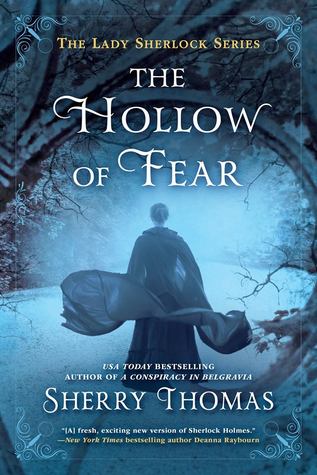
The Hollow of Fear

36342330The Hollow of Fear by Sherry Thomas

I read it as an: ARC

Source: publicist

Length: 336 pp

Publisher: Berkley

Year: 2018

The Hollow of Fear is the third in Thomas’s Lady Sherlock series and honestly, they just keep getting better and better. In this installment, Charlotte Holmes helps her dear friend Lord Ingram when his wife’s body is discovered in the ice house on the grounds of his country estate, Stern Hollow. Charlotte provides assistance and moral support to Ingram, who is the prime suspect in Lady Ingram’s murder. In order to be able to assist and move freely among the police investigators, Charlotte dresses up as Sherlock’s fictional brother Sherrington, which is hilarious since Sherlock himself is fictional as well. Livia, meanwhile, though concerned about Ingram, is also pining for the mysterious man she met in the second novel, while trying not to be obvious about it. Readers will be rooting  for her to get some kind of happiness, which has been so long withheld due to circumstance and her parents’ unkind personalities. Throughout the twists and turns, Charlotte has to keep her sisters safe, keep her identity as Sherlock secret, and keep Ingram out of the hangman’s noose.

There is so much to unpack in this novel. The plot is wonderfully complex and it kept me guessing until the surprising end. We learn that, as so often in real life, people are not always as they first appear. Some turn out to be nicer than we think, and in this case, learning that was a delightful surprise. Others are harboring dark secrets and it hurts to find out who it is. It was also a treat to learn more about Ingram’s other two brothers: Wycliffe, the eldest and the duke, and Remington, the youngest and free-spirited of the group. Although they really didn’t make an actual appearance on the page to speak of, it still gave a more well-rounded background for Ingram and Bancroft that was appreciated. Readers of the series are already intimately familiar with Ingram, of course, and Bancroft, a quasi-Mycroft figure.

But it is beyond the plot where the novel’s true strengths lie. Charlotte still desires Ingram, and propositions him on occasion, to his consternation, since he operates within the scope of society. However, she only wants him on her terms and is willing to wait if necessary. Unlike the original Sherlock, Charlotte isn’t asexual, but she refuses to allow society to dictate how she lives her life, and she isn’t driven purely by mindless desire, which would be terribly boring. The fact that she is almost certainly on the spectrum also makes for some interesting interactions because she reacts to emotions very differently. Also unlike the original, Charlotte uses food and eating as her addiction rather than cocaine, which sparks great discussion about body positivity and body image. I love her commentary about “maximum tolerable chins.”

My favorite element of this particular story is that it has lots to say about gender identity. Thomas takes Sherlock and gender-flips him into Lady Sherlock, which is fun enough on its own. But here, Lady Sherlock goes and dresses as a man so she can help Ingram. While she was dressed as Sherrington Holmes, the handful of people who know Charlotte is actually Sherlock – Ingram, Livia, and Inspector Treadles – maintained her cover, addressing her as a man and treating her as such. They said things to her and allowed her to do things as Sherrington that never would have been allowed had she presented as Charlotte, even it was just Ingram, who is indulgent of her and lets her do pretty much what she wants. I found the interplay of gender identity and gender fluidity to be fascinating.

Oh, and that last line! I simply can’t wait for the next book!

book review · books · historical fiction

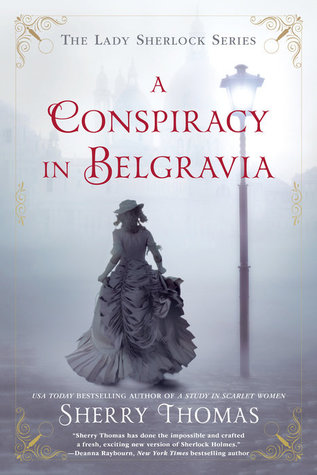
A Conspiracy in Belgravia

33835806A Conspiracy in Belgravia by Sherry Thomas

I read it as a: paperback

Source: library

Length: 317 pp

Publisher: Berkley

Year: 2017


In the second installment of the Lady Sherlock series, Charlotte Holmes has established her reputation as a consulting detective, albeit under the alias of Sherlock, her bedridden fictional brother. Here, she finds herself investigating the case of Lady Ingram’s first love, the man she would have preferred to marry rather than Charlotte’s friend Lord Ingram. The two former lovers have an agreement to meet but this year he misses the appointment, causing Lady Ingram to seek out help in finding him. At the same time, Charlotte’s sister Livia meets a handsome stranger and is being wooed by him, though he may not be who he seems. Through it all, Charlotte learns that her illegitimate half brother may be involved, and she also has to decide what to do with an intriguing marriage proposal to boot.

I thoroughly enjoyed the first book in this series, and I liked this one even better. Charlotte is growing as a person and it is interesting to see how it affects her logic. She kind of reminds me a lot of Cristina Yang in some ways – all cold logic and lack of emotions but hiding a caring person once she gets to know you. The way Thomas is handling original characters is really good. I still love Mrs Watson, and how shadowy Moriarty is in his (or her!) off-page debut in this novel. I really love the conclusion to this novel’s case, which is, I would like to believe, how Thomas will handle The Woman/Irene Adler. Maybe? I can see this particular character taking on that role, at any rate. I’ll be so interested to see how that plays out in later books. And that last line – loved it! I hadn’t actually seen that one coming. I love when that happens.

I really can’t talk in detail about the plot without giving spoilers, but this entire series so far is a genuine delight and I can’t wait to read the 3rd one!

book review · books · historical fiction

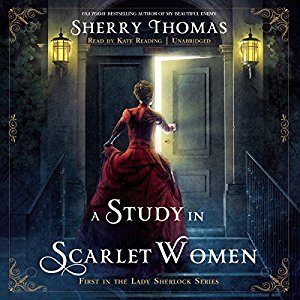
A Study in Scarlet Women

35009017A Study in  Scarlet Women by Sherry Thomas

I read it as an: audiobook

Narrator: Kate Reading

Source: my own collection

Length: 11:00:00

Publisher: Blackstone Audio

Year: 2016

A Study in Scarlet Women is, in essence, a gender-flipped Sherlock Holmes story. Right there, I wanted to read it. The premise of this novel is that Charlotte Holmes is a brilliant woman and has no interest whatsoever in marriage. She’s told her father so and they made a deal – if she makes a genuine effort to find a suitor and let him make her fall in love with him and she still doesn’t want to get married, when she is 25, he will pay for the education she needs to set up shop as the headmistress of a girls’ boarding school. Charlotte holds up her end of the bargain; her father does not. So she takes matters into her own hands and has an affair with a married man, thus ruining her reputation and rendering her unfit for marriage. Yay, idiotic Victorian morality! She has no intention, either, of being imprisoned at their family’s country estate forever, so she runs away to London where she intends to support herself as a typist. Eventually she meets Mrs Watson, who hires her as her companion. Mrs Watson convinces Charlotte to take on clients as an investigator, pretending to be the sister of the bedridden man, Sherlock Holmes. The ruse works and Charlotte is able to support herself quite well by solving mysteries. She is called in on one case that strikes close to home when suspicion falls on her sister, Livia, who had publicly accused the mother of Charlotte’s lover of ruining her sister’s life, and hours later, the woman was dead. When two other people die mysteriously, Charlotte and an Inspector Treadles work together to solve the mystery and figure out how the victims were connected.

I enjoyed seeing a gender-flipped Sherlock. Charlotte is a woman who knows what she wants and makes plans to get it. She has good body image and isn’t worried about being stick thin. These are all good things about this novel. There are a lot of strong and independent women, even being set in Victorian London. I think that the mystery itself took too long to set up and get to, though, and once we got to it, was unnecessarily convoluted. It was hard to keep everyone straight and the ending was really complicated. I read a ton of mysteries and am really good at keeping track of who’s who and it still confused the hell out of me. I felt that the book’s strength was in the character development, which was excellent for nearly every character we meet. Though I didn’t feel the mystery part of the plot was terribly well done, the rest made up for it and I am still looking forward to reading the rest of the books in this series.

book review · books · historical fiction

Fire Catcher

Fire Catcher  by CS Quinn

I read it as an: audiobook

Narrator: Napoleon Ryan

Source: my own collection

Length: 14 hrs 29 min

Publisher: Brilliance Audio

Year: 2015

In this second installment of Quinn’s Thief Taker series, Charlie Tuesday finds himself on the hunt for a sea chest which contains papers that have the potential to bring civil war back to England. He and his reluctant new sidekick, a young Gypsy woman name Lily, have to race to find the papers before they burn in the Great Fire of London.

I cheerfully confess that I began reading this series because the first installment, The Thief Taker, was all about the bubonic plague. We all know I have an unhealthy fascination with plague. But this book was kind of a meandering mess. Charlie and Lily run from one clue to another, the fire destroys stuff, the bad guy Blackstone gets badder and crazier, and eventually they find what they are looking for and figure out the mystery. It was actually quite long and rather boring for what could have been a much more interesting story.

I don’t know a ton about that time period – I’m a medievalist, so the 1660s are too modern for me! – but I think this was not a very accurate book. The descriptions of the city didn’t mesh with what I know of historic London. I also don’t know about the Duke of Clarence.

Also, it’s magnum opus, not magnus opus. Jesus.

The pacing was another problem for me. While I enjoy a fast-paced book as much as anyone, things happened in this book too fast and without any real purpose. It was like that movie Speed, just too much going on and most of it was eye-roll worthy.

The narrator, Napoleon Ryan, literally was all that kept me listening to this. He did a fantastic job, doing different voices and accents. I could listen to him narrate a lot of things, even if the story isn’t all that compelling.