book review · historical fiction · Medievalism

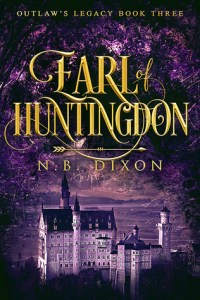
Earl of Huntingdon

42551630Earl of Huntingdon (Outlaw’s Legacy Book 3)* by NB Dixon

I read it as an: ARC

Source: Helen Hollick at Discovering Diamonds 

Length: 418 pp

Publisher: Beaten Track

Year: 2019

Earl of Huntingdon is the third in the Outlaw’s Legacy series, a reimagining of the Robin Hood legend by NB Dixon. In this installation, Robin of Huntingdon, formerly of Locksley, is an earl, a former outlaw pardoned by King Richard for his lawless ways. He had married Marian, the heiress of Huntingdon, though his heart was given to one of his companions, Will Scathelock. Now, years later, Robin is facing an old enemy from his Crusading days, Roger of Doncaster, who had been promised to Marian in his youth and never forgave her or Robin for coercing her marriage to Robin instead. Roger is determined to do all he can to destroy Robin, whose only solace now is in the arms of the man whose heart he broke.

The action begins with a new group of outlaws in Sherwood. The difference here is that these outlaws are truly bad people, raping, pillaging, and plundering from the innocent. The new sheriff of Nottingham, Matthew Picard, is as inept as Guy of Gisbourne ever could have been, and does nothing to stop them. Robin takes matters into his own hands and dispatches the outlaws himself with the aid of his loyal men…and Will Scathelock. However, the outlaws were connected to a spy in Robin’s midst working with Roger of Doncaster to bring Robin down and killing the outlaws sets in motion a chain of events neither Robin nor his men could have anticipated.

This was an utterly unstoppable read. While I confess I’ll read just about anything labelled “Robin Hood,” that doesn’t mean all such are actually well written or entertaining; Earl of Huntingdon, however, is both. I enjoyed the rich historical details, such as the training the men did in the lists and at the tiltyard, or the ways in which castles could be besieged. Adding in the historical details in this way make these novels which are based on legend spring to life, making it seem that much more possible that people like Robin Hood really could have existed.

The characters were all interesting and well developed. I loved how very human Robin was – he was conflicted in wanting to do right by Marian and by what I think was his genuine affection for her, but also his desire for Will and wanting to be with the man he truly loves. He isn’t a perfect person, and never tries to be, and it makes him that much more believable.

Marian is not always likeable and her reasons are understandable. She’s endured many losses and suffered a lot of heartache, which makes her rather shrewish at first. We get to know her more as the book goes on and I grew to like her more. Having Marian be less likeable than she often is in more traditional versions makes this novel compelling and more relatable – it reminds readers that she is a woman of her time and subject to the whims of the men in charge of her, and yet she has endured it all as best she can.

All the secondary characters – Will, John Little, Tuck, John’s wife Daphne, Alan a Dale, and so on – have distinct personalities and foibles of their own. Daphne in particular is a woman to be reckoned with. She’s awesome, even though her role in this novel was relatively minor.

Roger of Doncaster is a complex antagonist. He is so incredibly hateful towards Robin that, without having read the previous books, I am left to wonder if he is supposed to have been closeted. He hates Robin and other gay men so much, and bases his hatred for them in his religious devotions, that it makes me wonder if the hatred isn’t really supposed to be a projection of his own self-loathing. That possibility wasn’t really addressed in this book, but it did make me wonder as I was reading.

My only quibble, and it is minor, is that a couple of the secondary antagonists are a little stereotypical. Picard, for example, is very good at being a stupid fop and not much else. It makes him a rather boring antagonist because he is one-dimensional. There didn’t seem to be much else going for him. Again, this is a minor issue and didn’t detract from the rest of the plot overall, other than it made a few things a little predictable.

I loved the queering of the Robin Hood legend. It’s always fun to read a reimagining of any beloved story, and to see it done in a way that is socially relevant is a treat. It brings new discussion into the mix and raises a lot of interesting new questions to the traditional story everyone is familiar with. The chemistry between Robin and Will is unmistakable and fierce, but not over the top. As a non-reader of romance in general, I appreciate it when the romance isn’t actually smacking me in the face. The romance and sex in this novel were, I felt, very nicely done for both the gay and hetero couples.

I do feel I would have enjoyed the book even more had I read the previous two in the series. However, I do not feel like I was lost, plot-wise, for having missed them. Enough of the backstory was given so that any gaping plot holes were filled in, though I do feel like I missed out. I enjoyed the book enough that I went and purchased the first two in the series, and will quickly remedy that deficiency. Even without having read the first two in the series, I still happily recommend this book even as it is, and am looking forward to reading the whole series in order.

*Amazon affiliate link.

book review · historical fiction

The Salt Roads

61nvaeyynml._sl500_The Salt Roads* by Nalo Hopkinson

I read it as an: audiobook

Narrator: Bahni Turpin

Source: my own collection

Length: 13:15:00

Publisher: Tantor Audio

Year: 2003

This is the story of a fertility goddess, Ezilie, sometimes called Lasiren, and the women whose bodies she possesses. The main point of view characters are Mer, a healer and slave on a plantation on the island of St. Domingue, what is now Haiti; Jeanne Duval, the Haitian mistress of Charles Baudelaire; and Thais or Meritet, a Nubian slave and prostitute in Alexandria, Egypt, who later becomes known as Mary of Egypt. In nonlinear timelines, the narrative follows the lives of these women as Lasiren inhabits and influences them. Mer is tasked with clearing the salt roads, the connections between Haitian slaves and their African gods. She tries to do so through peaceful means, even though a violent rebel called Makandal is rising in power and urging slaves to revolt against white slave owners. Mer knows her duty is to heal all the Ginen people. Jeanne Duval’s narrative focuses more on economic freedom. She is trying to support herself and her mother, who is ill and can’t afford medicine. To do so, she becomes a stage dancer in hopes of catching the eye of a rich man who will take her as his mistress and set her up in comfort so she can care for herself and her mother. Thais’s story comes pretty late in the book overall, but I think it can represent freedom from sexual slavery, since she was a prostitute and relied on that for survival before Lasiren began interacting with her, driving her to wander the desert. Her interactions with Lasiren eventually resulted in her sainthood.

At first, I admit I didn’t quite get this story. I really enjoyed it, but it took a few days of really thinking about it for me to find the threads that bound it together. I really love that, when a story makes me think and I don’t get it right away. Maybe I still don’t have it right, but this is what I’ve come up with. The various forms of freedom are, I believe, the overarching theme. The salt is the common element which binds women around the world together, through blood, sweat, tears, birth fluids, and sex.

I really enjoyed the way the lives of these women were linked throughout the story. They were so very different, but they each had their own struggles for freedom which bound them together, and Lasiren teased out their desires and eventually managed to bring comfort to them all, even if it was a long time coming.

Each setting was vivid and complex, containing rich cultural details. I hadn’t known, for example, that Makandal was a real man and that he did actually instigate a rebellion on St. Domingue. I learned as well that the Ginen is the Haitian name for the ancestral home of enslaved Africans, and that it referred to the slaves on St. Domingue. I didn’t know that Charles Baudelaire had a Haitian mistress. I had never heard of Mary of Egypt. Now I have so many new things to read about in more depth because of this book!

The narrator, Bahni Turpin, did a stellar job, as she always does. Her accents really bring the characters to life and she dramatizes the story without being melodramatic. She is one of my favorite narrators.

This is definitely one of the most unique books I’ve read ever, and I thoroughly enjoyed it. I highly recommend it and am looking forward to reading more by Nalo Hopkinson.


*Amazon affiliate link.

book review · historical fiction · Medievalism

The Column of Burning Spices

43458335The Column of Burning Spices: A Novel of Germany’s First Female Physician (Hildegard of Bingen)* by PK Adams

I read it as a: digital book

Source: my own collection

Length: 370 pp

Publisher: Iron Knight Press

Year: 2019

The Column of Burning Spices is the second in PK Adams’s duology about the renowned medieval holy woman, Hildegard of Bingen. This picks up right where the first book left off and covers the latter part of Hildegard’s life, when she was writing and creating the works for which she is most well known.

Where the first book had given Hildegard an interesting background and a plausible history that filled in gaps in the historical record, this second book continued with what is known of her and fleshed her out in a human way. I don’t feel that there was quite the depth of character as there was in the first book, but I think this is simply because there was so much that Hildegard did in her life that it is impossible to capture it all in the scope of one novel. Authors have to make a choice – are they going to focus on her music or her scientific writing? On her struggles with the men of the church or on her charitable work? Adams is no different, and she did exceedingly well with what she chose to include. I thought the details were sufficient for Hildegard fans like me while also serving to whet the appetite of readers who may not be as familiar with her, hopefully inspiring them to go out and learn more about her.

How Hildegard dealt with the troublesome men of the church was handled deftly, and accurately. One of my favorite parts of the book, as well as actual events of her life, was how she handled the question of the burial of a man who had been excommunicated and then forgiven. He was buried, then the canons demanded that he be exhumed and reburied in unconsecrated ground. Hildegard refused because she said his sins had been forgiven. The canons told local authorities to exhume the body, so Hildegard and her nuns went around and removed all the grave markers from the cemetery. I love that so much. She sounds like my granny, a salty old crone. The canons placed Hildegard, her nuns, and the abbey under interdict, so no Mass could be performed and, worse for Hildegard, no songs could be sung. But eventually, she won and they could have their Mass and music back.

I enjoyed how the relationships between Hildegard and others were developed. Volmar, who was her confessor in real life, was given a deeper place in her life. It is not part of the historical record, but the way it was written in the book was believable and still within the scope of acceptable behavior for a Benedictine nun, and raised a poignant “what if” for them both. Similarly with Ricardis, Hildegard’s personal assistant. The two women had a close bond in real life, prompting some scholars to speculate that Hildegard was actually a lesbian. Maybe she was, but I also think that is a stupid assumption; she lived almost entirely in the company of women from the time she was 8 years old and most of the men of her acquaintance were her adversaries. It is no wonder that she formed her closest bonds with other women. It should have no bearing on her sexual preferences. I disagree, however, with how the author handled Ricardis leaving the convent. There is no indication in the historical record that she left because she’d been spying on Hildegard to Abbot Helenger or that she was in the church only to advance her family’s standing. If that had been the case, I doubt very much Hildegard would have continued to write to her after she left, asking her to come back, which she did several times. That part of the novel required too much of a suspension of disbelief, and didn’t fit with the existing historical record, for me to buy.

Overall, the duology was very pleasing – Hildegard of Bingen is hands down my favorite medieval holy woman, and favorite medieval woman second only to Eleanor of Aquitaine. The first installment was stronger, and I would rate it 4.5 stars, but the second still offered a solid performance and I would rank it at at 4 stars. I heartily recommend both books to anyone interested in this fascinating woman, or to anyone who has never heard of her and would like a starting point to learn about her.

*Amazon affiliate link.

book review

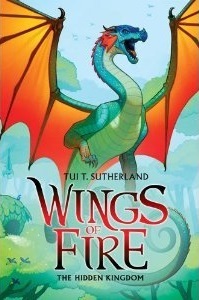
Wings of Fire 3: The Hidden Kingdom

16100976Wings of Fire Book Three: The Hidden Kingdom* by Tui T. Sutherland

I read it as a: paperback

Source: my daughter’s own collection

Length: 336 pp

Publisher: Scholastic Press

Year: 2013

This is the third book in the Wings (snerk. I mistyped it wongs. I am amused. And, apparently, 12) of Fire series, this time focusing on Glory, the RainWing. The dragonets have decided to travel to Glory’s home in the rainforest to find her tribe, the RainWings, and see if they might be prevailed upon to help them in their quest, or at least shelter them from the SeaWings who are pissed off and chasing them from the previous book. When they get there, they discover that “lazy RainWings” isn’t a euphemism applied to Glory by their mean jailers, it is a breed trait. The RainWings generally know nothing about the land beyond the rainforest, don’t care about anything beyond napping, can’t even read, and basically have nothing much going for them. Nor do they notice or apparently care that various members of their tribe are going missing. Incensed, Glory and the other dragonets decide to find out what is happening and discover magical tunnels, like mini wormholes, that take them in an instant from the rainforest to other parts of the world. One of those takes them directly to SandWing territory, and another to NightWing territory. Glory herself becomes a prisoner after using herself as bait, but makes her escape with the help of a spunky baby dragonet, Kinkajou, and returns to the rainforest to challenge the current queen for the throne.

This was a decent entry in the Wings of Fire series. They are all pretty entertaining so far, for kids’ books, though to date, nothing has managed to come close to my love of the Dragonriders of Pern. But my daughter is enthralled with this series and wanted me to read them, so I am reading them to please her. I remember wanting my mom to read the books I loved when I was little, so I am happy to do the same for my own child.

Anyway. This book focused mainly on Glory as she learned about her tribe, the RainWings. They are perhaps not lazy, more like indifferent to the outside world, ignorant, and irresponsible. It’s like they’ve mentally arrested at the development level of young children, or Republicans but without the generally wilful meanness. They just don’t do things they don’t want to, or that sound boring, or that interfere with their naptime. Glory sees this and is appalled, especially once she realizes that none of them even realise dragons are missing, and no one cares to do anything about it. When she takes her complaint to the Queen, Magnificent, she tells Glory that it’s just a few and there are lots of RainWings, so it’s ok. Glory uses herself as bait to get kidnapped so she can find out where the missing dragons are, gets one tiny dragonet out (with help from said dragonet and Clay), and then challenges the Queen.

Glory develops a lot in this book. She learns to be more empathetic – or else she always was and it just shows more here. When she uses herself as bait, she makes sure to do it in such a way that protects her friends as much as possible. When she challenges the queen, she relies on the RainWings who have helped her to win the throne, which she couldn’t have done if she had used her prophecy friends. She learns to trust people other than herself and rely on people to do their jobs for her when she can’t do it herself. I think that is a good lesson for kids, and for adults as well: we can’t always do everything ourselves, sometimes we need help from our friends, and it’s absolutely fine not to know everything or be able to do it all on our own.

The other dragons are less of a feature, though Kinkajou was sometimes cute and a solid ally. Jambu was as well, though rather annoying. The prophecy dragons were mostly an afterthought in this one and played little role in the plot overall, which may not appeal to major fans of those characters. For myself, I am somewhat indifferent to them and don’t have a favorite, so this wasn’t a problem to me. The story was fine and the resolution of the challenge to the queen was satisfying.

However, there were several unfinished plot threads that I found a bit irksome. I hope they are picked up in book 4 because it would be sloppy otherwise, more so than in the previous book with a couple abandoned plots there. Maybe everything will tie together in later books. This is why I get bored with long series. I like a good, tight plot, dense and intricate but still resolved in two or three books. After that, super long series just become like Grey’s Anatomy or Game of Thrones – bloated and unending and just carrying on for the sake of seeing how much more the writers can wring out of it before sending it to a sad and meaningless death. Hopefully that doesn’t happen here. Sutherland seems a talented writer, so I remain hopeful that she hasn’t forgotten the plots she left behind and will tie them up neatly in the rest of the books.

*Amazon affiliate link.

book review · historical fiction · Medievalism

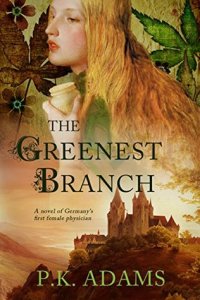
The Greenest Branch

40331955The Greenest Branch: A Novel of Germany’s First Female Physician (Hildegard of Bingen)* by PK Adams

I read it as an: ARC

Source: my own collection

Length: pp/time

Publisher: Iron Knight Press

Year:  2017

In the early 12th century, a young girl was given as a tithe to the church with the intention that she would be enclosed as an anchoress at the abbey of Disibodenberg. That girl was Hildegard, known to history as Hildegard of Bingen. This novel tells the story of her early years at the abbey of Disibod and attempts to fill in a gap in the historical record.

Author PK Adams does a lovely job bringing a young Hildegard to life with her clear and elegant prose. The setting of the medieval Rhineland is well described and gives readers a vivid image of life during the Investiture Controversy. The conflicts brewing between the Church and secular authorities were complex and distressing to people at the time, and Adams captured these emotions plainly in her characters.

I have, at times, railed against authors of historical fiction who take liberties with historical fact for the sake of telling a story. I think if they can’t tell a good story without embellishing the facts then they aren’t good storytellers. However, Adams has found a sweet spot with regard to Hildegard’s story, and she’s run with it. Little is known about Hildegard’s life after she initially entered the abbey until Jutta’s death. Adams uses that gap in knowledge and creates a detailed and plausible version of her own, enhanced with excellent and accurate details of medieval life. We may not know about what Hildegard’s life was really like for a number of years, but this novel presents us with a viable option for consideration.

Adams wove in many lyrics from Hildegard’s songs, which was a nice touch. A vital touch, in my opinion. I don’t think one should write about Hildegard without including some of her songs, given that she wrote SO MANY of them. I do wish there had been more about herbology, such as recipes she might have used, but that’s just because I am super interested in herbalism. There was enough on that front to appeal to most readers who aren’t as interested as I am, I believe.

The characters are nicely developed overall. I would like more development with Helenger; right now, he just seems like the flat archvillain, mean just for the sake of being mean. I would also like more development with Volmar, particularly since he played such a large role in Hildegard’s real life. Maybe that will be in book two. The issue with Jutta and her bodily mortification left me a little wanting – I wanted to know more about Hildegard’s thoughts behind it. But overall, these were minor issues and didn’t impact my enjoyment of the book as a whole.

I am excited that I don’t have to wait to read the next in the series – thanks, Netgalley! It will be interesting to see how the next book handles the later parts of Hildegard’s much more well-documented life. Hopefully, Adams will continue Hildegard’s story with the same eye for detail as she has begun.

*Amazon affiliate link.

book review · books

Get Well Soon

34443962Get Well Soon: History’s Worst Plagues and the Heroes Who Fought Them* by Jennifer Wright

I read it as an: audiobook

Narrator: Gabra Zackman

Source: my own collection

Length: 07:44:00

Publisher: Audible Studios

Year: 2017

Get Well Soon is all a brief overview of several of the worst/ scariest/ grossest diseases in recorded history. Each chapter deals with one disease or condition and written with what is obviously a shit ton of research to back it up. Also, lots of gallows humor and pop references, to keep you entertained.

It should come as a surprise to absolutely no one who knows me that I LOVED this book. I mean, I know am I morbidly obsessed with the bubonic plague. Seriously. I’ll read anything about the plague. But this book? It was hilarious! I get that a book about horrific diseases shouldn’t, maybe, be classified as “hilarious,” but too bad. If you can’t laugh inappropriately at things, then I am not the person for you to hang out with. We won’t make good friends. This is one of my favorite nonfiction books ever. The writing is engaging, not sophomoric as one wet-blanket reviewer suggested. It is fun, and the use of pop culture references, even older ones, keeps readers reading. Given the gnat-like attention span many people have now (thanks, social media), keeping their attention focused is a good thing. It helps people learn. Learning is fun. I learned that smallpox is hemorrhagic. And that “boo-boo” likely derives from “bubo,” though I already knew not to kiss a bubo to make it better. I teach fairy tales and folklore, so I found the connections to those stories and encephalitis lethargica to be fascinating. Also, this should be required reading for all anti-vaxxers.

I listened to this on audio book, and I have to say the narrator was not my favorite. She had this weird way of starting a sentence sounding sort of nasaly/ raspy, like Kate Mulgrew, and then ending the sentence in a normal tone. It was worse when she was quoting someone. It was annoying AF. But the content of the book itself was so good that I did my best to ignore the narrator’s voice.

Seriously, go read this. You won’t regret it.

*Amazon affiliate link.

book review

The Curious Incident of the Dog in the Night-Time

521953The Curious Incident of the Dog in the Night-Time* by Mark Haddon

I read it as an: audiobook

Narrator: Jeff Woodman

Source: my own collection

Length: 06:02:00

Publisher: Audible Studios

Year: 2003

Christopher Boone likes to go walking at night sometimes. On one of his nightly excursions, he encounters Wellington, one of the neighbor’s dogs. Wellington is dead, killed by a garden fork. This is puzzling to Christopher, who likes to understand why things happen and likes it when rules are followed; Wellington should not be killed with a garden fork. He decides to discover who killed Wellington and begins “detecting” like Sherlock Holmes, asking his neighbors rather uncomfortable questions. In the process, Christopher uncovers many more truths than he ever expected to, and now he has to learn how to live with the consequences of those truths.

This was a sweet coming of age story, told from the perspective of a boy who is on the autism spectrum. Christopher is highly intelligent and is gifted in math – he is going to take his A-Level maths exams later in the book so he can attend university. But he doesn’t know how to buy a train ticket without help. He doesn’t understand humor. He can’t tell a lie and doesn’t understand why you must always tell the truth but can’t tell an old person they’re old or a smelly person that they stink. I loved that he says metaphors are lies, but similes aren’t, and that he hated yellow and brown but red was the best. I really loved his thoughts on logic and reasoning and religion. Getting the story from his perspective is a wonderful change of pace from the typical narrator. I listened to this on audio book, so I didn’t see any of the diagrams that I think were in it. But I did enjoy figuring out before it was explained in the story that the chapter numbers were prime numbers. If you know how good I am not at math, you will know how impressive that is. I was rather proud of myself.

Seeing Christopher’s growth over the course of the book was wonderful. He learns that he IS able to do far more than he ever thought he could or would be able to do. He figures out a soul-shattering secret that has been kept from him and it sends him into a spiral of confusion, anger, and pain. Fleeing to London, on his own for the first time, Christopher learns that he is capable of much more than her ever knew.

I also thought the way his parents were portrayed was probably pretty realistic. I don’t have an autistic child, so I can’t imagine how hard it must be. I AM the mother of a very smart and difficult child, though, and know very well how frustrating and exhausting it can be. I wouldn’t change it for anything, but I can maybe understand how some parents would snap after a while. It doesn’t make it right, but it is a human reaction, and I think Christopher’s parents were shown in a very human and sympathetic light.

Highly recommended!

*Amazon affiliate link.

book review · Elizabethan England · historical fiction

Black Death

44597455Black Death (A Tudor mystery featuring Christopher Marlowe)* by MJ Trow

I read it as an: ARC

Source: Netgalley

Length: 224 pp

Publisher: Severn House

Year: 2019

Robert Green and Christopher Marlowe are not friends. But when Green believes someone is trying to kill him, he sends a desperate letter to Marlowe, behind for his help. When Green is found dead, Kit believes it is his duty to discover who murdered Green and so undertakes the investigation. At the same time, stage manager Ned Sledd is wrongly taken to Bedlam in lieu of an escaped inmate just days before the opening of one of Marlowe’s new plays. Marlowe has to find the connection between all these events and help his friend. And also, the Spymaster, Robert Cecil, is taking an inordinate interest in things. And there’s plague. What could go wrong?

This is a short, quick read and like other MJ Trow novels I’ve read, it is a fun and witty tale as well. The plot is full of twists and turns and not all is as it appears. The characters, especially Marlowe, are all multidimensional. I really love the little digs at William Shakespeare (spelled here as Shaxper) throughout and the subtle shade thrown on the authorship of his works. There are many literary gems hidden in these pages that appeal to any Anglophile.

The descriptions of Elizabethan London are also vivid and gritty. So much of that period is romanticized but here, we get the more realistic portrayal of what it might have actually been like – dirty, smelly, and depressing. Oh, and don’t forget the plague!

A fun and fast read, highly recommended for any lovers of Marlowe, Shaxper :-), or Elizabethan English history in general.

book review · books

All This I Will Give to You

43267676All This I Will Give to You* by Dolores Redondo (trans. Michael Meigs)

I read it as an: audiobook

Narrator: Timothy Andres Pabon

Source: My own collection

Length: 18:10:00

Publisher: Brilliance Audio

Year: 2018

Manuel Ortigosa is a writer  living in Madrid. He is hard at work on his next novel, waiting for his husband Alvaro to return from a business trip to Barcelona, when he receives word from police that Alvaro has been killed in a car accident. In Galicia, the opposite side of the country from Barcelona. Manuel travels to the town in Galicia where Alvaro died and learns that his husband was the Marquis of an ancient aristocratic family and Galicia is their ancestral home. Alvaro had hidden all this from Manuel because it seems he felt that his family was toxic and he wanted to shield Manuel from them. Upon his death, however, Manuel learns that Alvaro had saved his family from deep debt, using his own considerable funds to pay back loans and renovate the family homes, which put them in Alvaro’s personal possession, and thus he bequeathed everything to Manuel. Manuel is trying to come to terms with the fact that his husband hid who he was from him for the 15 years of their marriage, deal with the family who is indeed toxic, and find out what truly happened to Alvaro because he hadn’t died in an accident – he was murdered. Manuel meets two allies – a recently retired cop and a childhood friend of Alvaro’s, now a priest and Alvaro’s confessor – who aid him in finding out the truth.

This was a nicely complex book and I enjoyed not only the mystery plot but the travel element as well. I’ve never been to Spain, so the descriptions of the settings were some of my favorite parts, irrespective of the rest of the story.

The characters were generally complex and multifaceted. Manuel, the cop, and the priest were the ones I thought were the most multidimensional and complex people, though many of the other secondary characters, such as the family’s nanny, also seemed to have rich personalities.

There were many points of conflict – between Manuel and his husband’s family, between more progressive ideals and traditional Catholic practices, between the newer social order and the ancient traditions of nobility. There were also rivalries and intrigues between the family members as well, dark secrets and infighting. Alvaro was right – his family is toxic and he did well to keep Manuel from them. It would be exhausting to have to deal with a family like that.

I listened to this on audio book, so I have no idea how to spell some of the names, like the name of the cop friend, or the name of Alvaro’s family home. In any case, I think I would have preferred to eyeball read this one. I had picked up the audio book because it was a daily deal on Audible, but I didn’t care for the narrator. He did all right but I didn’t think he did a great job differentiating between characters. I had a hard time telling when it was supposed to be Manuel speaking and the cop, for example. His reading of women’s voices was pretty awful, though at least he didn’t make them sound like vapid cows like some male narrators do.

I loved the last line of the book SO MUCH. It is one of my favorite last lines ever now.

book review · historical fiction · Medievalism

Age of Saints

43925261Age of Saints: Druid’s Brooch Series: 7* by Author

I read it as a: galley

Source: Helen Hollick at Discovering Diamonds

Length: 240 pp

Publisher: Tirgearr Publishing

Year: 2019

Connall had promised his father that he would take care of Lainn, his little sister. Then his father went away and Connall, despite his best efforts, failed spectacularly in every way to uphold his promise. He and Lainn endure an abusive stepfather; a neglectful mother; starvation, terror, imprisonment, and torture in the land of Faerie; and literal insanity in both human and fey realms. Connall tries to draw on the power of a magic brooch, passed down through his family for generations, to help him and Lainn survive, but in doing so, is he saving them or only delaying the inevitable?

This is the seventh book in Christy Nicholas’s Druid’s Brooch series, and as with the others, it can be read as a standalone. I have read most of the others in the series and with each installation, I appreciate anew how well Nicholas crafts her characters. Each one has depth and vision to them, even minor characters who are only on the page a moment.

Equally appreciated is Nicholas’s deep understanding of Irish legend and lore. Her books are rich with these, and they bring the culture and people within the pages to brilliant life. This novel features the early days when the old ways of the Druids and the new ways of the Christians were still able to live together peaceably, though by the end of the book, the two religions were showing the strain. The Age of Saints refers to the 5th and 6th centuries when the Church was working especially hard to convert the Celtic countries, often using converted Celts to do so, such as St Patrick or Columba, who is referenced in this novel. It was interesting to see the interplay between the two cultures in this way.

I also loved the theme of protection that wove throughout the book. Connall cares for and protects Lainn as best he can, even when he fails utterly. He tries to keep his father’s words in mind as a way to protect himself as well, because at the end of the day, Connall is still a very young man, still in need of protection himself in a variety of ways. He learns how to protect himself, but also how to accept it from others when needed. The raven companion provides protection of a sort as well, and teaches a hard lesson. Connall protects his mother even when he doesn’t really want to. Even though most of the hardships in the book were because of a bad decision he made, Connall was still a sympathetic figure. He honestly did what he thought was best, or at least tried to. He never did anything out of maliciousness, just out of simple naivety or lack of experience, and he never whined about it, unlike some characters in other books. He Had his issues and his flaws, and he had an epic meltdown at one point, which I think was entirely understandable, but he was not an unsympathetic figure at all. He just needed someone to protect him but he had no one to do that, and so he did the best he could.

I also liked the exploration of his sexuality here, and how he was concerned about how Christians would think of him as sinful or unnatural to want to lie with another man, but the Druids had such members within their ranks and thought nothing of it. The conflict in him didn’t feel forced, like Nicholas was just trying to do something new or make a point. It was nicely done and flowed well within the narrative of the story.

One of the things I really love about this series is that it works in reverse time – the books begin in a more recent time and are gradually working back toward a time when the magic is newer and closer to the surface. I hope that, in the final installment of the series, readers will finally understand the genesis of the story, the event that caused the brooch to be given to the humans from the fey, and to see the full circle of all the novels in the series thus far. It has been a finely crafted series to date and I look forward to reading more. Highly recommended.

*Amazon affiliate link.