book review · sci-fi

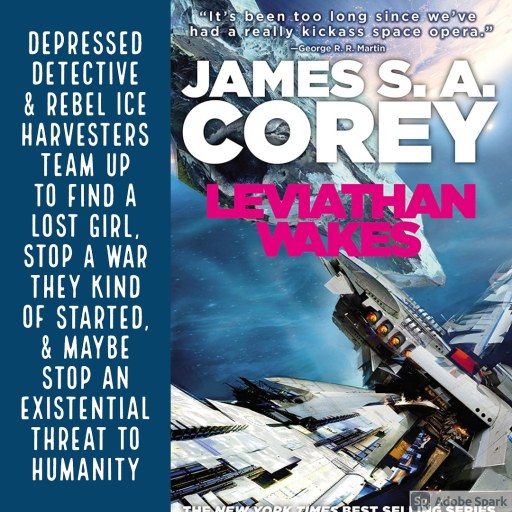
Leviathan Wakes (The Expanse #1)

leviathan wakesLeviathan Wakes by James S.A. Corey (Website, Twitter)

Genre: sci-fi

Setting: spaaaaaaaaaaaaaaace!

I read it as a(n): paperback

Source: public library 

Length: 572 pp

Published by: Orbit (2 June 2011)

Her Grace’s rating: 4.5 out of 5 stars

In the future, humans have colonized the solar system but we’re not cool enough yet to have warp drive or be able to get out of the solar system. Instead, we have a complex system with the inner planets of Earth, Mars, and Earth’s moon Luna, living in relative safety and security. Then there are the Belters, the people who have lived and worked in the asteroid belt for generations. Belters are taller, lighter, tough folks used to living in microgravity. Economy is based on selling air to space stations and colonized asteroids, foodstuffs to the Belt, water mined from Saturn’s rings and other asteroids. Mars and Earth have a tense political and military relationship. Most of the inner worlds ignore the Belt. And now there’s a young woman missing in the Belt who may or may not be the center of a terrible secret that has the power to kill billions.

Detective Miller is assigned to search for Julie Mao. Jim Holden is the executive officer of an ice miner. Their paths cross in some truly weird ways as they track Julie and this awful new evidence of extraterrestrial life all over the Belt and back. The ship Holden is from gets blown away to prevent them from telling the truth. Miller gets canned to prevent him from finding Julie. Everyone really likes to shoot first and ask questions later. 

This novel is, in a nutshell, a fucking awesome space opera. I have been on a big sci-fi binge lately anyway, but I am not sure how I missed this series before. I saw that there is a show based on the books and I had the thought to watch it. But books are always better so I figured I’d try it. If I was bored with the books, I planned just to watch the show. Instead, I blew through this doorstopper in just a couple days. Now I’m on the second book and almost finished with it. 

Anyway. The characters are maybe a tad stereotypical. A depressed, down on his luck detective. An unruly XO who sympathies with rebels. A girl from a rich family who gives it all up for her political views. Lots of stereotypes. But at the same time, they were well developed and very different. I enjoyed getting to know them and see how they intersected with one another’s stories. I loved the idea of basically two kinds of humans in conflict with each other in the solar system rather than humans vs aliens. 

I also loved the culture of the Belt. They have their own patois and even though I’m usually really good at figuring things out on context, even I had a hard time understanding what some of the true Belters were saying. I thought it added a layer of complexity and grit to the story overall. I loved that the Belters all really did live in the asteroid belt, that they develop differently because they don’t live in a gravity well like on Earth. The stations were vividly described to the point where I could see the crowds of people on Ceres Station, hear the hiss of air circulators, feel the way the gravity changed in relation to how close you were to the center of the spin. It was just a really fun read. I doubt the show can live up to it, though I still plan to watch it once I read all the books first. 
book review

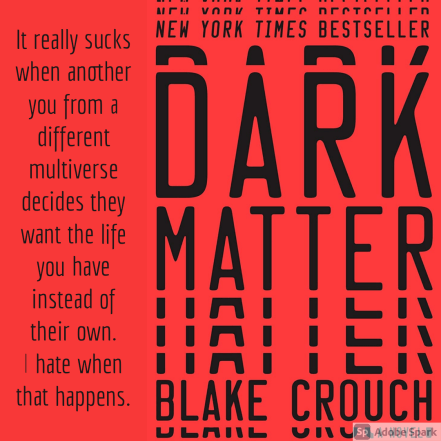
Dark Matter

Dark Matter by Blake Crouch (Website, Twitter)

Genre: sci-fi

Setting: several different variations of Chicago

I read it as a(n): hardback

Source: my own collection / BOTM Club

Length: 342 pp

Published by: Crown (26 July 2016)

Her Grace’s rating: 4 out of 5 stars

Jason Dessen is a physics professor at a small college in Chicago. Years ago, he’d had a promising future as one of the brightest young scientists in the world. He gave it up, though, in favor of living a quiet life and making a family with his wife. Then, he gets abducted and ends up in an alternate Chicago, looking at an alternate life. Now he has to figure out how to get back to his actual life in his own reality – or decide if he even wants to. 

This was a fast-paced, fun read full of “what ifs” and hypotheticals. It makes you think about the choices you make in your life and ponder the consequences of having chosen one way over another. What happens if you, as Jean-Luc Picard once did, start pulling at the threads that make up the tapestry of your life? 

akata warrios

Akata Warrior by Nnedi Okorafor (Website, Twitter, Insta)

Genre: fantasy

Setting: Nigeria

I read it as a(n): paperback

Source: my own collection 

Length: 477 pp

Published by: speak (3 Oct 2017)

Her Grace’s rating: 4.5 out of 5 stars

Sunny Nwazue is a Leopard Person, AKA Nigerian witch. In the aftermath of defeating the evil masquerade Ekwensu, Sunny is spending her time studying with her mentor and learning how to read her magic Nsibidi book. She soon learns of an existential threat to humanity, centered in the town of Osisi, which exists both in reality and in the invisible spirit world. Sunny goes on a quest to save mankind, aided by her friends, Orlu, Chichi, and Sasha, and her spirit face, Anyanwu.

Okorafor’s characters are ALL delightful and well developed. I fucking love Sunny and her friends, and am fascinated by the intersection of history, myth, and folklore that these books portray. The adventures and challenges Sunny faces are crazy fun to read and show kids overcoming obstacles, learning to be independent, becoming supportive friends, and strong leaders. Love it! Rumor has it that there’s a third book in the works for this series; I really hope that is true and that it will come out sooner rather than later. 

Eleanor Oliphant

Eleanor Oliphant is Completely Fine by Gail Honeyman

Genre: contemporary literature

Setting: London

I read it as a(n): hardback

Source: my own collection / BOTM Club

Length: 327 pp

Published by: Pamela Dorman Books (9 May 2017)

Her Grace’s rating: 5 out of 5 stars

Eleanor Oliphant is a woman struggling with other humans. She appears to be on the spectrum, is highly structured, dislikes being touched, and generally prefers her own company. Sometimes I wonder if I, too, am on the spectrum. I identified with Eleanor in some very uncomfortable ways. Anyway, a wrench is thrown into her routine when she meets Raymond, an IT guy at her work who insists on befriending her. They share a further connection when they both assist an elderly man who faints on the sidewalk. That connection impacts them both in ways no one could have predicted. I don’t mean romance. That’s boring and predictable in most books. This isn’t that.

I loved this book. One of my top reads of 2021 so far. Eleanor has a terribly sad history, which readers piece together slowly with tidbits of information parsed out over the course of the book. Raymond is a proper good guy you can’t help but like. The novel is about the various ways we can destroy ourselves but then usually we get by with a little help from our friends. 

Girls in the Garden

Girls in the Garden by Lisa Jewell (Twitter, Insta)

Genre: mystery, I guess

Setting: London

I read it as a(n): paperback

Source: my own collection 

Length: 313 pp

Published by: Atria (2 July 2015)

Her Grace’s rating: 2.5 out of 5 stars


This was a solid meh for me. I enjoyed it well enough to finish it, the writing was fast paced and held my attention. But it maybe wasn’t a mystery? Especially since the answer is literally in the title? I figured this out like in chapter two; I think it would not come as a surprise to anyone who has been or lived with teenage girls at any point. Teen girls can be real assholes. 

That said, I didn’t hate this book at all. Just wasn’t surprised. I do plan to read other books by this author. Maybe if there are ones that aren’t centered on teenage girls, those will not be as easy to solve. Plus, if they’re all set in Britain, I’m down for that. I’ll read just about anything set in Britain.

Love After Love

Love After Love by Ingrid Persaud (Twitter)

Genre: contemporary literature

Setting: Trinidad and NYC

I read it as a(n): hardback

Source: public library 

Length: 327 pp

Published by: One World (4 Aug 2020)

Her Grace’s rating: 5 out of 5 stars

Betty Ramdin is a young widow raising her son, Solo, on her own. Like, solo. In need of a little extra income or help, she takes on a boarder, Mr. Chetan. The three of them become their own unique little family until one day, Solo overhears his mother telling Mr. Chetan her darkest secret. Solo, like the little shit he is*, takes off to NYC to live with his paternal uncle as an undocumented immigrant. Mr. Chetan becomes the glue that tenuously holds the family together, until his own secret comes to light.

I read this for my book club, which is good because on my own, there is no fucking way I would have even looked at a book titled Love After Love. It sounds like a romance. I do not do romances. I’m glad I read it because it is on my top books of 2021 now. All the characters were richly developed, even if they were little shits. It was also interesting – and sad, sometimes – to see a glimpse of life in the Caribbean. Would definitely read more by this author!

*Solo isn’t a shit because he is undocumented. I am in favor of granting amnesty and Social Security numbers to everyone who wants to be here who doesn’t otherwise break the law. Solo is a shit because he is a spoiled, myopic asshole who could use a good ass-kicking.

book review · books · sci-fi

Interdependency

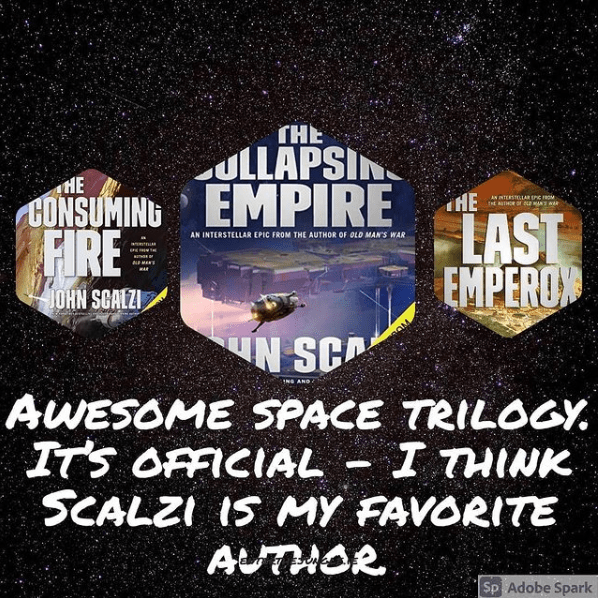
The Collapsing Empire, The Consuming Fire, The Last Emperox (The Interdependency) by John Scalzi (Website, Twitter)

Genre: sci-fi

Setting: spaaaaaaaaaaace! And various habitats, space stations, and occasional planets

I read it as a(n): audiobook

Narrator: Wil Wheaton

Source: my own collection 

Length: 9:24:00, 8:19:00, and 8:07:00, respectively

Published by: Audible Studios

Her Grace’s rating: 5 out of 5 stars, both for each book and for the series as a whole

In Scalzi’s Interdependency trilogy, humans have managed to colonize a lot of the galaxy. They do not do this, however, through the use of any sort of FTL or warp drive. The laws of physics prevent that. They do, however, have something called the Flow, which sounds a little like wormholes through which a ship can travel and arrive at a location in a matter of days, weeks, or months, depending on distance. Ships can only enter or exit at Flow shoals, and the Flow streams only go one direction. So if a Flow stream goes from Hub, the Capital of the Interdependency, to End, the one planet that supports human life and which is at the farthest reach of the Flow streams, then they need to use a different stream from End to get back to Hub. 

Oh, and the streams are beginning to collapse.

This is a problem because, as the title implies, every human habitat is interdependent upon each other for survival. The places where humans settled are all, with the exception of End, not compatible with human life. They’re either on tidally locked moons and planets, too hot or too cold to survive, or on space habitats in orbit somewhere. The Interdependency is organized around Guild Houses, each of which have a monopoly on a certain aspect of manufacturing things needed to sustain life. Once the Flow streams collapse, everyone will be well and truly fucked. 

Enter an inexperienced Emperox, Cardenia Wu Patrick (Imperial name Greyland II), a young woman who was never supposed to be Emperox and only became so when her half brother the Imperial heir died in an “accident.” The various noble Houses think this will be a good thing because they expect to be able to manipulate her. The main houses of Wu (the hereditary Imperial house as well), Lagos, and Nohamapetan, are the political powerhouses and are out for blood and profit. Also, I listened to these, so I may be WAY off on how the names are spelled. Just saying.

The Houses of Lagos and Nohamapetan are particular enemies. On one run between Hub and End, Kiva, the Lagos representative to the Guilds, learns that her House’s entire crop on End had been sabotaged and she naturally suspects the Nohamapetans. Having just spent 9 months in the Flow traveling to End, Kiva is righteously pissed because now she will have spent the best part of 2 years on a trip that is profitless. Kiva soon learns, however, that there is something wrong with the Flow and she ferries a young noble and Flow physicist, Marce Claremont, back to End to meet with the Emperox and come up with a plan to save the billions of people dependent on the Flow for survival. She also comes up with a way to make money on an otherwise failed venture, as one does. 

There’s a lot of politics in this story, but Scalzi makes it fun! Kiva is definitely my favorite character. She’s so thoroughly outspoken and rude and it’s just delightful. She’s also crazy skilled at strategy and politics and is the best person the Emperox could possibly have in her corner. Cardenia is sweet – on the outside. Then she manages to deflate the machinations of everyone conspiring against her, which is especially fun when she hamstrings the Nohamapetans. Really, the characters in this series are the best thing about it. Yes, the overarching story is bomb, and is very Scalzi-ish. But, as Renay Williams wrote, the central characters are all women, and they’re all truly awesome in their own ways. 

Also, the trilogy covers a lot of ground that lovers of sci-fi space operas will appreciate seeing, happily updated with a lot of modern thought, because actual colonialism is gross. There’s far-flung human colonization, empire, the ways in which all these things are connected and, like, interdependent on each other. It is really a good commentary on a lot of our actual current events and politics. I have screamed for years that sci-fi is the ideal medium in which to discuss and analyse current events; Scalzi’s trilogy is further proof. 

As I mentioned above, I listened to The Interdependency trilogy on audiobook. Wil Wheaton did a phenomenal job narrating. I honestly think it is one of his best performances. His timing and tone were spot on and turned elements of the book that were already amusing into laugh out loud hilarity. I loved listening to these books so much that when the third one ended, I wanted to start the series all over again. I didn’t, only because I have so very many audiobooks to listen to that I haven’t even touched yet. But I did go and buy the trilogy in paperback, even though I swore I wouldn’t buy any more books until I get through more of my TBR and cull ones I know I’m not going to read ever again. 

I can’t wait to read these again, and I can’t wait to see what Scalzi publishes in the future. If you haven’t read, or even better, listened to, this series yet, you are really missing out!

book review · sci-fi · Star Trek

Star Trek Discovery: Wonderlands

Disco WonderlandsWonderlands by Una McCormack (Website, Twitter)

Genre: sci-fi

Setting: spaaaaaaaaaaaace!

I read it as a(n): paperback

Source: my own collection 

Length: 333 pp. It’s only half evil.

Published by: Gallery Books (18 May 2021)

Her Grace’s rating: 4 out of 5 stars

Remember in the first episode of Discovery’s third season? When Burnham came plummeting out of the sky and figured out she made it nearly 1000 years into the future and her mission to stop Control from annihilating sentient life was successful? And she landed practically on Book? Then there was that year-long jump between the first and second episodes? Remember that? This is the story of that year in between. 

Michael Burnham is lost and alone in more ways than one at the beginning of this book. She’s almost a thousand years into the future from her point of view, the Federation is shattered, and Starfleet is more a figment of the imagination than a real institution. The economy is money-based and everyone is looking out only for themselves. Philanthropy on any appreciable scale is nonexistent and there are violent wannabe kings of local regions, plotting and betraying and backstabbing their way to the top of the pile. In other words, the polar opposite of the society Burnham is accustomed to. And the Discovery is nowhere to be found.

Circumstances naturally dictate that Burnham adapt to her new environment, and she does, though reluctantly. She convinces Book to help her get on her feet and get the lay of the land. She gets herself a tiny, tiny little ship of her own. She finds a Starfleet holdout in the form of one Aditya Sahil, the de facto commander of Starbase Devaloka. Burnham, being who she is, manages to browbeat everyone into at least trying things her way sometimes, just for kicks, and usually they are pleasantly surprised. It is a nice little lesson in playing nicely with others. 

This was also a rather sad book. Not sad as in pathetic. Sad as in fucking sad. She misses her chosen family, her friends, her society where everything really was better despite the Klingon War. She misses knowing the basics of technology, even though she’s the quickest study ever and gets up to speed in a flash. She misses her ship. It is an interesting commentary on how we contemplate the future. Star Trek is known for its optimism. Discovery has, from the start, turned that optimism on its head; that very darkness is why I love this series so much. Utopia doesn’t happen overnight. It isn’t without its struggles. Without that darkness, how would we ever know the light or the good? To me, that is what this series is good at – showing the good that is possible even if it isn’t there yet. 

I even wrote about this very thing about a year and a half ago for StarTrek.com. See? This Is Why Starfleet Needs Gabriel Lorca. *I* wrote it first, not that individual from Den of Geek who apparently read MY article, nicked my idea, and rewrote it a couple months ago. Fuck her.

Anyway.

There were several smaller missions, or side quests if you like, throughout the novel. Burnham (and usually Book as well) go off on various aid missions to give help to various groups. Very much in line with Star Trek ethics. I wish these could have been longer, or had a standalone book devoted to them like in the good old days of numbered Trek novels. But I suppose, because this was only one book, those side quests had to be truncated for the sake of expediency.

It is ok, though, since the novel’s true strength is in its character development. So far, all the Disco books, actually, have done a brilliant job at giving us the character development and back stories we know and love from other Trek series. I loved getting to see how Michael grew and changed in her new time, and how she tries to change it as well. I loved getting to know Book a little better. And Grudge is certainly the best character in the whole thing. 

I think the overarching theme in this story is that, when you can’t go home or have no home to go to, then you make a home as best you can, with the best people you can find to gather round you. 

Favorite part/ lines (potential spoilers!):

“They’re not doing anyone any harm.”

“Mostly harmless.” He laughed. “There are worse epitaphs, I suppose.” 

[High five to McCormack for that nod to The Hitchhiker’s Guide…! 😀 ]

book review · sci-fi

Neuromancer, and other stuff

I have been neglecting my blog a lot lately. Reading slump 1, me 0. I think I DNF’ed more books in March and April than I did in all of 2020. And then the ones I’ve finished, I haven’t really written reviews for. Oh well, I’ll get back to my usually scheduled program soon enough. The crowd, I’m absolutely sure, will go completely indifferent. 

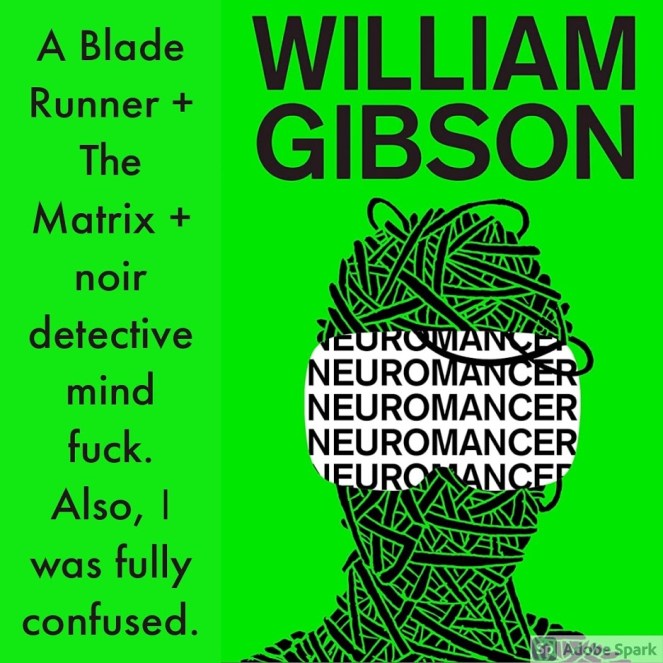
So. Neuromancer. I read this years and years ago and I do not recall being so utterly confused by it at that time. Maybe I was just cooler then. Though I’ve never been cool, so I doubt it. Maybe I only thought I read it and never did. That seems like something I’d do. But I am morally certain I read it. In any case, I can’t dislike a book that literally invented the term “cyberspace.” Even my granny knows what cyberspace is, and it started with this book. I generally love cyberpunk, but I think it was Gibson’s writing style itself that put me off. I don’t want to call it word salad, but it’s so full of invented jargon that it might as well be in parts. And then he goes in with the synesthesia and totally lost me. I do not care what blue tastes like and I’m pretty sure the rainforest glass came about after a long, bad trip of some kind. Plus awfully flat characters. But I still liked it and I really don’t know why?

My IG post sums it up better than any actual review I could write:

Neuromancer IG

book review · sci-fi · Star Trek

Star Trek TNG: Collateral Damage

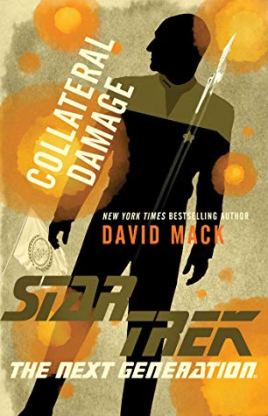
ST TNG Collateral DamageStar Trek TNG: Collateral Damage by David Mack (Twitter)

Genre: sci-fi

Setting: spaaaaaaaace! And Starfleet HQ in San Francisco

I read it as a(n): paperback

Source: my own collection 

Length: 368 pp

Published by: Gallery Books (8 Oct 2019)

Her Grace’s rating: 3 out of 5 stars

In this installment of the continuing adventures of the Enterprise crew, we find Jean-Luc Picard facing something like a military grand jury to decide whether or not to court martial him for his actions in coercing the Federation’s president to resign. So he and Crusher are on Earth, dealing with lawyers. Yaaay. Meanwhile, Worf is in command of the ship and they take off to answer a distress call from a research base. The base had been attacked by Nausicaans and the dome over the base is melting because of the extreme heat of the sun. Geordi and his engineers have to figure out how to keep the dome intact until the sun goes down, which happens every 6 days by Earth-standard. Throw in some Nausicaans with a planet-killing weapon and a major desire for vengeance, and a man from Enterprise’s past who seems to throw a wrench in every plan and you have yourselves a story.

So Picard is facing the music at SFHQ for his role in the events leading up to President Zife’s forced resignation and subsequent murder. Whoops! That wasn’t very friendly. Of course, Picard mostly gets acquitted, and his lawyer did a good job proving how Picard was not at fault for the actions of his superior officers. However, I had a weird experience while reading this that I never thought I would feel towards Picard. One of the charges against him is sedition. Even though this book was published in 2019, I just now got around to reading it. The sedition element made it more visceral for me, considering the insurrection of January 6, 2021 at the US Capitol. If Picard acted in a manner even remotely similar to the inbred, mouth-breathing, Trump supporting insurrectionists, then he deserves to have the book thrown at him and spend the rest of his life in prison. I cannot recall the events that initially led to him being charged, though I remember being somewhat bored by that particular book. Also, in a way, Picard is like the Trump of Starfleet – he often breaks the rules and sometimes an admiral will yell at him for it, but mostly he gets away with everything. I didn’t like realizing that similarity at all because Picard always acts in the best interest of others, and the orange guy never does. It is still an uncomfortable realization. However, Picard’s lawyer did a good job rehashing things to give a thorough background. It became clear that he was truly unaware of the actions and results of his superiors, that he had been used as a scapegoat, and was subsequently off the hook. But still, I am conflicted about the entire thing. It’s fucked up.

The storylines with Worf and Geordi were classic Trek and a great deal of fun. It shows how much Worf has grown as a person because there were several times when he wanted to rip someone’s lungs out through their spine but he refrained. He even put on his diplomat hat and got two separate peoples to agree to a mutually beneficial arrangement, even though they were bitterly opposed to both the agreement and each other initially. 

Geordi is always a fun character to focus on, and his subplot was no less fun. He gets to save 66,000 people by preventing them from melting! That alone is worth a read. No melting people! 

Throughout both Worf’s and Geordi’s storylines, we get reunited with Thadiun Okona, who made his debut in the TNG episode “The Outrageous Okona” in season two. He’s had an…interesting…couple decades between the events of that episode and the events of this book. Life takes you in some weird directions sometimes. Ask Okona about that. He can tell you. 

It’s been a long time since I read a Star Trek novel, so maybe I’m just out of practice. But this one felt almost like an old fashioned numbered MMP that they used to make for the literary Trekverse. I miss those days bad; each book was a standalone story similar to an episode, not one part of a giant story arc where you’re completely lost if you miss reading a book. I get really tired of that kind of story, to the point where I am thinking maybe I won’t bother buying new Trek books unless they really are standalones. I also think the books should be canon. When we’ve gone years and years without any new Trek series and all we had were the books, it is kind of jarring when the new shows don’t align with the stories we’ve been given in prior years via the novels. The authors are all extremely well-versed in Trek lore, they’re not just making up random crap, so it just seems like the novels ought to be considered canon.

Anyway, this was a pretty fun book and it was good to see some other characters who’ve made appearances in the Trekverse at one time or another. 

book review · sci-fi

Ready Player Two

Ready Player TwoReady Player Two by Ernest Cline (Website)

Genre: sci-fi

Setting: mid-21st century Columbus/ the OASIS virtual reality

I read it as a(n): I switched back and forth between audiobook and hardback

Narrator: Wil Wheaton

Source: my own collection / Xmas gift (hardcover)

Length: 370 pp/ 13:46:00 hours

Published by: Ballantine Books (24 Nov 2020)

Her Grace’s rating: 4 out of 5 stars

Ready Player Two is the continuation of Cline’s earlier novel, Ready Player One. It picks up just a couple years after the end of RP1 and shows how Wade Watts (Parzival); his best friend, Helen Harris (Aech); Samantha Cook (Art3mis); and Akihide Karatsu (Shoto) have come along since Wade won the hunt for Halliday’s Easter Egg in RP1. The four are now the governing board of the company that created and runs the OASIS, the virtual reality software that basically everyone on Earth uses to get away from the shitty existence of reality. Added in to the mix now is a new technology hidden in Halliday’s inventory that makes it so there is no distinction between the OASIS and the real world. This time, however, flaws in the system have the potential to become fatal. Wade et al. are now on another quest to find another sort of Easter Egg that which will either bring everything back to normal or result in the deaths of millions of OASIS users. 

RP2, though not as good as RP1, was a fun read. I liked the way the four friends had grown and evolved since they won Halliday’s fortune. Not all was peachy between them. Wade and Samantha had fallen in love but then broke up prior to the beginning of this book. She felt he was going in a wrong direction and stuck to her guns and in the end, it wasn’t a relationship they could sustain. Wade was well on his way to becoming another Halliday – addicted to the OASIS, in VR far more than the real world, growing further away from his humanity. Aech and Shoto were still close with Wade but even among them, things were tense. 

In RP1, there was a theme of the benefits of technology. It could help people escape from otherwise unbearable lives, children could attend free virtual school in a safe environment, and it allowed the economy and trade to flourish. In RP2, we saw the other side of the coin. Yes, technology can be shiny. It can also ruin lives, friendships, and result in global catastrophe if it all goes sideways. I like that this aspect was explored in more depth. Our current plugged-in society could stand to pump the brakes a bit.

There was a fair amount of character growth, mostly for Wade. Of all the group, I think he was the one who was the most in need of some self-reflection and change. As I said, he was like a mini-Halliday – socially backward, hooked on tech, and possibly allowing his new wealth to change him in ways he never expected. It was good to see him get over himself. 

Samantha, too, grew as a person, learning how to go with the flow a little better and compromising when it was necessary. Before, she was more of a control freak and didn’t have a good ability to compromise, which made her character sometimes come across as shrill and demanding. She was right, though. 

There were still plenty of ‘80s references in RP2 to make people of my generation happy. Overall, it was a fun, fast read and I recommend it to other sci-fi fans and children of the ‘80s who are, like me, bitter that we’re not living on the moon by now.

book review · sci-fi · Star Trek

Star Trek Picard: The Last Best Hope

The Last Best Hope (Star Trek: Picard #1)

Star Trek Picard: The Last Best Hope by Una McCormack (Website, Twitter)

Genre: sci-fi

Setting: spaaaaaaace!

I read it as a(n): hardback

Source: my own collection 

Length: 322 pp

Published by: Gallery Books (11 Feb 2020)

Her Grace’s rating: 4.5 out of 5 stars

The Last Best Hope is the story of the mission Jean-Luc Picard led to evacuate Romulans from their home world and nearby planets when their sun went supernova. It is the prequel that forms the foundations of the Star Trek: Picard series. On its surface, it is the story of how one of the most beloved figures in all of science fiction ended his career. Digging deeper, it examines some of the darker aspects of humanity that we all carry.

I confess that I didn’t like the first season of STP very much. I only watched the season once and didn’t care at all for, well, most of it. Not because it wasn’t just TNG rebooted. I neither wanted nor expected that. I think it’s mostly that I didn’t recognize the characters in it. They were too changed, too damaged. I went into this book hoping it would help me like the show better, especially since McCormack is one of my favorite Trek authors.

I suppose it did that. I can understand how it would completely fuck with you to be put in command of THE biggest humanitarian mission in history, only for it to fail. And to fail largely because of politics? Adding insult to injury. Star Trek has always been political. It’s one of the many things I love about it. The Picard series, and this book, are no exceptions. The difference this time is that the politicians here are truly awful, with not the remotest veneer of idealism that they portray in the series. The political leaders of the Federation in this book are concerned with optics, with PR, with the cost to themselves. Councilor Quest is repugnant. She represents, to me, the worst of certain American political parties. I won’t say which but it starts with an R and ends with -epublican. Nationalism and only looking after one’s own interests is such bullshit and yet it’s on the rise. This book takes a look at the potential impact of nationalism, distanced through the lens of sci-fi. There were lots of oblique references to the Trump administration, trumpism, and nationalism. I’m so fucking glad he’s out of office and fuck anyone who gave this book a lower review just because it rightly was critical of those kinds of politics. We should take care of everyone, not just those in our immediate circle.

Picard, in TNG, is an idealist and a compassionate man. But he’s tempered with logic and pragmatism as well. Picard here gets so involved in the mission to save the Romulans that he becomes pretty myopic in his determination to fulfill the mission. If millions and millions of lives were in my hands, I probably would be myopic about my job, too (Actually, no, you could just put me in a padded room and have done with it if that task fell to me). I know some readers felt this Picard was a bit too starry-eyed, almost naive especially with regards to political machinations, but I felt that he was throwing himself headlong into the ideals of what Starfleet stood for. His doing so is the only way I can see to really explain his utter disenchantment with the fleet when the Romulan star blows and he fails in his mission. If he hadn’t been so involved, maybe more of his pragmatism would have prevailed and he would have been able to remain in the service. He still would have been horrified and grief-stricken at the loss of life, but he could have taken that extra distance to realize it was a futile effort from the start and to celebrate the lives they WERE able to save. But he wasn’t, and didn’t, and so railroaded his career, thus setting up the premise for the TV series. 

I do wish there had been more detail from the planets. We got some, but it would have made the story more visceral if we had seen more scenes from Romulus, the effect the supernova had on the citizens. What scenes we do get felt rushed a bit, more told than shown. Not that I want vivid descriptions of dying and suffering people. But it would have been just that much more depth to the story. 

And, maybe not super relevant to the story, but I thought Maddox/Jurati was gross. I can’t remember how her character was in the show so maybe McCormack picked up on something from that and ran with it. But Jurati in this novel was like everything I wouldn’t want to be as a woman. Yes, it’s rad she has a doctorate in robotics and is whip smart. I love that part about her. But she acts like a submissive, insecure little mouse who is desperate for Maddox’s approval, which makes her come off as pathetic. It’s such a big dichotomy, and unlike most of the other women in Star Trek that McCormack has written, and I haven’t figured out why it exists. 

Rereading what I just wrote, it sounds like a negative review. It absolutely is not. I loved this book, but I hated a lot of the people in it. I think that’s a sign of good writing, to make me hate a thing about a figure I’ve loved for the majority of my life, or to hate elements of the society I grew up watching and hoping to achieve in reality. I unreservedly recommend this book, especially if you haven’t yet seen the Picard series. It fills in a lot of gaps in the Picard series. I think it will be a good book to help build the Picard series canon. 

Favorite part/ lines (potential spoilers!):

  • He turned to the helm. 

“Lieutenant Miller…”

“Go on,” Raffi whispered. “They’re dying for you to say it.”

And why not?

“Engage!” (p 55)

  • The admiral shrugged. He had never seemed so French. “Better to ask forgiveness than permission, Raffi.”

“I’ll look forward to using that on you one day,” she said.

“I’d be disappointed if you didn’t.” (p 115)

  • “Who knows. An encounter with Beethoven might be the making of the man.”

“It might do something to him. Jeez, though, this might backfire. He might make us listen to Romulan indeterminate polyphony.” (p 130)

  • Mistakes are, after all, how we learn. (p 143)
  • “Warrior nuns. Romulan warrior nuns. You know, Raffi, I am grateful.”

“Grateful?”

“That the universe can still delight me.” (p 154)

  • “Story?”

“A fiction. A tale. Something made up.”

“A lie?” The boy looked puzzled.

“No,” said Picard gently. “A human way of telling certain truths.” (p 158)

  • “Tell a lie often enough, someone will believe it.”

“It’s worse than that, Kirsten. Tell a lie often enough, and it stands a good chance of becoming the truth.” (p 214)

  • Just a general comment that I thoroughly approve of Star Trek finally embracing the word fuck, as well as many others. To quote Tilly, this is so fucking cool.
book review · sci-fi · Star Trek

Star Trek Discovery: Die Standing

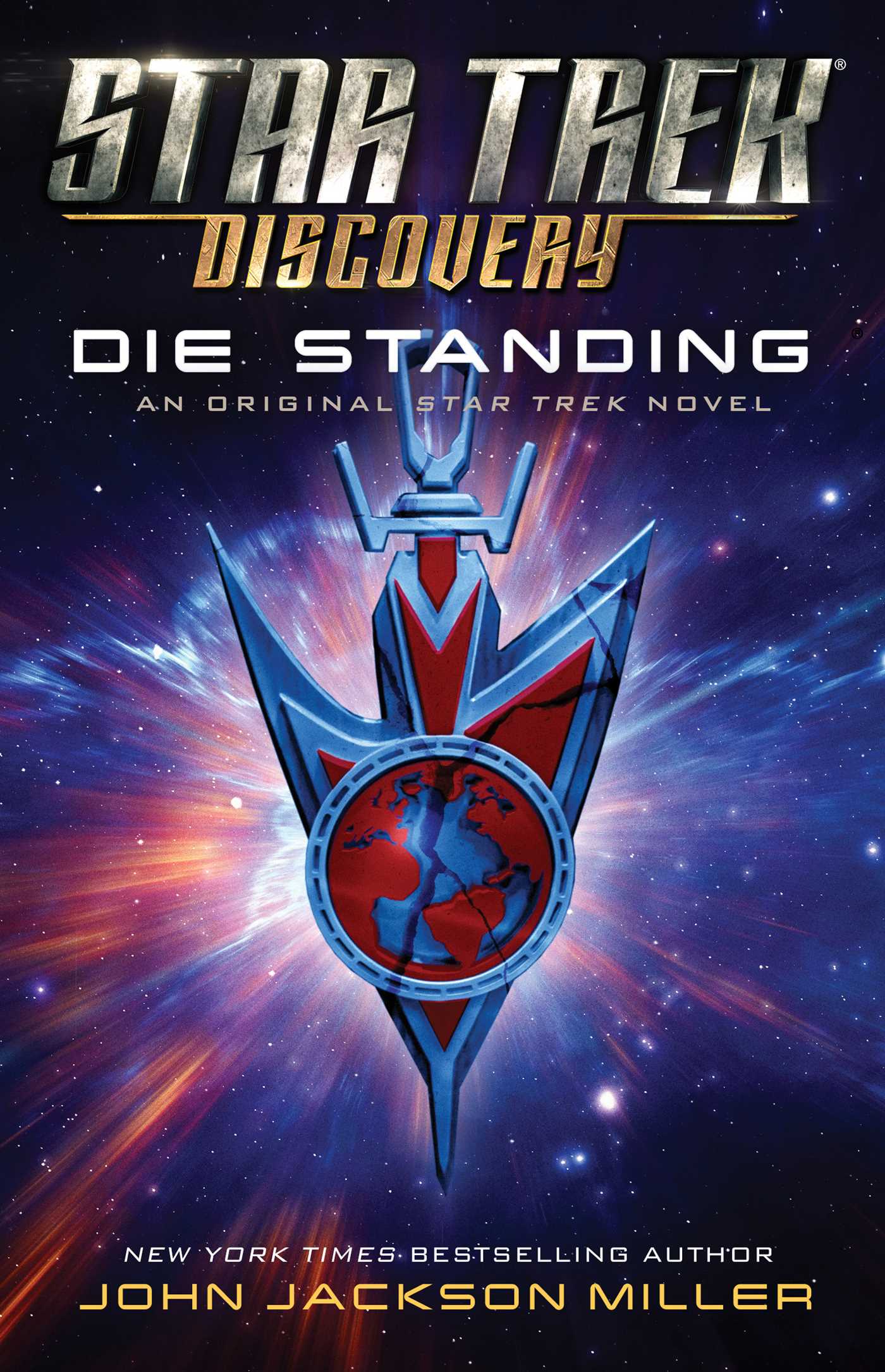
STD Die StandingStar Trek Discovery: Die Standing by John Jackson Miller (Website, Twitter)

Genre: sci-fi

Setting: spaaaaaaaaace! And some alien planets!

I read it as a(n): paperback

Source: my own collection 

Length: 403 pp

Published by: Gallery Books (14 July 2020)

Her Grace’s rating: 4 out of 5 stars

***Probably spoilers for at least season 1 of Discovery, in case someone hasn’t seen it yet.***

Die Standing recounts the events and actions of Emperor Philippa Georgiou between season 1 of Discovery and season 2 where she shows up as a Section 31 agent. Now that she’s been brought into the Prime Universe – against her will by Michael Burnham – Georgiou needs something to do. She’s recruited by Leland for Section 31 after she escapes from Qo’nos, where she was kept by L’Rell after her role in ending the Federation/Klingon War. Turns out that threatening to blow up the entire planet a) had a peacekeeping effect and b) wasn’t well-received by the Klingons. Or the Federation. However, the mission Leland sends her on, which is to track down the source of a mysterious menace that kills indiscriminately, is a test to see how she will react under pressure and under orders. Do you think that went well for Leland? If you said no, you are absolutely right!

Georgiou learns that the thing she is trying to find, a cloud-organism, can be used as a superweapon. She decides to use everything at her disposal, including a doppelganger of her assassin in the Mirror Universe and a young Emony Dax, to attain the weapon for herself and recreate her lost empire. She’s having some difficulty accepting that Lorca’s rebellion overthrew her in her universe and now she has some things to work through. In the end, though, the Prime Universe is wearing off on her and Georgiou eventually works with Dax not only to contain the superweapon but also to stop a dangerous citizen from forming a small empire of his own.

So I love Emperor Georgiou. She has zero fucks to give and she’s not shy about telling you what she thinks. She’s ruthless and scary but sometimes she does the right thing, so she has a whole potential redemption arc available. I can’t wait for the Section 31 series. I suspect she will keep them on their toes.

It was cool to see a Dax in this story as well. Here, the Trill have not yet shared that they are a joined species. Emony actively seeks to hide the fact that she is host to a symbiont. That approach was taken for a couple Trek episodes, including TNG’s “The Host.” The Trill kept it secret for a long time and it was only later, in the 24th century, that it became widely known that many individual Trill are hosts to symbionts. Their secrecy was absolutely exploited by Georgiou, because of course she figured out that Emony Dax was a joined Trill. She knows things you don’t want her to know. So it was fun to see how that part of Trill society was hidden, particularly since many of us are so familiar with and fond of Jadzia Dax and Ezri Dax. 

The character of Finnegan was also a fun addition. In the MU, he was Georgiou’s favorite henchman. He’d been lobotomized and would kill on command for her. In the Prime Universe, he was a scrappy guy who enjoyed a good barroom brawl as much as anyone but was basically kind. Definitely not a killer type. He had a long history with Admiral Cornwell, who also made several appearances. I like her character immensely. It would be awesome if someone wrote a novel of her story, including her ties to Lorca. They clearly went to the Academy together and were friends with benefits. I’d love to know that whole story.

Anyway, the entire novel was interesting in that it played on the idea of personality and redemption. Can an evil MU emperor be good? Can a good person from the Prime turn evil? Under what circumstances for each? Examining moral ambiguity and the nature of humanity is a classic Trek pastime, and JJM did a fabulous job with it. He is becoming one of my favorite Trek authors. He really captured Georgiou’s tone throughout and was quite funny at times. More, please.

book review · books · sci-fi · Star Trek

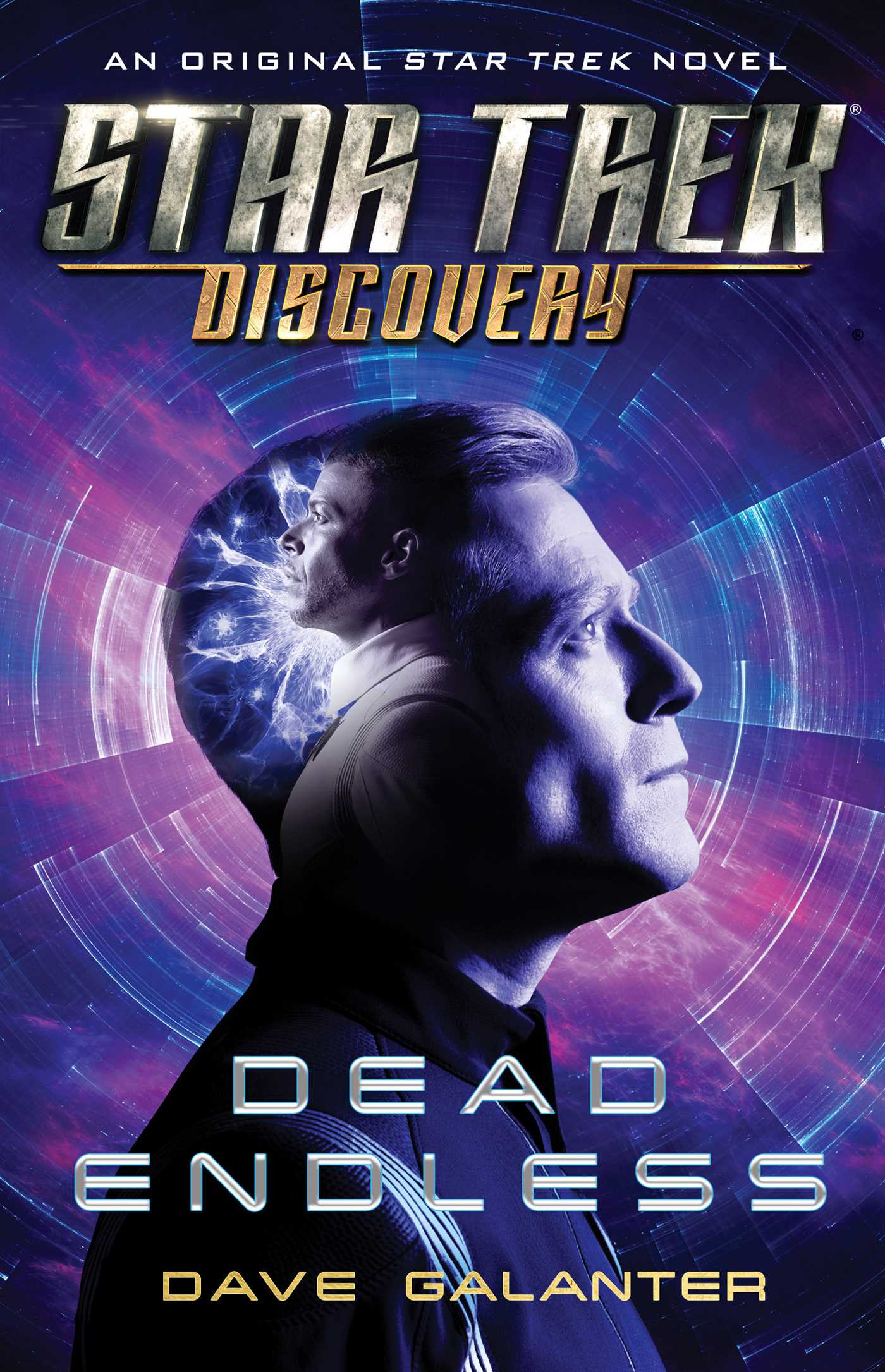
Star Trek Discovery: Dead Endless

ST Disco Dead EndlessDead Endless by Dave Galanter (Twitter)

Genre: sci-fi

Setting: the mycelial network, mostly

I read it as a(n): paperback

Source: my own collection

Length: 342 pp

Published by: Gallery Books (17 Dec 2019)

Her Grace’s rating: 3.5 out of 5 stars

**Spoilers abound!**

Discovery receives a distress call, which is not anything out of the ordinary for a Starfleet vessel. What is unusual is that it originates from within the mycelial network, the subspace domain Discovery can navigate briefly, but not endure for long, thanks to Lt. Paul Stamets and the spore drive he created. The crew responds to the distress signal and gets stuck in the mycelial network as a result. While there, the ship’s store of spores and the forest from which the crew harvests them disappears. Without the spores, there is no way for Discovery to return to normal space, and staying in the mycelial network will kill them sooner rather than later. The crew has to decide whether or not to trust someone who seems to be a human even though he was living in the network, or figure out if he’s an alien who intends to use Discovery’s spores to escape from the mycelial network at any cost.

This was a really unique story. At first, I was totally lost because the earliest references to “the captain” were vague. Is it Gabriel Lorca? Christopher Pike? It is only quite a bit later that we learn the captain refers to Michael Burnham. Of course, that sets off a whole other host of confusions because Burnham was never a captain, of Discovery or any other ship. Eventually, we learn that it IS Burnham but the setting is an alternate universe from either the Prime timeline or the Mirror Universe which we have seen in the show itself. I thought this was a great way to tell this story since it places the narrative within familiar territory – the ship itself with all the same characters – but in such a way that it doesn’t interfere with potential future canon. 

I enjoyed the mystery of how the spores were disappearing. Often, I don’t care one way or another for new aliens we meet in the books, but I really liked the Maligonq folks in this story. It was fun to see the Starfleeters knocked down a peg or two by being considered the far less advanced society of the two! 

Yes, a fun plot (once you figure out what the hell is happening) and fun aliens, but what really shines about this novel is the relationship between Stamets and Culber, and the interplay of those two characters with the rest of the crew. Galanter nailed their voices, especially Stamets’s. The whole idea of their relationship is beautifully written and shows a side of these men we can infer but do not always see in the show. It is a love story like any other, which is partly the point. In the future which Star Trek envisions, straight, gay, nonbinary, whatever is all fine, it just is love between people and that is all that matters. 

There is also an underlying theme about missed opportunities and the roads not taken. I thought it was so bittersweet that the Stamets we see in this story is NOT our Stamets in the Prime timeline. It IS Prime Culber who was trapped in the network, and who is eventually rescued in the show. But here, he encounters Stamets as he was early in their marriage, not a man who became bitter from watching his life’s work get conscripted into wartime use. The other Stamets is a kind and funny person, if somewhat irritable, partly because in his universe, there was never a Battle of the Binaries, no Klingon War. Burnham didn’t mutiny but instead became Discovery’s captain after Lorca moved on. Culber is trapped, he thinks, in this new alternate timeline and is torn because this new Stamets is more like the man he originally married and he wants to stay with him. But there is already a Hugh Culber in this timeline serving on another ship, and he feels too that staying with this Stamets would be the same as cheating on his spouse. Of course, Stamets recalls his universe’s Culber because their initial encounter with Hugh humming Casseelian opera ended with them calling each other an asshole and never meeting again. Stamets learns what he was missing out on for all those years he and Hugh could have been together. By the time he realizes it, it’s too late and Culber is drawn back into the network and is beyond reach. Like I said, missed chances. It ends on a very hopeful note, though, not as melancholy as it could have been.

I definitely recommend this one. It’s funny, too, that it is the first Discovery novel that’s actually set primarily on the titular ship. All the other ones before it were prequels and had nothing, if anything, to do with the ship itself. Those focused all on the characters, which is also just fine with me. The ship doesn’t have to be the setting to make a Disco novel, though I get why some readers were a little put off by that. ANYWAY. Read this book. Some of my favorite lines are below. It will be interesting to hear what some of your favorite lines are.

Favorite part/ lines:

    • On a scale of zero to Vulcan, it’s a Tilly, so…draw your own conclusions (10).
    • “Is sarcasm terminal?” “Yours is chronic” (36).
    • “You know,” Burnham said as they walked through, “my mother had a solution for tense situations. … She told me that there was nothing wrong with being nervous. Nerves remind us we’re alive. Nerves tell us we’re in pain, or when we’re experiencing pleasure, or when we’re in danger. It’s an important part of who we are” (78).
  • “I never want to hurt anyone. Like any living entity, I have instincts and I reacted.” “Do you know what those instincts are?” Chittering thoughtfully, Ephraim seemed uncertain. “I suppose only once they come into use.” “I guess that true of us all.” Ephraim’s mouth puckered and he radiated happiness again. “Then I am a people?” Smiling slightly, Culber nodded. “You certainly are to me.” 
  • “Is he pink?” Breytik asked Burnham. “He’s very pink.” He turned back to Stamets. “You’re very pink.” “Thank…you?” “I hope you feel better soon,” the Maligonq told him, just above a whisper.

***N.B.: As I was Googling to find the URL for Galanter’s various sites, I stumbled across an announcement from earlier this month. Galanter posted a long, beautiful, and sad note on his social media sites telling us that he was diagnosed a year ago with late-stage cancer of the bile ducts. His doctors now predict he has 3-6 months left to live, with the note that it is probably closer to three. This is supremely sad news and I wish Galanter and his family and friends a gentle time. For the full post, please view Galanter’s Twitter.