book review

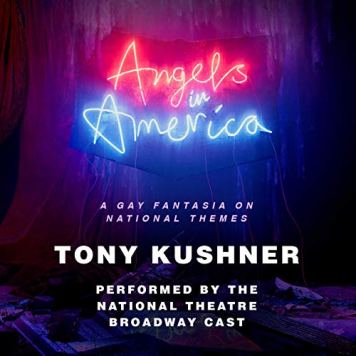
Angels in America

51vmgruhwl._sl500_Angels in America by Tony Kushner

Her Grace’s rating: 4 out of 5 stars

Genre: contemporary literature/plays

I read it as an: audiobook (audio play?)

Narrator: National Theatre Broadway cast

Source: public library

Length: 06:53:00

Published by: Random House Audio (14 May 2019)

A two-part play, Angels in America focuses on gender identity, social justice, and AIDS in the time of the Reagan Republican counter-revolution. It features various storylines of several people living in NYC, primarily Prior Walter, Joe Pitt, his wife Harper, Roy Cohn, and Belize. Each person is struggling to make sense of themselves, often hiding who they really are, and the miseries and fears that go along with denying your true self. 

This was a brutal read. It was set in the 80s, my childhood, so when it was actually happening, I was too young to understand or care about issues like AIDS, the gay community, or why it is so important not to cover up your identity. I also wouldn’t have understood why that was sometimes the only way people could survive. Although it was a painful story to hear, I am so glad I did. My favorite character was Belize, so quick to tell you just what he thinks but at the same time also quick to care for another person, even if that person just royally offended or insulted him. We need more people like Belize in the world.

I have never listened to a play on audiobook before, though I’ve certainly been to several live performances. I didn’t know what I would think of the experience, but it was fantastic! The cast was amazing, of course, and the way the narration and stage directions were delivered made it really easy to follow. I would definitely listen to more plays on audiobook. 

book review · historical fiction · Medievalism

Sword of Shadows

47863903Sword of Shadows  by Jeri Westerson (WEBSITE, FACEBOOK)

Her Grace’s rating:  4 out of 5 stars

Genre: historical fiction

I read it as an: ARC

Source: Netgalley 

Length: 224 pp

Published by: Severn House (20 April 2020)

We are nearing the end of the adventures of Crispin Guest, disgraced lord and knight, self-created Tracker of London. In this tale, Crispin and his apprentice Jack Tucker are hired by Cornish treasure hunter Carantok Teague to assist him in finding a long lost sword. It turns out to be none other than Excalibur that Teague seeks. Crispin is, of course, skeptical, but takes the job as he needs money, as always. Teague leads them to Tintagel, the fabled birthplace of King Arthur, to seek the sword. While there, two men in the castle guard are murdered, and Crispin is sidetracked from the search for the sword to investigate the deaths. Along the way, he encounters Kat Pyke, his one-time lover, as well as a host of young women jilted by one of the murdered men, and a hidden village in the forest full of Druids. Exactly what Crispin needs to have an interesting time.

Anyone who knows me at all knows I have a particular soft spot for Arthurian legend. Mixing that in with one of my favorite historical fiction series is like human catnip to me. The murder investigation element of the story takes a fairly normal course, and certainly not all is as it first appears. The Arthurian element was fun because who hasn’t thought about that sword in the stone or of where its final resting place might really be? I did feel that the Athurian sections were not as well fleshed out as the rest, but that just adds to the mystery a bit. And the surprise at the end with the old caretaker was a delight. 

Jack is grown now and Crispin is letting him take the lead on a variety of tasks that he wouldn’t have before. I’ve said it before and will say it again here that it is good to see Jack grow from a mischievous young boy to an honorable, dependable man. If she wanted to, Westerson could easily continue her medieval noir novels with Jack as the protagonist and new Tracker, with Crispin making cameo appearances. I think she has no such plans, but it is still fun to consider, as well as the final story in the series. I know how *I* hope Crispin’s tale ends, but we shall have to wait and see what Ms Westerson thinks about it! 

Strongly recommended! 

book review

Catch-Up Round: Book Club edition

122943In the Country of the Young  by Lisa Carey (WEBSITE, TWITTER, FACEBOOK)

Her Grace’s rating:  4.5 out of 5 stars

Genre: magical realism/ ghost story

I read it as a: paperback

Source: my own collection

Length: 286 pp

Published by: Perennial (1 Oct 2000)

In the late 1800s during Ireland’s Potato Famine, hundreds of Irish immigrated to America and Canada on ‘famine ships.’ One ship, the Tir na Nog, ran aground off the coast of Maine and most aboard died, including a young girl, Aisling. In modern times, artist Oisin MacDara lives an almost hermit life in the woods of Tiranogue Island. He rarely has any contact with other people and the islanders have come to accept him on his own terms. On Samhain night, Oisin lights a candle and leaves his door open, as tradition dictates, and from the mist comes a girl. Oisin had been able to see ghosts and spirits in his youth, but lost the ability when his twin sister died. In all the years since, Oisin has tried to figure out how to bring his Sight back. Now, it seems he is able to See spirits once more, or at least one spirit, who enters his life on Samhain night.

Carey’s novel is a delight. It is atmospheric and gothic, full of Irish myth and tradition. Readers get a sense of disbelief at first when Aisling wanders in out of the shadows, and, very slowly, come to realise the girl is the same as the one who died on the famine ship. As Aisling’s stay with Oisin becomes longer, she begins to grow at an astronomical rate, catching up to her adult self and gaining the experiences she missed out on in life. Oisin reluctantly takes on the role of provider, by turns pleased for and interested in the companionship and resenting her presence in his quiet, solitary life. With the help of an open-minded and trusting neighbor, Deirdre, Oisin is able to give Aisling a lifetime of experiences in what he knows will be the limited time available to her.

The character development here was extraordinary. I loved seeing Aisling’s growth and how she changed from a scared little girl into a self-confident young woman. Oisin, too, changed and grew to accept love and help from others. I identified with him a lot since I am also a very solitary person and don’t trust easily. 

Various themes of loss, mental illness, sexuality, and inflexible social customs made for some very rich discussion during this particular book club meeting.

Favorite part/ lines (potential spoilers!):

  • It’s the same as day turning to night. Your life is like the day, and after death comes, it’s all different – not worse or better, just different – because, as at night, the world no longer looks the same. It’s why twilight is the holy time, when day and night come together, and the living and the dead can meet one another on the road.
  • “It’s wrong to spend your life afraid, Oisin,” she said. “No matter what you see.”
  • What that night became for her was the moment she stepped away from all her definitions and into herself. Suddenly it no longer mattered who she was, only that she was. She stopped editing her thoughts and analyzing her actions. When she looked in the mirror, her brown eyes were tired or angry, often amused, but no longer plain. Beneath the fears and posing, she had been there all along.
  • Doesn’t he know that every minute counts? That waiting is often the same as missing a lifetime?
  • My mom says if you wait for people to read your mind, most of them will hear only your silence. … Which is why I have to tell you something,” Gabe says. … “When I’m old enough to have my first love, I’m going to remember you. Is that okay?”


5730888The Unit  by Ninni Holmqvist 

Her Grace’s rating:  3.5 out of 5 stars

Genre: dystopian 

I read it as a: paperback

Source: my own collection

Length: 268 pp

Published by: Other Press (9 June 2009)

In this dystopian society, when people reach a certain age (50 for women, 60 for men), and have no family or an irreplaceable skill, they are sent to live in ‘reserve banks’, like retirement homes. It is not optional and everyone goes if they didn’t have children in their life. Dorrit Weger dutifully checks into the Second Reserve Bank Unit on her 50th birthday. From there, she makes new friends among the other residents, engages in experiments with new drugs and therapies, and eventually begins making donations as needed and required to the outside community. She and her fellow residents are there to provide their organs to people who need them and who have been deemed of more value to society. 

This was fascinating, if somewhat derivative of many other dystopian novels. As with many books dealing with the lives of women in the future, this society has decided that people who have never had children are ‘dispensable’ and are therefore a perfect group upon which to experiment with new drugs or psychological therapies, forcing them to donate organs to indispensable recipients until they make their final donation, usually their heart or lungs. It is terrifying because I can see something like this happening. What was the most disturbing of all was how quickly the Unit’s residents accepted their fate and even managed to convince themselves that it was for the good. 

It was also just…sad…since Dorrit only found love for the first time once she entered the Unit and it would necessarily be cut short by the practices they are enduring. While I do NOT think one has to have a great love to have a great life or to be complete, it is sad when someone wants that and only finds it at the end of her life. 

There is a lot of material to unpack about what makes a life or a person worthwhile and fulfilled. Why is having children the be all and end all of a person’s worth? It takes no skill at all to have a baby. I always look side-eye at anyone who says having their children was their greatest accomplishment. Really? I LOVE my child but having her took no particular skill on my part. I’m prouder of the things I’ve written, dragged out of my brain by sheer determination, persistence, and force of will, because those things took a lot of effort. Saying this does not mean I am not proud of my daughter. I am proud – of HER accomplishments and the person she is becoming, not of simply having her. See the difference? And who is to say what I accomplish is somehow more important than, say, my friends who have chosen to remain childless? It’s not like we aren’t overpopulated as it is. Humans are like cockroaches. We’re all over the fucking place. It’s just a scary thing to think that people might one day be valued on their ability to reproduce rather than on their actual ability to contribute. 

This was another excellent book for a book club. There were so many things to consider from ethics, love, the value of a human life, and spirit. We had a very lively discussion for this one!

There were many lines that I highlighted while reading this, but the one below sums up everything perfectly for me:

  • “People who read books,” he went on, “tend to be dispensable. Extremely.”
book review · historical fiction · Medievalism

The Land Beyond the Sea

31568110The Land Beyond the Sea by Sharon Kay Penman (WEBSITE, FACEBOOK)

Her Grace’s rating:  5 out of 5 stars

Genre: historical fiction

I read it as an: ARC

Source: Edelweiss+

Length: 688 pp

Published by: Putnam (3 March 2020)

Many people are at least a little familiar with the Crusades, Richard the Lionheart, and Saladin. Far fewer, I would wager, know about the life of Balian of Ibelin, a Frankish lord born in the Levant. Penman tells his story in The Land Beyond the Sea. The timespan of the novel is actually fairly short, beginning when Balian is a young man. Penman takes readers on a journey among the Poulain, the people born in the Levant and descended from the Crusaders who remained in the region after the First Crusade; she shows us the complex and surprisingly collaborative interactions between the Poulain, the migrant Crusaders, and the Saracens, which influence the local politics to an extraordinary degree; and she demonstrates, above all else, that history is not always what we’ve learned from school. 

Balian’s story here starts with his relationship with King Baldwin, known to history as The Leper King. The two had a relationship built on respect and Balian rose high at the court in Jerusalem as a result of Baldwin’s favor. Balian also had a good relationship with Saladin himself, as well as his brother, Al-Adil, one of Saladin’s most trusted advisors. These relationships came into play at the height of Balian’s influence, when he convinced Saladin to accept Jerusalem’s peaceful surrender after a prolonged siege that would have left thousands of civilians dead or sold into slavery. 

The labyrinthine politics of the court are described in detail and were an interesting change of pace, for me anyway, from the court politics I’m more used to reading about. I understand the politics of periods like the Wars of the Roses, the Tudors, or the Plantagenets, but I had never read anything set in the medieval Levant. Penman does a thorough and highly accurate job of showing these twisting intrigues. It was a bit surprising to me to learn how much the European and Saracen societies mingled and cooperated with one another. I think I had this vague notion that the two societies were mostly segregated from each other because of the religious wars between them. I think my favorite thing was learning just how closely tied the societies were and how much they had in common. Though, really, that shouldn’t surprise me at all, since rationally I knew the region was something of a melting pot; I just hadn’t really thought much about it. 

Related to that, I was fascinated by the way they treated each other. For example, once Saladin accepted Jerusalem’s surrender, he allowed the people to put forth a ransom rather than have them all shipped off to the slave markets in Cairo. Of the roughly 15,000 people who were too poor to help raise a ransom and would have been sent into slavery, he released 7000 of them, then granted his brother, Balian, and Patriarch Eraclius gifts of 1000 slaves each, which they immediately manumitted. The way the Saracen guards/escorts treated the group who was able to leave Jerusalem was also wonderful to read. They took good care to protect them, even though they were defeated enemies; however, Saladin had ordered them to treat them well, and so they did. In Penman’s extensive Author’s Note, she indicated, rightly, that she would have been hard pressed to believe that if it had been described so only in Saracen chronicles, but the description came from several Christian chronicles. 

Also, Penman has a great talent for taking her characters, whether fictional or historical, and making readers care about them. I was so sad when William of Tyre died; I felt awful for and was sad when Baldwin died, because he was so brave in facing his illness; I was furious when Guy de Lusignan did, well, all the stupid things he did; I loved and was grateful to Anselm for his unflinching service to Baldwin. So many other examples. Even though these people, the ones who were real anyway, died nearly 1000 years ago, Penman breathes life into them, brings them springing forth with their wonderfully messy, complex, endearing, irritating humanness. 

All in all, while I have come to expect nothing short of amazing writing and research from Sharon Kay Penman’s books, it is nevertheless a delight to dive into a new book of hers and discover that her reputation as a precise and vivid storyteller remains intact and well-deserved. 

Favorite part/ lines (potential spoilers!):

  • “You can get Amalric to pay his ransom.” Others might have found that answer cold, uncaring. Agnes did not. Her mother was simply recognizing the reality confronting them, as women had been compelled to do down through the ages. 
  • William suddenly found himself on the verge of tears, almost as if he knew he’d just been given a precious gift, a memory of the young king at a perfect moment in his life, one that held no shadows or dread, only bright promise. 
  • “This is the first course, honey dates stuffed with almonds. I am sure you’ll like them if you give them a try.” Balian leaned over and put a date on the other man’s plate. The knight let it lie there untouched. He was gazing at it as if it were offal, not a delicacy sure to please the most demanding palates, and Balian began to entertain a fantasy in which he held Gerard down and force-fed him every date in Outremer. 
  • He gestured toward the arrow with a grimace, saying it was only a flesh wound. [Was this a deliberate reference to Monty Python and the Holy Grail?? If so, well played, Ms Penman, well played.]
  • Almost as if sensing how dark his thoughts had become, Cairo padded across the chamber and nudged Baldwin’s hand with a cold nose. He’d noticed years ago that the dog never touched his right hand, the one without feeling; it was always the left, crippled but still capable of sensations. How did Cairo know? [Another thing I love about Penman’s writing is how she always portrays the dogs as noble and loving. Dogs are so much better than we are. We do not deserve dogs.]
  • [Balian playing with his children upon arriving home from battle] Once his father had boosted him up onto his shoulders, he whooped with delight, and for reasons he was too young to understand, that moment imprinted itself upon his memory. Long after he was grown, with sons of his own, he would recall very little of their flight from Nablus. But he would vividly remember the afternoon that his father came home and made him fly.
  • He wondered if the other man had acted impulsively, moved by the misery of the enslaved Franks. Or had he always intended to make this request, confident that his brother would welcome an opportunity to display mercy again? … Balian smiled, realizing he’d never have the answer to that question. He could answer another question, though, one that he’d pondered since their first meeting in Salah al-Din’s tent at Marj al-Safar. They shared neither the same faith nor the same blood. But al-Malik al-Adil Saif al-Din Abu Bakr Ahmad bin Ayyub was his friend. 


books

Read Harder 2020 plan!

br_rh2020_fb-1024x536-1
Read Harder Challenge. Image credit Book Riot, https://bookriot.com/2019/12/03/2020-read-harder-challenge/

Yay, it’s here! Read Harder 2020 is here! I look forward to this list every year. In part, I just like to see what the brains at Book Riot have come up with, and in part, I love to put together a plan for myself for how to cover the tasks. Additionally, I try to make it more feminist by finding books to cover each task that are written by women or authors who identify as women. For various reasons, this doesn’t always happen, but I try hard to make it so. #RequisiteStarTrekReference

So, what do we have this year? How will this pan out? I am thinking of the following: 

  1. Read a YA nonfiction book: #NotYourPrincess by Lisa Charleyboy or How Dare the Sun Rise by Sandra Uwiringiyimana
  2. Read a retelling of a classic of the canon, fairytale, or myth by an author of color: Boy, Snow, Bird by Helen Oyeyemi OR One Thousand and One Nights by Hanan Al-Shaykh. Probably the 1st one since I’ve owned it forever and haven’t got round to reading it yet.
  3. Read a mystery where the victim(s) is not a woman: The Appraisal by Anna Porter OR The Distant Hours by Kate Morton OR Behind the Scenes at the Museum by Kate Atkinson
  4. Read a graphic memoir: Photographic: The Life of Graciela Iturbide by Isabel Quintero
  5. Read a book about a natural disaster: Wave by Sonali Deraniyagala OR Salvage the Bones by Jesmyn Ward 
  6. Read a play by an author of color and/or queer author: Angels in America by Tony Kushner. Mostly because I know Jason Isaacs (Twitter) was in this play at one point. Carrying on with my hardcore Jason Isaacs (Insta) crush. 
  7. Read a historical fiction novel not set in WWII: The Land Beyond the Sea by Sharon Kay Penman. Also, this task is funny to me, as ALL the HF I read is set in a time other than WWII. Is there really that much WWII HF? LOL. I’m already reading this one, so I might as well use it for this task; I won’t get it finished before the new year, so I reckon it counts.
  8. Read an audiobook of poetry: If They Come for Us by Fatimah Asghar OR The Poets’ Corner by John Lithgow
  9. Read the LAST book in a series: Big Sky by Kate Atkinson (don’t know if it is the LAST, last, but it is the most recent one out in the Jackson Brodie series). Also, DID YOU KNOW that there is a TV series of these books called Case Histories? It stars… wait for it… Jason Isaacs! Dear god, that man’s eyes… 
  10. Read a book that takes place in a rural setting: Gilead by Mary Robinson OR The Miseducation of Cameron Post by Emily Danforth
  11. Read a debut novel by a queer author: How to Survive a Summer by Nick White OR Jonny Appleseed by Joshua Whitehead OR Bright Lines by Tanwi Nandini Islam
  12. Read a memoir by someone from a religious tradition (or lack of religious tradition) that is not your own: Muslim Girl by Amani Al-Khatanahtbeh OR Educated by Tara Westover. Every religion is different for me. Hardcore atheist…
  13. Read a food book about a cuisine you’ve never tried before: Longthroat Memoirs: Soups, Sex and Nigerian Taste Buds by Yemisi Aribisala OR Notes from a Young Black Chef: A Memoir by Kwame Onwuachi (both Nigerian chefs). This was hard for me even to find some since it turns out I’ve eaten a LOT of different cuisines, and many that I haven’t seem not to have any books written about them.
  14. Read a romance starring a single parent: Maybe Home Again by Kristin Hannah, mostly because someone gave it to me and so I don’t have to look for something else. I really don’t know yet since I am definitely not a romance reader. I might pick one from this list because it’s awesomely comprehensive: Smart Bitches, Trashy Books
  15. Read a book about climate change: Salvage the Bones by Jesmyn Ward (double dipper!) OR The Sixth Extinction by Elizabeth Kolbert
  16. Read a doorstopper (over 500 pages) published after 1950, written by a woman: The Land Beyond the Sea by Sharon Kay Penman (double dipper!)
  17. Read a sci-fi/fantasy novella (under 120 pages): Every Heart a Doorway by Seanan McGuire OR Last Summer at Mars Hill by Elizabeth Hand. Probably the 2nd. I love Elizabeth Hand; her stories are so fucked up.
  18. Read a picture book with a human main character from a marginalized community: No idea. I’ll probably just wander around the kids’ section at the bookstore and pick one while my daughter is browsing.
  19. Read a book by or about a refugee: Inside Out and Back Again by Thanhha Lai (because my daughter already has it, so that’s convenient) OR The Silence and the Roar by Nihad Sirees
  20. Read a middle grade book that doesn’t take place in the U.S. or the UK: Inside Out and Back Again by Thanhha Lai (double dipper!) OR Sweetness in the Belly by Camilla Gibb. Probably the 1st since the 2nd seems a little older than middle grade.
  21. Read a book with a main character or protagonist with a disability (fiction or non): House Rules by Jodi Picoult or maybe Me Before You by Jojo Moyes
  22. Read a horror book published by an indie press: After the People Lights Have Gone Off by Stephen Graham Jones. Been wanting to read this one forever.
  23. Read an edition of a literary magazine (digital or physical): I have a backlogged stack of Arthuriana that will do nicely for this.
  24. Read a book in any genre by a Native, First Nations, or Indigenous author: #NotYourPrincess by Lisa Charleyboy (double dipper!) OR The Round House by Louise Erdrich

It’ll be interesting, at the end of 2020, to see how many of these books I’ve planned are the ones I actually ended up reading for this year’s challenge. 

book review · books

Read Harder 2019 – complete!


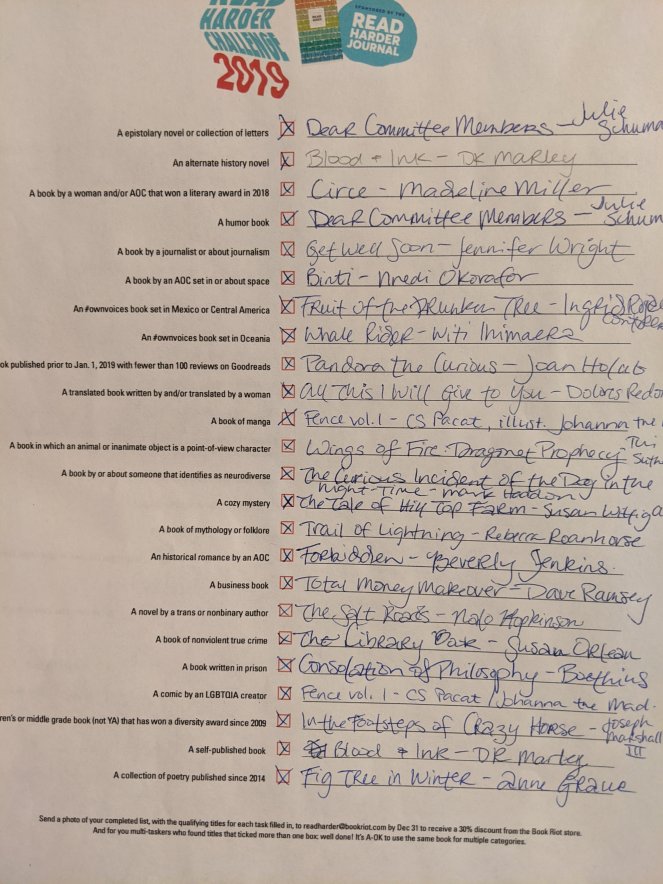
I did it! Here are the books I ended up reading for the 2019 Read Harder challenge. I am trying to write reviews for every book I read as well, although I didn’t manage to do so this year. Where I could, I linked to my review of the book.

  1. An epistolary or collection of letters: Dear Committee Members – Julie Schumacher
  2. An alternate history novel: Blood and Ink – DK Marley
  3. A book by a woman and/or AOC that won a literary award in 2018: Circe– Madeleine Miller (and the best lines from Circe…)
  4. A humor book: Dear Committee Members – Julie Schumacher
  5. A book by a journalist or about journalism: Get Well Soon – Jennifer Wright
  6. A book by an AOC set in or about space: Binti – Nnedi Okorafor
  7. An #ownvoices book set in Mexico or Central America: Fruit of the Drunken Tree – Ingrid Rojas Contreras
  8. An #ownvoices book set in Oceania: Whale Rider – Witi Ihimaera
  9. A book published prior to Jan. 1, 2019 with fewer than 100 reviews on Goodreads: Pandora the Curious – Joan Holub
  10. A translated book written by and/or translated by a woman: All This I Will Give to You – Dolores Redondo
  11. A book of manga: Fence Vol. 1 – CS Pacat, illustrated by Johanna the Mad
  12. A book in which an animal or inanimate object is a point-of-view character: Wings of Fire: The Dragonet Prophecy – Tui T. Sutherland
  13. A book by or about someone that identifies as neurodiverse: The Curious Incident of the Dog in the Night-Time – Mark Haddon
  14. A cozy mystery: The Tale of Hill Top Farm – Susan Wittig Albert
  15. A book of mythology or folklore: Trail of Lightning – Rebecca Roanhorse
  16. An historical romance by an AOC: Forbidden– Beverly Jenkins
  17. A business book: Total Money Makeover – Dave Ramsey
  18. A novel by a trans or nonbinary author: The Salt Roads – Nalo Hopkinson
  19. A book of nonviolent true crime: The Library Book – Susan Orlean
  20. A book written in prison: The Consolation of Philosophy – Boethius
  21. A comic by an LGBTQIA creator: Fence, vol. 1 – CS Pacat, illustrated by Johanna the Mad
  22. A children’s or middle grade book (not YA) that has won a diversity award since 2009: In the Footsteps of Crazy Horse – Joseph Marshall III
  23. A self-published book: Blood and Ink – DK Marley
  24. A collection of poetry published since 2014: Fig Tree in Winter – Anne Graue
book review · sci-fi · Star Trek

Catch-Up Round: ALL the Star Trek

42853106._sx318_Star Trek Prometheus: The Root of All Rage  by Christian Humberg and Bernd Perplies 

Her Grace’s rating: 2 out of 5 stars

Genre: sci-fi

I read it as an: audiobook

Narrator: Alec Newman

Source: my own collection

Length: 08:57:00

Published by: Titan Books (22 Aug 2016)

In this second instalment, the Prometheus is still in the Lembatta Cluster, exploring the strange region of space that is home to the terrorist organization called the Purifying Flame. Something in the region is having a profound effect on the inhabitants there, including the crews of the Prometheus and the Klingon ship Bortas. Local radiation is causing crew members with telepathic abilities to lose their minds, and other crew are feeling hyper-aggressive. The Purifying Flame wants to start a galactic war, which the Federation is trying to prevent and the Klingons seem to desire. 

As with the first book in this trilogy, the second, The Root of All Rage, has some interesting elements to it. I thought it was a little more actiony in terms of Star Trek plotlines. However, it still dragged that plot out too long. There are very obvious analogies to modern-day terrorism that got a bit heavy-handed the longer the book went on. It also still employs a LOT of what feels like very racist language. People are judged based on what they look like and are called red-skin murderers and so forth. It is not in keeping with what Star Trek is about. Including things like that just to allow characters to overcome their prejudices is a lazy way to write and I expect better from Star Trek. 


42604905._sy475_Star Trek Prometheus: In the Heart of Chaos by Christian Humberg and Bernd Perplies 

Her Grace’s rating: 2 out of 5 stars

Genre: sci-fi

I read it as an: audiobook

Narrator: Alec Newman

Source: my own collection

Length: 09:59:00

Published by: Titan Books (19 Sept 2016)

In this last instalment, the crews of the Prometheus and Bortas are working to restore peace to the Lembatta region, which was impacted by a radiation that makes everyone violent. While the two crews work together, they are trying to trace a secret weapons facility but find instead that an old being from their past is behind the cycle of violence. Now they have to refocus their efforts to stop it from perpetuating violence throughout the quadrant.

Finally! The last book of this trilogy. I’m so glad it’s over. This whole story really didn’t need three books to be told. It dragged out way too long in places, and I think with better writing and editing, it could have been told in one long book, or perhaps a shorter duology. Honestly, I stopped listening to a lot of this since it was fairly repetitive. 

It got old real quick to have more famous Trek characters making cameos or having a role here at all. It felt like it was an afterthought, adding in things fans love because the rest of the plot was lacking. And as I mentioned in my reviews of the other two books in the trilogy, enough with the weird, racist comments. Constantly describing people solely by their looks – his bright blue skin, his jet black hair, his glowy eyes – got really tiresome. Yes, many being in the Trekverse are described by how they look, but in other authors’ hands, it is merely an observation and doesn’t come across as a character assessment based on those looks. 

I regret using Audible credits and my own cash to get these. I wouldn’t recommend it, and if you must read them, don’t waste your money – just pick it up at the library. 


41058420._sy475_Star Trek TNG: Available Light by Dayton Ward 

Her Grace’s rating: 2 out of 5 stars

Genre: sci-fi

I read it as an: paperback

Source: my own collection

Length: 368 pp

Published by: Gallery Books (9 April 2019)

This novel continues the plot that has taken over most of the TNG relaunch books, and much of the relaunch books across Trek series overall. In the fallout from Ozla’s explosive reporting of Section 31 and the multitude of ways in which the rogue agency has influenced the events of the Federation, the President has ordered a complete dismantling of 31 and the arrests of its operatives. It is a far-reaching system and players include Admirals Ross, Nechayev, and Nakamura, as well as Capt Jean-Luc Picard. Attorney General Philippa Louvois is in charge of leading the investigation into the charges against 31 operatives. Meanwhile, exploring in the Odyssean Pass, the Enterprise crew encounters a massive, ancient spaceship. They are on board trying to discover where it came from when a ship full of basically space pirates comes along and claims the derelict ship as their own. This triggers the ship to come to life in some new and surprising ways, including taking Tryssa Chen and a boarding party from the pirate ship into the lost depths of the massive ship. 

It sounds a lot more interesting than it really was. I was about 75% of the way through this before I felt it started picking up the pace. Overall, it was an unexpected disappointment. I felt like the A Plot was too drawn out and, frankly, done before, and the B Plot was more interesting and should have been the A Plot. I saw one reviewer who commented that it felt like DRGIII had made a guest writing appearance, which isn’t a good thing. As it was, it was really truncated by comparison to what it could have been. Maybe the next book will have more on the 31 trials and so forth. Right now, the Trek books that are winning for me are ones by Una McCormack and the Discovery novels, mostly because Discovery is still new and exciting and hasn’t been done to death yet. 

book review

Fig Tree in Winter

38465750._sy475_Fig Tree in Winter  by Anne Graue (WEBSITE, TWITTER)

Her Grace’s rating:  5 out of 5 stars

Genre: poetry

I read it as a: paperback chapbook

Source: my own collection

Length: 36 pp

Published by: dancing girl press (2017)

As part of the 2019 Read Harder challenge, I chose this book to complete the task for ‘read a collection of poetry published since 2014.’ I am the first to confess that I rarely read poetry and I am often confounded by it. However, in the interests of full disclosure, Anne is a friend of mine so it felt natural to want to use her book to complete this task; friendship aside, though, I find her poems to be beautifully feminine and strong as well as challenging. 

Anne was the person who taught me what found poetry is. I was delighted to learn this, because it was something I had done for ages and ages, from childhood, and just didn’t know there was a real name for it. I find it to be a really stunning form of art and would like to learn more about it, maybe even try some of my own, just for a new thing to hang on my library wall if nothing else.

I don’t really know how to review poetry. I think that this collection, though, has a strong theme of feminism and lost innocence to it. Many of the poems evoke feelings of nostalgia for our younger selves, for wishing we had known then what we know now, and more than a little disappointment and heartbreak at the way things turn out in the end. My favorite poems in the collection are ‘A World Divided’, ‘the asylum’, and ‘The Cure for Thinking’. These, to me, sum up so much of a woman’s experience that it is a little shocking to find in such a few brief lines.