book review · fantasy · historical fiction

Sorcery in Alpara

47870793._sy475_Sorcery in Alpara by Judith Starkston (website, Twitter, Facebook)

Her Grace’s rating:  5 out of 5 stars

Genre: historical fantasy

I read it as an: ARC

Source: digital ARC from the author

Length: 439 pp

Published by: Bronze Age Books (14 Oct 2019)

This second novel in Starkston’s Tesha series picks up right where the first story, Priestess of Ishana, left off. Tesha and Hattu are newly married and traveling to Alpara, his capitol city. Tesha is to be crowned as Hattu’s queen and rule beside him. Instead, as they travel through hostile lands, a dark force attacks Hattu and his army. Tesha frees the army through the use of her skills as a priestess of Ishana, but at a steep price. Tesha is drained of her strength and power, unable to move or speak. As she gradually recovers, under the care of her sister Daniti, it becomes clear to Tesha that Hattu has been overcome by the same dark force. Tesha must struggle against betrayals that take everything she holds dear from her, save Hattu and her new kingdom, without sacrificing herself in the process. 

Second novels in a trilogy often struggle with a sluggish plot in some odd sort of literary ‘middle child syndrome.’ Sorcery in Alpara definitely does not suffer from this problem. From the start, it is full of action and magic, love and despair. Readers get several gut-punches as Tesha fights to save those she loves, even while being unjustly accused of a crime she didn’t commit. 

A major subplot of the novel involves Tesha’s older sister, Daniti, who was taken captive by a faction of Hattu’s enemies. Daniti uses all her considerable skills to delay her captors from carrying out their plans. Helping her is Marak, Hattu’s second-in-command, who had allowed himself to be taken hostage to protect Daniti. Their whole story, while not quite as fraught as Tesha and Hattu’s, is intriguing and highlights some of the facets of being disabled in the ancient world. Daniti’s blindness doesn’t hinder her ability to be a formidable ally to Tesha and fierce enemy to Paskans and others who would overthrow her brother-in-law. 

Hattu’s people, the Hitolians, are based on the ancient Hittites. Starkston does a masterful job weaving in elements of their culture and religious practices throughout her writing. The religious rituals the Hittites practiced lend themselves extraordinarily well to creating the magic spells Tesha and other priestesses use in this series. Using historically accurate details to turn them to one’s own purpose in a story really helps create a richer reading experience. Starkston has this practice well in hand and she uses her impeccable research on the Hittite culture to modify and implement magic rites within the world she has built around Tesha, who is herself based on a real life Hittite queen, Puduhepa. 

In short, this is an excellent addition to the Tesha series. I can’t wait to buy a hard copy for my own library. Strongly recommended to anyone who loves historical fantasy, or who has an appreciation for well researched books with a seriously fun plot. 

PLEASE NOTE: If you go to the author’s website, you can preorder a copy of this book for $2.99 on kindle. When you preorder Sorcery in Alpara, you get a free short story which continues the narrative of Anna, a prequel story to the Tesha series. The first short story installment comes when you sign up for Judith’s newsletter. I’ve received both and the short story and the newsletter are entirely worth your time. 

book review

Wonder

11387515Wonder  by RJ Palacio (website, Twitter)

Her Grace’s rating:  3.5 out of 5 stars

Genre: Contemporary lit, middle school

I read it as a: hardback

Source: my daughter’s collection

Length: 314 pp

Published by: Knopf (14 Feb 2012)

Wonder is the story of August ‘Aggie’ Pullman, a boy who was born with a rare condition that leaves him with severe facial abnormalities. Because he spent so many years having various surgeries and health issues, Auggie never went to traditional school and was instead homeschooled by his mother. Then, 5th grade comes around and Auggie’s parents decide he needs to start attending a regular school. He tests into a well respected private school and starts middle school. A group of kids who were asked by the principal to keep an eye on Auggie and help him out are integral to his experiences in his first year at real school and Auggie learns that some people hide surprising depths. 

My daughter read this in her class this year and she really liked it. She wanted me to read it as well and since I enjoy talking about books with her, I was happy to do so. I found the multiple perspectives to be effective in giving various angles to Auggie’s story. Sometimes, multiple POVs are just disorganized or distracting but it works well in this narrative. The book starts out with Auggie’s POV then shifts between his older sister Via, her friend Miranda, Jack, Via’s boyfriend Justin, and Auggie’s friend Summer. I do wish there had been a perspective for each of his parents and for Mr Tushman, the principal. It would have been insightful to get the views from adults who were a big part of Auggie’s story as well, so I feel that a lot of added depth was missed by leaving them out. 

I enjoyed seeing the ways in which Auggie grew over the course of his first year in a real school. I have long said kids can be real assholes, and it held true in this book, but it was also a good example of how kids learn from example as well. Some are born assholes and some are born kind, but often they can be influenced one way or the other by the way they are raised. One kid was apparently born an asshole and that was reinforced by his horrid mother; another was basically good but his childhood reinforced ways for him to be an asshole; and one kid is just a good kid, although we don’t see the parents to know how they are raising their kids. 

The overarching message was, of course, to be kinder than is necessary. I think this is a really relevant theme for kids to learn, all the time, but especially now. With the cruel, racist, hateful Trump administration eroding compassion and empathy everywhere, it is nice to read something that sends a good message, even though it was written well before that thing became President. Yes, I will find a way to make even a kid’s book political, because fuck Trump. NO, I am not empathetic to him or his toadies. 

ANYWAY. It is a good message to teach kids not to judge anyone by the way they look, whether it is the color of their skin, the clothes they wear, or if they have medical conditions making them look different from most people. Auggie is a cool, funny, smart boy, but many people would never know it because they are shallow and freak out about the way he looks rather than trying to know the person inside. 

Definitely recommended reading for all parents and kids. Reading it together is even better. Talk to each other. 


book review · bookish things · books · historical fiction

Arrr, Ahoy Me Hearties! Books for International Talk Like a Pirate Day*

Mateys. Why be pirates so mean? I don’t know, either, they just arrrrrr. 

I know, I know. Sink me, it’s awful. But I know two jokes and that be one of them. I wasn’t goin’ to be passin’ up the chance to share it with ye. Ye’re welcome. Since September 19 be International Talk Like a Pirate Day, it’s also a jest worthy of the day. Why be there a Talk Like a Pirate Day? Well…why not? It all really started as a parodic (parrotic? Do pirates really have parrots?) holiday for jolly good fun by two silly scalliwags who thought it be a good idea. Nothin’ more to it than that. And really, what better reason be there to drink grog and read about some of the finest swashbuckling crews on the high seas? 

There be pirate books a’plenty, far more than those penned by those most renowned authors Robert Louis Stevenson or Daniel Defoe (or Jonathan Swift, Herman Melville, Jules Verne, Bernard Cornwell, or Patrick O’Brian).  So if ye want to be learnin’ about talkin’ like a pirate so ye sound more like an old salt instead of a sprog, have a gander at some of these fine volumes. Just don’t go droppin’ ‘em in the briny deep or ye’ll be keelhauled. Savvy? 

And yes, I expect all ye landlubbers to talk (and write) like a pirate all the live long day. 

1958775Sea Witch by Helen Hollick. The first in the Sea Witch series featuring fictional pirate Jesamiah Acorne. Hollick’s research be impeccable and many other real life pirates have roles in these tales. This high seas rollicking adventure makes it easy to see why pirates be romanticized so often.

Lost Boy: The True Story of Captain Hook by Christina Henry. This be the story of Peter Pan, told from the perspective of Captain Hook, a Gentleman ‘o fortune who has been mightily abused by literature and that scoundrel Pan.

Winterwood by Jacey Bedford. A cross-dressing lassie privateer captain discovers she has a younger half-brother, inherits a magic winterwood box that might save all of the rowankind (like the wee fairy folk), and has a shapeshifting wolf courting her, to the great annoyance of her husband’s ghost. Read it anon!

32620311._sy475_Hook’s Tale: Being the Account of an Unjustly Villainized Pirate Written by Himself by John Leonard Pielmeier. As the title suggests, this be the autobiography of the illustrious, dashing Hook himself. 
Destiny’s Captive by Beverly Jenkins. Noah Yates sets off on the high seas, seeking adventure, not a wife. And then he be captured and tied up by a woman. Literally. A woman who be descended from pirates. Who then steals his ship. All manner of great, grand adventure ensues. 

Hurricane Dancers by Margarita Engle. A boy be traded from pirate ship to pirate ship as long as he can remember, used as a translator between Spanish and his mother’s Taino Indian language. Then a ruddy hurricane sinks his ship, he escapes, and he gets to decide the fate of his former captors. To keelhaul or not to keelhaul…

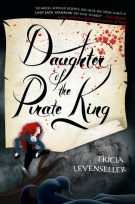
33643994._sy475_Daughter of the Pirate King by Tricia Levenseller. A 17-year-old pirate captain allows herself to be captured so that she can search her enemy’s ship for a secret map to a hidden treasure. A true pirate will go to any length to seek treasure and adventure.

Blackhearts by Nicole Castroman. A fancy rich merchant’s sprog wants to flee his strict social class and go to sea to make his own way, while a young orphaned woman wants to return to her mother’s home in Curacao. They meet, fall in love, and must decide whether to follow social rules or not. A pirate would tell rules to walk the plank. The young man grows up to be Blackbeard, the most fearsome and renowned pirate ever to sail the seven seas… 

49851Under the Black Flag by David Cordingly. Written by the former head of exhibitions at the British National Maritime Museum, this novel be all about the fact and fiction of a pirate’s life. Yo ho, yo ho, a pirate’s life for me…

One Piece by Eiichiro Oda. Pirate manga! Monkey D. Luffy wants to be the Pirate King. Instead, he accidentally gained the power to stretch like rubber, at the cost of never being able to swim again. Now, he and some pirate sprogs are on a quest to find the One Piece, which is reputed to be the greatest treasure in all the wide world.

*Originally posted on Book Riot. 

academic · Medievalism

A Feather on the Breath of God

hildegard_of_bingen_and_nuns
Hildegard and her nuns

In the year 1112, a young girl who had been given to the church by her parents as a tithe was entombed in an anchorite’s cell with another woman, Jutta. The mass of the dead was performed over the enclosed cell, as was customary, and the girl became an anchoress until her eventual release in 1136 upon Jutta’s death. The girl, now around 38 years old, was then unanimously declared as the next abbess of the Disenbodenberg convent. She went on to become a renowned theologian, composer, and mystic. The girl was Hildegard of Bingen (1098 – 17 Sept 1179), medieval firebrand, visionary, thorn in the side of her male contemporaries, and she remains as relevant today as she was in her own time.

Hildegard was a product of her time and was not a feminist by any modern definition of the word, but she was a fierce advocate of the sacred value of women. Her theology was feminine, focusing largely on the idea of God as a cosmic egg, a womb that nurtures all things. She acknowledged the dogma of her time, which decreed that God was male, but she claimed that she was unable to bear looking upon the divine in her visions unless it presented as female. Although women were prohibited from preaching, nevertheless, she persisted, going on several tours to preach to her male superiors about the sins of the Church, which was rife with sexual misconduct and corruption. One of Hildegard’s more interesting visions, Ecclesia, depicts the Church giving birth to the Antichrist because of the venality of its clergy. She was not afraid of confrontation, and even wrote scathing letters to Pope Anastasius IV about the sad state of his Church:

You are neglecting justice, the King’s daughter [the Church], the heavenly bride, the woman who was entrusted to you. And you are even tolerant that this princess be hurled to the ground. Her crown and jeweled raiment are torn to pieces through the moral crudeness of men who bark like dogs and make stupid sounds like chickens which sometimes begin to cackle in the middle of the night. They are hypocrites. (Fox, 1987, p. 274)

At one point, Hildegard and her nuns were even placed under interdict for refusing to comply with orders to disinter a suspected apostate, whom Hildegard allowed to be buried in hallowed ground in her convent. Hildegard refused to relent and eventually the interdict was lifted. She could, and did, go toe to toe with male authority, and bravely fought for her beliefs within the system that was available to her.

Hildegard was also a gifted composer of music, another realm generally designated for men only. Because she was a Benedictine nun and adhered to that order’s strict daily schedule, she sang the Divine Office eight times a day. She believed that singing was the highest form of prayer and music connected humankind directly to the divine. During her interdict, she was prohibited from singing, which was the harshest punishment for her. Hildegard said in a letter to the prelates of Mainz that “the soul is arises from heavenly harmony” (Fox, 1987, p. 359) and in music she referred to herself as a feather on the breath of God. She wrote over 70 songs and Ordo Virtutum, which is sometimes considered to be the first opera. A sampling of her songs may be found at the following sites: https://www.youtube.com/watch?v=Q8gK0_PgIgY or http://www.slacker.com/artist/hildegard-von-bingen

Her mystical visions still bring inspiration. Often, they reflect her concept of Viriditas, the greening power, which she believed was the divine made manifest in everything on earth. She wrote, “I, the fiery life of divine essence, am aflame beyond the beauty of the meadows, I gleam in the waters, and I burn in the sun, moon and stars … I awaken everything to life” (Fox, 1987, p. 8-10). Hildegard felt the creation of all things reflected the face of the divine and that nature was sacred, something that is “highly relevant for us in this age of climate change and the destruction of natural habitats” (Sharratt, 2012, para. 6).

Hildegard’s death on September 17, 1179 marks a date of commemoration for this woman, a medieval mystic, visionary, healer, and saint. She was ordained a Doctor of the Church 900 years after her death. Today, women the world over still find solace and strength in her words and songs. We can use her for guidance to find our own viriditas, strength, and sacredness in nature, regardless of faith or lack thereof.

References

Classical Music goturhjem2. (2013, Feb 13). Hildegard von Bingen – Music and Visions [Video file]. Retrieved from https://www.youtube.com/watch?v=Q8gK0_PgIgY.

Hildegard of Bingen. (1987). Hildegard of Bingen’s Book of Divine Works: With Letters and Songs. Matthew Fox (Ed.). Santa Fe, NM: Bear & Company.  

Hildegard von Bingen. (n.d.). Slacker Radio. Retrieved from http://www.slacker.com/artist/hildegard-von-bingen.

Newman, B. (1987). Sister of Wisdom: St. Hildegard’s Theology of the Feminine. Berkeley: University of California Press.
Sharratt, M. (2012, Oct 27). 8 Reasons Why Hildegard Matters Now. Huffington Post. Retrieved from http://www.huffingtonpost.com/mary-sharratt/8-reasons-why-hildegard-matters-now_b_2006626.html.

book review · historical fiction

In the Footsteps of Crazy Horse

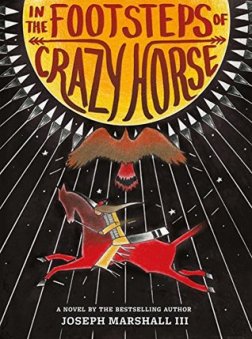
27778554._sx318_In the Footsteps of Crazy Horse by Joseph Marshall III (website, Twitter)

Her Grace’s rating:  3 out of 5 stars

Genre: children’s fiction

I read it as an: ebook

Source: library

Length: 176 pp

Published by: Harry Abrams (10 Nov 2015)

This children’s novel follows Jimmy McLean as he travels with his grandfather to learn about his famous ancestor, Crazy Horse. Jimmy has a hard time with bullies who mock him for not being full-blooded Lakota. Jimmy’s mother is Lakota but his father is biracial Lakota and Irish. His grandfather takes Jimmy on a road trip so they can visit the sites of Crazy Horse’s most famous moments. In the process, Jimmy learns something of strength, honor, and taking care of people, including yourself. 

I enjoyed this slim novel well enough. I tend not to read children’s fiction much; even the books my 9 year old reads are generally YA. So the writing felt overly simple to me with some information missing that I would have liked to have. However, I had to remind myself that it IS for children and they may not be able to read books that deeply yet. It was fun to learn more about Crazy Horse, especially from a Native American perspective. So much history is written by the victors, so the version of Crazy Horse we tend to get in school here is that he was a rabble-rouser and problematic for the white soldiers. I always took that with a grain of salt anyway, but it is still nice to hear about the story from a different perspective. 

I read this for task #22 of the Read Harder challenge: A children’s or middle grade book that has won a diversity award since 2009.

Favorite lines:

  • “A long time ago,” Grandpa said as he and Jimmy rode down the highway, “people and animals could understand each other’s languages. A person could understand what a hawk said. The hawk could understand people. But things changed. Animals and people don’t understand each other anymore. That’s sad.”
  • “When things like that happen, like to your dad and Crazy Horse, it’s okay for tough guys to cry. Don’t you ever forget that.”
  • Jimmy looked around at the hilly landscape. He had the same strange feeling he’d had at the Hundred in the Hands battlefield. He felt like he should be quiet or talk only in a whisper.
  • “That’s the sad part about war and battles,” he concluded. “Doesn’t matter who you are, what side you’re on. It’s still sad, no matter what kind of uniform you wear or the color of your skin. It’s still sad.”
  • Sometimes you have to do things no matter how scary it is, or how scared you are.
  • …that’s what being a warrior was all about: facing the scary things no matter how afraid you were. That’s what courage is.
book review

Whale Rider

949043Whale Rider by Witi Ihimaera (no author websites found)

Her Grace’s rating:  2 out of 5 stars

Genre: fiction

I read it as an: audiobooks

Narrator: Jay Laga’aia

Source: library

Length: 03:39:00

Published by: Bolinda (8 July 2005)

This is the story of Kahu, a young Maori girl who badly wants to be loved by her great-grandfather, her tribe’s chief. He has no time for any girl children and is absorbed in his duties and responsibilities as the chief. Their tribe, which claims descent from the legendary whale rider of myth,  always has a male chief but now there is no male heir. To gain her great-grandad’s approval, Kahu struggles to learn the stories and roles of her tribe and show everyone that she is worthy. Among her allies is the spirit of the whale rider himself. 

This is, apparently, a very well known legend in New Zealand. I confess I had no knowledge of it other than a vague recollection from the film, which I saw years ago. It was interesting to learn about Maori culture and language in modern times. The struggles indigenous peoples around the world still face are incredible. Why are we so awful to each other? 

I didn’t care for the narrator too much. He made his voice sound really, badly high when he was speaking a woman’s lines. No. Don’t do that. He was fine for the various men’s voices, though, and said Maori words with what appeared to be fluency. Not knowing a single word of the Maori language, I wouldn’t know if they were pronounced incorrectly anyway. I enjoyed how the native language was spread throughout the book. 

I found the writing style to be rather simple, or simplified perhaps, which was sort of a turnoff. I also found it an odd choice for the story to be told from Kahu’s uncle’s point of view. Why not from Kahu’s herself? Or even her great-grandad? It just seemed a weird person to act as the narrator. 

Overall, I’m glad I listened to it, always like learning more about a culture, but I didn’t realllllly care for this one too much. 

academic · sci-fi · Star Trek · Tudors · weird

“…The Common Ties of Humanity…:” 20th Century Lessons from More’s Utopia and Roddenberry’s Star Trek

Throwback Thursday meets fandom and academia. I was cleaning out a bunch of old files on my computer and found a paper I wrote when I was a little baby undergrad many moons ago. I am amused. LOL. And yes, it was still the 20th century when I wrote it. I am an old.

9534340011_717843d04b_o-590x711
Image copyright watschi, posted on https://www.designcrowd.com/community/contest.aspx?id=1673030

Is it possible for two men who lived 400 years apart to have similar premonitions of the possibilities human society could achieve? Although there is no way to tell for sure, seems that Thomas More, author of Utopia, and Gene Roddenberry, the creator of Star Trek, both had such visions. The society of the 24th century that Roddenberry so vividly brought to life and the society of the Utopians are both ideal cultures and are similar to each other in many ways. They also have some contrasts as well. Despite the few differences between the two works, Star Trek and Utopia both paint very realistic descriptions of an idyllic society that humanity may one day attain. Continue reading ““…The Common Ties of Humanity…:” 20th Century Lessons from More’s Utopia and Roddenberry’s Star Trek”

book review · historical fiction · weird

River of Teeth

31445891._sy475_River of Teeth by Sarah Gailey (website, Twitter)

Her Grace’s rating:  4 out of 5 stars

Genre: alternative history

I read it as a: paperback

Source: my own collection

Length: 173 pp

Published by: Tor (23 May 2017)

Sarah Gailey’s novella, River of Teeth, finds its origins in a little known yet true bill Congress had considered passing in the 1800s. This bill would have imported hippos to the Louisiana bayous to breed as an alternate meat source to cattle. As the publisher’s blurb says, this was a terrible idea. Lucky for us, it clearly didn’t happen. In this alternate history, though, it did, and now shit’s about to get real. Some hippos in the novella’s past had escaped their farms and bred and expanded indiscriminately throughout the area. These feral hippos are tremendously dangerous and like to eat people. (Trying real hard here not to make a comment about how hungry the hippos were since I’m sure it’s been said many times. They were hungry…hungry hippos.)

Former hippo farmer and mercenary hippo wrangler, Winslow Houndstooth, is hired to herd these feral hippos out of the bayou and into a safer, contained region. If they are successful, he and his crew will make a fortune and Houndstooth will get revenge for a past wrong done to him. 

This book was so much fun! I love historical history, but not so much alternative history…unless it is one like this. Gailey pulled off an engaging, boisterous tale with complex characters, complete with their own motives, skills, and backgrounds. Houndstooth was the primary character, but the others were extremely well developed, particularly given that the story was so short. 

One thing I really loved was how diverse the cast of characters is. Men and women work alongside each other nicely (mostly), there are characters of color, nonbinary characters, LGBTQ characters, a woman who is about to become a single mother by choice. So many different people are represented and I fucking love it!

Definitely recommended for anyone looking for a fast, fun, diverse read. 


book review · Medievalism

The History of William Marshal

29006215The History of William Marshal translated by Nigel Bryant

Her Grace’s rating:  3 out of 5 stars

Genre: nonfiction/biography

I read it as a: paperback

Source: my own collection

Length: 243 pp

Published by: The Boydell Press (1 Aug 2016)

This medieval chronicle, written in the 1220s in verse, depicts the life of William Marshal, The Greatest Knight. The author is unknown, but he was likely a close friend or a member of Marshal’s household. He wrote events as he knew them, both from firsthand knowledge or by asking those closest to Marshal. It certainly exaggerates Marshal’s life and abilities and glosses cheerfully over the times he blew it, but it is overall a valuable document of medieval noble life.

As a medievalist, I’ve read my share of chronicles and documents of the time. This one was a delightful change from the texts that are often dry accounts. It was easy to read and surprisingly funny. In part, this is due to Bryant’s skillful translation, but he can’t translate what wasn’t already there to begin with. The chronicler had a witty and sometimes playful tone to his writing. 

The whole document gives a fascinating glimpse into medieval noble life and the ways in which a knight can make a name for himself. The medieval mindset and things that the chronicler focused on are so intriguing. The politics and balancing acts these people had to perform must have been exhausting. It is also clear that women may have been respected (Eleanor of Aquitaine is mentioned in glowing terms) but they are still very much second-class citizens. One of Marshal’s horses is given a name, Blancart, and yet none of his sisters were named. Even queens are often referred to as ‘the queen’ or so and so’s wife. 

I wonder how much of the Stoics the author knew. Some passages were very Stoic in their reader: ‘But I tell you truly, no heart should grieve or rejoice excessively’ (p 28). Almost certainly he was influenced by Boethius as well; The Consolation of Philosophy had a lot of influence on medieval thought, and throughout Marshal’s history, numerous references exist to Fortune and her wheel. It feels like there may be some influences of the Beowulf poet on the chronicler as well. I’ll have to look into that more, because I’m a nerd. But the intro reminded me very much of the intro to Beowulf: þæt wæs god cyning! Yes, þæt wæs god knight! 

 This is definitely a must-read for any medievalist. Who doesn’t like learning about knights anyway, especially the one who was known as the greatest knight even in his own lifetime? 

Favorite parts/ lines:

  • On helping Empress Mathilda escape but she slowed them down by riding sidesaddle: ‘By Christ, lady, you can’t spur when you’re seated so! You’ll have to part your legs and swing over the saddle!’ (29)
  • And the fact is, sirs, the prowess of a single valiant knight can embolden a whole army… (37)
  • …joy and happiness are the due reward and stimulus for aptitude and prowess. (43)
  • Let’s be honest: being sedentary is shameful to the young. (52)
  • He won something of far more value, for the man who wins honour has made a rich profit indeed. (59)
  • I loved the part where the Marshal was at a tourney and he got smacked on the helmet so hard that it got stuck and he had to go lay on the smith’s anvil so the smith could pry it off. LOL. 
  • A man reveals himself by his actions! (70)
  • People often get what they deserve, and those who covet all lose all. (72)


academic · editorial · Elizabethan England · Tudors

The Heart and Stomach of a King

330px-elizabeth_i_in_coronation_robes
Elizabeth I in her Coronation Robes

The Virgin Queen. Good Queen Bess. Gloriana. By whatever name one called her, Elizabeth I, daughter of Henry VIII and Anne Boleyn, granddaughter of the indomitable Elizabeth of York, was no woman to be trifled with. On September 7, we mark the 484th anniversary of her birth and the beginning of a long, tumultuous, vibrant life. Her reign is known as the Golden Age of England, during which time writers such as Shakespeare, Marlowe, and Spenser crafted their literary masterpieces; artists like Hilliard, Gower, and Segar painted portraits still recognized the world over; and the music of Tallis, Dowland, and Campion echoed in cathedrals and town squares alike. Elizabeth was quite possibly the apex of the British monarchy, but there are several things not commonly known about this Renaissance powerhouse.

Elizabeth may have been more traumatized by her mother’s execution than she could risk admitting to. She grew up hearing her mother called “The Great Whore,” who was beheaded by her father, Henry VIII, on false accusations of treason and adultery, before Elizabeth was three. However, there are signs that Elizabeth was secretly devoted to her lost mother in ways she couldn’t express openly. A locket ring was removed from her hand after her death which held a miniature of Anne. In a family portrait, she also wore a necklace with her mother’s “A” at her throat, an act which would have landed her in quite a lot of trouble had her father noticed it. At various times of her youth, she was a princess, declared a bastard and removed from the line of succession, reinstated, a political prisoner held in the Tower, and survived sexual scandal that led, in part, to the execution of Sir Thomas Seymour. All without a mother to comfort her.

Her difficult childhood tempered her, though, and her humanist education honed her already keen intelligence. Elizabeth was a polyglot, fluent in six languages by the time she was 11 years old – French, Greek, Latin, Spanish, Welsh and of course English. She also studied others and had a functional understanding of Flemish, Italian, and Gaelic. She learned Gaelic as part of her diplomatic attempts to subdue an Irish rebellion in the 1590s. Diplomacy and oration were great strengths for Elizabeth. She often used flirtation and flattery in her diplomacy to goad her male contemporaries into granting her political wishes. England was in dire straits when she came to the throne and she was pressured on many fronts to marry to secure various alliances and produce an heir, yet Elizabeth remained steadfastly unwed while still maintaining good relations with the majority of Europe throughout her reign. In a 1559 speech to Parliament, she said,

…I am already bound unto an husband, which is the kingdom of England, and that may suffice you. And this… makes me wonder that you forget, yourselves, the pledge of this alliance which I have made with my kingdom. … And reproach me so no more … that I have no children: for every one of you, and as many as are English, are my children and kinsfolks…. (Elizabeth I, 2000, p. 59)

Remaining unwed and fully in control of her government during a time in which women were most often used as bargaining chips, means to getting heirs, securing alliances, and bettering one’s social standing was a testament to Elizabeth’s strength of will and shrewd political acumen.

Another pressing issue of her reign was poverty. Elizabeth created the Act for the Relief of the Poor in 1597, which was the first fully comprehensive bill for poverty relief. It was later amended by the Elizabethan Poor Act of 1601, which remained unchanged until the mid-1800s. The Elizabethan Poor Act essentially taxed the wealthier citizens of the country to provide food, shelter, and clothing to the poor, generally within their own communities. People who were unable to work, such as the very young, the elderly, or the mentally or physically disabled, were cared for in an almshouse or poorhouse. People who could work were sent to “houses of industry.” These were the precursors to the infamous Victorian workhouses, but in Elizabeth’s time, they were a vast improvement over being labeled a vagrant, a hanging offence. Children who were old enough to work were made apprentices in various trades. People who were too lazy to work, though, were on their own and would either have to decide to work or would eventually wind up in prison or be hanged as a persistent beggar, as the term was known under the Vagrancy Act of 1547 (Rathbone, 2017). Elizabeth instituted what were, for the time, sweeping reforms for the care of the poor.

Elizabeth may be best known for reigning during the time of Shakespeare, Spenser, Marlowe, and the like, but her own contributions to her country and culture cannot be overlooked. She was the woman who was never meant to be Queen but who became one of the most beloved monarchs of the British monarchy. She was the woman who roused her troops with speeches worthy of the gods. Gloriana.

330px-darnley_stage_3
The Darnley Portrait

Elizabeth I. (2000). Elizabeth I: Collected Works. Leah S. Marcus (Ed.). Chicago: University of Chicago Press.

Rathbone, Mark. “Vagabond!” History Review. March 2005, Issue 51, p. 8-13.