book review · books · historical fiction

The Witch’s Daughter

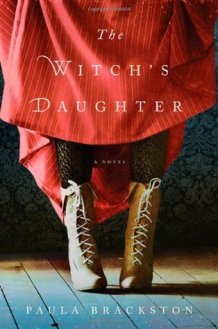
the witch's daughterThe Witch’s Daughter by Paula Brackston (Website | Twitter)

Genre: magical realism

Setting: Batchcombe, Wessex

I read it as a(n): paperback

Source: my own collection 

Length: 403 pp

Her Grace’s rating: 3 out of 5 stars

Bess Hawksmith is a young woman when the Great Plague of 1666 swept through her small village of Batchcombe. Naturally, the bereaved townsfolk need a scapegoat to blame for the losses they suffered. Bess’s mother, Anne, is a healer, so bingo! She must be a witch! The townsfolk round her up, along with another old woman who is a midwife, and hang them. The thing is, Anne really was a witch, and so is Bess. Bess flees and spends the next several centuries (she’s effectively immortal) running both from the memory of the horrific persecution as well as from the warlock who made a deal with the devil to give Bess her supernatural powers. Living a solitary life, Bess eventually finds a kindred spirit in young Tegan, a lonely teen who is drawn to Bess and her energy. But in taking Tegan under her wing, Bess inadvertently puts her in danger from Gideon, the man who has been hunting her throughout the years.

This one was, for me, SUPER slow to start. I almost quit. But then it picked up around chapter 4 or 5 and it was a very fast read from there out. I enjoyed this story a lot, though I don’t think it really had anything too unique about it. It was fairly predictable at the end, but the journey getting to the end was worth the read. I have a particular fondness for the Victorian Era, so I enjoyed that section the most. The bit from World War I was awful (an awful experience, not an awful read or awful writing). I don’t know much about that war, nor about the Battle of Passchendaele specifically, but it was an interesting, if sad and gory, part of the book. 

Overall, I think the characters were fairly well developed, but I’m not sure how much growth they really showed. Bess did mature and became a wise woman, but once she reached her maturity, she kind of stalled out. Gideon was consistently wicked but he was not a Bad Boy kind of character to me. I usually like those. Gideon was more like a cancerous presence to be cut out of a life rather than one who held any real attraction. Tegan was just a regular teen and didn’t really show anything other than that. Which is fine. They all worked for the story.

I think readers who enjoy Sarah Addison Allen or Alice Hoffman will enjoy this book. SAA and AH have more complex characters and richer storytelling, but I do think PB will get there eventually as well.

book review

Sadie

SadieSadie by Courtney Summer (Website | Twitter | IG)

Genre: YA/ contemporary fiction

Setting: Cold Creek, CO/ various other shithole small towns 

I read it as a(n): hardback

Source: my own collection 

Length: 336 pp

Her Grace’s rating: 4 out of 5 stars

Sadie is the story of Sadie Hunter, a young woman who goes missing and is presumed to have run away. However, when it is clear that she has run off after her little sister was horrifically murdered, radio personality West McCray takes an investigative journalism approach into the situation with the intent to make a podcast similar to Serial. He learns that Sadie took off with the intent of finding her sister’s murderer.

This was a fast read and I really enjoyed the format. The chapters switched back and forth between Sadie’s POV and the podcast transcript. I think it kept the story from getting too terribly overwhelmed with the unrelenting hopelessness all the characters carry with them. I’m so incredibly privileged that I don’t have to live in a shithole town with crushing poverty, a rampant drug and alcohol problem, and where the best jobs are working at a gas station. How do people not want to get out of that? It has to be a totally foreign mindset because I think I would do anything to get out. Get a job at Starbucks or Walmart, places that will help you attend college. The lack of interest even to try is beyond me. 

Anyway, Sadie’s story is tragic and heartbreaking and I wouldn’t wish her life on anyone. I usually love a good, ambiguous ending but in this case, I did want to know more. The book left me feeling unsatisfied with the end, as though the novel was incomplete or that the author just got tired of writing and ended it. Even adding in a small clue of some kind could have made it more properly ambiguous. But on balance, I liked this book and think it’s something a lot of young folks would benefit from reading. It’s a great example of how fiction helps to build empathy.

book review

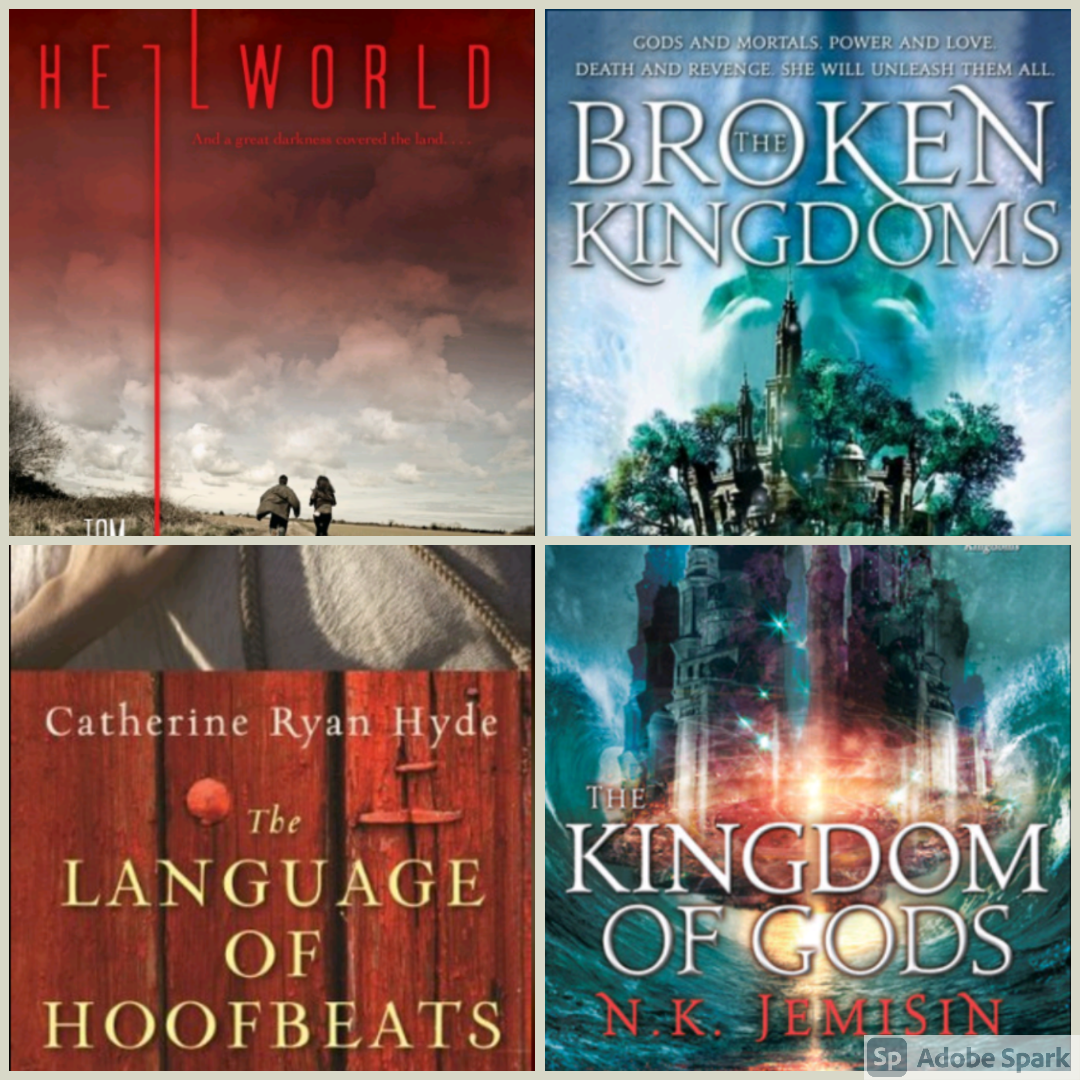
Catch-up Lightning Round: The Language of Hoofbeats, Hellworld, The Broken Kingdoms, and The Kingdom of Gods

Adobe_Post_20211105_0708420.02021520360969087

The Language of Hoofbeats by Catherine Ryan Hyde (Website | Twitter)

Genre: contemporary fiction

Setting: Easley, CA (fictional podunk town)

I read it as a(n): audiobook

Narrator: Kate Rudd and Laural Merlington

Source: my own collection 

Length: 10:27:00

Her Grace’s rating: 3.5 out of 5 stars

I liked it more than the typical 3-star book but not as much as a 4-star. So, 3.5 stars! I’m so smrt. 🤪 A lesbian couple, Jackie and Paula, moved to a small town with their adopted son and two foster children. Across the road from their new digs lives Clementine, the town shrew. She hates everything and everyone and blames it on her daughter’s suicide which, frankly, I think is totally valid. I would hate everything and everyone, too. But she apparently was always like that and she ends up driving her husband away and her treatment of Comet, her daughter’s horse, causes Star, Jackie and Paula’s troubled foster girl, to run away with him. Various dramas ensue and in the end, Clementine decides to be nice, just like that, and everything turns out bright and shiny.

For a piece of fluff, this was good. I liked the kids and their histories and I think it was nice that they weren’t written as all escapees from Hell or a mental asylum, nor that they automatically fit right in and adapted to being a foster kid. I thought Jackie and Paula were well developed enough that they were different on the page, but overall they were fairly one-dimensional. Clementine had development, but I didn’t find it all that believable. Still, she was the most richly-depicted adult in the book, a character you love to hate. I would read more by this author, though I’d probably get it from the library rather than spend my own money on it.

Hellworld by Tom Leveen (Website | Twitter | IG)

Genre: horror

Setting: mostly Tucson, AZ

I read it as a(n): hardback

Source: my own collection 

Length: 297 pp

Her Grace’s rating: 3 out of 5 stars

This was a fast read. I like to support local authors and I bought this one and another of Leveen’s books at a local book festival a couple years ago. So that was fun. He is a delightful human being from what I could tell. And I did enjoy this one, but I generally have a very hard time with most horror. Not because I get spooked – I don’t. It’s because I can’t suspend my disbelief. It’s why I don’t like werewolf or zombie or even sexy vampire stories all that much. They simply aren’t believable to me. Why I have a hard time suspending disbelief for horror and not for the billions of SFF books I’ve read over the years, I have no fucking clue. 

That said, I really liked the vast majority of this book. It was told in a sort of back and forth timeline, the same characters living in the moment for one chapter and then the next chapter being set X number of days, weeks, or months ago. I thought the characters were nicely developed for a genre novel. That’s not shade – genre novels don’t focus as much on character development, but these characters all felt like they had a history and experiences that made them people, not just templates of people like you find in a lot of genre novels. The crux of the plot is that four teens lost their parents a number of years ago while filming a show that sounds similar to Ghost Hunters. They were exploring a cave in the Arizona desert and never came out. The kids go gallivanting off to find them, but whoops! Instead they accidentally open an ancient ark of some kind that lets out gigantic monster bug things that can shoot lasers and fireballs and they start annihilating nuclear power plants, hospitals, schools, and news organizations. You know. Kind of like the Republicans want to do.

I’m not entirely sure the whole story isn’t actually an analogy about the GOP, in fact…

The Broken Kingdoms and The Kingdom of Gods by NK Jemisin (Website | Twitter)

Genre: fantasy

Setting: The city of Shadow, in the Hundred Thousand Kingdoms

I read it as a(n): audiobook

Narrator: Cassaundra Freeman

Source: my own collection

Length: 11:25:00 / 16:58:00

Her Grace’s rating: 3 out of 5 stars

(The Broken Kingdoms) A blind artist called Oree takes in a homeless man who glows. She can see some things like magic and the homeless man, who Oree names Shiny since he won’t tell her his name, throws magic all over. Also, someone is murdering godlings and now Oree is smack in the middle of it thanks to her act of kindness. Shiny happens to be Itempas, so you know things are going to get weird.

(The Kingdom of Gods) The gods of the Arameri are finally free and now they’re pissed, but they’re also all that is keeping the world from descending into unending war and annihilation. Good times. This one is told from the perspective of the godling Sieh, who has been changed into a mortal and is aging in leaps over time.

As always, crazy rich world-building and awesome characters in both of these books. I will want to read them again one day, only with my eyeballs, because the narrator was what kept these from being 4 star books. Her voice was too calm and unchanging and I found myself bored of listening to her. Once, someone ripped a heart out of someone else’s chest with their bare hands – and I missed that at first because there was just no emotion or anything to indicate exciting action in her voice. 

I really love Jemisin’s writing. It’s so complex and descriptive. She takes familiar fantasy tropes and turns them on their head. Some people might think that is heretical but I think it’s brilliant and it makes for a wholly new reading experience. One should never assume she will let the good guys win or allow a happily ever after in her books. I really, really appreciate that. She has said that she set out to subvert the genre and she has been successful in doing so.

book review

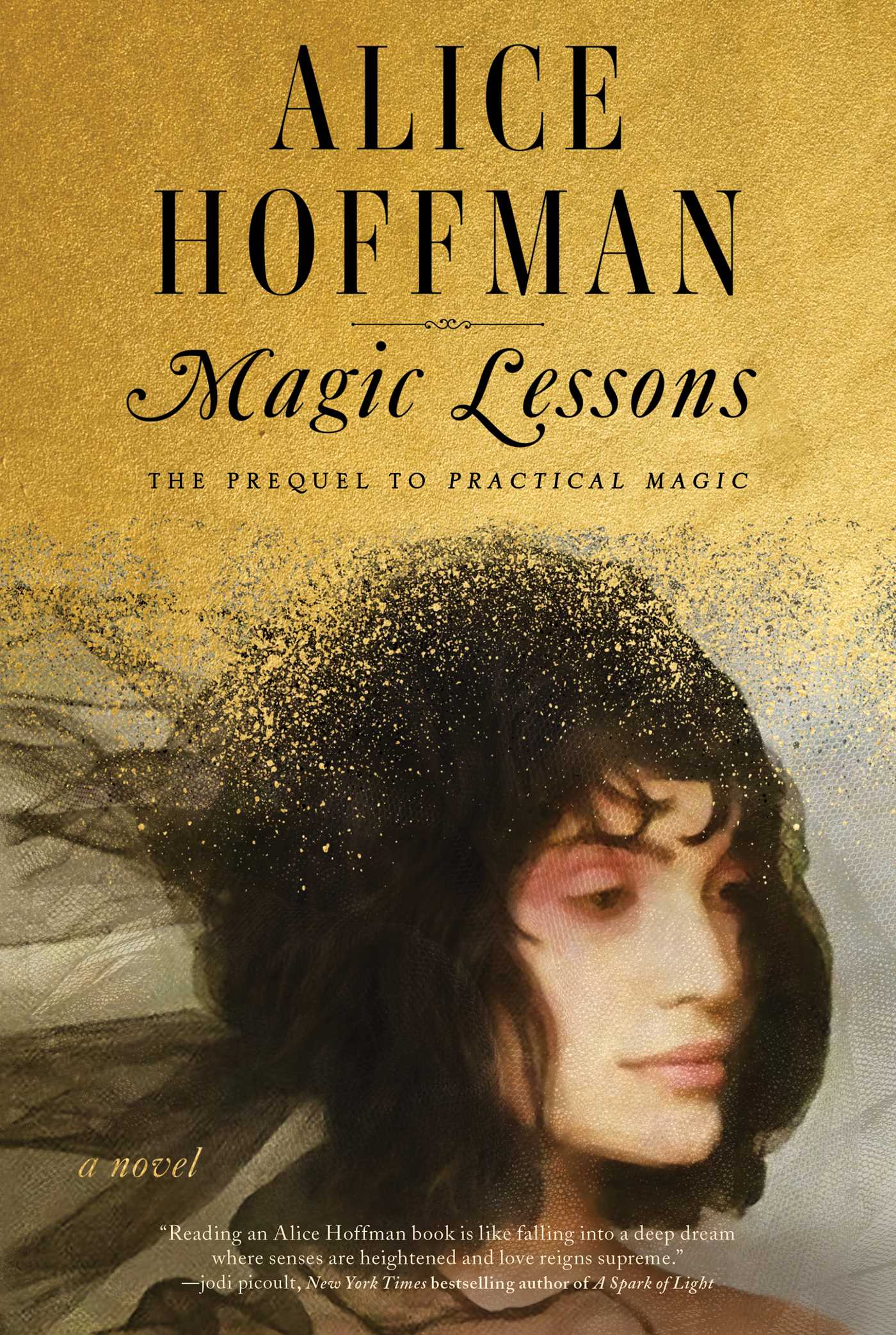
Magic Lessons

Magic LessonsMagic Lesson by Alice Hoffman (Website | Twitter | IG)

Genre: magical realism

Setting: New England Colonies

I read it as a(n): hardback

Source: my own collection 

Length: 396 pp

Published by: S&S

Her Grace’s rating: 4 out of 5 stars

At long last, the story of Maria Owens, the witch they couldn’t hang. Maria was abandoned as an infant in Essex County, England, where she was found and raised by the kind hearted Hannah Owens. Hannah taught Maria all she knew of healing and folk magic, but Maria, as it happens, was a witch by birthright. All Hannah taught to her was compounded by her latent magic talent. When a horrific tragedy occurs, Maria flees England for Curacao. There, she finds love and follows that to New England. And the rest, as they say, is history. Or is it magic?

I fucking love the Practical Magic series. I could probably conclude my review with that. But I’m also a sucker for a good back story, which this is. I always wanted to know what happened to Maria, how she got tricked by a man who left her, where she was from, and where she went after her failed hanging. I could talk about those things. I could talk about Maria’s history, her experiences, what she learned and taught. I could talk about the history of witch trials and women’s power. But I think it would be better for you to go read it and find out for yourself why this is such a great book. 

Favorite lines/ scenes/ characters (potential spoilers!):

  • This was true magic, the making and unmaking of the world with paper and ink (13). 
  • “Never be without thread,” she told the girl. “What is broken can also be mended” (55).
  • Tell a witch to go, and she’ll plant her feet on the ground and stay exactly where she is (164). [Yep. Don’t tell me what to do.]
  • Tell a witch to bind a wild creature and she will do the opposite (184). [I told you, don’t tell me what to do!]
  • Arnold, the horse who belongs to the peddler Jack Finney, is my favorite. He is a good boy.
  • These are the lessons to be learned. Drink chamomile tea to calm the spirit. Feed a cold and starve a fever. Read as many books as you can. Always choose courage. Never watch another woman burn. Know that love is the only answer (396).
book review · fantasy

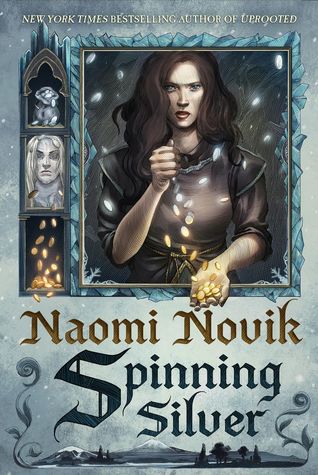
Spinning Silver

spinning silverSpinning Silver by Naomi Novik (Website | Twitter )

Genre: fantasy

Setting: someplace very like Russia

I read it as a(n): hardback

Source: my own collection 

Length: 466 pp

Published by: Del Rey (2018)

Her Grace’s rating: 4 out of 5 stars

Miryem’s father and grandfather are moneylenders. Her grandfather is good at it; her father, not so much. Tired of living in poverty and seeing her parents be taken advantage of, Miryem takes it upon herself to begin collecting the debts her father is owed. She is so good at it that the people of her town grumble that she can change silver into gold. This, unfortunately, draws the attention of the Staryk king, a being from a snowy alternate world where gold is precious. He takes Miryem and commands that she change all his silver into gold.

Irina is the daughter of a duke, not beautiful and viewed only as a pawn by her father. Through a set of jewelry with magical properties, Irina becomes beautiful to all who see her, except to the tsar, a young man she’s known since childhood and who is cruel. Naturally, her father contrives to marry her to the tsar.

Wanda is a peasant in Miryem’s town. When her father is unable to pay his debt, Miryem allows Wanda to come work for her family to help repay it. Over the course of the months, Wanda and her brothers become family to Miryem. Their love and aid help Miryem and Irina to rid their land of a horrible demon that is hell-bent on feeding on Irina – unless she can bring him a snow king.

I loved this book. I don’t know why it took me so long to get around to reading it, but I’m glad I did at last. I liked Novik’s earlier novel, Uprooted, well enough, though I remember not being thrilled with the verbal and mental abuse the dragon put the protagonist through. This book didn’t have that. What it does have are three very strong young women who are each, in their own ways, selfless and put the needs of their loved ones, whoever they may be, before themselves. Naturally, I like books that show women banding together for a common goal. Sometimes, it goes overboard and shows them being selfless to the point of overwriting their own needs or personalities, but that didn’t happen in this novel. I think it showed a good and necessary balance between helping others and helping oneself. 

The plot with the tsar and how he got his demon was a great twist. I didn’t see that coming and it added a lot of dimension to his character. He wasn’t just a flat character that is so common in folktales, purely good or purely evil. 

I liked, too, how Novik wove in a lot of Jewish culture and stories with this. I think it was a great blend of cultures and tales – Jewish culture, the girl who could spin straw into gold, and Russian Baba Yaga and Chernobog folktales. I definitely recommend this one. I should check out Novik’s Temeraire series one of these days!

Favorite lines (potential spoilers!):

  • (Irina considering political marriages): But he wasn’t a fool, or cruel. And more to the point, I was reasonably certain he wasn’t going to try and devour my soul. My expectations for a husband had lowered (229-230).
  • I had never seen any Jew but Miryem’s family before except the woman on the line and her son. Now I did not see anyone else. It was a strange feeling. I thought that when Miryem had to go to the Staryk Kingdom maybe it was like this for her. All of a sudden everyone around you was the same as each other but not like you. And then I thought but it was like that for Miryem already. It was like that for her all the time in town. So maybe it hadn’t been so strange (303).
  • But I won’t ever tell you what it is (466). [My favorite last line of a book in a good long while.]
book review

The Whisper Man

the whisper manThe Whisper Man by Alex NorthTwitter )

Genre: mystery

Setting: Featherbank (fictional, England)

I read it as a(n): hardback

Source: my own collection 

Length: 355 pp

Published by: Celadon (2019)

Her Grace’s rating:  out of 5 stars

The Whisper Man by Alex North is a fast-paced, engaging novel about a widower and his young son. Deciding they need a fresh start after his wife’s sudden death, Tom Kennedy and his son Jake move to the countryside village of Featherbank. Or send an ideal setting, but it has a dark past that is coming back to life. 20 years ago, a serial killer murdered give young boys. Detective Pete Willis thought the like was caught and put away, but now another boy was murdered in the same manner. The killer has his sights set on Jake next.

As not only a single parent but my child’s sole parent, this book gave me anxiety. I cannot imagine anything worse than for your child to go missing. It would even be worse than if they died because then at least you would know it instead of wondering where they were or what was happening to them. If they just disappeared you couldn’t even kill yourself because what if they turn up the next day? 

Also, no. I totally don’t have anxiety. /sarcasm

I think the thing I liked most about this book is how it captured a lot of parental guilt, feelings of inadequacy, and helpless uncertainty. Mothers are very often depicted with these feelings but I haven’t come across many books that assign these emotions to fathers. I think that’s a good thing to discuss. Normalize men feeling uncertain and insecure in their parenting choices as well as women. It’s ok for fathers to think they’re completely fucking up their kids just as bad as mothers think they are.

Parental feelings of utter failure aside, this plot was fun (side from the crippling anxiety it instilled in me and the fact that it was centered around killing children) and well written. I’m not really sure why I like murder mysteries, to be honest… 

Favorite lines (potential spoilers!):

Courage is not the absence of fear, Pete knew. Courage requires fear (63).

book review

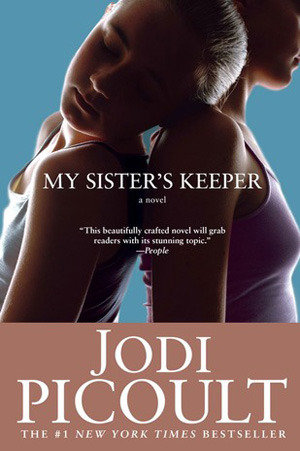
My Sister’s Keeper

my sister's keeperMy Sister’s Keeper by Jodi Picoult (Website | Twitter | IG)

Genre: contemporary literature

Setting: Providence, RI

I read it as a(n): MMP

Source: my own collection 

Length: 500 pp

Published by: Pocket Books (2004)

Her Grace’s rating: 4 out of 5 stars

**Yeah, I’m gonna go ahead and smack a great big SPOILER ALERT on this whole review. Read at your own risk, you’ve been warned**

Thirteen-year-old Anna Fitzgerald loves her sister, Kate, who has a rare form of leukemia. But that doesn’t mean she is willing to donate a kidney to her on top of everything else she’s already had done to her. Anna was born via in vitro specifically so that she could be a donor for Kate. To be fair, her parents only wanted to use her cord blood to help Kate and everyone thought that would be the end of it. Turns out, it was only the beginning of years of blood, bone marrow, and other body part donations to Kate. Now Anna is suing her parents for medical emancipation, for her right to control her own body, even if it means Kate dies as a result.

Somehow I have missed the Jodi Picoult fandom; this is the first book of hers I’ve ever read. I can see why she is so popular! I sat my ass down and read this entire 500 page book in one day. I found her writing to be engaging and the story compelling. I look forward to reading more of her books in the future. 

The appeal of this one was how easily I could see and sympathize with all sides of the situation. There is so much to talk about regarding medical and scientific ethics. I don’t think anyone know what they would do in certain circumstances until they found themselves in it. I’m not sure I would have a whole other baby on the off chance their cord blood was curative. But then I also don’t have a child with a rare, treatment-resistant form of leukemia, either. Maybe I would have had baby after baby until one was a match, or gone the route the Fitzgeralds took and basically had a designer baby who would be a perfect match. I just don’t know. And neither do you, unless you’ve already lived it. 

I am not sure what I would feel about discovering that the cord blood only worked for a while and now the leukemia is no longer in remission, thus needing to turn to the younger child again for more blood and platelets. Or for that to be the constant situation. Or to have both children in the hospital because one has leukemia and the other is recovering from whatever else was done to her to donate blood, marrow, and other body fluids to the other. 

I really don’t know what I would do if my child was guaranteed to die without a new kidney, but might not make it off the table even if she did get her sister’s organ. I don’t know how to weigh the almost-certain death of one child against the life-long risks associated with losing one kidney for the other child, not to mention that the kidney donation itself is a major surgery with many weeks of recovery time required. 

And poor Jesse! Who is Jesse? He’s Anna and Kate’s brother. Yeah, his parents and usually his sisters forget about him all the time, too. I’d act out if I were in his shoes. I don’t need to have lived the same experiences to know at least that much. 

The parents of these kids were given the short straw for sure. But so did their children. This isn’t Never Let Me Go or The Unit. We don’t breed or keep people for the sole purpose of giving other people their organs. I know they only thought they would need Anna’s cord blood. But it still feels morally wrong to me to have a baby even for that one-time donation. I think if I were that kid, I would probably feel very used and mostly unwanted, that I was only here because of that and otherwise, they didn’t want me in the first place. 

I liked the lawyer, Campbell Alexander, for taking on Anna’s case for free, partly because of his own lack of control over his body and partly because Anna refused to take no for an answer. He did his job and won her case and then had to use his new Power of Attorney over Anna in the most heartbreaking way. This ending, BTW, was entirely different in the film version of this book, which I watched after I finished reading it. The movie ending sucked. The book’s end was so much more poignant. I can’t fathom why on earth the screenwriters would change it.

In the end, I loved this book for its multitude of ways it got me thinking. The fact that it was written in such an engaging and easy manner, with characters who I cared about, made it that much better. I am looking forward to reading more books by Picoult. That’s one good thing about coming to the party so very late – now I have a plethora of her books to choose from!

book review · fantasy · sci-fi

Binti: The Complete Trilogy

BintiBinti: The Complete Trilogy by Nnedi Okorafor

Genre: sci-fi

Setting: Earth, Ooma Uni, and spaaaaaaaaace!

I read it as a(n): paperback

Source: my own collection 

Length: 358 pp

Published by: Daw

Her Grace’s rating: 3 out of 5 stars

Binti is a young woman from Earth, a member of the Himba people of Namibia. She is what is known as a master harmonizer, a person who has a skill in bringing balance to all, usually through math. Her role is to succeed her father as her tribe’s master harmonizer. However, that is upended when Binti is accepted into the prestigious Oomza Uni, an entire planet devoted to learning. Binit runs away against her parents’ wishes to study, but while her ship is en route, it is attacked by the warlike Meduse, leaving her the traumatized only survivor. Binti eventually forms a bond with Okwu, one of the Medusae from the attack, and a link is created between their two peoples, paving the way for an unusual peace.

I read these novellas in the form of an omnibus paperback, so I can’t really separate the three stories in my mind. To me, they’re all one story. But, as always, I am impressed with Okorafor’s skill in creating such rich characters and culture in a relatively short span of pages. The Himba people are not fictional; they have a long and complex culture from which Okorafor could draw. But she fleshed out the people in ways that made them entirely real. I cared about every character on the page, which is a rare thing for me. 

I loved Binti’s search for herself, her bravery in leaving the only home she’d ever known in an attempt to create a different life for herself. The act of leaving home, becoming independent, learning new things about yourself is one of the best gifts we can give ourselves. I feel bad for people who never experience that in any way. 

The ways that humans and the Medusae were at conflict and how they resolved their problems is sadly still a relevant metaphor for human society as a whole. We seem plagued with people, whether groups or individuals, who only care about enriching themselves or enforcing their agenda and worldview. There isn’t enough peace anywhere. So much can be said about this but, as I’ve said for years, SFF is an ideal medium in which to discuss real-world issues. Binti is no different. There were many themes that made me think: home, community, identity, conflict, colonialism, friendship. I’m sure examinations of these themes and more could be made, and wind up longer than the book itself. I love that; books that make me think while also providing a good story are to be treasured.

Overall, I liked this story, though I think I enjoyed Okorafor’s other works that I’ve read a little more. This trilogy (plus the short story included in the omnibus edition) seemed to focus more on how to fit in social issues than how it impacts the plot, so I think there are some gaps that need to be filled. But still, the Binti trilogy is a terrific story and one I definitely recommend. 

Favorite lines:

  • Will his happiness kill him? (Okwu asked this without a hint of irony or sarcasm. Me, too, Okwu. Me. Too. Deeply suspicious of happiness.)
book review · fantasy

The Hundred Thousand Kingdoms

the hundred thousand kingdomsThe Hundred Thousand Kingdoms by NK Jemisin (Website, Twitter)

Genre: fantasy

Setting: the city of Sky

I read it as a(n): audiobook

Narrator: Cassaundra Freeman

Source: my own collection 

Length: 11:47:00

Published by: Daw 

Her Grace’s rating: 3 out of 5 stars

Yeine Darr is the daughter of a disgraced noblewoman of the Arameri, the rulers of the Hundred Thousand Kingdoms. Their seat of power is in the city of Sky. Yeine is summoned to Sky by her grandfather, her mother’s father, who is also the ruler of the Arameri. To her utter shock and horror, he names her as one of his three heirs to the throne. Now she will be expected to compete against two cousins she never knew for the throne. While she is learning the ways of Sky, rife with political machinations and corruption, Yeine also learns that several gods are held by the Arameri as slaves after they lost to the god Bright Itempas in the Gods’ War. Now those gods are bitter, unsurprisingly, and they have a plan to help Yeine win in her struggle for the throne.

This first instalment in Jemisin’s The Inheritance Trilogy is, in many ways, a pretty typical fantasy narrative: a young warrior woman loses her family, is named an heir to the kingdom, falls in love with a god, is used as a pawn by a variety of people, and eventually is victorious. But Jemisin sort of upends a lot of traditions as well, which was her stated goal in writing her novels. 

The people who were the ruling class, the Arameri, were the highest class because the high priestess of the goddess Itempas was an Arameri when the Gods’ War occurred millennia ago. So that part makes sense within this story. I really like how Jemisin then creates a society that is more and more corrupt the closer one gets to the gods. I don’t think it is untrue at all here, but it is certainly not what most people want to believe. This story tackles it head-on. 

The world building in this novel is amazing. That is one of the best things about Jemisin’s writing. I did find it a little hard to keep track of at times, which might be partly because I listened to the audiobook rather than eyeball reading this one. Sometimes the dialogue was not well marked that I could tell, so I wasn’t sure who was speaking for kind of big sections of discussion. But I’m not sure, again, how much that is a function of listening to the book instead of reading it. 

In line with the rich world building are many, MANY different themes. Off the top of my head, there is slavery, colonialism, racism, power, tradition, and religion. These are intricately woven throughout the entire narrative in ways that are sometimes startling or subversive. It’s a great way to get readers to think about many things we believe and hold dear without really knowing WHY we do. So many traditions in this novel were followed simply because that’s what has always been done, which is of course why something is a tradition. But if a tradition blows, then you should change it or abandon it. Columbus Day, for example, isn’t a traditional holiday we should still be observing in the 21st century. It is being replaced in many states by Indigenous Peoples Day, which is far better. Change can be a good thing. 

Every single character in this book is richly nuanced and complex with the exception, I think, of Scimena Arameri, Yeine’s cousin and another potential heir. She was all hate and bitterness, all the time. I’m not too sure why this one character was so one-dimensional but I’m sure Jemisin has her reasons. I may have just not picked up on what it was. She was an easy character to despise, though. Otherwise, the rest of the cast was really interesting, even those who you don’t like. 

Looking forward to getting into the second book!

book review

Sistersong as Social Narrative

In modern society, it can feel nearly impossible to escape from news focusing on politics, social issues, or conflict. Regardless of where one falls on the social or political spectrum, there is no escaping the fact that these topics are instrumental in shaping the cultural narrative. Exploring the implications of these topics is similarly vital and, as readers of historical fiction well know, an ideal place to do so is within the pages of a book. Lucy Holland’s Sistersong examines several social and political topics through the fascinating lens of a forgotten character from a traditional folk ballad. 

Sistersong centers around three sisters, children of King Cador of Dumnonia, whom Holland interprets as the sisters from the ballad “The Twa Sisters.” Riva is the eldest of the three, scarred for life by a fire; Keyne, the middle child, battles with her family to be accepted for who she truly is; and Sinne, the youngest, is spoiled and thoughtless in her pursuit of romance. When a mysterious warrior, Tristan, arrives at their father’s stronghold with urgent news about an imminent invasion by a dangerous Saxon king, a chain of events is set off that will affect the sisters in unimaginable ways. Aided and mentored by the fictional Myrdhin, stymied by the historical Gildas, the royal sisters embark on their own journeys to become the people they were meant to be. 

Throughout the novel, there is a recurring theme of agency. “The Twa Sisters” is a murder ballad in which a man comes between two sisters and “even the bonds of sisterhood are not strong enough to withstand the sexual jealousy that leads one sister to murder the other.” Holland believes the genesis of such ballads can be placed directly from the limited role women had in society. She tackles the question of agency by giving the sisters control over their fates while also acknowledging the social role expected of them. Riva, Keyne, and Sinne, as royal daughters, were expected to marry men their father chose for them based on political alliances. This expectation is fundamentally at odds with Keyne, who identifies as male and battles daily to be recognized as such by his family. Disregarding Keyne’s identity and refusing to use masculine pronouns for him is a symptom of erasure. This misuse of language and deliberate forgetting of people because it “does not fit with the narrative upheld by the patriarchy” partially explains a lack of gender fluid or transgendered people in much of the historical record, despite evidence that these identities are not found only in the modern world. 

Holland says, “The absence of people like Keyne is indicative of the way they are written out of the dominant social narrative. In writing Sistersong, I felt it was vital to restore such people to a society in which they undoubtedly participated.” Holland envisioned Keyne’s identity as an explanation for why “The Twa Sisters” initially referenced three siblings but by the end, there were only two mentioned.

Holland’s novel begins in 535 C.E., in post-Roman, pre-Saxon Britain. She describes it as a liminal moment in time, an ideal term to apply to the political, social, and even spiritual shifts that were occurring. Further, the discovery of a Romano-British settlement near her home in Devon intrigued Holland, as well as the relative lack of primary sources and the fact that the region was one of the last in Britain to come under Saxon rule. As such, she felt that it was a “perfect setting for a folktale that would draw heavily on myth as much as history.” Sistersong balances on that fine line between myth and history, which readers see in Holland’s use of Christianity, paganism, and pure magic. This commingling of religions was not fictional. As Holland explains, the installation of Christianity into Britain “was not a smooth or straightforward process. Tensions between these two spiritualities led to a complicated fusion of beliefs…in which both religions were practiced alongside each other, vying for control of a nation’s collective soul.” Religious and political issues were also overshadowed by the steady migration of the Saxons throughout Britain. 

When dominant groups begin to shift, as they are doing in Sistersong, the intersection between the groups and the way they write the social narrative can cause a great deal of conflict. Holland exemplifies such conflict in the characters of Myrdhin and Gildas. Myrdhin is a variant of the Arthurian wizard Merlin; Gildas was a historical monk who lived in the 6th century. His major work was De Excidio et Conquestu Britanniae (On the Ruin and Conquest of Britain), which was an excoriation of the five most recent rulers and ecclesiastical leaders of his time. Myrdhin embodies the waning strength of druidism and other pagan religions in the face of the rising power of Christianity and its ability to convert kings to the new faith. Gildas reflects the sense of inevitable change that came to British society alongside his religion. The conflict between Myrdhin and Gildas was natural – they did represent opposing religions, after all – but Holland admits that her portrayal of Gildas might have been “overly influenced by his vitriolic treatise.” She is quick to point out, though, that she didn’t intend for him to be the stereotypically evil priest common to historical fantasy: “I am sure he believed wholeheartedly in the benefits that Christianity could bring to Britain; it’s this belief that directs his actions in the book. He is guilty only of intolerance…but it’s worth remembering, of course, where intolerance can eventually lead.” 

There are so many pertinent topics covered in Lucy Holland’s enchanting novel, Sistersong, proving again that historical fantasy is an excellent medium in which to examine them. The issues that occupy our thoughts today are much the same as they were in early medieval Britain, at least in this beautifully written novel. Holland’s skill brings to life a mysterious period of history and shows that history, myth, and folklore can intersect in wonderfully relevant ways. 

This article was originally published by the Historical Novel Society: Sistersong as Social Narrative