Book review · historical fiction · Medievalism

The Land Beyond the Sea

31568110The Land Beyond the Sea by Sharon Kay Penman (WEBSITE, FACEBOOK)

Her Grace’s rating:  5 out of 5 stars

Genre: historical fiction

I read it as an: ARC

Source: Edelweiss+

Length: 688 pp

Published by: Putnam (3 March 2020)

Many people are at least a little familiar with the Crusades, Richard the Lionheart, and Saladin. Far fewer, I would wager, know about the life of Balian of Ibelin, a Frankish lord born in the Levant. Penman tells his story in The Land Beyond the Sea. The timespan of the novel is actually fairly short, beginning when Balian is a young man. Penman takes readers on a journey among the Poulain, the people born in the Levant and descended from the Crusaders who remained in the region after the First Crusade; she shows us the complex and surprisingly collaborative interactions between the Poulain, the migrant Crusaders, and the Saracens, which influence the local politics to an extraordinary degree; and she demonstrates, above all else, that history is not always what we’ve learned from school. 

Balian’s story here starts with his relationship with King Baldwin, known to history as The Leper King. The two had a relationship built on respect and Balian rose high at the court in Jerusalem as a result of Baldwin’s favor. Balian also had a good relationship with Saladin himself, as well as his brother, Al-Adil, one of Saladin’s most trusted advisors. These relationships came into play at the height of Balian’s influence, when he convinced Saladin to accept Jerusalem’s peaceful surrender after a prolonged siege that would have left thousands of civilians dead or sold into slavery. 

The labyrinthine politics of the court are described in detail and were an interesting change of pace, for me anyway, from the court politics I’m more used to reading about. I understand the politics of periods like the Wars of the Roses, the Tudors, or the Plantagenets, but I had never read anything set in the medieval Levant. Penman does a thorough and highly accurate job of showing these twisting intrigues. It was a bit surprising to me to learn how much the European and Saracen societies mingled and cooperated with one another. I think I had this vague notion that the two societies were mostly segregated from each other because of the religious wars between them. I think my favorite thing was learning just how closely tied the societies were and how much they had in common. Though, really, that shouldn’t surprise me at all, since rationally I knew the region was something of a melting pot; I just hadn’t really thought much about it. 

Related to that, I was fascinated by the way they treated each other. For example, once Saladin accepted Jerusalem’s surrender, he allowed the people to put forth a ransom rather than have them all shipped off to the slave markets in Cairo. Of the roughly 15,000 people who were too poor to help raise a ransom and would have been sent into slavery, he released 7000 of them, then granted his brother, Balian, and Patriarch Eraclius gifts of 1000 slaves each, which they immediately manumitted. The way the Saracen guards/escorts treated the group who was able to leave Jerusalem was also wonderful to read. They took good care to protect them, even though they were defeated enemies; however, Saladin had ordered them to treat them well, and so they did. In Penman’s extensive Author’s Note, she indicated, rightly, that she would have been hard pressed to believe that if it had been described so only in Saracen chronicles, but the description came from several Christian chronicles. 

Also, Penman has a great talent for taking her characters, whether fictional or historical, and making readers care about them. I was so sad when William of Tyre died; I felt awful for and was sad when Baldwin died, because he was so brave in facing his illness; I was furious when Guy de Lusignan did, well, all the stupid things he did; I loved and was grateful to Anselm for his unflinching service to Baldwin. So many other examples. Even though these people, the ones who were real anyway, died nearly 1000 years ago, Penman breathes life into them, brings them springing forth with their wonderfully messy, complex, endearing, irritating humanness. 

All in all, while I have come to expect nothing short of amazing writing and research from Sharon Kay Penman’s books, it is nevertheless a delight to dive into a new book of hers and discover that her reputation as a precise and vivid storyteller remains intact and well-deserved. 

Favorite part/ lines (potential spoilers!):

  • “You can get Amalric to pay his ransom.” Others might have found that answer cold, uncaring. Agnes did not. Her mother was simply recognizing the reality confronting them, as women had been compelled to do down through the ages. 
  • William suddenly found himself on the verge of tears, almost as if he knew he’d just been given a precious gift, a memory of the young king at a perfect moment in his life, one that held no shadows or dread, only bright promise. 
  • “This is the first course, honey dates stuffed with almonds. I am sure you’ll like them if you give them a try.” Balian leaned over and put a date on the other man’s plate. The knight let it lie there untouched. He was gazing at it as if it were offal, not a delicacy sure to please the most demanding palates, and Balian began to entertain a fantasy in which he held Gerard down and force-fed him every date in Outremer. 
  • He gestured toward the arrow with a grimace, saying it was only a flesh wound. [Was this a deliberate reference to Monty Python and the Holy Grail?? If so, well played, Ms Penman, well played.]
  • Almost as if sensing how dark his thoughts had become, Cairo padded across the chamber and nudged Baldwin’s hand with a cold nose. He’d noticed years ago that the dog never touched his right hand, the one without feeling; it was always the left, crippled but still capable of sensations. How did Cairo know? [Another thing I love about Penman’s writing is how she always portrays the dogs as noble and loving. Dogs are so much better than we are. We do not deserve dogs.]
  • [Balian playing with his children upon arriving home from battle] Once his father had boosted him up onto his shoulders, he whooped with delight, and for reasons he was too young to understand, that moment imprinted itself upon his memory. Long after he was grown, with sons of his own, he would recall very little of their flight from Nablus. But he would vividly remember the afternoon that his father came home and made him fly.
  • He wondered if the other man had acted impulsively, moved by the misery of the enslaved Franks. Or had he always intended to make this request, confident that his brother would welcome an opportunity to display mercy again? … Balian smiled, realizing he’d never have the answer to that question. He could answer another question, though, one that he’d pondered since their first meeting in Salah al-Din’s tent at Marj al-Safar. They shared neither the same faith nor the same blood. But al-Malik al-Adil Saif al-Din Abu Bakr Ahmad bin Ayyub was his friend. 


books

Read Harder 2020 plan!

br_rh2020_fb-1024x536-1
Read Harder Challenge. Image credit Book Riot, https://bookriot.com/2019/12/03/2020-read-harder-challenge/

Yay, it’s here! Read Harder 2020 is here! I look forward to this list every year. In part, I just like to see what the brains at Book Riot have come up with, and in part, I love to put together a plan for myself for how to cover the tasks. Additionally, I try to make it more feminist by finding books to cover each task that are written by women or authors who identify as women. For various reasons, this doesn’t always happen, but I try hard to make it so. #RequisiteStarTrekReference

So, what do we have this year? How will this pan out? I am thinking of the following: 

  1. Read a YA nonfiction book: #NotYourPrincess by Lisa Charleyboy or How Dare the Sun Rise by Sandra Uwiringiyimana
  2. Read a retelling of a classic of the canon, fairytale, or myth by an author of color: Boy, Snow, Bird by Helen Oyeyemi OR One Thousand and One Nights by Hanan Al-Shaykh. Probably the 1st one since I’ve owned it forever and haven’t got round to reading it yet.
  3. Read a mystery where the victim(s) is not a woman: The Appraisal by Anna Porter OR The Distant Hours by Kate Morton OR Behind the Scenes at the Museum by Kate Atkinson
  4. Read a graphic memoir: Photographic: The Life of Graciela Iturbide by Isabel Quintero
  5. Read a book about a natural disaster: Wave by Sonali Deraniyagala OR Salvage the Bones by Jesmyn Ward 
  6. Read a play by an author of color and/or queer author: Angels in America by Tony Kushner. Mostly because I know Jason Isaacs (Twitter) was in this play at one point. Carrying on with my hardcore Jason Isaacs (Insta) crush. 
  7. Read a historical fiction novel not set in WWII: The Land Beyond the Sea by Sharon Kay Penman. Also, this task is funny to me, as ALL the HF I read is set in a time other than WWII. Is there really that much WWII HF? LOL. I’m already reading this one, so I might as well use it for this task; I won’t get it finished before the new year, so I reckon it counts.
  8. Read an audiobook of poetry: If They Come for Us by Fatimah Asghar OR The Poets’ Corner by John Lithgow
  9. Read the LAST book in a series: Big Sky by Kate Atkinson (don’t know if it is the LAST, last, but it is the most recent one out in the Jackson Brodie series). Also, DID YOU KNOW that there is a TV series of these books called Case Histories? It stars… wait for it… Jason Isaacs! Dear god, that man’s eyes… 
  10. Read a book that takes place in a rural setting: Gilead by Mary Robinson OR The Miseducation of Cameron Post by Emily Danforth
  11. Read a debut novel by a queer author: How to Survive a Summer by Nick White OR Jonny Appleseed by Joshua Whitehead OR Bright Lines by Tanwi Nandini Islam
  12. Read a memoir by someone from a religious tradition (or lack of religious tradition) that is not your own: Muslim Girl by Amani Al-Khatanahtbeh OR Educated by Tara Westover. Every religion is different for me. Hardcore atheist…
  13. Read a food book about a cuisine you’ve never tried before: Longthroat Memoirs: Soups, Sex and Nigerian Taste Buds by Yemisi Aribisala OR Notes from a Young Black Chef: A Memoir by Kwame Onwuachi (both Nigerian chefs). This was hard for me even to find some since it turns out I’ve eaten a LOT of different cuisines, and many that I haven’t seem not to have any books written about them.
  14. Read a romance starring a single parent: Maybe Home Again by Kristin Hannah, mostly because someone gave it to me and so I don’t have to look for something else. I really don’t know yet since I am definitely not a romance reader. I might pick one from this list because it’s awesomely comprehensive: Smart Bitches, Trashy Books
  15. Read a book about climate change: Salvage the Bones by Jesmyn Ward (double dipper!) OR The Sixth Extinction by Elizabeth Kolbert
  16. Read a doorstopper (over 500 pages) published after 1950, written by a woman: The Land Beyond the Sea by Sharon Kay Penman (double dipper!)
  17. Read a sci-fi/fantasy novella (under 120 pages): Every Heart a Doorway by Seanan McGuire OR Last Summer at Mars Hill by Elizabeth Hand. Probably the 2nd. I love Elizabeth Hand; her stories are so fucked up.
  18. Read a picture book with a human main character from a marginalized community: No idea. I’ll probably just wander around the kids’ section at the bookstore and pick one while my daughter is browsing.
  19. Read a book by or about a refugee: Inside Out and Back Again by Thanhha Lai (because my daughter already has it, so that’s convenient) OR The Silence and the Roar by Nihad Sirees
  20. Read a middle grade book that doesn’t take place in the U.S. or the UK: Inside Out and Back Again by Thanhha Lai (double dipper!) OR Sweetness in the Belly by Camilla Gibb. Probably the 1st since the 2nd seems a little older than middle grade.
  21. Read a book with a main character or protagonist with a disability (fiction or non): House Rules by Jodi Picoult or maybe Me Before You by Jojo Moyes
  22. Read a horror book published by an indie press: After the People Lights Have Gone Off by Stephen Graham Jones. Been wanting to read this one forever.
  23. Read an edition of a literary magazine (digital or physical): I have a backlogged stack of Arthuriana that will do nicely for this.
  24. Read a book in any genre by a Native, First Nations, or Indigenous author: #NotYourPrincess by Lisa Charleyboy (double dipper!) OR The Round House by Louise Erdrich

It’ll be interesting, at the end of 2020, to see how many of these books I’ve planned are the ones I actually ended up reading for this year’s challenge. 

Book review · books

Read Harder 2019 – complete!


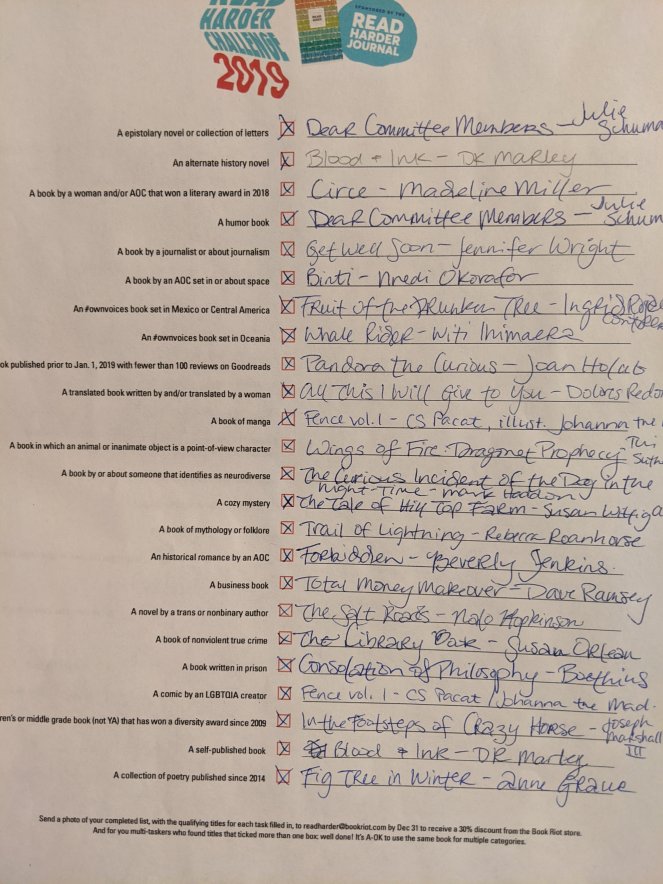
I did it! Here are the books I ended up reading for the 2019 Read Harder challenge. I am trying to write reviews for every book I read as well, although I didn’t manage to do so this year. Where I could, I linked to my review of the book.

  1. An epistolary or collection of letters: Dear Committee Members – Julie Schumacher
  2. An alternate history novel: Blood and Ink – DK Marley
  3. A book by a woman and/or AOC that won a literary award in 2018: Circe– Madeleine Miller (and the best lines from Circe…)
  4. A humor book: Dear Committee Members – Julie Schumacher
  5. A book by a journalist or about journalism: Get Well Soon – Jennifer Wright
  6. A book by an AOC set in or about space: Binti – Nnedi Okorafor
  7. An #ownvoices book set in Mexico or Central America: Fruit of the Drunken Tree – Ingrid Rojas Contreras
  8. An #ownvoices book set in Oceania: Whale Rider – Witi Ihimaera
  9. A book published prior to Jan. 1, 2019 with fewer than 100 reviews on Goodreads: Pandora the Curious – Joan Holub
  10. A translated book written by and/or translated by a woman: All This I Will Give to You – Dolores Redondo
  11. A book of manga: Fence Vol. 1 – CS Pacat, illustrated by Johanna the Mad
  12. A book in which an animal or inanimate object is a point-of-view character: Wings of Fire: The Dragonet Prophecy – Tui T. Sutherland
  13. A book by or about someone that identifies as neurodiverse: The Curious Incident of the Dog in the Night-Time – Mark Haddon
  14. A cozy mystery: The Tale of Hill Top Farm – Susan Wittig Albert
  15. A book of mythology or folklore: Trail of Lightning – Rebecca Roanhorse
  16. An historical romance by an AOC: Forbidden– Beverly Jenkins
  17. A business book: Total Money Makeover – Dave Ramsey
  18. A novel by a trans or nonbinary author: The Salt Roads – Nalo Hopkinson
  19. A book of nonviolent true crime: The Library Book – Susan Orlean
  20. A book written in prison: The Consolation of Philosophy – Boethius
  21. A comic by an LGBTQIA creator: Fence, vol. 1 – CS Pacat, illustrated by Johanna the Mad
  22. A children’s or middle grade book (not YA) that has won a diversity award since 2009: In the Footsteps of Crazy Horse – Joseph Marshall III
  23. A self-published book: Blood and Ink – DK Marley
  24. A collection of poetry published since 2014: Fig Tree in Winter – Anne Graue
Book review · sci-fi · Star Trek

Catch-Up Round: ALL the Star Trek

42853106._sx318_Star Trek Prometheus: The Root of All Rage  by Christian Humberg and Bernd Perplies 

Her Grace’s rating: 2 out of 5 stars

Genre: sci-fi

I read it as an: audiobook

Narrator: Alec Newman

Source: my own collection

Length: 08:57:00

Published by: Titan Books (22 Aug 2016)

In this second instalment, the Prometheus is still in the Lembatta Cluster, exploring the strange region of space that is home to the terrorist organization called the Purifying Flame. Something in the region is having a profound effect on the inhabitants there, including the crews of the Prometheus and the Klingon ship Bortas. Local radiation is causing crew members with telepathic abilities to lose their minds, and other crew are feeling hyper-aggressive. The Purifying Flame wants to start a galactic war, which the Federation is trying to prevent and the Klingons seem to desire. 

As with the first book in this trilogy, the second, The Root of All Rage, has some interesting elements to it. I thought it was a little more actiony in terms of Star Trek plotlines. However, it still dragged that plot out too long. There are very obvious analogies to modern-day terrorism that got a bit heavy-handed the longer the book went on. It also still employs a LOT of what feels like very racist language. People are judged based on what they look like and are called red-skin murderers and so forth. It is not in keeping with what Star Trek is about. Including things like that just to allow characters to overcome their prejudices is a lazy way to write and I expect better from Star Trek. 


42604905._sy475_Star Trek Prometheus: In the Heart of Chaos by Christian Humberg and Bernd Perplies 

Her Grace’s rating: 2 out of 5 stars

Genre: sci-fi

I read it as an: audiobook

Narrator: Alec Newman

Source: my own collection

Length: 09:59:00

Published by: Titan Books (19 Sept 2016)

In this last instalment, the crews of the Prometheus and Bortas are working to restore peace to the Lembatta region, which was impacted by a radiation that makes everyone violent. While the two crews work together, they are trying to trace a secret weapons facility but find instead that an old being from their past is behind the cycle of violence. Now they have to refocus their efforts to stop it from perpetuating violence throughout the quadrant.

Finally! The last book of this trilogy. I’m so glad it’s over. This whole story really didn’t need three books to be told. It dragged out way too long in places, and I think with better writing and editing, it could have been told in one long book, or perhaps a shorter duology. Honestly, I stopped listening to a lot of this since it was fairly repetitive. 

It got old real quick to have more famous Trek characters making cameos or having a role here at all. It felt like it was an afterthought, adding in things fans love because the rest of the plot was lacking. And as I mentioned in my reviews of the other two books in the trilogy, enough with the weird, racist comments. Constantly describing people solely by their looks – his bright blue skin, his jet black hair, his glowy eyes – got really tiresome. Yes, many being in the Trekverse are described by how they look, but in other authors’ hands, it is merely an observation and doesn’t come across as a character assessment based on those looks. 

I regret using Audible credits and my own cash to get these. I wouldn’t recommend it, and if you must read them, don’t waste your money – just pick it up at the library. 


41058420._sy475_Star Trek TNG: Available Light by Dayton Ward 

Her Grace’s rating: 2 out of 5 stars

Genre: sci-fi

I read it as an: paperback

Source: my own collection

Length: 368 pp

Published by: Gallery Books (9 April 2019)

This novel continues the plot that has taken over most of the TNG relaunch books, and much of the relaunch books across Trek series overall. In the fallout from Ozla’s explosive reporting of Section 31 and the multitude of ways in which the rogue agency has influenced the events of the Federation, the President has ordered a complete dismantling of 31 and the arrests of its operatives. It is a far-reaching system and players include Admirals Ross, Nechayev, and Nakamura, as well as Capt Jean-Luc Picard. Attorney General Philippa Louvois is in charge of leading the investigation into the charges against 31 operatives. Meanwhile, exploring in the Odyssean Pass, the Enterprise crew encounters a massive, ancient spaceship. They are on board trying to discover where it came from when a ship full of basically space pirates comes along and claims the derelict ship as their own. This triggers the ship to come to life in some new and surprising ways, including taking Tryssa Chen and a boarding party from the pirate ship into the lost depths of the massive ship. 

It sounds a lot more interesting than it really was. I was about 75% of the way through this before I felt it started picking up the pace. Overall, it was an unexpected disappointment. I felt like the A Plot was too drawn out and, frankly, done before, and the B Plot was more interesting and should have been the A Plot. I saw one reviewer who commented that it felt like DRGIII had made a guest writing appearance, which isn’t a good thing. As it was, it was really truncated by comparison to what it could have been. Maybe the next book will have more on the 31 trials and so forth. Right now, the Trek books that are winning for me are ones by Una McCormack and the Discovery novels, mostly because Discovery is still new and exciting and hasn’t been done to death yet. 

Book review

Fig Tree in Winter

38465750._sy475_Fig Tree in Winter  by Anne Graue (WEBSITE, TWITTER)

Her Grace’s rating:  5 out of 5 stars

Genre: poetry

I read it as a: paperback chapbook

Source: my own collection

Length: 36 pp

Published by: dancing girl press (2017)

As part of the 2019 Read Harder challenge, I chose this book to complete the task for ‘read a collection of poetry published since 2014.’ I am the first to confess that I rarely read poetry and I am often confounded by it. However, in the interests of full disclosure, Anne is a friend of mine so it felt natural to want to use her book to complete this task; friendship aside, though, I find her poems to be beautifully feminine and strong as well as challenging. 

Anne was the person who taught me what found poetry is. I was delighted to learn this, because it was something I had done for ages and ages, from childhood, and just didn’t know there was a real name for it. I find it to be a really stunning form of art and would like to learn more about it, maybe even try some of my own, just for a new thing to hang on my library wall if nothing else.

I don’t really know how to review poetry. I think that this collection, though, has a strong theme of feminism and lost innocence to it. Many of the poems evoke feelings of nostalgia for our younger selves, for wishing we had known then what we know now, and more than a little disappointment and heartbreak at the way things turn out in the end. My favorite poems in the collection are ‘A World Divided’, ‘the asylum’, and ‘The Cure for Thinking’. These, to me, sum up so much of a woman’s experience that it is a little shocking to find in such a few brief lines.

Book review · sci-fi · Star Trek

Architects of Infinity

Architects of Infinity book coverArchitects of Infinity by Kirsten Beyer 

Her Grace’s rating:  out of 5 stars

Genre: sci-fi

I read it as an: mass market paperback

Source: my own collection

Length: 388 pp

Published by: Pocket Books (27 March 2018)

**Spoilers ahead!**

In Architects of Infinity, the Full CIrcle fleet is dying for some down time. When they discover a planet covered with biodomes and a wholly new element, Adm. Janeway decides this would be the perfect spot to give the crews some shore leave. Teams comprised of officers who normally don’t interact very much are assigned to the surface to do various experiments and research and still enjoy the pure and uncontaminated areas within the biodomes. The mystery of who built the biodomes and where they went is irresistible to the crews of the fleet. However, the mystery soon becomes rife with danger, placing every crew member in peril.

This was a fun and exciting story overall. I enjoyed seeing the interaction of the various ships’ crews who normally don’t interact a lot. I think that was a good idea for Chakotay to send them off in neat little groups like that. I think everyone learned a lot, which was the point. It was also cool that they discovered a brand new element and dubbed it Sevenofninonium. LOL. 

It was a little disappointing that we never figured out or met the people who created the biodomes were, not really. The whole point of that particular plot seems to have been that there are or were people out there even more advanced than the Federation, Borg, or Krenim, and that the Federation isn’t ready for this kind of tech. OK. That was a long book to read for just that. 

I did not like that a major plot point, the evolution of Starfleet officers as individuals and as units within the fleet, were really glossed over. A big component was that the lower decks crew often feel overlooked or devalued because they were not part of Voyager’s original crew that was stuck in the Delta Quadrant for seven years. I can see how that might happen, or how it might at least seem like it happens, but other than some grumbling amongst themselves, and one conversation about it to a command officer at the end, nothing at all is done to address this topic. Did Devi learn from her actions? Did the command staff figure out they need to let the junior officers learn and do things and receive the same respect as original Voyager crew? We didn’t get to find out. 

Also? I still hate, possibly even more so in this book than in the previous one A Pocketful of Lies, the whole Conlon/Kim pregnancy thing. As I said in the review for that book, it’s the 24th century. Can they not turn off their balls/ ovaries until they are ready to have babies on purpose? In this book, the pregnancy ends up being irrelevant anyway, except to add teenage kinds of angst to the story. Before, the pregnancy was needed to give a potential source of a cure for Conlon’s degenerative condition through fetal stem cells. But then they didn’t get enough and the stem cell harvest was irrelevant in the end. What purpose is there for this? Just a means to have some bizarre pro-life discussion since the fetus, after it gets transported to an incubator, is now a separate being with full rights? Why wasn’t it considered such before, if that’s the route the story’s going to take? Why isn’t it viewed scientifically as a thing with the potential for life but no separate life of its own yet? If it just needed to be swapped into an incubator instead of its mother’s uterus, why was it not a problem then that Conlon wanted to terminate her pregnancy? I find the entire logic behind that flawed in the extreme and badly written. This is not what I’ve come to expect from Beyer’s normally airtight writing at all. 

And then the whole pregnancy/baby/Kim/Conlon issue blows up in the end. Literally. It’s Star Trek, so I’m sure they aren’t really all dead. Maybe. They do kill off major characters aplenty, but I can’t tell if this is just a catalyst for future plot development or if the entire crew of the Vesta really did just flame out. In either event, it really doesn’t sit well with me, given all the drama surrounding Conlon and her illness and the rights of a fetus and whatnot. 

I DID appreciate the medical ethics involved in treating Conlon. I am always down for a good discussion on medical ethics and it was interesting to see how Dr Sal convinced Rhys to give blood, a taboo in her culture, to help find a cure for Conlon using the metaphasic cells in her body. Sal was apparently engaged somehow in ethically questionable practices when it came to Conlon’s actual treatment and based on a previous trauma Sal had experienced with a similar disease 30 years prior. She crossed a line, according to Farkas, the captain of Vesta. I am not so sure she did. She did not coerce Gwyn into donating blood, she didn’t force a treatment upon Conlon, and she told the truth to Gwyn as much as she could have while preserving doctor/patient confidentiality. The harvesting of the embryo’s stem cells also seemed fine. Sal got permission from the child’s father to do it, which is his right to grant since the mother was out of commission. Sal didn’t use the cells on Conlon and was going to wait for her to wake up to broach the subject. There is no real issue, I don’t think, in getting ready just in case Conlon changed her mind. It doesn’t mean it was a line crossed, and yet Farkas raked her over the coals for it. It’s like Star Trek: Snowflake, and I didn’t care for that at all. We can be enlightened and progressive and democratic without going around the twist about every little thing. 

Overall, I liked the exploration portion of this but did not like the actual character studies or commentary. It had potential but fell flat in a big way for me, and as I’ve said before, it is not what I expected from Beyer. Maybe she was stretched a little too thin because of her work on Discovery, which is so fucking cool. I’d prefer her to focus on that (and on bringing back/finding Prime Lorca, please) than on writing more novels if this is the way they’re going to go from here on out. 

Favorite lines:

  • We all have two lives, Counselor: the one we want and the one we learn to live with. I’m content with both of mine.
  • Past failures are not certain indication of future possibilities. If we worked together, imagine what we might learn and achieve in the process.
  • Young Tom Paris had made it his mission in life to taste every delight available from the Federation’s most exotic worlds: the fragrant fields of Artan, the soft packed snow on the mountains of Mons Tianus, the pools of tranquility on Sirangai, and an entire menu of delights on Risa. That day, Commander Tom Paris decided that the waters of an unnamed planet in the Delta Quadrant seen through his daughter’s eyes put them all to shame.
  • Some errors are essential to discovery.
  • “There might have been a time when I found mysteries comforting,” Farkas said. “But not that long ago, I lost hundreds of people to a mystery, and I’m not sure to this day I really comprehend why. The stakes are very real here. They are measured in the lives of those we command. We have a responsibility not to lead them into a false sense of security or complacency.”

“We all do,” Janeway said. “But we also have a responsibility to expose them to the mysteries and challenges that they will have to conquer as we progress in our understanding of the universe.”

  • I’ve always believed that attraction was attraction. I would have been open to finding a partner of either gender. 


  • That’s the difference, he decided, between leaders and followers. No matter what, leaders put themselves last. 


Book review · sci-fi · Star Trek

A Pocketful of Lies

A Pocketful of Lies book coverA Pocketful of Lies by Kirsten Beyer

Her Grace’s rating:  2 out of 5 stars

Genre: sci-fi

I read it as an: mass market paperback

Source: my own collection

Length: 381 pp

Published by: Pocket Books (26 Jan 2016)

I read this ages ago and forgot to post it here. Derp.

Huh. OK, I have some Thoughts about this one. There are spoilers, so consider yourself warned.

First, there were a lot of things that I really liked about this book. Honestly. It had rather a lot of action and adventure and meeting new aliens and all the things we love about Star Trek. I continue to really like seeing the development of people like Seven and Icheb, and I think Liam O’Donnell is just quirky and cool and a very believable character. 

I also am enjoying the continuation of the exploration of the Delta Quadrant. It is like coming home in many ways, but bittersweet, too, since you can’t go home again. 

This novel was…not my favorite, though, because for starters, it was just too busy. Some of the various plots felt rushed. I kind of want more time with O’Donnell and the Nihydron, for example, perhaps fleshed out better in a separate novel, rather than trying to cram it all into one. 

Also, I’m kind of tired of multiverse problems. Like, cool? I know it’s a thing? But maybe let’s not have another Kathryn Janeway who was horrifically tortured and now has essentially Stockholm syndrome because she loves her captor. Ok, to be fair, she didn’t know he was her captor but still. It seems contrived. 

And of COURSE they had a child together. What IS it with Trek characters having babies now? First Picard and Beverly in the TNG relaunch books and now Janeway? I know she’s the Janeway from the “Shattered” episode, but still. DEAR STAR TREK AUTHORS: WOMEN DO NOT NEED TO HAVE BABIES TO BE COMPLETE. Please read Selfish, Shallow, and Self-Absorbed: Sixteen Writers on the Decision Not to Have Kids by Meghan Daum. Honestly, what the fuck? At this point, it’s just getting out of character. People can like, or even love, babies without getting all achy in the ovaries and needing to reproduce one of their own. 

Which leads me to my other major peeve with this novel. Nancy Conlon, Harry Kim’s girlfriend, gets pregnant accidentally. Really? REALLY? Are you really saying that these people can travel in spaceships that go faster than light, but they can’t manage to figure out how a rubber works? Or, like, turn their ovaries off until they actually want to make a baby? Come ON. I can’t even. I have a kid. I love her more than anything. But enough with the babies in Star Trek. People don’t have to have babies if they don’t want to, there is nothing wrong with just wanting to have a career you love and friends you love without children, nor are they missing out on anything as Tom and B’Elanna suggested at one point in this book. Frankly, that is offensive. There are many other ways to live a fulfilling life than by getting married and having kids. I really hope the authors – all of them – get over the baby thing soon

Book review · sci-fi · Star Trek

Enigma Tales (Deep Space Nine)

Enigma Tales DS9Enigma Tales (Deep Space Nine) by Una McCormack (TWITTER)

Her Grace’s rating:  4 out of 5 stars

Genre: sci-fi

I read it as a: mass market paperback

Source: my own collection

Length: 350 pp

Published by: Pocket Books (27 June 2017)

Fan favorite Elim Garak is now castellan of the Cardassian Union. Part of his plan is to open enquiries into Cardassia’s war crimes against the Bajoran people, which may well turn the military against him and is making for some very awkward and tense situations. Enter Katherine Pulaski, who can, and does, make already tense matters into an interstellar incident. She is on Cardassia to accept an award on behalf of her and the team of doctors who solved the crisis of the Andorians’ fertility. The team had included Julian Bashir, who now lives on Cardassia under Garak’s supervision, trapped in his own mind from his previous encounters with Section 31. At the same time, a new head of academics at the University of the Union is to be appointed and the frontrunner is Natima Lang, a darling of the public eye and one of the rare genuinely innocent Cardassians. However, a document uncovered by a researcher may expose that Lang is hiding some of the worst crimes of all.

So, Una McCormak now ranks right up there for me with authors like Peter David for favorite Trek authors. I’m not always a fan of DS9 but McCormack’s books are always really fun and the writing is at an actual adult level. I loved seeing more of the inner life of Garak. He was my favorite recurring character in DS9, as I think he was for many people, so it was great to see lots of him and get inside his head a bit. Really, I think I am not out of line to suggest that ONLY Una McCormack be allowed to write Garak. 

I never liked Pulaski – I was too much a P/C shipper to welcome her onto the show – but in this book, she was a lot of fun. Salty and utterly unrepentant, Pulaski had plenty of moments to shine here, both in diplomatic situations (oh hai, let’s make a diplomatic incident!) to quick thinking and bravery when kidnapped (if she hadn’t been a fraction of a second too slow, she would have totally kicked that guy’s ass), to helping rescue someone else (she WILL hunt you down and find you). She was really a fun element to the story, and for me, it was a very pleasant surprise.

I loved the somewhat more minor but vital plot with Natima Lang. I loved seeing how she stuck to her guns and fought for what she wanted, even going toe to toe with Garak, even though it made her shake to do so. I think his plans for her are putting her talents to much better use than her previous ideas. I hope to see more of Lang and Garak in future books. 

Beyond just the delight of getting to know Garak and Pulaski better, the overarching theme was how societies can recover from the ills of their past and set to rights the wrongs they had done previously. The message rang through strong and clear that no one is above the law, not castellans, not presidents, no one. All the quotes scattered throughout about how literature reflects a society and can lead the way to the cure is really spot on. They reflected the Cardassian Union here, but of course reflect the problems plaguing modern society as well. I thought all those quotes were perfectly timed.

Highly recommended!

Favorite part/ lines (potential spoilers!):

    • There is nothing quite to compare with arriving on a new world. … Questions form in the mind: What will I see that is new? Will I learn something? Will I be surprised? Will my visit here change me in some small but significant way? 
    • “Popular culture,” said Garak portentously, “can tell us a great deal about a society.”
    • Monstrous behavior speaks for itself.
    • “They’re [genre fiction stories] more interesting than that,” Lang said. “They offer a microcosm for society and, I think, the means to diagnose its ills – and, perhaps, the method to bring about its cure.” “I think you see more deeply than the average reader,” said Parmak. “But I have come to believe that this is what literature always does – reflects back some part of the reader. You see a means to reform society.”
    • “A free and open society,” he said. “It’s the ideal toward which we aim, isn’t it? Even if we don’t always manage it.” “Hey, mister,” said Pulaski. “I think we do pretty damn well.” She looked around the room. “And you know what? I think these folks are doing pretty damn well too.” Parmak raised his glass and clinked it against Pulaski’s. “I’ll drink to that,” he said. Land and Alden raised their glasses. “To the ideal,” said Lang. “Elusive, and perhaps ultimately unattainable. But always worth the effort.”
    • T’Rena tasted the tea. “Not unpleasant.” “Mostly harmless,” said Garak. She looked up at him calmly. “I beg your pardon?” “It’s a quotation from a human classic,” said Garak. Rather a flippant one. He tried to get a grip on himself. 
    • Don’t assume cleverness when a cock-up is the more likely explanation.
    • Newscasts, broadsheets, channel upon channel – there is too much. It keeps a lot of people very busy. Still, I foresee some difficulties ahead. The proliferation of material means that people might start to become selective about what they consume and, if my instincts are correct, they are likely to read only that which confirms what they already know. This means they will never have their ideas tested. I worry that as a result, people will form tight groups around those who confirm their biases, mistrusting those whom they encounter who think differently. 
    • She found that she completely admired [the Cardassians]. They had guts, grit, and determination. To come through this hell, to keep on digging deeper into themselves to find the place where hope lived and to keep drawing from that well, to keep on trying and building and healing. That, she thought, was worthy of her respect.
    • [H]e thinks that “on balance you add greatly to the gaiety of life.”


  • Do no harm was a good rule to live by, but Do good with everything you have? That was a great deal better…


  • “I admire them [humans] for how far they’ve come. But in one respect they fail. They continue to be convinced of their superiority. But not us.” Garak shook his head. “We will never – I hope – tell ourselves such lies again. And perhaps that is what we have to offer.” 
  • Sometimes, Garak thought, one did not need a confessor. One simply needed to sit and examine one’s conscience alone.


Book review · sci-fi · Star Trek

Star Trek Prometheus: Fire with Fire

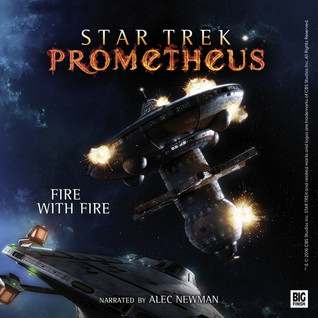
Star Trek Prometheus 1 coverStar Trek Prometheus: Fire with Fire by Bernd Perplies and Christian Humberg 

Her Grace’s rating:  1.5 out of 5 stars

Genre: sci-fi

I read it as an: audiobook

Narrator: Alec Newman

Source: my own collection

Length: 11:02:00

Published by: Titan Books (28 Nov 2018)

After several terrorist attacks claim the lives of thousands, Starfleet sends the ship Prometheus to the Lembatta Cluster, from where the attackers hail. The region is already unstable and the crew of Prometheus are tasked with stopping further attacks and potential galactic warfare. 

I really wanted to like this book. I thought it was rad that an original Trek novel was written in a language other than English at last. But damn, it read like fanfiction. I mean, I suppose all of the novels are fanfiction, but they don’t act like it. Other Trek novels are better written and more engaging. The crew of Prometheus are, frankly, kind of boring. There really aren’t any stand-out characters for me. I kind of wonder if the authors recognized that, weren’t sure quite how to fix it, and so brought in a shitload of cameos by other characters to make up for it. The Klingons were more interesting, which is saying something coming from me since I’ve never been that interested in the Klingons. 

Parts of this also came across as almost…racist? I’m not sure it is that blatant, but the way in which some of the characters were described or spoken to just put me off. If someone said things like that to me or in front of me, I would have told them off. I can’t even think of an example of it anymore – I listened to the audiobook rather than reading it where I could make notes on the pages – but some phrases just set me on edge and not in a good way. Maybe it was a translation issue, I don’t know.

The audiobook thing is another issue. Normally, I love audiobooks. I have never listened to a Trek audiobook, though, since if it’s a book about, say, Lorca, I want Jason Isaacs to narrate it. Or Patrick Stewart for a Picard-centric book, Michelle Yeoh for Georgiou, etc, etc. Since this book isn’t set in one of the actual series with the characters I know and love, I figured it wouldn’t make me mental to have someone who isn’t Jason Isaacs/ Patrick Stewart/ Michelle Yeoh narrating. And in that regard, I was correct. It didn’t bother me that the narrator didn’t sound anything like them. He has a pleasant voice, in fact, and I would probably listen to more of the things he’s narrated. However, it drove me nuts at how many words he mispronounced. It wasn’t a dialect thing, either, or a Britishism. It was just wrong. Like ‘hegemony.’ Got it wrong every time. A few other actual words I can’t think of now. And even words specific to the Trek-verse were wrong. I know, I know, they are made up and not real but even so, can you at least pronounce them like they are in the various series? It’s TAL shee-AR’ not ‘tal SHY-er,’ ‘KIT-o-mer’ not ‘kit-OH-mer.’ … It’s levi-OH-sa, not levio-SAR. I mean, it’s the little things, you know? 

Overall, this is a solid ‘meh’ for me. I like a new Trek book, but this one fell short for me. 

academic · bookish things · books · editorial

History Rhymes: The Function and Importance of Historical Fantasy*

Within every issue of Historical Novels Review one section of reviews is labeled “Historical Fantasy,” where readers find books like Guy Gavriel Kay’s that introduce magical or supernatural elements into their historical framework. Tolkien is perhaps the most famous writer to have brought the realms of myth and magic into solidly historical contexts. Certainly, one result of this blending of history and fantasy is greater entertainment — escape, if you will. On this subject, Tolkien, in his essay “On Fairy Stories” wrote:

I have claimed that Escape is one of the main functions of fairy-stories, and since I do not disapprove of them, it is plain that I do not accept the tone of scorn or pity with which ‘Escape’ is now so often used: a tone for which the uses of the word outside literary criticism give no warrant at all. (Tolkien, 1947)

Most of us enjoy escaping through fiction and agree with Tolkien’s embrace of it as a virtue of reading. But, along with providing marvelous exits out of the everyday world, historical fantasy also appeals to so many readers because it is a particularly rich and effective medium to explore current social issues.

More than one study shows that the genres of science fiction and fantasy promote deeper empathy in readers who are introduced to the genre at a young age. One study published in the Journal of Applied Social Psychology quantifiably demonstrates how reading books like Harry Potter increases tolerance and reduces prejudice (Vezzali, et al., 2015). Vezzali explains that the fantasy genres are “especially effective in assuaging negative attitudes [toward social issues] because the genre typically doesn’t feature actual populations and thus avoids potential defensiveness and sensitivities around political correctness” (quoted in Stetka, 2014). Writing fantasy grants authors the creative room to explore sensitive or controversial contemporary issues without triggering readers’ preset ideas and biases. Combine fantasy with the distancing effect overall of any historically set fiction and readers find a potent mix for examining controversy without building mental barriers.

Exploring this mind-opening aspect of historical fantasy with several writers of the genre seemed particularly worthwhile amidst our current social debates. I therefore approached Guy Gavriel Kay, Judith Starkston, Juliet Marillier, Marie Brennan and Roshani Chokshi to get their views on writing historical fantasy that addresses current social issues.  The resulting conversations offer an insider’s view of these authors’ approaches regarding emotional engagement with social issues.

When asked how writing historical fantasy allows him to bring current social issues to his readers’ awareness, author Guy Gavriel Kay (A Brightness Long Ago, Berkley Books 2019) explained, 

I have argued for the universalizing effect of deploying the fantastic. Stories and themes from history cannot be read as specific only to a given time and place. Beyond this, I find it important to explore both the “strangeness” of the past and the ways in which people and lives can offer a startling familiarity at times. Among other things, this can erode an a-historical sense that what we are living through is new. Usually it isn’t.  As has been said, history may not repeat, but it rhymes.

Through historical fantasy, authors highlight issues that continue to concern modern society as well as help readers learn more about a topic. However, as author Judith Starkston (Priestess of Ishana, Bronze Age Books 2018) noted, “Combining history and fantasy has to be done with care.” She explained that being able to lift readers out of the regular world is liberating for both author and reader. Starkston believes when readers experience a book that draws them into its own world, they tend to leave behind the locked, preconceived notions of how things are and how they ought to be. Incorporating fantastical elements into historical events or people lets us 

accept unusual solutions as entirely normal. When I talk about the historic queen who is the model for my main character, people are incredulous that a woman held such power and influence across the ancient Near Eastern world. We harbor a false notion of history as gradually progressive. Things are supposedly better now and worse in the past, but that isn’t accurate.

Starkston added that the best way to accomplish this blend of magic with historical accuracy is to adopt “fantastical elements that arise from the beliefs and practices of the period. That the Hittites practiced so many rites we would call magical made this especially easy for me—I had only to extend their scope.” Fidelity to history even within the magical creates believable historical fantasy. Incorporating elements of reality that lend themselves well to the use of magic helps to carry readers over the threshold of disbelief and encourages new patterns of thought, precisely the area in which historical fantasy excels.

Juliet Marillier (The Harp of Kings, Ace 2019) also takes a similar approach in her own writing. She stated that her writing has three main purposes: “to teach, to heal and to entertain … Real life challenges (tyranny, cruelty, conflict, flood, famine) might become the dragon, the monster, the fearful place in the dark wood.” Using real life examples of illness or emotional damage brings such topics front and center while at the same time fostering empathy and an awareness of their causes. The capacity to heal in particular has found a vibrant ally in Marillier. Many of her books deal with themes touching on violence, repression, PTSD, or other issues that Marillier draws from historical fact as well as current events. She highlighted the vital role literature plays: 

Storytelling is a powerful tool for helping the troubled (and for helping others understand and support them.). Many other issues relevant to contemporary society find a place in my books – notably, women dealing with domestic violence or other forms of repression. The voice of those characters, whose stories come from long ago and are touched by the uncanny, still seem to ring true for today’s reader. 

Seeing in works of historical fantasy topics that are relevant to contemporary society strikes a chord with readers who may be struggling to make sense of the world and the current events. Ultimately, it can help bring about hope and healing.

Marie Brennan (Turning Darkness into Light, Tor Books 2019) and Roshani Chokshi (The Gilded Wolves, Wednesday Books 2019) both discussed the importance of historical fantasy mirroring reality at least tangentially in order to create a believable and relevant world. Brennan stated that historical fantasy “has the advantage of being able to come at a topic from a slantwise angle. It lets us show how various problems have played out in the past—which encourages the reader to think about how things have and haven’t changed, or what alternatives might look like.” Holding up a mirror of our world through the lens of historical fantasy does, indeed, allow authors to look at our own world, society, or beliefs in new ways. By doing so, Brennan goes on to say, showing a world “in the context of a society that’s not the one we currently live in, it can slip its points in under the radar, instead of having to come at them directly.” Chokshi’s position also meshes with Brennan’s in that she finds that historical fantasy “allows me to take an issue and breathe life into it by tangling it up with a character’s emotional stakes and placing it beneath a lens of magic. A story is nothing if it evokes no feeling. I want to make my readers feel even as they’re thinking, and hopefully that inspires my audience to research an issue further.” Inspiring feelings and igniting curiosity in a topic seems to be a unifying goal for these authors, even if they know their role is not to solve the questions their works may pose. Rather, they seek to “make it a present question in the minds of my readers,” as Chokshi explains. This is an important point because authors have the platform to effect change and influence society. Consider the changes that were inspired by novels such as Uncle Tom’s Cabin, The Jungle, or Beloved. What we read has a definite impact on what we think, and authors have the power to influence societies. 

Other influential authors, including Zen Cho (The True Queen, Ace 2019), Mary Robinette Kowal (The Fated Sky, Tor 2018), and Nalo Hopkinson (The Salt Roads, Open Road Media Sci-Fi & Fantasy 2015), impact the way readers think by incorporating an abundance of diversity in their novels. Their novels have a focus on the strength of women, the second-class role of women and people of color, sexism, and narratives of freedom, highlighted beautifully by fantasy/speculative elements. On her website, Cho states that she writes in the genres she does because “It’s as good a form for understanding the world as any other” (Cho, 2019). Kowal, in a blog post, makes an excellent point: homogeneity in historical literature is a choice, for the fact is that Europe and the UK had a “wide range of classes and abilities/disabilities. … People of color were throughout the UK and Europe and had been basically since people started to travel, which means always” (Robinette, 2012). Hopkinson draws on the deep traditions and narratives of the people brought as slaves to what is now Haiti, exploring various themes of freedom, linked by elements which bind women across the world: blood, sweat, tears, birth fluids, and sex. On her website, Hopkinson states that certain genres “…allow us to step outside our known reality and examine that reality from a different perspective. They do so by creating imaginary worlds as lenses through which we can view our world” (Hopkinson, 2019). 

Historical fantasy holds a striking place in literature through its universalizing effect to allow readers to internalize new views on social issues and to understand the ways in which history “rhymes.”
References

Hopkinson, Nalo. “FAQ.” Nalo Hopkinson, Author, 2019.

Kowal, Mary Robinette. “Don’t blame the homogeneity of your novel on historical accuracy. That’s your choice, as an author.” Mary Robinette Kowal, 2012.

Kowal, Mary Robinette. “About the Lady Astronaut series.” Mary Robinette Kowal, 2019.

Stetka, Bret. “Why Everyone Should Read Harry Potter.” Scientific American, 9 Sept 2014. 

Tolkien, JRR. “On Fairy Stories.” In Essays Presented to Charles Williams, compiled by CW Lewis, Oxford University Press, 1947.

Vezzali, Loris, et al. “The Greatest Magic of Harry Potter: Reducing Prejudice.” Journal of Applied Social Psychology, 45, 2015, pp. 105-121.

*Originally published in Historical Novels Review, issue 90, Nov 2019.